

Leaderboard
-
Fugax Contrapunctus
Members3Points221Posts -
Luis Hernández
Members3Points3,401Posts -
ARCMusicPublishings
Members3Points44Posts -
MK_Piano
Reviewers2Points176Posts


Popular Content
Showing content with the highest reputation on 06/26/2026 in all areas
-
A lighter composition for the early Summer, conceived as an exercise in harmonic development, apoggiaturas and chromatic saturation. Greatly inspired by Chopin's Op. 28 Prelude in E minor. YouTube video link: Funereal Postlude Waltz in A minor.mp3 Funereal Postlude Waltz in A minor.pdf3 points
-
I'm wondering greatly why this piece did not receive any feedback (let alone positive and encouragingly complimentary feedback), even after 3 weeks and more. I absolutely love many elements that have been used in this score: Use of melodic Caliope (Baritone woodwinds, Soprano Strings) background call-and-response (alternating between Violone and Violin/Violinone) moment of introductory climatic moment (the herold of the Timpani's and Double-Bass's dotted-rhythmic march) Just to name the few things. It also invokes a beautiful sense of a late evening walk down an urban city. (I just checked the name of your piece again, and it speaks of the "Frank Bridge"! The setting illustration you were going for seems excellently executed!) ~~~~~~~~~~~~~~~~ I do concur that arranging 2/4-hand Piano works into Orchestra is quite the arduous and ambitious task. Most people don't realize how difficult it really is to learn idiomatic writing for 30 or more instruments; so that your performers can perform your work at ease and with joy; and your audience can, at the same time, enjoy the listening experience of it. (I have come across a lot of works that is a 'joy' to play, because it's highly idiomatic and "quite easy to perform" with "minimal rehearsal"; but with little thought having been put into the music, which makes the listening experience of it a bit dull and flat. "Boring" music, as some would call it. In short, easy and simple to play; not fun to listen to!) As far as difficulty of instrumental writing is concerned (you brought up your virtuosic pitched percussion lines being advised by Musescore as difficult): a lot of times, it heavily depends on the personal practice (as well as personal incentive and motivation) by individual performers to bring your works to life. From my own experience: if it doesn't sound like how it's supposed to and/or it seems like the performer is struggling and making the music seem too difficult to fully and viably perform.... a lot of times, it's because they haven't practiced the music, and/or they simply need to care about it more. In these instances, it often has minimally or not at all to do with your own fine writing. Just as a composer-to-composer word of reassurance. ;) (Check out my own music score that I posed two days ago! I have spent time writing fairly to greatly idiomatically for many of the instruments; making the line seem 'harder' than it actually is. Yet, the players of its earlier first edition still struggled, when I gave it to a Philharmonic (one of 'the best' in Europe, as it is reputed; especially considering the historic famous composers who had given it premiere music to perform! Not naming names, not naming the orchestra) to performed. Furthermore, guess what?? During the first rehearsal, the dress rehearsal and the final performance that premiered this Tone Poem), it sounded like an intermediate half-learned high-school concert band that's just learning how to get it together. Individual instruments were literally sticking out, and a few sections were quite off pitch, shrill, crass and.... not performing the affects I was intending/asking for. This happened, despite having the music 3 weeks to a month before their final performance; and, they have the MIDI mockup. They were given the resources to make it happen. And, it didn't. It was very embarrassing, seeing that, at the end of the premiere, I had to stand up and take a bow. Forever, that European audience saw my face and will remember me: that it must be me as a composer. After speaking to people later down the line who reviewed the (earlier first edition of this) music, the remark I received was, "....Why was it not performed better?" or "... Why did they sound like that?" "The line is fairly easy and straight-forward to achieve, with some bit of practice." See that? Was it my music, or was it simply that my performers didn't care enough to practice it? I suppose I can diverge into the topic about Philharmonics rolling their eyes when it comes to having to "deal with" new student works (You know, 'here we go again...student works.... let's get this done, so that we can enjoy playing Beethoven and Shostakovich!!'), but I won't get too far off the topic at hand. What was my point in all of this? Your Vibraphone and Marimba lines are likely fine. It's probably regarded as difficult, but that certainly doesn't make it not viable and easy to learn! Really, it comes down to the attitude and the desire by your percussionists to learn and practice it!)2 points
-
Hello I was surprised by this piece, which is in a very different style to what I’m used to. I must say that the melody works well and it gives me the feeling of a ballad from a 1960s film. I’m not sure to what extent you’ve worked in these styles, or in styles other than ornate counterpoint. What I notice here is that, curiously, there isn’t much of a counterpoint underpinning, which is nevertheless present in the Romantic period. I think the rhythmic motif, in particular, becomes a bit monotonous after more than 4 minutes. I also notice that the bass is underused as an accompaniment, and that the chords are excessively dense; the arpeggio loses its effect when it’s played all the time. And some sections are unplayable unless you resort to arpeggios again. (bars 8, 9 ...) The idea is good, but I think the overall approach falls a little short. Oh, I’d also like to mention (something I’ve said before) that Chopin’s Prelude in E minor takes a very different approach. The chords are the essence of the piece, due to their minimal movement and the perfect voice leading they achieve.2 points
-
Bois, lads, (or anyone of persuading affiliation), it is time for this piece to not die! I have found another call for scores fitting the instrumentation requirements in Boston, MA. I have just finished my application and will find out mid or late July. Here's to some success! (Also, updated the score to match new engraving... once again lol)2 points
-
Well, it's been so long since I was last here! I hope this community has been well since. I’m looking for some nice detailed peer feedback on my first Tone Poem, Myst o' Foryst a Spryng Nyte. It is a 5-part programmatic work written for a large woodwind/brass configuration, percussion ensemble, and features a prominent chamber core of Viola, Double-Bass, and Piano. (My "Alto Piano Trio" ensemble) I would be nicely interested in your thoughts on the orchestration, the pacing of the sections, and how you perceive the overall structural architecture as you listen along with the score. Please tell me of your stylistic impressions of this piece! (Note: this is a computer generated audio RENDER; not a live performance. Some of the techniques were lost in translation when it rendered, so it wouldn't sound correct. This is ESPECIALLY true of the audio files IIa and IIIa. If in a moment something sound so "wrong" and "off" in any of these audios, please rely on what is written on the page.) Thank you for your time and ear! Myst o 'Forest a Spryng Nyte (Composition) - 2nd edition - Audio portion I - meas. 1-149.mp3Myst o 'Forest a Spryng Nyte (Composition) - 2nd edition - Audio portion IIa - meas. 150.mp3Myst o 'Forest a Spryng Nyte (Composition) - 2nd edition - Audio portion IIb - meas. 151-223.mp3Myst o 'Forest a Spryng Nyte (Composition) - 2nd edition - Audio portion IIIa - meas. 224-236.mp3Myst o 'Forest a Spryng Nyte (Composition) - 2nd edition - Audio portion IIIb - meas. 237-275.mp3 A. Chen - Myst o' Foryst a Spryng Nyte - 000 - FULL SCORE (with Conductor's Rhythmic ref).pdf1 point
-
1 pointOver the last month, I have challenged myself to compose every day, and the following 10 pieces are the result. It's been quite a challenge and I need a bit of rest after this, but I'm proud of the amount of work I was able to put into composition this month. YouTube link Score I hope you find some joy in them!1 point
-
1 pointHello It’s a rather mixed bag. Some tracks seem to be aimed at a sort of children’s album, like ‘Pulling Together’ or ‘Little Walk’ – which isn’t to say they’re bad. Others have a more serious feel to them. Overall, it’s worth a listen, but those challenges of writing a piece a day… I don’t know, we’ve all had moments doing that or thinking about it… but in the end, and over time, I think you learn to try and make the most of the ideas that stand out. And even then, you might like them or you might not. Best regards.1 point
-
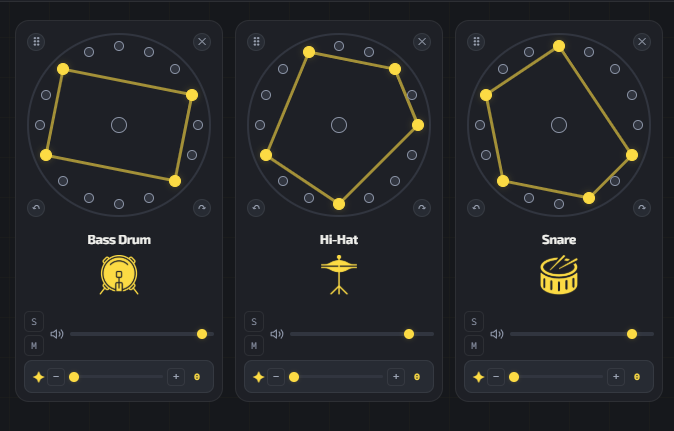
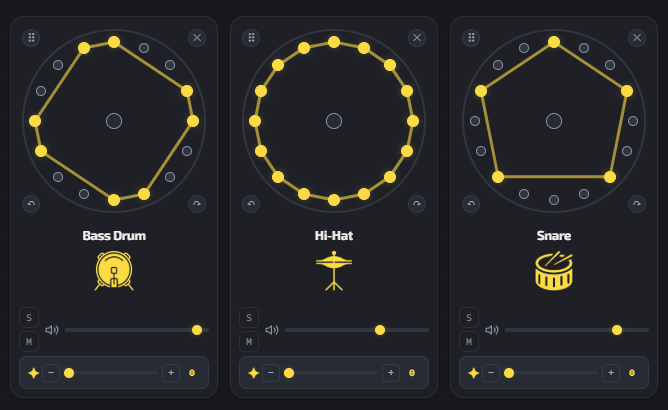
I've developed a free web app https://erhythm.org/ (disclosure: I'm the developer), it's a visual, interactive rhythm composer inspired by Godfried Toussaint's "The Geometry of Musical Rhythm". The core idea is simple: rhythm is represented as geometry. You place beats on a circle, the active beats connect to form a polygon, and you can immediately hear the pattern. Euclidean rhythms, polyrhythms, and world rhythms all become visually intuitive this way. As music educators or experienced musicians, do you think a geometry-based visual approach like this has real pedagogical value for beginners who haven't yet learned to read notation? Specifically I'm wondering: Can seeing rhythm as a polygon on a circle help a pre-notation learner feel and internalize rhythm more naturally? Would you consider integrating something like this into early lessons? Are there risks or limitations to this approach compared to starting with traditional notation? As a live example, here is a Bembé Afro-Cuban rhythm you can play and interact with directly: 👉 Try it here — https://erhythm.org/composer/r/bembe-afro-cuban?utm_source=youngcomposers.com I'd appreciate honest, critical feedback from anyone with teaching or learning experience.
 1 point
 -
All right, so I'll be looking at your structure of this. Since because this is a canon by nature, it should have a really good structure intact with it. I do see some call and response sort of situation in between with the strings. However, though, I think this is due to the nature of the canon, how the melody is kind of like twisted in that sense. Just a little bit of mixing and balancing, I do believe that the chorus is a bit too loud compared to the actual orchestra itself. I don't know if the score is condensed, but I don't see any brass. So what I would just do is just blend in, fix that. Nice change of melody and great job with the ending. I appreciate uh the very satisfying ending. I do see that you do are changing keys a lot. You're getting into territory that there are double flats and also weird enharmonics, so for example, like B sharp and like C flat and so forth, and like F flats, all that crazy stuff. But anyways, though, I would treat this like a really good uh orchestral warm-up in a sense. Really good work.1 point


