Leaderboard
-
Fugax Contrapunctus
Members14Points221Posts -
Luis Hernández
Members5Points3,401Posts -
MK_Piano
Reviewers3Points176Posts -
ARCMusicPublishings
Members2Points44Posts


Popular Content
Showing content with the highest reputation on 06/27/2026 in all areas
-
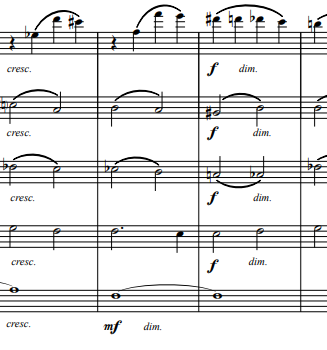
Hello! Interesting piece to have listened to. I must apologize now as I have some comments and in an effort to stay concise, I will be blunt. Here are my thoughts: (view on PC if able, not mobile) Double check the alignment of your diminuendos and crescendos. To me, it casts the illusion that the score is a little unpolished: With the slur groupings (two-note slurs), was it your intention to make it an ensemble feature? I saw some spots that have two-note slurs in one instrument, but not the others, even when the gestures feels the same: Measures 2 and 6 (in cello) as one example. Last thing would be dynamics themselves. If cello is the main feature, I think it a little asymmetrical to have the violin 1 be a dynamic marking louder than the melody. Shouldn't the cello be the loudest voice when presenting the melody? With the tempo markings, I think it looks better and easier to read when the text is a font size or two bigger or in bold. As a performer, it helps visually distinct the two text field types. Last few picky things would be measures 8,14 and 21. Why not just use a half rest for the other voices on beats 3-4? For the ending 4-bars, why not write "Sempre diminuendo" meaning "Always Diminishing" or "Morendo" to imply "dying away". Your pianissimo to Niente dynamic is a little messy with the spacing not consistent between all instruments. Final thing is to double check/ update is the idea of adding copyright information and a subtitle to say "for String Orchestra" or "for String Quartet". This helps as on first look of the score, the ensemble size is not mentioned. Good work!
 3 points
 -
To highlight a few key differences between either piece, in Chopin's prelude the melodic contour seeks minimalism in a way that balances out the listener's focus and allows the left-hand chords to shine and be heard more clearly. However, in my composition, the melody is most of the time merely a product of the top line of the right-hand chords and while it does produce a distinctive effect due to the rhythmic motif and its characteristic contiguously rising and falling eighth note in the 4th beat of its initial measure, it is not a sufficiently distinctive part to be considered, in my view, integrally alienable from the lower voices or the right-hand chord progression as a whole. Well, some earlier pieces of mine, composed almost exclusively for piano specifically, were mostly focused on styles closer to that of this composition than those of my usual production, such as in this post: https://www.youngcomposers.com/t44435/triwaltzia-no-1 You're correct in pointing out the deviation from my usual style with heavy counterpoint. The title, however, was not actually a strict or entirely accurate stylistic descriptor, and instead it purely serves as an indicator of a particular style I sought to emulate from the Romantic era. It obviously does not account for the entire range of styles and genres that this period in the history of Western classical tradition has to offer, but instead builds an association based on the "vibes" of the music, if I may use such a term. I especially agree with your first line of criticsm: the constant reiteration of the same rhythmic motif ending up producing a far too monotonous, repetitive or boring impression was indeed a concern even before this piece was finished. However, every time I tried to vary the rhythms or change the bass, it felt jarringly sudden and unexpected, breaking pattern in a way that not only was far from subtle, but also completely imbalanced considering the listener's expectations after the first couple phrases. Adding a contrasting B section with an entirely different theme might have solved the issue, but I failed to execute such an option in time before the whole piece was nearly complete. The density of the chords doesn't concern me nearly that much. Reducing the number of internal voices in the middle sections seemed to create the same unexpected vacuum I just described, so as long it doesn't get in the way of the dynamic contrast across the piece I personally see no problem with it, since I'm certain any sufficiently skilled pianist would be able to perform those in spite of the uniform chord density throughout. I'm interpreting what you mean by the bass being "underused" as not providing sufficient rhyhtmic or schematic variety, which could just as easily be referring to the right hand chords, just as in your first point. As for the arpeggios, I disagree with the premise that it is merely an effect: it is integral to the motif across the whole composition. I do understand what you actually mean by that, however: it once again comes back to the original line of criticism. The bars you mentioned were unplayable without additional arpeggios merely included a major 9th and 10th. The 10th in question has been edited to an octave for easier performance with a smaller handspan, even though it is still arpeggiated. However, that doesn't solve the rest of the 10th in the 2nd beat of each measure in that sequence, so sorry in advance to pianists with smaller hands: I must admit feasible playability is still not my main priority (ah, what would I do without the wonders of modern technology...) Anyway, thank you kindly for your review and points of criticism. I will most likely take them into careful consideration when setting myself to write compositions similar to this one.3 points
-
2 pointsHello A few years ago, whilst on a course I took on ‘Contemporary Composition Techniques’, I wrote a short piece for piano which I later revised and titled ‘One more try’. Recently, I had the idea of orchestrating it. It is written in a free, non-functional, chromatic style. The score isn’t condensed because the instruments that come in pairs often have very different or distant lines. It’s in concert pitch. Below is a video of the piano version. One more try orch.pdf One more try 2.mp3 One more try 2.pdf2 points
-
2 points@Alex Weidmann Thank you for listening. Yes, the piano version is very different – more ‘intimate’, perhaps? – despite that crescendo. I was in no doubt that the brass section was meant for that part... When I orchestrate something that already exists (for piano, generally speaking), I have two options: 1) to be as faithful as possible, which in some cases is almost essential, 2) to recreate the piece for the orchestra. In this case, it usually turns out quite differently.2 points
-
1 pointA revamped and corrected version of a previously published prelude and fugue transposed from F-sharp minor to E minor, originally comprised of two separately uploaded works joined together as neatly as possible. YouTube video link: Prelude and Fugue in E minor.mp3 Prelude and Fugue in E minor.pdf1 point
-
Since this is in essence a revised version of my earlier Enharmonic Perpetual Canon No. 3, whose single contrapuntal flaw replicated across all voices required a modification of an octave leap which ultimately ended up necessitating a transposition of the whole canon a perfect fourth higher, I decided to change the title of the entire series thus far to "Pantonal Perpetual Canons", as the previous title didn't quite serve as an accurate descriptor of the technicalities within the compositional process that gave rise to these pieces. Due to the necessary integral transposition of this work, however, the coda's newly resulting ending key (F-sharp/G-flat major), the only key along with its relative D-sharp/E-flat minor that displays an equal number of accidentals when enharmonized, far too many inconsistencies relating to the enharmonization of melodic intervals can be found in this version. Normally I would have managed to transcribe the melodic theme across all its internal transpositions in a way capable of satisfying apparent melodic continuity throughout the notation process, but due to the ambivalent quality of this key when it comes to enharmonization, not even the coda could be perfectly transcribed without far too many double accidentals. As such, as much as it irks me to see it like this, I have had no choice but to leave the currently notated version of this canon as is. The choral lyrics of this canon (once again, in Latin) translate as follows: "Change is inevitable in all things. Everything flows in the balance of those who are tempestive." As for the coda, its own lyrics further drive the meaning of these aphorisms to greater clarity and realization. YouTube video link:1 point
-
1 pointA nice and cute miniature piece. It is (obviously,) one movement long, and has 124 bars. It is written in Ab Major. https://musescore.com/user/96214813/scores/35260994 Sketch No. 1.mp3 Etuden Op. 53.pdf1 point
-
This is a short thing I wrote in one day, perhaps a bit self-indulgently expressing my rather, shall we say... mixed... feelings right now about my country as we near the 250th anniversary of independence. The cellos play the melody of "America the Beautiful" while the violins and violas add harmonies that subvert the simple tune. As always, any comments or feedback would be appreciated! Semiquincentennial.mp3 Semiquincentennial.pdf1 point
-
I'd never written for concert band before, however, that's the only ensemble, aside from one performance, that I've ever rehearsed and performed a production within... So I am very familiar with how the instrumentation is utilized in concert band scores. This was inspired by some work from another collegue of mine, that with their permission, I was allowed to put my own "twist" on it, and it is very very far from it's original form... I suppose that makes it more original than arrangement, but ah. I can't take all the credit for it if I didn't conjure it up myself from scratch. It's very short, and I didn't really have any intent on developing it into a more lengthy, complete piece, despite my desire to do so... I think it's quite extravigant, triumphant and reminds me of a hopeful feeling. I suppose the idea is that it can be used, potentially as an opener piece for a band somewhere, somehow. lol Let me know what y'all think P.S. Yes, I know there are a couple of engraving errors, such as Dynamic marking placements for example. The score isn’t a polished and finished product, 100% as of right now. Just an FYI 😅 Thanks!! -Unc EDIT I had some different harmonic ideas... Post has been updated :) Untitled score123.pdfUntitled score123.mp31 point
-
A lighter composition for the early Summer, conceived as an exercise in harmonic development, apoggiaturas and chromatic saturation. Greatly inspired by Chopin's Op. 28 Prelude in E minor. YouTube video link: Funereal Postlude Waltz in A minor.mp3 Funereal Postlude Waltz in A minor.pdf1 point
-
Thanks very much for your suggestions! I'm revising the score to make some of these fixes. The cello line is not really meant to be the main feature; I think of it more like a cantus firmus, and I prefer the familiar melody to be there more subtly. But I didn't write slurs into the cello part just to try to give it a little bit of detachment from the other parts. Not sure how well that works, but that was the idea. The two quarter rests in those measures you mention are because the a tempo comes only on the fourth beat of the measure. Thanks again!1 point
-
Hello, This modified version flows very naturally and feels more balanced. I also like the fact that the transitions between sections are smooth.1 point
-
Ah, I see. (I thought Frank Bridge was a landmark; which I hadn't looked up yet. Ha!) Regardless, you brought Britten's advisor's piano music to life. Your rendition of it is quite stunning; and does invoke the urban late night mood as for-mentioned. And, the second portion of my post (regarding difficulty of percussion part) still stands.1 point
-
Hi, many thanks for the kind words, and thoughtful review. Frank Bridge is actually the composer. (Don't worry, I hadn't heard of him either until very recently!) This is my orchestration of his 3 movement piano work "The Hour Glass". (You can find the other 2 movements lower down in the Orchestral and Large Ensemble category.) Far as I know, it's never been orchestrated before. Frank was a British composer (1879-1941), who mentored the young Benjamin Britten. I think the main issue with the marimba part is whether you can actually physically get round the instrument to play those octave movements at this tempo. And also whether you can find an extra large marimba (and vibraphone) to cover the pitch range required. I'm thinking I'll probably rework those passages so they fall into a narrower range. I've heard those stories about orchestras not taking student works seriously; but what can you do?1 point
-
As the third installment in my enharmonic perpetual canon cycle, this one follows a procedure nearly identical to that of the first one and is quite similar in duration as well. The lyrics (once again, in Latin) sung by the choir translate as follows: "Change is inevitable in all things. Everything flows in the balance of those who are tempestive." As with the previous installment, the coda further drives the meaning to greater clarity and realization. YouTube video link:1 point
-
Thank you for your review. I should point out, however, that the chorus is intended to sound louder in order for the lyrics to be at the very least audible and not drowned by the orchestra, let alone trying to make them sound barely intelligible. I find it optimal since the choir is singing the canon in th exact same configuration as the other instrumental sections: the placement of the voices across different lines and registers is the exact same for all three. And also, there is no brass in the score or audio. This is not intended as a symphonic orchestral arrangement, and I personally dislike the timbre of brass instruments and even some woodwinds such as the saxophone for example, so they are not getting included in the score anytime soon. Have a nice day.1 point
-
I'm wondering greatly why this piece did not receive any feedback (let alone positive and encouragingly complimentary feedback), even after 3 weeks and more. I absolutely love many elements that have been used in this score: Use of melodic Caliope (Baritone woodwinds, Soprano Strings) background call-and-response (alternating between Violone and Violin/Violinone) moment of introductory climatic moment (the herold of the Timpani's and Double-Bass's dotted-rhythmic march) Just to name the few things. It also invokes a beautiful sense of a late evening walk down an urban city. (I just checked the name of your piece again, and it speaks of the "Frank Bridge"! The setting illustration you were going for seems excellently executed!) ~~~~~~~~~~~~~~~~ I do concur that arranging 2/4-hand Piano works into Orchestra is quite the arduous and ambitious task. Most people don't realize how difficult it really is to learn idiomatic writing for 30 or more instruments; so that your performers can perform your work at ease and with joy; and your audience can, at the same time, enjoy the listening experience of it. (I have come across a lot of works that is a 'joy' to play, because it's highly idiomatic and "quite easy to perform" with "minimal rehearsal"; but with little thought having been put into the music, which makes the listening experience of it a bit dull and flat. "Boring" music, as some would call it. In short, easy and simple to play; not fun to listen to!) As far as difficulty of instrumental writing is concerned (you brought up your virtuosic pitched percussion lines being advised by Musescore as difficult): a lot of times, it heavily depends on the personal practice (as well as personal incentive and motivation) by individual performers to bring your works to life. From my own experience: if it doesn't sound like how it's supposed to and/or it seems like the performer is struggling and making the music seem too difficult to fully and viably perform.... a lot of times, it's because they haven't practiced the music, and/or they simply need to care about it more. In these instances, it often has minimally or not at all to do with your own fine writing. Just as a composer-to-composer word of reassurance. ;) (Check out my own music score that I posed two days ago! I have spent time writing fairly to greatly idiomatically for many of the instruments; making the line seem 'harder' than it actually is. Yet, the players of its earlier first edition still struggled, when I gave it to a Philharmonic (one of 'the best' in Europe, as it is reputed; especially considering the historic famous composers who had given it premiere music to perform! Not naming names, not naming the orchestra) to performed. Furthermore, guess what?? During the first rehearsal, the dress rehearsal and the final performance that premiered this Tone Poem), it sounded like an intermediate half-learned high-school concert band that's just learning how to get it together. Individual instruments were literally sticking out, and a few sections were quite off pitch, shrill, crass and.... not performing the affects I was intending/asking for. This happened, despite having the music 3 weeks to a month before their final performance; and, they have the MIDI mockup. They were given the resources to make it happen. And, it didn't. It was very embarrassing, seeing that, at the end of the premiere, I had to stand up and take a bow. Forever, that European audience saw my face and will remember me: that it must be me as a composer. After speaking to people later down the line who reviewed the (earlier first edition of this) music, the remark I received was, "....Why was it not performed better?" or "... Why did they sound like that?" "The line is fairly easy and straight-forward to achieve, with some bit of practice." See that? Was it my music, or was it simply that my performers didn't care enough to practice it? I suppose I can diverge into the topic about Philharmonics rolling their eyes when it comes to having to "deal with" new student works (You know, 'here we go again...student works.... let's get this done, so that we can enjoy playing Beethoven and Shostakovich!!'), but I won't get too far off the topic at hand. What was my point in all of this? Your Vibraphone and Marimba lines are likely fine. It's probably regarded as difficult, but that certainly doesn't make it not viable and easy to learn! Really, it comes down to the attitude and the desire by your percussionists to learn and practice it!)1 point
-
Updated post with new score files - modifications have been made. Please, if anyone has the time, take a listen / look, and let me know what you think :) @Luis Hernández @Lithl @JorgeDavid1 point
-
1 pointHi Luis, For me the most successful part of this orchestration is your highly effective brass writing, especially in Bars 19-22. Overall it reminds me of "5 Orchestral Pieces" Op.16 by Schoenberg. I like the piano version too: I find it atmospheric and relaxing. Surprisingly mellow compared to the orchestral version!1 point
-
1 pointHello, friends. About three years ago, I penned this song cycle for a friend from El Salvador, based on poems by the beloved Salvadoran poet, Alfredo Espino. These hold a special place in my heart because they're the last music I've ever written, though they were sadly never performed. The songs and directions are completely in Spanish. Here they've been rendered by Cantamus (unfortunately sung in a Castilian accent and not the Latin American accent spoken in El Salvador) and the piano accompaniment has been [poorly] played by me. They're not the best recordings and some of the lyrics didn't render properly, but hopefully they deliver the music effectively. The cycle is chiasmic in structure (i.e., the first and last movements and the second and fourth movements mirror each other) and it tells the story of a day in El Salvador. I. Madrugada: This means early morning. The lyrics and music represent the waking of the Salvadoran countryside: farmers starting their day, roosters crowing, birds chirping. It begins mysteriously but soon "warms up," preparing us for the rest of the song cycle. II. Plombagina: The title is about a tiny flower found along the riverbanks in El Salvador; here it represents the playfulness of the river and the hopefulness of midmorning. This one is unmistakably waltzlike and lyrical. III. Tardecitas: "Little afternoons" is a piece about watching the rainfall in the heat of the day. It's lazy and less ambitious than the others in the cycle, representing the languor of a dreary, rainy day. IV. Estrella in el río: We return once more to a song about the river, this time in a more contemplative frame of mind. "Star in the river" is shimmering and reflective, capturing the tranquility of twilight as the stars begin to pinprick the sky and cast their reflections into the river below. V. Nocturno: While "Madrugada" expresses the joys of a new morning, "Nocturno" explores the angst found at the close of the day. It's by far the most restless of the cycle, employing a sort of perverted tango rhythm in mockery of the soothing sway of a nocturne. In it, you'll find themes of grief and fear and anxiety, embedded in harmonies very reminiscent of Spain/Latin America. Even if you don't understand Spanish, I hope these songs move you and perhaps inspire you. As ever, I'm happy to receive any feedback you may have. Best, Jordan Canciones de El Salvador.pdf I. Madrugada.mp3 II. Plombagina.mp3 III. Tardecitas.mp3 IV. Estrella en el río.mp3 V. Nocturno.mp31 point
-
To commemorate the date designated as Bach's actual birthday under the Gregorian calendar, this time I have decided to upload the definitive revised version of another one of my previous fugues, originally in the key of E minor though still for the same ensemble. I would also like to dedicate this fugue as a birthday present to my dear friend Julia as well, whose family has been going through exceedingly difficult times for more than one year now. Since the loss of a very special loved one has taken a severe toll on us all, my sincerest hope now is that she and her family can start anew and rebuild their lives from the ashes of their grief, even when all hope for a better future seems gone forever and endless mourning seems to be the only thing left to live for. Bach himself was no stranger to painful, heart-wrenching losses. Even as he lost both parents at age 10, his first wife at 35, and in line with the astronomical infant mortality rates of his era, more than half of his 20 children during childhood, he was likely reassured that his dedication to God alone through his music would be worthy of a place in Heaven for all those he loved and whose safety he prayed for daily. This key of F-sharp minor in our currently standardized A = 440 tuning always evoked in me a far greater sense of mourning in the wake of tragedy than any other. Perhaps because of this reason I felt naturally drawn to it when thinking of those precious loved ones we may have lost along the way, the precious, cherished moments that will never again come to pass, and the longing memories broken by the sudden wound their departure left forever imprinted in our hearts. Youtube video link: Fugue in F-sharp minor for String Quartet.mp3 Fugue in F-sharp minor for String Quartet.pdf1 point
-
As stated in the title, I've been recently experimenting with ways to add more voices to Bach's 14 canons (BWV 1087) based on the multiple contrapuntal transformations of the harmonic bassline of the Goldberg Variations' Aria. Despite being derived from the tonally transposed inversion of that main theme, the so-called "Theme 2" has been kept separate across this whole compendium since it isn't contrapuntally compatible with its inversion when also retrogradated, syncopated or played with "per arsin et thesin" imitation simultaneously. Had the latter not resulted in whole segments of parallel ocatves, an 8-voice "omnibus" canon might have been possible, but that seems to be out of the scope of these musical materials without significant alterations that would render their canonic accompaniment non-imitative and thus, non-canonic at all. There is one canon from the original that is conspicuously absent from this recollection and that is the penultimate, 13th variation: a triple canon a 6 so densely packed and finely tuned in its original conception that adding more voices without irrecognizably altering the basic structure of the others turned out to be practically impossible. Almost like Bach himself knew this one canon, in its apparent simplicity yet brilliantly complex counterpoint, was the worthiest and most perfect when he chose to be depicted holding it for his portrait. Admittedly, this video would have been better suited for this year's 276th anniversary of Bach's passing (July 27th). However, due to my tightly packed schedule this summer, I find it highly unlikely I'll be able to post anything in time to commemorate that date, hence why I'm posting this video as soon as possible in order to leave room for focusing on my final exams. Lastly, it would be short of an understatement to recognize late Gerubach's video on the 14 Canons proved invaluable to my understanding, research and tinkering with these canons, as well as the core material of much of Bach's repertoire as a whole. Some of his most laborious contributions have since been taken down after his passing more tha three years ago now in 2023, such as for example the scrolling video on the Art of the Fugue. The quality of my scrolling certainly doesn't come anywhere close to his standards, and yet, as poor and humble a homage this may be, I have chosen to honor his memory and the tireless spirit of his countless contributions by acknowledging at the very least the gargantuan influence he has had on the accessible spread of Bach's music and its myriad intricacies. YouTube video link: Google Drive folder link (full score + audio): https://drive.google.com/file/d/15rJHDw9G3SUX6rtj0w6V88JuirWnBOxq/view?usp=sharing J. S. Bach's 14 Canons BWV 1087 Vocibus Pluribus Additis.mp3 J. S. Bach's 14 Canons BWV 1087 Vocibus Pluribus Additis.pdf1 point
-
1 pointSince today is this year's Mother's Day, I finally decided to finish revamping a composition I had already published for the very same occasion 3 years ago. Compared to the original, the whole piece has been transposed from E to B minor in order to better accommodate for newly included passages. However, still not dissimilar from the first drafts, passages with constant false relations are abundantly featured in this piece, to the point that the harmonic resolutions expected of more conservative counterpoint are frequently sacrificed for the sake of chromatic saturation. Scrolling video link (YouTube): Passacaille en Valse in B minor.mp3 Passacaille en Valse in B minor.pdf1 point
-
The subject of this one first came to mind roughly 7 hours ago already in its current form, and realizing its potential I wasted no time in writing it down, lest I forgot its exact melodic contour whose progression has been able to accommodate for elaborate chromaticisms in the other voices. Now, after yet another sleepless night put to good use with tireless contrapuntal machinations, this little fugue for string trio is at last complete in my eyes. YouTube video link:1 point
-
In anticipation for this year's Christmas Eve, I decided to try my hand at writing another religious motet. Considering the fact that the bulk of this piece has been composed merely in the span of yet another insomnia-driven bout of inspiration, perhaps its modest length may as well be a reflection of missed potential, as I reckon it could have been developed into a more complex structure should its latter half not have got stuck on a protracted pre-cadential spiral. Once again, just as with my previous vocal fugue, the main goal of this composition was to make the text as intelligible as possible (specially taking into account the musical history of such a well-known textual setting), that is, within the confines and constraints of an 8-voice motet. This has ultimately led to some interesting contrapuntal oddities which, despite the preservation of independent voice-leading and thorough avoidance of melodic and harmonic blunders, have produced a number of somewhat unorthodox unresolved dissonances throughout. Nevertheless, I believe such contrapuntal licenses are more than sufficiently justified given the scope of this piece, as well as the sheer volume and density of its texture all the way through. This piece was specifically conceived as a submission for this year's edition of the forum's Christmas Music Event, and shall be presented accordingly in its dedicated thread. YouTube video link: Motet a 8 O Magnum Mysterium in E-flat major.mp3Motet a 8 O Magnum Mysterium in D major.mp3 Motet a 8 O Magnum Mysterium in E-flat major.pdf Motet a 8 O Magnum Mysterium in D major.pdf Motet a 8 O Magnum Mysterium in D major.mp3 Motet a 8 O Magnum Mysterium in D major.pdf Motet a 8 O Magnum Mysterium in D major.mp3 Motet a 8 O Magnum Mysterium in D major.pdf1 point
-
After undergoing plenty of struggle to find a proper textual setting capable of matching the rhythmic patterns of this vocal fugue, I decided to settle for an altered version of the "Libera me" movement commonly found on Requiem masses. Despite the minor changes required for the text to fit the subject of the fugue, its treatment throughout has been a conscious attempt to make it as audibly intelligible as possible, as opposed to the vast majority of my previous vocal works, where any regard for the text was completely secondary to the music. This composition, as well as its harrowing message, has been dedicated in memoriam to the victims of the Wang Fuk Court fire, which tragically befell Hong Kong on November 26th. May their souls find peace and eternal rest. 請安息吧! YouTube video link:1 point