
Leaderboard
-
ComposaBoi
Members3Points156Posts -
lraveton
Members2Points2Posts -
mazeth
Old Members1Points54Posts -

Karlsson
Members1Points8Posts




Popular Content
Showing content with the highest reputation on 10/27/2026 in all areas
-
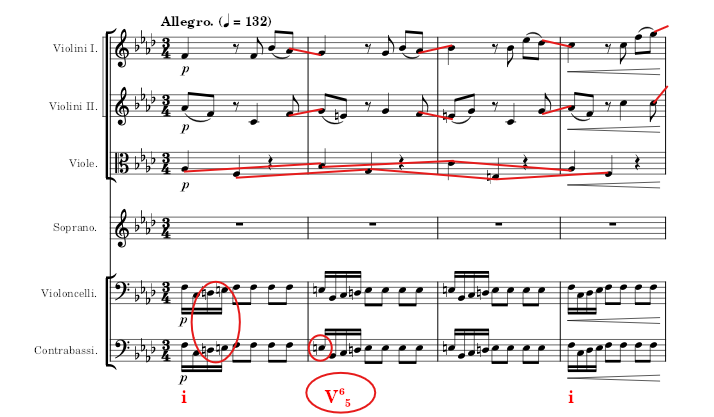
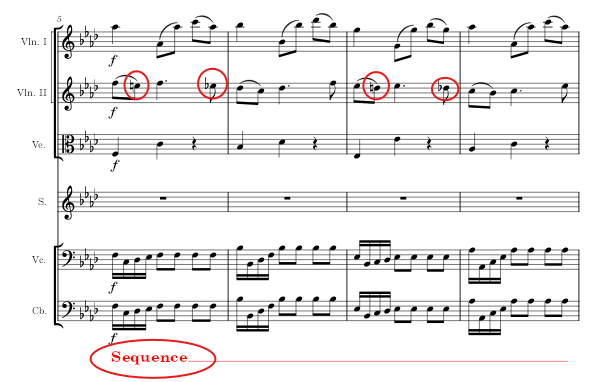
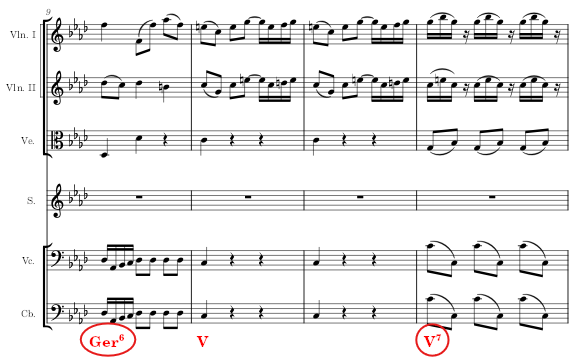
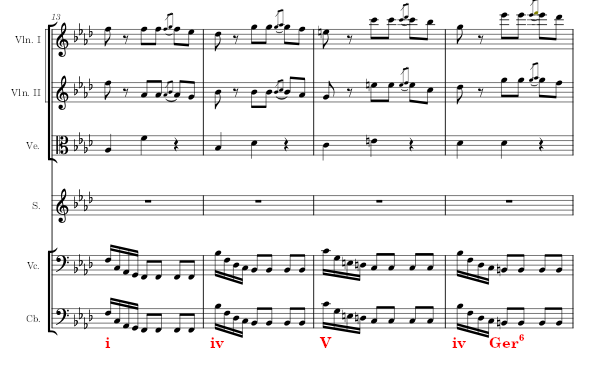
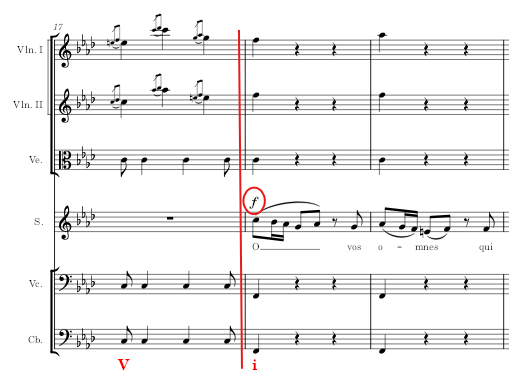
3 pointsOk, so to help you understand what I'm trying to say, I've copied and reworked the first 18 or so measures with tonal music theory in mind whilst trying to maintain a baroque aesthetic. Notice in my rework what I have done. This is how I would have done these first 4 bars had I written this piece. I have relabeled the Roman Numerals to better reflect the harmony that you suggested (which was simply i-V65-i). Also notice I have included dynamics at the beginning of the piece, as well as a metronome marking, and I've nixed the solo violin as I felt it was redundant. I have revised the second violins to not interfere as much with the first violins; see how they overlap much less. This provides melodic and harmonic clarity. Look also how the bass line now has the scalular run in melodic minor, which means it includes the leading tone for F-minor, making the tonic feel stronger. I also made the beginning of the 2nd bar in the bass an E-natural to bring about better harmonic clarity (dominant chord in first inversion). Finally, notice how at the ends and starts of each new measure, the lines cadence to each chord with smooth voice leading. This next system had a very nice sequence over the circle of fifths. The biggest changes I have made was to raise the leading tones, which makes the harmony clearer. I have also changed the Roman Numeral analysis, since much of the harmonies you analyzed would actually not be functional. This would simply be labeled as a sequence. The next system felt imbalanced because of the premature resolution. I decided for this example to extend the dominant pedal, and I believe it had a great effect. I also adjusted the harmony to better reflect what you implied, which would be some augmented 6 chord (your analysis said VI and then later, VIb5, however, the functionally since it leads into the dominant, it would be augmented 6. In the second one, there was no flat 5 present, instead the 5 was actually raised, making it a Germain 6 chord. In the future, be sure you understand chord functions.) Here I have continued to adjust the notes to match the harmony you implied. In particular, I found the parallel 4ths to be problematic and changed them to parellel 6ths. Finally, here I felt that the music began to lose momentum, so I simply cut out a few bars. Note the entrance of the soprano has a dynamic marking, and it appears above the music. This is so it doesn't interfere with the lyrics. Also be sure to divide the syllables properly and know that the "____" marks the ends of words being sung over multiple notes, and the "-" only occurs between syllables of the same word. Your usage of both of these is very inconsistent and unclear. And note how I simplified the line to make it slightly easier to read and sing. The rest of the piece has similar issues throughout. In terms of playability, I have already explained that the soprano is too fast and intricate and especially goes too high for this speed. Here is a great chart for vocal part ranges. choral-ranges.pdf Slightly simplifying the melody, especially removing the appoggiatura, should help. As for the violins, you mentioned they may go too high in some areas. They do not, the range is fine. What bothered me were these huge leaps. However, having checked with a violin player, these are actually doable. The changes I've made are obviously free to take what you like and discard what you don't. The important thing to keep in mind is that the music has proper voice leading, and clear harmony. My revision does improve it, but there are other ways to improve it besides what I did. Just remember to study voice-leading and harmonic function more in depth, and you'll be golden OVosOmnesReworkAndAnalysis.mp3
 3 points
-
It's been a while since I've composed anything, so I felt like getting back into doing some Persichetti composition prompts. I am now on Chapter 8 of Persichetti's "20th Century Harmony" which is titled "Compound and Mirror Harmony". The particular prompt for this piano piece was "8. Write an opening section of a two-part piece for the piano employing two symmetrically invertible scales. The mirror writing should be kept strict throughout." So I tried to do just that with this ~1 minute long piano piece. I tried my best to make an actual piece of music rather than an exercise, but let me know how I did! I'd appreciate any of your comments, critiques, suggestions or observations! Thanks for listening! Here's the form of the piece: A - Right Hand - C Mixolydian, Left Hand - C Aeolian B - Right Hand - C Ionian, Left Hand - C Phrygian A Persichetti Exercise 8 - 8.mp3 Persichetti Exercise 8 - 8 Score.pdf1 point
-
Truly one of the most stylish pieces I have ever heard. It is so bold and unusual, yet at the same time incredibly stylish and unique. I genuinely loved it. Bravo, my dear friend!1 point
-
1 pointHello, yet again with another prelude... GAWL aren't you sick of them yet?? Anyway, this one flirts between Db and C#m. It's 6 pages, but not that long as far as measures. It's grandiose, yet soft and subtle. Unfortunately, the midi doesn't do it justice. The arpeggio measures don't hold the first chord/low note in each one, but hopefully the score paints the right picture. I think it's due to the amount of notes held with the sustain. I hope you enjoy this, and any comments or concerns are welcome. :) Prelude 18 - Db.mp3 Prelude 18 - Db - score - Full Score.pdf1 point
-
1 pointOne practical thing to add for the orchestration stage: ranges. They're in every one of those books, but they're easy to lose track of once you write in a notation program or a DAW, because the samples will play notes no player would give you. The usual trouble isn't the outer limits but the edges of them: a horn sitting high for bars on end, a bassoon parked near its top, a flute low and quiet under brass where nobody will hear it. Writing mostly inside each instrument's practical range and keeping the rest for special moments is a good default while you're learning. I made a free range chart on my site with full and practical ranges for 28 orchestral instruments at sounding pitch, and you can drop a MIDI file on it to list every note outside either range by bar and beat: https://modwheel.net/tools/instrument-ranges1 point
-
Suppose a cue must finish within 90 seconds, including its final decay. Would you calculate a tempo adjustment from the entire file, or reserve time for the tail and measure the musical section separately? When would you prefer to revise the ending or render the cue again instead of stretching the existing audio?1 point
-
Reserve the tail and fit the musical section on its own. At a new tempo the notes move but the reverb decay stays the same length in seconds, so a ratio taken from the whole file comes out wrong. The sum is tempo = beats x 60 / seconds. Say the cue is 48 bars of 4/4 at 128 BPM, exactly 90 seconds with no room for a tail. Keep 3 seconds for the decay and you need 192 beats in 87 seconds, so 132.4 BPM, about 3.4 percent faster. A plug-in's decay time is the time to fall 60 dB, so reserving that much is safe. Re-rendered from MIDI, 2 or 3 percent rarely gets noticed. Much past 5 percent the cue starts to sound rushed, and I'd rather cut a bar, shorten the last chord or end on a hit. I'd only stretch rendered audio if the project is gone, and only slightly. I made a free calculator on my site whose fit-to-duration box does this sum and gives the tempo for a whole number of bars: https://modwheel.net/tools/tempo-calculator1 point
-
Hi @islav , compositions such as yours is one of the reasons why I am keen to be part of a platform like youngcomposers: your work is really novel and inspiring. I didn't like everything, otherwise the many changes of rhythm in the melody, as well as the many strange and unexpected dissonances make your piece very coherent. Things I didn't quite like (really personal taste): bars 7-9 were too mellow for me I felt like the end was too abrupt, and didn't really go well with the piece I felt like the trill was used a little too often (e.g.: bbs 58, 67, 69...) Things I particular liked: the transitions in bar 20, bar 39 or bar 53, really surprising and somehow relaxing the rhythm pattern you regularly use, e.g.: in bbs 43-45 Thanks for sharing and continue the good work! Julien1 point