
Leaderboard
-
Ali Baghbani
Members10Points26Posts -
Luis Hernández
Members7Points3,427Posts -
DarwinNE
Members3Points12Posts -
tylerplayspiano
Members2Points3Posts




Popular Content
Showing content with the highest reputation on 11/19/2026 in all areas
-
2 pointsI want to share this little piece. It was originally a bit longer, written for solo piano. But I used it for an orchestration exercise and shortened it. It’s based on Spanish dances and themes. At some points, I wasn’t sure if certain things were possible on specific instruments, but my professor—whom I trust completely—gave it the green light. I hope you like it because of its folk-inspired sound. Best regards. ANDALUZA.mp3 Andaluza.pdf2 points
-
Hello everyone, I wanted to share the last piece I finished and performed at the piano. It is an arrangement of a jazz ballad lead sheet that I composed, but the arrangement sounds more classical than jazzy. I suspect it might work better arranged as this rather than as a lead sheet, because of the avoid notes that I use here and there. As it is common in jazz, I gave the tune a name so I am using the same name for the piece. The piece in this arrangement is in the form [AABABA]. For those interested in seeing the lead sheet, I attach it as well. It is not a hard piece to play but it was hard for me to keep the tone and volume constant, so sorry about the mistakes. As always any feedback is more than welcome! Thank you and hope you enjoy it! Ruby's_Prayer_Ballad_Lead_Sheet.pdf2 points
-
2 pointsDear guys, thank you very much for your kind words! I'm glad you liked the piece and the video. The place with the ruins is a hermitage containing an ancient church dating back to the 12th century. It is situated near Châteauneuf-Val-Saint-Donat, in the south of France. The tunnel was dug in the 19th century by a monk who wanted to remove all the material that accumulated during the centuries in the church, hence the rails. It is quite a hidden place, you need to leave your car and hike in the forest for a while. The view from the high places is taken from a hike on top of the Pénitents des Mées we did during the same vacation. This is exactly the kind of feedback I am seeking for when I am sharing my pieces in this forum! It's very useful. I will think about what you said next time I'll write another atmospheric piece like this (that happens often, as I really love the Bit 99 for this).2 points
-
Hello I love the way it sounds. I can’t remember the original – I’d have to listen to it again to compare – but I don’t need to, as it works really well for me just as it is. I don’t know which parts have been added, but as it all sounds very cohesive, I don’t mind. I think that when you orchestrate something, you can be very, very literal or the complete opposite; the important thing is to do it with flair or with a purpose. The chromatic descents sound phenomenal. The oboe with the muted trumpet is a combination that might seem a bit odd at first, but when the trumpet is muted, they blend together beautifully. When the full string section comes in on bar 34 – although it’s not exactly the same, even in terms of instrumental density – it reminded me of Wagner, or Maher. Perhaps because of the chromaticism present. What a crazy but intriguing idea – Bach-Wagner. I’m sure Wagner studied Bach.2 points
-
2 pointsHello A very moving piece. I think it ties in very well with the Romantic tradition – what remains of it, at least. I love watching people play. But as my interest lies in composition, I like to look at the scores – if there are any – as I always learn something from them. I liked the linear descent at 1:24.2 points
-
2 pointsHello, thank you for sharing this fugue start — I listened to the full 32 seconds, and the subject in Db major has a clear, singing shape that I could follow easily as it begins to unfold. I liked how the entries overlap and the texture thickens, which already gives it a fugal feel even in such a short opening. One suggestion: since you mentioned the last bar feels impossible to play, it might be worth thinning the voices there for a moment, or giving the lower voice a rest, so the line can breathe before the next entry. Are you planning to answer the subject in the dominant next, or to develop it freely first?2 points
-
2 pointsThank you for clarifying that, Martynas — a separate prelude makes good sense, and it can stand on its own while still sharing something of the minuet's light, staccato character in 3/4. I like the idea of it as an independent piece rather than a movement, since that leaves you free to give it its own shape and ending. Will you keep the prelude in C major, or try a different key so it has its own colour apart from the minuet?2 points
-
Welcome all. Here is my attempt to orchestrate a lament from Bach's BWV992 keyboard suite. The original is mostly one and two part material: so I had to invent several new counterpoint lines; otherwise the orchestration sounded too thin. I'm currently working on the other movements. Wonder if you think my added counterpoint is successful? The suite was suggested by an AI, when I asked which work by Bach was crying out to be orchestrated, where no prior orchestral arrangements exist. I know there are lots of note-stalks pointing in the wrong direction, as well as missing a2 directions, and missing slurs; but can you see any other problems? Bach - Capriccio (BWV 992) #8 (partial).mp3 Bach - Capriccio (BWV 992) #8 (partial).pdf1 point
-
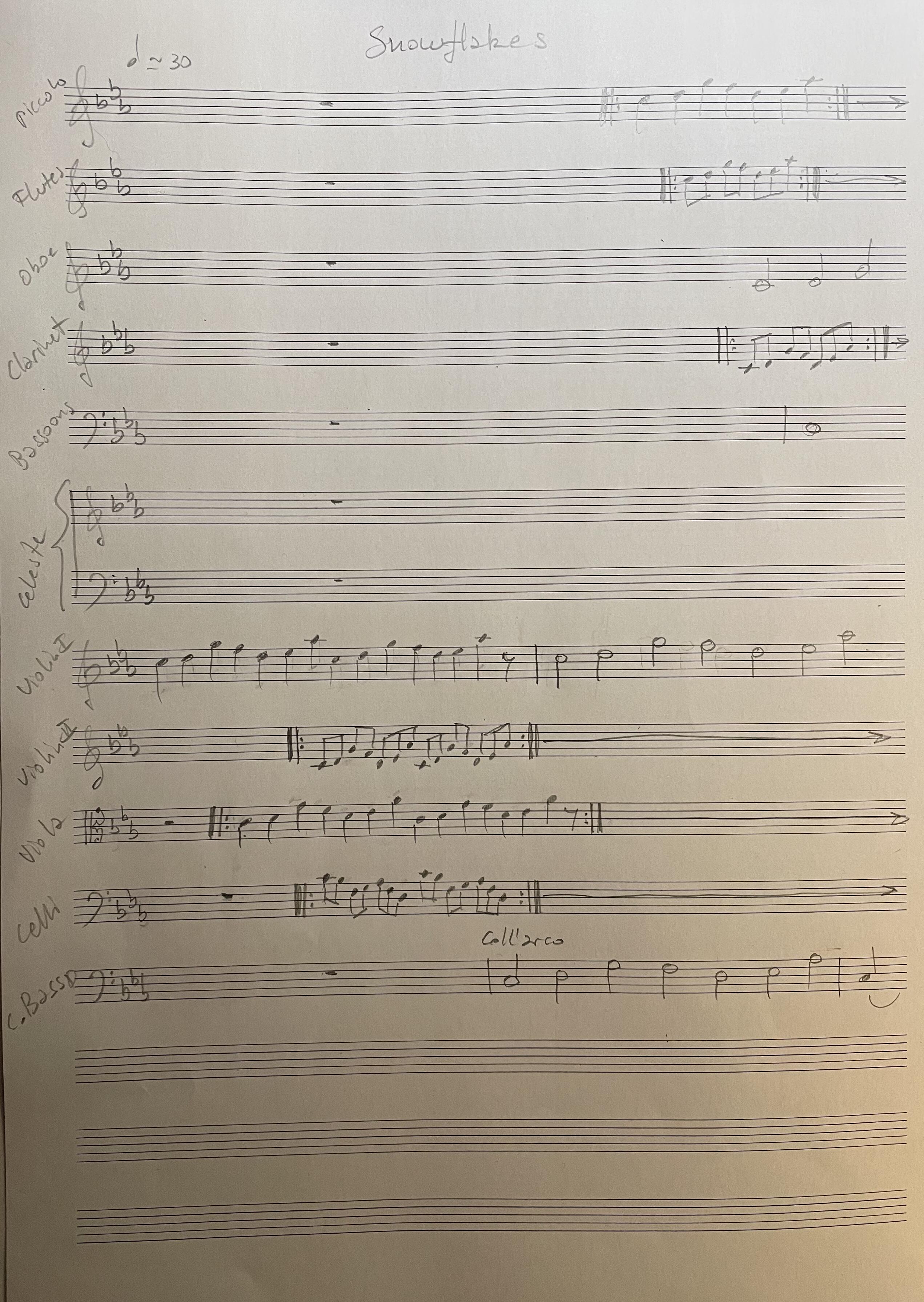
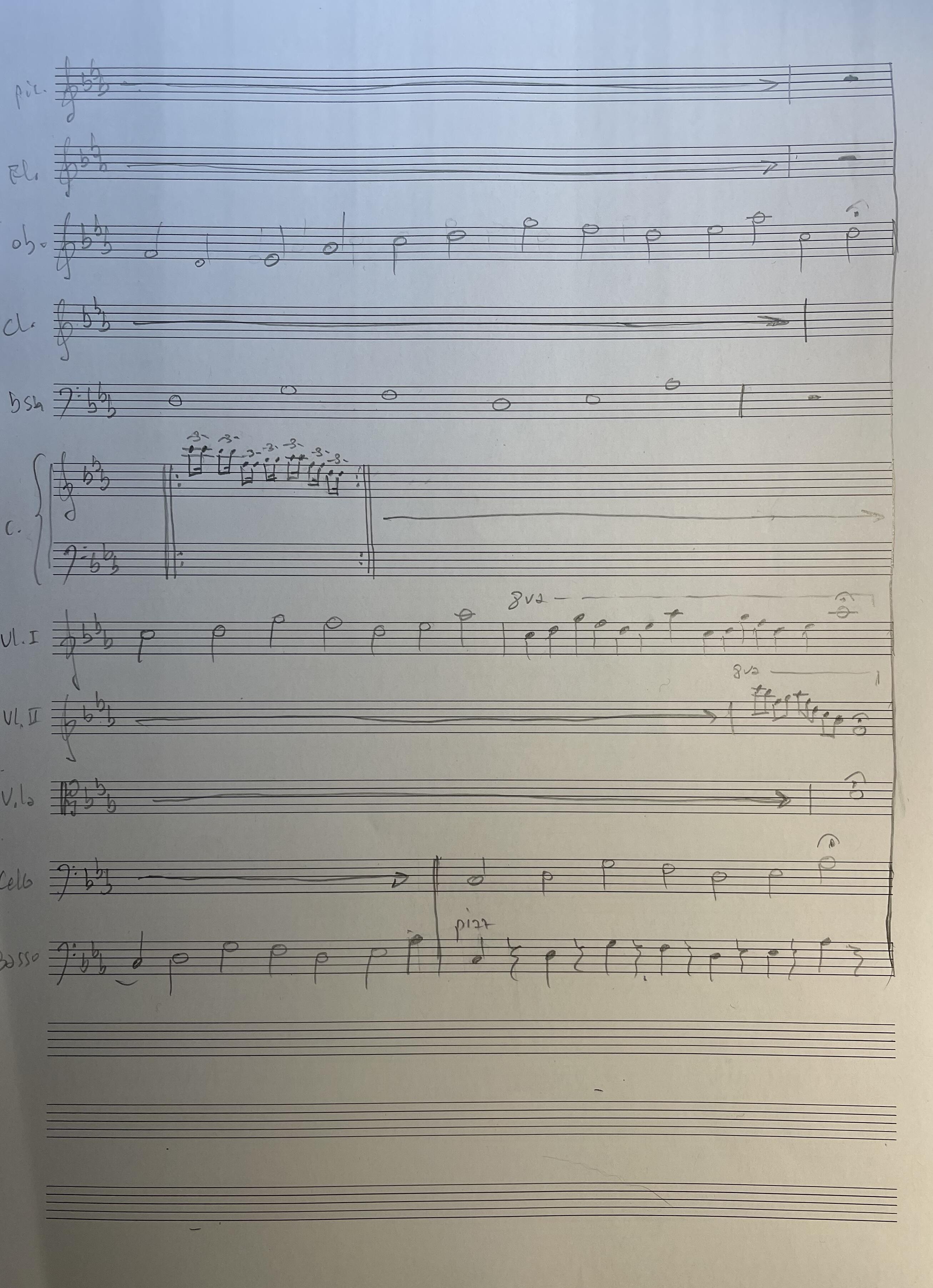
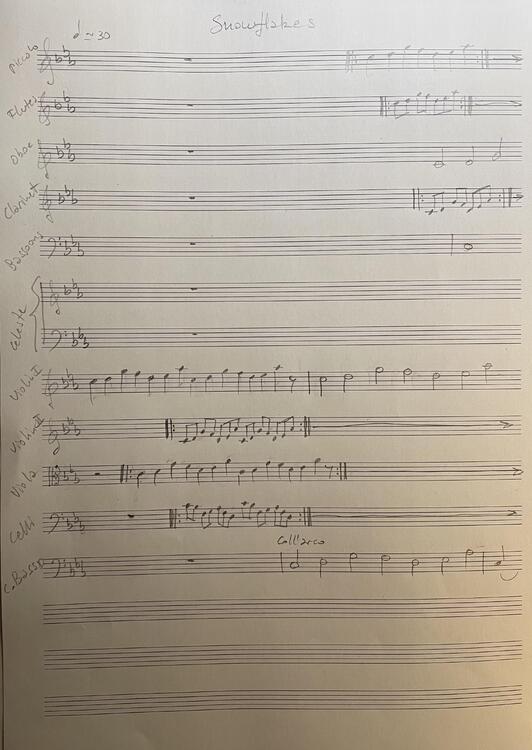
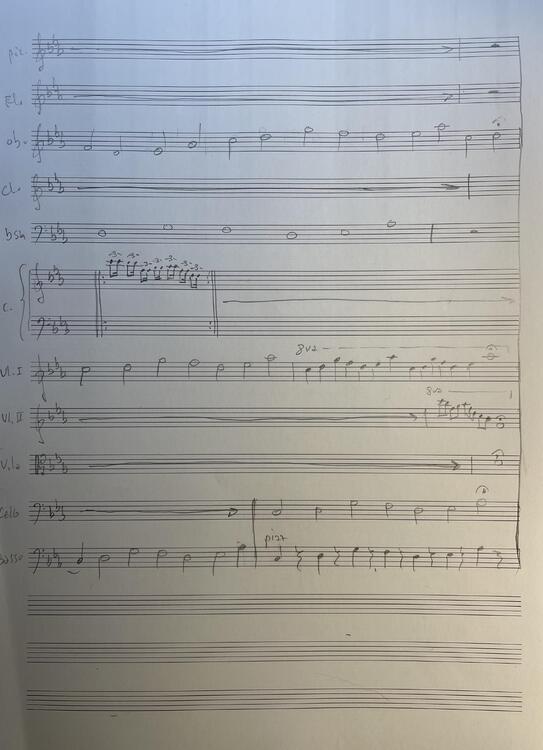
Dear all, I wrote a minimalist piece of music about one year and a half ago. The piece is finished and I also put together a music video for it. However, I don't know what is the best way to notate it, hence this post. I wrote it using a DAW and at the beginning it was just an experiment using a small theme composed by 7 notes (C, D, G, F, D, Eb, Ab) that is repeated more or less continuously. The theme is played at different speeds and heights, in a sort of free counterpoint. Harmonically, the repeated themes create a cluster, so I tried to give a structure of the piece by creating moments of tension and relieve when only one or two instruments are playing it. I also introduce a second theme (C, Bb, F, G, Ab, F, D), that is inspired by the first one mirrored vertically (but not rigorously). I tried to orchestrate using strings and woodwinds and I realized that I quite liked the result! That was unexpected to me, as I don't usually write music using such techniques. I would now like to score it, but there is not a regular beat in the piece. The relations between the different portions are to be respected, but not the exact timing at which the instruments enter. On the other hand, the general structure should appear from the semi-random repetitions and so there are some points where the voices should stop. I tried to sketch the first two pages. Please excuse my handwriting and the bad quality of the scan. I can do better for a finished version, but this is still in a preliminary test phase 🫣 Do you think this is a good direction? When I have clearer ideas, I may see how to notate this using software.
 1 point
-
This little piano piece is a little Elegy for the great italian journalist and writer Corrado Augias, which is dead today at the age of 91. I have a lot of esteem for this person, which was very intelligent and, arguably, one of the better intellectual mind in Italy. He was also a great passionate of classical music. I decised to wrote this elegy in is memory. If you prefer to listen the piece on YT here the link: https://www.youtube.com/watch?v=CL9C_OUONkY. IElegia.mp3Elegia.pdf1 point
-
I will try both, and share the result. Thanks for your interest in this piece! Best wishes1 point
-
1 pointI definitely see how this is Spanish inspired, I liked your use of multiple instruments and variation (I feel like it expresses more creativity), something to keep in mind is that with changing the song around so much (for me, and you should take this with a bucket of salt because I'm not familiar with orchestral composing, I only have 2 years of experience AND I make all my pieces on FL Studio,) you also make it difficult to find rythm and catchiness to the piece. I enjoyed your piece, though! It's best classified as being very dynamic as well as remaining on theme to the song title! Great job! :)1 point
-
1 point
-
Hello, I am a novice composer and this is my first post on this forum, which I discovered by accident today. This forum is just what I'm looking for, a place to share my compositions to others other than YouTube. I haven't got a lot of experience in composing or orchestration, so please take this in mind. Any constructive criticism would be welcome. I also have a YouTube channel where I upload my compositions: https://www.youtube.com/@tylerplayspiano-2026 video-score_sinfoniettamscx.mp3 video-score_sinfonietta-2mscx.mp3 video-score_sinfonietta-3mscx.mp31 point
-
Thank you for the feedback. I'm not really used to writing for large ensembles at all since I mostly play the piano, I'll definitely take what you said into account in future ensemble works. Have you listened to the 2 other movements? What do you think?1 point
-
Hello I’ve listened to Part 1 on YouTube, because I like to look at the score. Your ideas are very good, but I think there are a few things to consider in terms of orchestration. I’m no expert, but that’s my opinion. The opening catches the ear because I don’t think those pp dynamics up there on the flute are feasible. The clarinets are playing figures that are typical of the piano – not very idiomatic – but, what’s more, with no rest for so many bars, they need to catch their breath. Another thing I’ve noticed is those very long notes that form the harmony; they don’t sound right on these instruments. The harmonic foundation needs to move; in fact, in an orchestra, everything has to be alive.1 point
-
1 pointI've written many love songs over the years for specific individuals. This is...really just another love the song. The opening notes are supposed to represent how my heart stopped and fluttered when I saw her and hopefully my feelings for her will now be immortalized on the internet. I noticed that people don't seem to post too many love songs on this forum...but which one of us have not written a love song at some point in our lives? I wrote this one earlier this year and got around to recording it last weekend. Trying some new formats. I notice that a lot of people here don't tend to post live pieces. Do people like having the sheet music, vs watching someone play? Let me know....Recorded on a Bechstein Grand. I might try to add the sheets in so you can see my hands playing and the sheet music, if people feel this is a nicer format1 point
-
1 pointHello Ali, thank you for your comment. I think you've understood my piece. I am also not 100% sure about the current ending either. You've given me some ideas to consider for the ending, thanks. I can post a score, though I am not very good at engraving. I think the current score I have for this one is a bit messy!1 point
-
That sounds like a good direction, Laurent — it fits what I heard in the piece, too. The piano's repeated pattern is lovely in the first nine bars, but when it stays full while the bass clarinet holds its long notes, the clarinet has to work hard to be heard. Simplifying or muting the piano just in those moments should let its low, warm line come through without losing the piano's character. Will you try it first in the opening, or in the passages where the clarinet holds its longest notes?1 point
-
Hello JorgeDavid, thank you for sharing this — I listened to your performance and followed the score in the video. I enjoyed how the melody in Eb major keeps its singing, ballad character through the AABABA form, and the classical arrangement suits it well: the harmony feels rich without losing the tune, and the softer pp delicato passages give the return of the A section a gentle, prayer-like quality. One suggestion: since you mentioned keeping tone and volume constant was difficult, it might help to let the left hand stay a little lighter in the A sections, so the melody can stay in front even at a soft dynamic. Did you find the B section, with its different harmony, easier or harder to keep even in tone than the A sections?1 point
-
1 pointThank you for sharing the new version, Tristan — I listened to Melodic Rhapsody 2, and the change is clear. The opening motif now flows on in that waltz-like way you describe, and cutting the harsher passages lets the melody carry through more continuously, especially as the song-like opening opens out into the longer, flowing phrases. One thought: the opening theme is still so memorable that a varied return of it near the end, perhaps in a different register, could tie the new 50 measures together even more. Did the new ending change as well, or did the free-form middle grow out of the original ending?1 point
-
Currently I think I need at times to simplify and occasionally to mute the piano accompaniment to give the clarinet more room.1 point
-
1 pointThank you, islav — that makes complete sense, and I appreciate you explaining it. Leaving the title abstract fits the piece well, since the harmony does so much of the work and the melody stays close to it, and the high descending figure with the fermata in bars 2-3 already gives the listener plenty to imagine without a picture in the title. I also like hearing them as standalone character pieces — each one can keep its own mood that way. Do you have another standalone piece in mind already, or are you letting the next idea arrive on its own?1 point
-
Thank you, Laurent — I am glad this combination is one you would like to try again, even if you want to solve that small riddle in this piece first. For me, what already works so well is the contrast between the piano's repeated pattern in the first nine bars and the bass clarinet's low, warm entry, and the way the final clarinet phrase settles onto a long note in bar 58. Which passage feels closest to the change you have in mind, or is it more a question of the overall balance between the two instruments?1 point
-
1 pointHi relating to your subtitle suggestions, a bit too on the nose for me, i like more abstract titles, to leave the exact imagery open to interpretation. but i appreciate the thought. And no i don't really hear any of my music as parts of a potential collection, just a bunch of stand alone character pieces and ideas. Thank you for your feedback and thoughts1 point
-
1 pointI agree with you guys—that castle/mine-like place is beautiful, and not only that, the scenic view from a high place is also wonderful. As for the piece, I enjoyed it—it has a gentle, spacious atmosphere and, as Peter said, tranquil. I think the current version is good, but personally, I think you could lengthen the release, maybe. More like a continuing sound to emphasize more spacious vibes. The same thing is true of the kick drum—add a bit more reverb, not release though. But the most important thing is whether you like it, so if you like that, that is the best thing! It's just my impression, so please don't take this too seriously :) I enjoyed it and am looking forward to hearing your works in the future. Thanks to you, the electronic topic is now revived! P.S. I love your videos—the colors gradually get colorized and the final view of a beautiful place :) Best, Lithl.1 point
-
1 pointHello islav, thank you for sharing this — I listened and followed the score, and I was struck by how patiently the piece unfolds. The opening is especially effective: the right hand waits through the first bar, then answers with that high descending figure and fermata in bars 2–3, while the left hand keeps the nine-note groups moving underneath in 9/8. That contrast between the still, singing line and the continuous accompaniment gives the harmony room to shift without the melody ever having to hurry, and holding E minor back until the very end makes the arrival feel earned. One suggestion: because those wide leaps in both hands can blur which line is the melody, you could try thinning the accompaniment slightly or softening the lower nine-note groups where the right-hand line is at its highest, so the singing line stays in front. For a subtitle, something like “Nocturne — After Rain” or “Nocturne — Late Light” might suit that quiet, harmonically driven mood. Do you hear the piece as a single nocturne, or as the start of a set of short night pieces?1 point