
Petar Dimov
Members
-
Joined
-
Last visited
-
Thank you very much! I am deeply flattered. I am not a marimba expert myself either but I did consult a couple of percussionists during the process. I am working on the matter and have something in mind regarding a live premiere. We'll see how it goes. I will most definitely share it on the forum.
-
Hello everybody! I am very excited to present to you my most recent composition - a piece for solo marimba and string orchestra. It is in standard sonata form. I would like to hear you thoughts on it. Hope you enjoy! The project was made possible by the generous financial support of National Cultural Fund, Bulgaria - https://ncf.bg/bg
-
Hello everyone, here I am presenting you another composition of mine. This one I finished a few years ago as part of my academic studies. It is a typical variation cycle. The goal was to practice putting thematic material in different context, as you will hear. I hope you enjoy the video too.
-
@gmm, @Thatguy v2.0, @Jean Szulc It brings me joy when I see that my efforts in trying to transmit an intelligible message within this labelled as unintelligible realm are not futile. I will continue uploading on YouTube as well as posting here in the future. You are welcome to subscribe if you find it suitable. Many thanks!
-
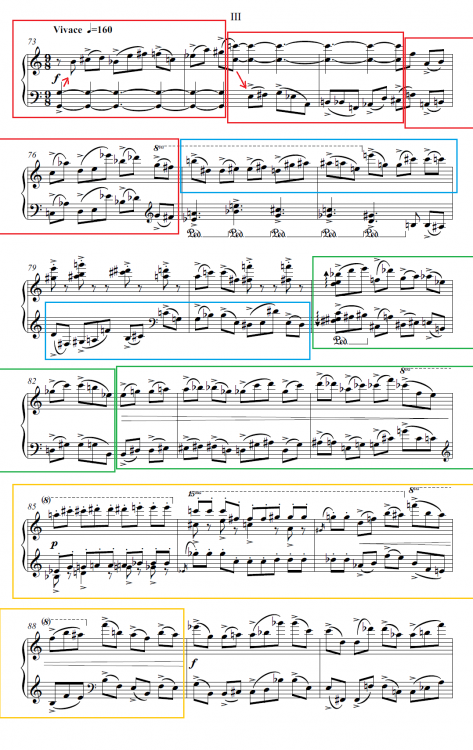
In most cases I have an overall idea of the direction of the music and how I envision it evolving - that can be a structural idea, a strictly sonoristic one but rarely a lick or melody. The latter are shaped afterwards and are what is perceived by the listener - that surface layer I mention in the post above. In this case I was thinking of ways to implement all 12 tones and therefore achieve a sort of emancipation from tonality but at the same time retain it's key characteristics, not the T-S-D-T cadences of course, rather it's gravitational pull towards an assigned center (in this case, a temporary one - the changing pedal point which, with it's consequent notes stacked on top of one another, forms the most tonally ambiguous diminished 7th chord). I find that produces an interesting effect, chaos withing order, and is what prevents that particular section from making you feel seasick, in other words, the listener is not overwhelmed by a barrage of atonality, although it is definitely not tonal at all. To answer the second question - no, the B section is not in any way derived from section A. That's the idea, it's a contrast in almost every aspect possible - that of texture, rhythm, metric, melody and harmonic color. It is even quite classical in terms of periodic organisation - two phrases (antecedent and consequent) of equal length as opposed to the 4:3:2:1:0.5 asymmetrical relation of phrasal subdivisions in section A. The motivation is similar to the one I presented above. The path is different, therefore the result too. Here I was looking for an ostinato pattern to support a free-form jazz improv allusion in the right hand. Again, think of it as a distant cousin that has inherited just the right features to still be recognized as a family descendant. The improvisational manner is very apparent - starts slow, phrases are more spread out; gradually intensifies; climax; cools down and restates the opening motives; dies away. That is a cause and effect game there. If you look closely, the regions, although six, are really only two with three different transpositions starting on F#, Bb and D (notice the other tonally ambiguous chord implied here - the augmented one). Now, if you hold down the notes forming the ostinato pattern you'll notice that in one case you are left with a near whole-tone scale order and in other, with two groups of three chromatic notes a minor third apart. The linear contour of what you have at your disposal is quite different, therefore the melodies which stem out of it have a different shape. I find it interesting, rather than perplexing. The unity is still within the direction of the whole movement which I tried to depict. [snip attached below] Each "deployment" of the row is contained within a rectangle. The different colors are to represent the varying sections. In red, it is stated three times exactly as it is conceived, in it's raw form - no additives. That's the exposition. Each time it is transposed a fourth apart (here I was thinking of the quartal harmony of the B section in the first movement. As extremely vague and distant as it may seem at this point, it gave me a creative impulse and that's what's important here. I do not delude myself that anybody could ever notice that unless stated. It wasn't intended to be obvious, it's merely one of these invisible laws that govern the piece). In the next section, "blue", the row is stretched to fill the same length of four bars by only appearing two times, as a result some notes are repeated. There is also an additional layer of 2-note sonorities remotely tied to the row itself but I will not go into detail here for the sake of brevity. Next is section "green" in widely spaced parallel major thirds - two unequally distributed rows as opposed to the symmetrical "blue" section.. In section four, the yellow one, the "theme" is diluted even further. Now it occupies the entire four measure expanse. The change of articulation, added embellishments and dynamic contrast is quite obvious and adds interest. What follows from here on are the same sections in reverse order - the whole movement has a mirrored form. The "red" section, here the last to appear at m.97-100, is a bit varied to serve as a build-up - the row is very muddy in the lowest register of the piano and is in it's reprisal form (three reiterations a fourth apart); a whole-tone cluster gradually develops on top. I am glad you picked that up (note, here again in reverse - B followed by A)! I've gotten that before too, the reminiscence being short-lived. I agree. Let's not forget it's supposed to be a sonatina after all, not an actual sonata. I see it as a resume. It is quite rich in events but packed within a smaller box. It was a good brain exercise for sure! It helps me understand better what I did by thinking of ways to verbalize it. Thank you for your questions.
-
Thank you very much for the feedback guys! I'm glad you find my music interesting. As for the theoretical aspects behind my musical language, @Luis Hernández has pointed out a few in his comment above which are, of course, quite obvious. What I try to do is make everything stem out of the thematic material. What I mean by that is that coherence comes from structural unity, harmonic/melodic uniformity is just the outer layer which, when peeled off, reveals the piece's intrinsic characteristics. A composition should be a complete independent world of it's own, governed by it's specific rules and natural laws. Having all of that in mind, yes, I do have preconceived melodic and harmonic ideas but they merely serve as building blocks for this specific cosmos (check other compositions of mine on my YouTube channel and hopefully you'll understand better what I mean). The key point is this - expression evolves with the piece itself, language is driven by and is specific to an aesthetic which in turn is only applied upon an initial idea that might not even be a strictly musical one to begin with. Back to the point, there are several ways in which I distribute the 12 tones in a loose dodecaphonic manner. Some quick examples: the first two slides (up until m.9) implement the juxtaposition of major and minor modes over a sustained pedal point on top of which a melody comprised of the remaining 8 notes of the chromatic scale is soaring in longer note values; the second movement can be split into several twelve-tone regions, each 2 staves long, where 6 notes of the chromatic scale make up the ostinato pattern in the left hand and the other 6 form the melodic material in the right hand; the last movement is a straight 12 tone row from start to end - transposed, embellished, varied with occasional repetitions of gives notes, in consonant or dissonant intervallic relationship between the two hands. All of that is quite boring theoretical stuff which needs a little bit of tweaking, even "impurity", stepping out of the boundaries which the musings above suggest. It's dead by itself. What makes it alive is interesting and justified dramaturgy - to put it simple, arranging just the right sized stones with just the right amount of mortar to build a beautiful, durable and balanced wall. Talking about music is one of the hardest things there is and remains inexplicable to a great extend. I did my best. Thanks for the challenge @Thatguy v2.0.
-
Hello, everyone. I am new to the forum and decided to share my most recent composition for solo piano in three part sonata form. I am looking forward to your reviews. This piece displays the current evolutionary stage of my musical language - where I'm at regarding expressive capabilities, structure, how I handle development and so on and so forth. I hope you enjoy or at least that it triggers an aesthetical response of some sort which in turn would mean that it has inherent artistic value. P.S. I put a bit of effort in producing a visually appealing score video too. It would definitely help my YouTube channel grow if you like, subscribe or leave a comment there. Petar Dimov