All Activity
Past hour
-
“The Last Request” (from the cycle of musical illustrations to Max Dalin’s novel “The Bonfire and the Salamander”). This is a decadent romance. The video is simply a story and is not directly connected to the plot of the novel. Music by A. Khomenko Lyrics by V. Osadchenko Sung by A. Yachmenev Lyrics: Why should I fear the grave, or death’s embrace? A shimmering moonlit path calls me away. But, friends, as you escort me from this place, Upon my breast the sacred Eye don’t lay. White roses, silks, chrysanthemums so fair Will wrap my body gently in their fold. Though mournful, mute, you’ll hear me singing there: A dead heart through the roses, calm and cold. And when the moon is full, unbar the door. How weightless is the moon-winged flight! Whoever stays faithful, though life is o’er, Will enter eternity with me tonight. Twilight will take our weary souls to rest. No more of candles, no more of prayer. The grief of old grows quieter in the breast, And old remembrance hardly hurts us there... (translation by Claude)
-
This is my piano miniature. In this music, I wanted to capture the image of a doll or a figurine: a cold, lifeless kind of beauty... But is it really lifeless? =)I enjoyed listening to this. I’m far from the best person to analyze other people’s music, but here are some thoughts on what I heard. First, I think you should just call this f minor and write it as such. Phrygian dominant would have a g flat, I believe. (But I haven’t worked with modes in years and you might have a different reason for not putting this is f minor.) Add accidentals for the natural minor as needed. It will still give the sound you are looking for and make it much easier for a piano player to read. Also, is that a tie on the top note of each pair of notes on beats 2 and 3? It doesn’t sound like it is in the recording. I think they are not necessary and I found them distracting when playing through the piece. I like the themes. They are pleasing to the ear, at least to mine. There could probably be a little more variety. Measures 13-14 do reverse the direction of the tune, but it’s still rhythmically the same, and I wonder if that is giving enough sense of “new material”. Also, it’s in the same key. (This is a problem I have writing music — trying to keep things familiar but not beating any dead horses). How about putting something in a related key, maybe a major or try reversing measures 13 and 14, so you would have the new phrase start with three quarter notes. How about putting in some theme that has wider intervals. You have mostly step-wise motion the whole way through with the exception of a few jumps in the octave section. I think measure 39 and following have the more successful new material. Good variety but the key is still intact, so it’s provides some connection (again, for my ears, can’t speak for others). Maybe don’t use repeats for measures 63 / E section. The listeners’ ears will be well-familiar with the ideas by that point. Finally, I vote for an authentic cadence to at the end. It sounds unfinished. Like I said, just some thoughts I had.
Today
Thank you very much – and, haha, I do not recognize the dissonances that much. But good to know that I’m just far enough away from „simple harmonies“, so that I must not exaggerate with dissonances much more! That’s nice to hear. At first, I wanted to develop the fugato further to a usual climax and ending. But, since its flow had already been „disrupted“ twice by the second and third stanzas of the poem, I decided to conclude the piece with a recapitulation of the opening „improvisation“, to finally come home to the key of Bb major. I was not sure about that decision, since that recap has a much more melancholic mood than one would expect for the task to depict a bright summer day. So I really appreciate that you – and some others – enjoyed that particular section. Yes, this kind of “orchestra” is indeed a bit weird (or “diverse”, as you politely called it). I use the YCF competitions to experiment with instrumentation while orchestrating my pieces, which I usually compose (initially) for solo piano. And since the competition rules limit the amount of instruments or players to five, I had to figure out how to achieve the greatest possible variety of colors: I needed a melody instrument and a substitute for the human voice, so I used the trumpet both with and without a mute. The cello and guitar provide the “orchestra” with the bass and rhythmic foundation. The piano remains as an accompanying instrument, but being paired with the accordion, which—in my opinion—is the most important instrument for the piece to produce a somewhat „French“ mood. Thank you, that is a great compliment for me and proves that I was not as wrong with the „weird“ accordion idea! Fortunately, yes—I won third prize in that competition.Hello @InstrumentalistElle, I still remember your masterful string quartet, which depicts rocks or mountains surrounded by clouds. And since it features many “extended” string techniques involving harmonics and flageolets, I considered it to be a great composition example, but having rare chances to be ever performed live. Now, with this magnificent live performance, you’ve proven me wrong! Congratulations—for a composer, having one’s own pieces performed live is an incomparable reward, far greater even than winning a prize at a composers’ forum competition! How did you achieve that connection with such an outstanding ensemble? If you could tell me, I might even try to compose a string quartet (end of joke). 😀Hi again and this is may be the biggest i would like a very helpful information about my pieces I. Prelude (Andantino) – C minor II. Sonatina: Allegro – G major III. Sonatina: Andantino – G minor IV. Sonatina: Finale (Presto – Adagio) – C minor Sonatina c moll finale.mp3Prelude in c moll.mp3Sonatina sol dur 1 mov.mp3 Sonatina c moll finale.pdf Prelude in c moll.pdf sonatina sol dur 1 mov.pdf Sonatina g sol mov 2.mp3 Sonatina g sol mov 2.pdfHi YC members, hope everything is going well with you. Today, I got the idea to start this topic: the best pieces you have listened to in 2026 so far. I don't mean you have to only mention pieces released in 2026 — but the best pieces you have listened to in 2026 as of now. I'd like to share: Jon Appleton's "Homage To Orpheus". Makoto Ueno "Preludes, Livre 2, CD 131: No. 10, Canope". Also, this piece as well: Ben Nobuto's "Hope Spiral". My friend @CrystalCanon told me about him, and I immediately fell in love — please check him out! Thanks, CrystalCanon! Well, I actually have many more pieces, but that's all for now. Next, it's your turn — what are yours!?Yesterday
A really enjoyable piece, Alexx. It all flows smoothly from one section to the next. There’s good balance between the parts and good sound production. I especially like your phrasing. I think waltzes can be kind of stagnant if the phrases adhere to the 1, 2, 3 beats to much, but you seemed to have broken the phrases up just enough to give it all a nice forward momentum. Really good listening to this.PeterthePapercomPoser replied to PeterthePapercomPoser's topic in Music Appreciation: Suggest Works or ArticlesSuper Bonk - Shoot the Smiley:Here's a little something I cooked up this week. I was aiming to weave interesting harmonies from the interactions between the voices. It doesn't have a title yet: so any ideas welcome. Do you think it's too repetitive? Or maybe needs more counterpoint? I could extend it with a contrasting middle section perhaps? I'm not done with the notation yet: so lots of missing slurs. In terms of production, I wonder if the quiet section needs to be boosted further? Full orchestra improv #12 (with ZL compressor).mp3Full orchestra improv #12 (with ZL compressor).mp3All thoughts welcome. Full orchestra improv #12 (with ZL compressor).mp3 Full orchestra improv #12 (with ZL compressor).pdfAmazing recording. Enjoyed it. And congratulationsI would heavily recommend starting with an introductory textbook on harmony, such as this one by the ABRSM which you can view for free. The counterpoint you're interested in (18th-century counterpoint) is essentially the usage and adaptation of (16th century) contrapuntal techniques in the context of harmony, so detailed knowledge of the latter is absolutely essential.ticklemonster67 joined the communityI agree with the others that this is a little repetitive, even for a short piece. 12 of the 21 bars are the arpeggio figure with mordent and a lot of those are pairs of arpeggios in the same key. You changed up the keys a little later, which helps, but that still a lot of repetition. How about continuing new material from 3 into 4 rather than going back to the figure of m. 1 and 2? Extending the new material through m. 4 would give interest before returning to d minor. Since this is a baroque-style piece, I think a D octave in the bass of m. 10 is required. My ear at least felt its absence.ProkofievsSalt joined the communityVery high degree of Spanish influences, shifting rhythmic syncopation and time signatures and Phrygian mode. You clearly know what you're doing. This is a very pianistic piece, despite never having written for piano before. All of the chords and embellishments fall easily under the hand, and you're careful to give time for the performer to breathe. I'm still quite an amateur in terms of compositional technique, but I would say as a pianist this is a very fine start to writing for piano. I would recommend exploring the instrument's capabilities a little bit more in order to balance out the edge. You could, for example, have added some of the lower bass notes in the left hand accompaniment for bars 23 - 24. Since they're so low and resonate for a significantly longer time, they give a much richer, ringing tone quality to your staccatos. Not to mention, it helps to activate the resonators in the piano, leading to a much richer tone in general, and it lends to a much more powerful and dramatic effect. However, this is still a very well thought out composition.Last week
My dear friend, thank you so much for your beautiful and thoughtful words! It always makes me happy to know that my music reaches you in such a way. And yes, Schubert’s D.959 is indeed one of my absolute favourites, although I find it almost impossible to choose just one work of his. His music possesses a depth, tenderness and humanity that I have rarely encountered elsewhere. His last three piano sonatas are, to me, among the greatest treasures in the entire piano repertoire. I found your question about exploring a different style particularly interesting. I have occasionally wondered what my musical language might sound like outside the Classical and Romantic world that I love so deeply. Perhaps something more impressionistic, in the spirit of Satie’s Gymnopédies, would be an interesting experiment. Atonal music, however, would probably take me much further away from my natural musical instincts! Harmony, melody and a certain sense of tonal warmth are very much at the heart of how I think and feel about music. Still, one never knows where inspiration might lead. And thank you for calling me the legendary composer of YC! Haha! That is far too kind of you, my friend, but I truly appreciate your friendship and encouragement. It means a great deal to me. Warmest wishes, and have a wonderful day! 😊HELLO Let me just say that if you have no experience in composition, you’ve got a long way to go before you can compose a proper fugue. I get the impression you must have some knowledge of counterpoint. But before you start composing fugues, you need to master other, less demanding areas of strict counterpoint. It’s simply not possible to come up with a logically structured composition just by studying two of Bach’s fugues and leaving it at that. What you’ve written doesn’t sound bad, but, in my opinion, there’s a point (which I think is the one mentioned by @Lithl ) where everything falls apart quite a bit, and that’s in bar 6. Because you’re forming a D#–A tritone which, although the intention is for some of these to be passing notes, I think that should resolve into a Bb chord. Enharmonically, you have Eb–A, a tritone which, in this context, must resolve in this way. The solution you’ve suggested for another context is fine, but here, at least for me, it ruins the whole thing.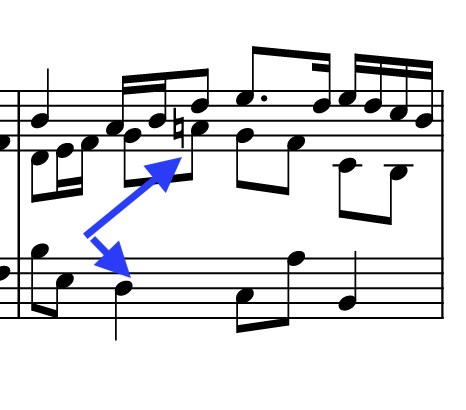 Hello @electricporridge27! Wow, is that really an improvisation? Please tell me it isn't... This sounds amazing; you have incredible piano sense and wonderful ideas. It's such a pleasure to listen to. Sometimes, people appear in this forum who discourage me with their sheer talent, as if saying, "Hello, when are you going to quit music?"—well, not literally, but you know what I mean, haha. It's truly at that high of a level. I'd love to listen to your non-improvised pieces, too. Thank you for sharing and welcome here :) Best, Lithl.