All Activity
Past hour
-
Hello @Fruit hunter ! I wish, I could press both buttons, „Thank you“ and „Ha, ha“, but since that is not possible, I did a simple „Like“. And even though the “fruit hunter award of excellence” will not really appear in my collection of badges, I’ll collect it in my mind! Thank you, very much. It’s nice to hear, that you don’t find the use of the muted trumpet as „too annoying“. And yes, this time, I tried to blend the instruments together (as it is done in a full orchestra) as far as possible and not only to simple distribute the four-part voice leading of the original piano work to the instruments. Unfortunately, I have no practical experience how fast a cellist can change from bowing to pizzicato. I hope that it is possible in the relatively slow tempo. I remember discussions on that topic on even faster tempo, where finally came around that nowadays string players would be able to do so, even in relative fast tempo. And, by the way – ha, ha – I remember that you’ve earned similar concerns with your mallet changes in your „On Pastel Skies“ submission ... Yes, always after finishing one of my piano pieces, I try out the fingering (and test the playability). Perhaps my fingering instructions are somewhat exaggerated, but it is not as easy even in passages one might find simple at the first glance, so that I often struggle which fingering marks are redundant and obvious. Another fun was for me to learn about the notation for the Accordion, applying registration hints and the notation for the bass.

-
Hello @Kvothe! Thank you very much for your instant review of my submission. You have mentioned a number of concerns or suggestions with my engraving, which I now have thoroughly checked out, so that I can give some explanations for some of the decisions I made concerning them: Piano and Accordion. When I came around with my unusual instrumentation, I asked myself how to organize the score, especially the ordering and grouping of the instruments. In a „normal“ piano quintet (i.e., for example, a piano and four strings) we would have the strings at the top (in their usual order), grouped together, and at the bottom the piano as a single instrument of the „piano group“. But in my case, the piano is not the prominent or single accompanying instrument, thus I considered my ensemble as an „orchestra“ – while only consisting of five instruments. I Googled somewhat around how to organize such a kind of „orchestra“ (and interestingly, there were various responses, some of which contradicted each other). So I finally decided to use the answer suggesting the following grouping/order: 1. Brass section – Consisting of the Trumpet only. 2. Plucked string section – Consisting of the Guitar only. 3. Percussion/keyboards section – Consisting of the Accordion and the Piano 4. String section – Consisting of the Cello only.Breaking beams. That kind of grouping/order finally leads to the impression, that the Trumpet, Guitar and Cello are „sole instruments“ (since each group consists of only one) and the only real section or „family“ are the Accordion and Piano together, so that they share the bar lines (as it is usually done for instrument families in an orchestral score). However, I must admit, it might look a bit weird at the first glance. Stem direction. There are different rules applied determining the stem direction for different instruments/staves: For the homophonic or single-voiced instruments (that are the Trumpet, the Guitar and the Cello), I used „neutral stem direction“ where notes below the middle staff line have upward stems, and notes on or above the middle line have downward stems (which is exact the opposite of that you have supposed). I think, my Lilypond software did it correct, since I did not declare that there is a particular voice for that staves. For the treble and bass staves of the Piano part and the treble staff of the Accordion part, I used „voice stem direction“, since those parts are derived from the original piano composition which has a strict four-part voice leading. Thus, the „pickup“ you mentioned (e.g. the first four notes of the Piano) are in the alto voice which always has the stems down. I must admit that the four-part voice leading is not recognizable everywhere, since lots of the notes of the original piano composition have been removed, since they have been „handed over“ to the other instruments. The bass staff of the Accordion uses the „Stradella Bass“ system where notes below the center of the staff are bass notes and notes above the center of the staff indicate chord buttons (labeled with M, m, 7, or D (or d, or dim) to a signify major, minor, dominant seventh or diminished seventh). Yes, you’re right. There are passages with „unbeamed“ eights and sixteenth notes, especially in the trumpet part for the reason that this is the vocal part where the poem is set to music (with the muted trumpet as a substitute for the human voice). Other occasions of „unbeamed“ notes have been introduced intentionally, as the result of the texture of the second fugue subject and its counterpoint – whereas that is, admittedly, not easy to recognize in the orchestrated version. Dynamic markings. Perhaps, I somewhat exaggerated with the dynamic markings. But I’ve listened to many orchestation/scoring tutorials where hairpins without a starting and ending dynamic were considered as an error. Thus, all my hairpins lead from a distinct dynamic to another one. And, yes, „mezzo“ (either mp or even mf) isn’t always welcome.
Today
-
-
@Seni-G Hello Thank you for listening and commenting. Yes, I also feel at home with this sort of more or less post-tonal music. I very much agree with what you say about using the orchestra’s timbres sparingly. There are a few reasons for this: it’s an exercise I completed in just two days; it’s so short that, well, this is how it turned out. And the priority was to work on the set of four notes.
-
@Luis Hernández I think this is lovely! Though it’s modern, it still sounds tonal and classical-influenced to my ear. That’s my favorite kind of sound, something that feels new and classic all at once. I like that the music has a distinct shape and direction, despite the modern sound. The orchestration is lush and beautiful. It feels like you’re having fun, which makes it fun for the listener. My only suggestion would be this: if you use the entire color palette on the front end, you don’t save very many arrows in your quiver for later. You might try limiting the number of colors used at the start, so that later on you can introduce more in order to keep it fresh and exciting. Sometimes many colors used one after another can start out interesting, but quickly becomes a bit flat since they lose their uniqueness, and the thrill of introducing a new color wears off too quickly when it’s surrounded by other interesting colors. In a way, it’s about restraint in how you deploy your instruments, so that each important color change has a chance to stand out and shine. I’m excited to hear more of your orchestral work!
-
Great thread Lithl. Lots of good stuff here. By the way...how do you pronounce your name? Is it...lith-el? Like "little" but with a lisp? At least that's how I say in my head when I see your name pop up. Please correct me if I am wrong! I will share one guy....this guy is incredible. I drew inspiration from him in writing my own music.
-
Grant Weep replied to PeterthePapercomPoser's topic in Music Appreciation: Suggest Works or ArticlesDon't think anyone has posted this yet... Star Fox 64, Sector X. I prefer the quartet version.
-
Haha... well I've listened to Mahler's second symphony while working out at the gym, so there! The prelude for guitar is lovely, by the way! It reminds me a bit of Scarlatti, though maybe it's because of my lack of exposure to this particular style.
-
-
Thanks @Lithl & @CrystalCanon Do not disparage your contribution to discussion on this forum, Lithl. Your feedback is as important to us as anyone else here. The second movement is indeed different. To some extent it is more stylictsticaly reminiscent of earlier galant chamber music, particularly in my use of the initial bass pattern that contains semiquaver passing notes. This is quite common in, for example, the chamber music of Carl Abel (a close associate of JC Bach) of late 1750s & early 1760s: But structurally it is quite different and in my view more akin to a fantasy - more liberal with greater meandering in the development and license in the recapitulation. I leave it to other's to determine whether it is a good fit or not... after all it was composed initially as a standalone piece that I thought would complement this suite. Listen carefully to some of the bass motifs at cadential in Abel's flute concerto in the below video (first piece) to see what I mean:

-
Exactly! Some of the best chorus' of Bach's festive cantatas, with the splendor of the full baroque orchestra, are in 3/8. I personally recommend that of Vereinigte Zwietracht der wechselnden Saiten, BWV 207, for which he reused the first movement from his Brandenburg Concerto no 1. Such clever stuff! I listen to it while working out in the gym... I must be the only one in the world doing that 🤣
-
Hi Markus! It’s a really nice quartet, definitely in the spirit of Mozart and Haydn. The portamento in the sound samples of the strings can be mildly distracting. Also for some reason, I was slightly unsettled by bar 17 for some reason, though maybe the effect was intentional, or maybe it was partly because of the portamento. Great piece though, and I’m excited to hear the final version!
-
@Lithl Thank you kindly for the review! The kids are doing great, thanks for asking. That was a picture of my oldest some when he was a newborn, and now he’s a tween. Time flies. I’ve never heard of Kapustin but I’ll definitely check him out! @Luis Hernández Good call about dropping the repeat in the first movement. I left it in because I wanted to keep that classical sonata form, but maybe it should be an optional repeat. And thank you for the Ives comparison. I have always felt a certain kinship with Ives. He achieved so beautifully what I long to achieve: a prolific quantity of ear-stretching music that never breaks away entirely from classical harmony and form. I appreciate the comparison!!
Yesterday
-
Entry: A Song of Beauty and Melancholy Melodies Themes Motives Harmony Chords Textures Form Development Structure Time Originality Creativity Score Presentation Instrumentation Orchestration Playability Execution of Given Challenge Taste 9 9 9 10 4 4 7 8 Average Score:7.5 When I looked at the score at the distance, the first thing I noticed was that Piano and According parts are not separated but connected. It appears as if it one instrument and not two separate instruments. You have to disconnect the bars between piano and the according. Another issue I noticed is that is weird beaming patterns and stems positions. For instance, in the pick-up you have steams downwards, that is not correct. When they are connected like that, it should be up, since the majority of the notes are above the middle line. It looks just nicer that way. Another thing I noticed is you break beams a lot. This makes harder to read! You do this a lot in measures where the meter is 2/4. The only time beams are not connected is in vocal music. I see no vocal part. You have a lot of unnecessary dynamic markings. Hairpins are wonderful things. I would not use mezzo dymanics as much. Possibly changing from F to P is more effective vs F to MF. Also save those tripple markings for special moments. However, this is highly creative. You have written wonderful textures using different instruments and timbres. I see no problem there. It was just overall engraving. Total: 60/80
-
Yeah, again it was kind of a random idea that popped in my head. This was purely out of curiosity it’s fine.
-
PeterthePapercomPoser replied to PeterthePapercomPoser's topic in Announcements and Technical ProblemsHi @Fruit hunter First off, I think this belongs in the List of Manually-Awardable Badges thread as that is where new kinds of awards would get proposed. But I don't think you should bother about requesting it because creating such an award is: Lacking in meaning. Can easily be replaced by a simple "Like" reaction from you showing your approval. Would be too overwhelming - what if every member of the forum requested their own unique award to be able to give out to members? In any case - only staff are able to give out awards so you wouldn't be able to award the badge at your leisure but would have to continually request the staff to award each individual badge which would be logistically challenging. But of course - feel free to suggest other kinds of awards about specific characteristics of submitted pieces or their composers! Thanks for your interest.
-
guys hear me out. “ the fruit hunter award of excellence.” when I review a piece of music for a competition and it demonstrates it’s excellence then it gets the special honor of my award of excellence. This always has been something that has been in my head after listening to a really good composition so it may be a gimmick that i may picked up. in order for a piece of music to qualify there are two gates The total average of the score is 9.5 or greater If a piece of music, is that a threshold of 9.45-9.49 but the taste score is 9.75 or higher then it will also receive the score but this is just my little stupid idea that I have it kind of just rolls off the tongue and I thought it would be fun to present it to y’all
-
this production receives the “ fruit hunter award of excellence” !!!
-
awesome. I’ll do this in two parts my initial thoughts and then I’ll revisit the score and I’ll try to find things to pick out and to justify some rankings which could be positive as well so don’t get scared. Anyways, I kinda like the idea of this kind of acting like a sandwich with the bread, acting like this nocturne sort of like hymn sort of statement. and then a more wild, more tonically free section. I definitely appreciate the dissonance news here and the initial thought that I couldn’t even swap away was the frustration that you may have gone through, which may have caused this intentional dissonant harmony as a composer myself I also have gone through this sort of phenomenon so treated kind of as “key smashing”. I also appreciate the orchestration as well with the blending within the trumpet with its muted parts with the accordion, and also the blending within the guitar and cello making the sound simultaneously the same instrument. The one lick pic about the orchestration though is that I could barely really hear the cello on its own and pick it apart however, though this should be treated as a good thing, so you have your own justification for that. I also liked how you did some of the program notes and your ideas with putting “lyrics” to the trumpet part and also achieving that singing voice quality with the instrument that’s not the voice the accordion was especially a nice touch as it’s going to buff your originality score in your orchestration score by tons anyways the only concern is the bow changes which should be achievable due to the low tempo, but just making sure that people will most likely start to miss notes and parts getting cut out around pages 6 to 10 in the cello part. The supplemental techniques and fingerings provided are appreciated. I always enjoy that pedagogical style that you provide. score - MelodiesThemes Motives Harmony Chords Textures Form Development Structure Time Originality Creativity Score Presentation Instrumentation Orchestration Playability Execution of Given Challenge Taste 9.6 10 9.1 9 10 8.675 9.8 9.75 average: 9.49 magnificent job here definitely going to be a memorable piece of this competition the only thing I would say though about why your orchestration score got a little bit off was just because of the bow changes, however, though they could possibly be possible. anyways, amazing job.
-
Hello @Markus Boyd, thanks for sharing this beautiful baroque inspired prelude for acoustic guitar! Congratulations for the good scoring. Unfortunately, I had needed this a few weeks earlier, since I also featured an acoustic guitar in my last composition (for the ongoing 2026 Summer Competition). I hope that I did not cause many playability issues there, since the part is mostly single-voiced. That would be great, already excited. Yes, pieces in 3/8 are wonderful for their beautiful and thriving character, but that meter has – in my opinion - always the inherent danger from constantly listening as „hum-ta-taa, hum-ta-taa, hum-ta-taa“. There are a number of recordings of, for example, the opening choir and the choir „Herrscher des Himmels“ from Bach’s Christmas Oratorio, which suffer from that problem to be as rhythmically monotonous, regardless of the tempo. However, in your prelude this is not the case, perhaps since the repeated staccato eights are (wisely) used sparsely.
-
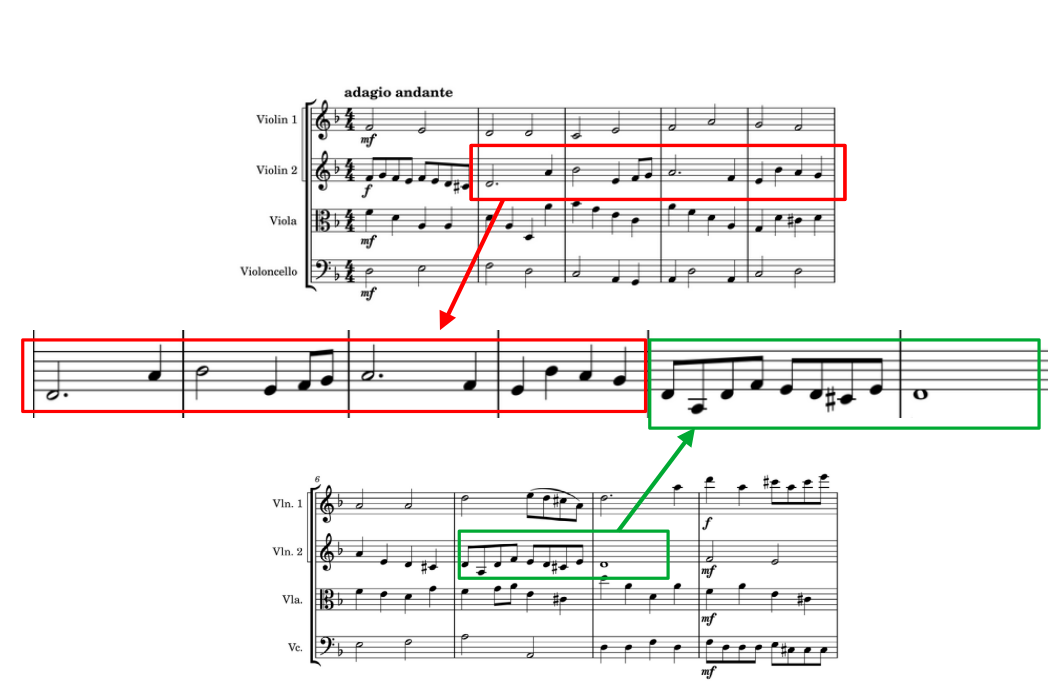
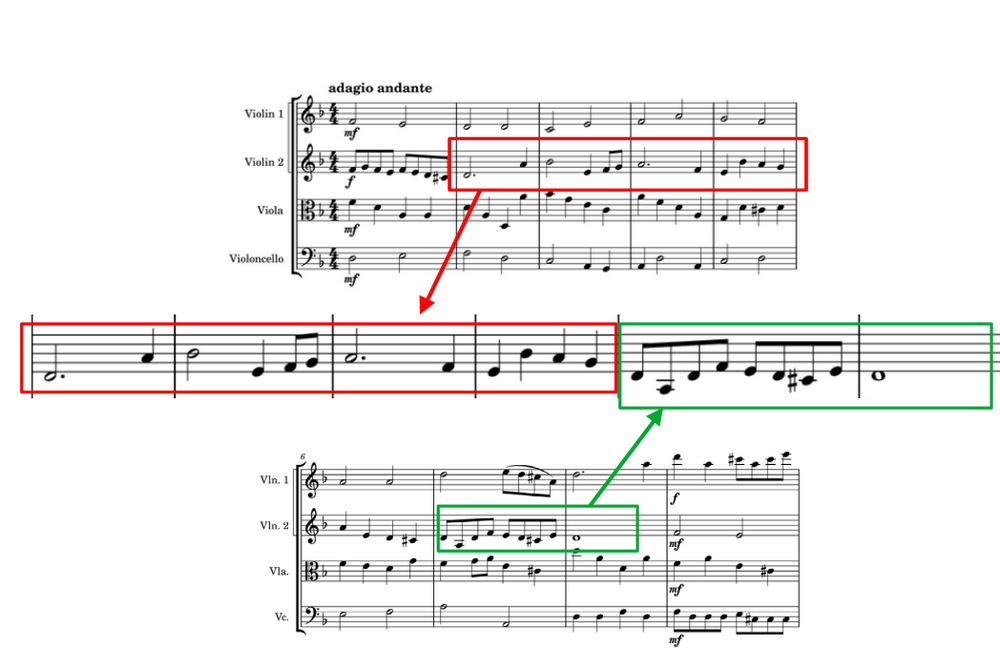
Hello @Woofi_9, since you are (relatively) new at this forum, first my warm welcome! Whenever one posts an unfinished piece – what I think is here the case due to the title and the plenty bars at the end with rests only – there is a good chance to receive rich feedback with usually polite suggestions for improvement. So I very appreciate @MK_Pianos explanations on „Melody and Harmony“ which are not only intended and useful for you, but for all readers of the forum. I can’t compare myself to him because I don’t have an entire „tutorial“, but only a repost with some considerations about „Rhythm and Texture“ which, I think, supplements Mason’s explanations. I intentionally just did not listen to the piece and am focusing only on that I am seeing in the score, trying to formulate my concerns and suggestions – however the piece might sound fine. A string quartet consists of four individual instruments, usually playing a single voice (and, furthermore, of four individual humans). Thus, it perfectly fits for a four-part-voice leading where each voice is „independent“ and „equal“ to each other. Such kind of music is called „polyphonic“ or even „counterpuntal“ music – the opposite to a musical „style“ that consists of a (prominent) melody voice and (subordinate) accompaniment. I think, your piece is a kind of this approach. However, we do need a memorable melody and rhythm, often called a „theme“, which is played multiple times (sometimes unchanged like in a canon or fugue - or otherwise slightly altered) by all instruments throughout the piece. So the role, which instrument is most prominent and which are the accompanying ones changes, finally creating variety. And there I’m coming now to my concerns or „criticism“: I can’t recognize such a memorable „theme“ which I would usually expect at the beginning of the piece in the upper voice. Instead, the Violin 1 has a somewhat repetitive texture with repeated half notes for the first 6 bars. Although the piece has enough distinctive textural motifs (each one bar long), they are not distributed well enough between the voices resulting in that the same motif is repeated too often by the same instrument (for example, the Cello in bars 9-14). My suggestion is, to take the one-bar motifs and create a „theme“ from them. In the example below, I have taken two passages, snippet them out and glued them together to create such a „theme“ from then which I would consider to distinctive enough. (Note, that I didn’t take care of the melody, i.e. the pitches and didn’t bother how it would sound, it is a rhythmic or textural example only). I would start with that „theme“ in Violin 1 and would repeat it at least two times (or better three times to involve all four instruments) thereafter by other voices. The other instruments should than apply rhythmical motifs which are contrary to that bars of the theme, meaning where the theme has a slow motion, the other instruments should have the faster motion – and vice versa.
-
Dear Acerylio, Thank you so much for such a thoughtful, detailed, and appreciative review! I was genuinely delighted to receive it and have read it several times. I was actually aware that I had not made enough use of the English horn and its particular qualities in this piece. To be honest, I originally intended to write the piece for two oboes. It was mainly because of the final section, where the very last note falls just below the oboe’s range, that I eventually decided on this instrumentation. Perhaps I was also a little too hesitant to create a greater contrast between the registers of the two voices, as I did not want to disturb the feeling and character of the piece. I actually tried several times to move the second voice into a lower register in other passages, but somehow it just did not sound right to my ear. So in the end, I decided to leave it as it is. This is my very first piece for oboe and English horn, and I am only a beginner hobby composer, so your feedback is all the more valuable to me. If I decide to revise the piece at some point, or to write something new for these instruments—or for strings, for that matter—I will definitely keep your advice in mind. Once again, thank you very much for your time, your knowledge, and your thoughtful and helpful feedback! Warm regards, Yevgeniy
-
Here is my contribution to the "From Nothing, to Something" 2026 Summer Composition Competition:
-
Dear fellow composers, I’m pleased to present you today my submission to the YCF 2026 Summer Competition! I must admit, that the task of the competition was really challenging, starting from „Nothing“ and than get the right ideas for „Something“ that is reminiscent to the mood of the summer day as expressed by Paul Verlaine’s poem. The challenge. When a composer has trouble coming up with a brilliant idea for a new piece, it sometimes takes several attempts, each of which yields different individual ideas. And there are some pieces that consist of several ideas that have been “glued” together, ultimately resulting in something like a “collage song.” I’m thinking, for example, of “A Day in the Life” by the Beatles or “Band on the Run” by Paul McCartney and Wings. However, there also exists such a kind of piece in Bach’s Welltempered Clavier, the Prelude VII in E-flat major, BWV 852. That particular prelude starts with a short section with runs of 32th notes, followed by a „more serious“ part in slow motion, that reminds me at a „chorale“. The third and longest part is a fugato with two subjects that further develops the ideas from the first two sections. So with this particular Bach prelude in mind, I had thus found the model for my own prelude, which serves as the „sketch“ for the quintet finally presented here as my submission. I always start to compose the pieces for piano in order to – on the one hand, have another piece for my preludes and fugues project, and on the other hand, because I find it to hard to mix the two phases of „composing“ and „orchestrating“ together. So I have posted the piano version as a standalone piece "Prelude XXI in B flat major" on the „Piano Music, Solo Keyboard“ thread. The poem. When I came around to the second part, the “Chorale” section, I faced the challenge of treating the upper voice of this four-part harmony as the melody for a musical setting of the poem. Since I don’t speak a word of French and have no idea how the syllables are rhythmicized, I looked at Gabriel Fauré’s setting of the poem in his Op. 61, No. 7 to find out which words are pronounced or sung briefly and which are longer. As an interesting fact, I discovered that Fauré had actually chosen the same key, B-flat major, that I had chosen before. The instrumentation. Now that the decision had been made to set the poem to music, I wondered how I could orchestrate it so that it would sound like a French “chanson.” My first thought was to choose the accordion as the main accompanying instrument. And since I wasn’t sure, I Googled: “What are the typical accompanying instruments for a French chanson?”—and sure enough, “accordion,” “guitar,” and “piano” came up. In addition to these, and to take advantage of the possibility of a quintet, I use a trumpet and a cello. Both of these instruments are capable of contributing different timbres (the cello either played with a bow or pizzicato, and the trumpet either muted or unmuted), and during the poem stanzas, I always use the muted trumpet as a substitute for the human voice. The title. Another challenge. A title in French would be appropriate, but I do not really trust translation programs in such delicate situations, since I don’t understand the nuances of the possible result. Thus, I’ve chosen the simple title „Summer – A Song of Beauty and Melancholy“. The latter since the piece features more passages in minor than in major and, therefore, does not only express the joy and beauty of the summer day, but is somewhat melancholic, too. Form and structure: 00:00 (mm. 1-14) The first section is an „improvisation“ which introduces the warm key of B-flat major. 00:34 (mm. 15-29) The second Adagio section could be a „chorale“ and is used to set the first stanza of the poem to music. 01:31 (mm. 30-90) The third and longest section is a fugato based on two subjects, interspersed by further stanzas of the poem (second stanza 02:18 at mm. 48-63 and third stanza 03:37 at mm. 75-90). The first subject quotes the first four-note motif of the „improvisation“ section and develops it further, paired with the second subject, thus creating a joyful and dance-like mood. 04:22 (mm. 91-114) The piece finishes with a coda – or better to say – with a recapitulation of the „improvisation“ from the first section. Now in a more melancholic way, meandering between minor and major. I hope, you’ll enjoy it. Wieland Finally, as a kind of „non-AI proof“ I also attached my „working score“ from which the MIDI is generated. It is nearly unreadable and of cause not intended for playing but shows in detail all dynamics, articulations, agogics etc. I applied to achieve the final recording. Praeludium-XXI-B-flat-major-accordion-mix.mp3 Praeludium-XXI-B-flat-major-accordion-with-coversheet.pdf WORKING-SCORE-P21.pdf
-
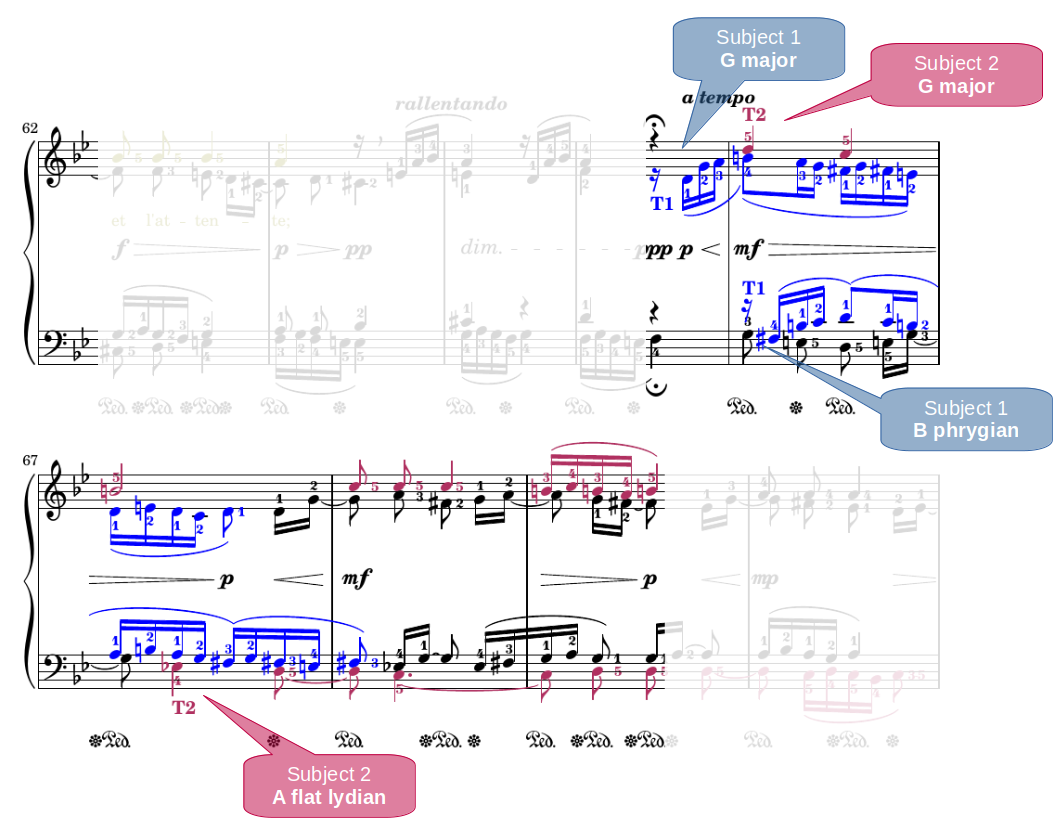
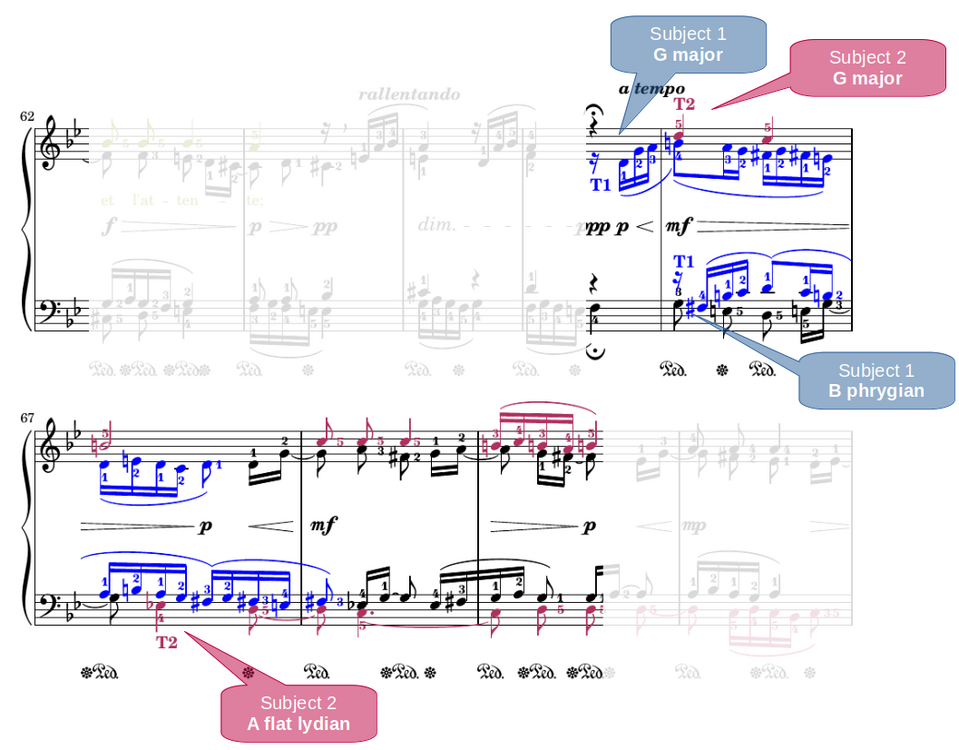
Thank you, for that example. I find it interesting, that phrygian and lydian fit so well together. I usually thought that was caused due to they are the both „extremas“ in mood – lydian the brightest one and phrygian the darkest (if taking the unusual locrian away ...). But the occurrence of all 12 chromatic steps in this combination was new to me and might be the better argument. There is, perhaps, another example for the usage (or even abuse?) of modes within a piece of tonal music – which I think is merely used for „technical reasons“: Transposing a fugue subject, which is initially major or minor, to one of the other modes. I first heard about this “trick” when I read an in-depth analysis of Shostakovich’s fugues (Op. 87) in comparison to the fugues from the “Well-Tempered Clavier”: Shostakovich often uses fugue subject entries in modes, whereas Bach does not. Ever since then, whenever I encounter harmonic problems with my fugue subjects while creating the counterpoint—especially when composing strettos—I always try to figure out whether I could alter some of the pitches in the original subject so that they fit better with the respective harmony or key, but by no means arbitrarily; rather, in such a way that the subject is “correctly” transposed into one of the other modes. Here is a short passage of the fugato in my Prelude XXI in B flat major, whichs tonality in the four bars is around G major (with also harmonies in C minor and D# major). However, the four subject entries in this stretto consist of Subject 2 in G major (soprano) Subject 1 in G major (alto) Subject 1 in B phrygian (tenor) and Subject 2 in A flat lydian (bass) which altogether finally stabilize the above mentioned G major tonality of the section. (Interestingly, there is also a combination of phrygian and lydian here – while not on the same pitch). p21--bars-65-69.mp3








.thumb.png.8b5b433a341551e913a34392660bc95b.png)