
All Activity
- Past hour
-
This sounds lovely! Great job
-
 I made this very small renaissance motet for 4 voices, Cantus, Altus, Tenor and Bassus. However my stupid brain wrote the text wrong and instead of "Sicut LILIUM" it became "Sicut ILIUM", I only noticed it after finishing the motet! But besides that part everything is in accordance to what it should be. Enjoy! Text: Sicut [l]ilium inter spinas Sic amica mea inter filias
 -
 Greetings @Wieland Handke! The F-natural in bars 3 and 4 of the 1st and 2nd entry is very much intentional, even though it does generate a certain degree of instability not present in the original, fully tonal rendition of Mozart's own canon. In fact, I should thank you for highlighting the matter of accidentals, as the previous version did not, in fact, feature completely real transpositions of the theme. There were a handful of mistakes every 3rd bar, not contrapuntal, but harmonic and thematic, as the continuity and integrity of the transpositions was broken with leading tone and its minor 3rd/5th of a dominant chord being raised a semitone higher. All of that has now been corrected, so unless any more oversights of mine were to resurface, every single entry should now be a real transposition to the lower major 2nd of the main 18-bar-long subject. I'm glad to learn that the current length of this canon would prevent it from seeming far too repetitive to the eyes of an educated listener. Indeed, I was worried it might end up sounding excessively mechanical despite the flowing timbre of legato strings, as monotony may distort even the most sophisticated of musical devices into pure pure noise after far too many identical, tiresome reiterations. It's a relief to know that to you it did not appear to be the case here, and I must thank you for your acute observations, for otherwise I might not have come to realize that the transpositions were not 100% exact. I should also probably check @PeterthePapercomPoser's take on the Persichetti exercises, especially considering this canon on different scales you just mentioned. I'm anticipating a gold mine of modal/post-tonal contrapuntal solutions! Thank you for this recommendation as well.
 -
Persichetti Exercise 2 - 14 for Clarinet Trio
Wieland Handke replied to PeterthePapercomPoser's topic in Chamber Music
Oh that's a difficult question about the differences and preferences between the two versions! For the first impression, they sound similar. And that is not meant as superficial impression, but rather I'm all the more amazed at how these three different scales retain their personality while now acting together (or against each other) in a different distance and relation. Maybe the tertian variant is more melancholic and serene, while the quartal one has a more excited character. This impression might be emphasized by the fact that the three voices are now narrower together in the tertian version and the sopranino clarinet does not play in such a high register and is less shrill. (By the way, I like that you’ve used three instruments with different registers, so that the voices are clearly separated, despite the somewhat annoying sound.) - Today
-
Hallo @Fugax Contrapunctus! I’m astonished how it works to create such a harmonically balanced piece while stepping down a whole note for each subsequent voice entry! Since @PeterthePapercomPoser also presented a canon based on different scales in one of his recent Persichetti exercises, I would like to know if you transposed some of the canon imitations into other modes or scales to achieve this harmonic consistency? I didn't check it out thoroughly, as I initially thought you had changed from minor to major to minor in the first three entries, without noticing that there is no F# in violin 2 in bar 4. No, the three entries are identical. But now, I think I’ve probably figured out the trick: The theme starts on the lydian fourth, F# in the theme being in C major – at least for the first four bars. However, a few bars later the melody starts to descend to the flats handing over the harmonic center to the next voice. So the descent is inherent in the melody which might be a bit difficult to learn due to its harmonic instability. While being heavily repetitive by its nature, the entire canon is not boring – at least not at this length. If being part of a larger work, such as an oratorio, I could imagine that it would be contrasted by a more declarative and stable section.
-
 Yeah. It is also tremendously difficult... Let's say two guitarists somehow managed to premiere it by playing the main part together.
 -
 The really! How? Is how someone would actually perform this...😦
 -
And it is 4 not 3 movements long too.
-
Firstly, You combine the symphony and the concerto, and the you add an electrical guitar. wow. i am IMPRESSED. (really! How?)
-
Hey there, I am also a pianist, not as like, a job, but more as a hobby. I mean, I am just a student, you know. Nothing special about me... Small Tip: Try to read transcript your music for solo piano, but don't write it down! Start easy with 2 instruments, and then get more and more! (No plans allowed) 🙂 Bye! (See you later I mean. Hasta Luego...)
-
Sonatine 649 Bars, 10 Minutes and 23 Seconds By TristanTheTristanTheTristanTheTristanTheTristanTheTristanTheTristanTheTristanTheTristanTheTristanTheTristanTheTristanTheTristanTheTristanTheTristanTheTristanTheTristanTheTristanTheTristanTheTristanTheTristanTheTristanTheTristanTheTristanTheTristanTheTristanTheTristanTheTristanTheTristanTheTristanTheTristanTheTristanTheTristanTheTristanTheTristanTheTristanTheTristanTheTristanTheTristanTheTristanTheTristanTheTristanTheTristanTheTristanTheTristanTheTristanTheTristanTheTristanTheTristanTheTristanTheTristanTheTristanTheTristanTheTristanTheTristanTheTristanTheTristanTheTristanTheTristanTheTristanTheTristanTheTristanTheTristanTheTristanTheTristanTheTristanTheTristanTheTristanTheTristanTheTristanTheTristanTheTristanTheTristanTheTristanTheTristanTheTristanTheTristanTheTristanTheTristanTheTristanTheTristanTheTristanTheTristanTheTristanTheTristanTheTristanTheTristanTheTristanTheTristanTheTristanTheTristanTheTristanTheTristanTheTristanTheTristanTheTristanTheTristanTheTristanTheTristanTheTristanTheTristanTheTristanTheTristanTheTristanTheTristanTheTristanTheTristanTheTristanTheTristanTheTristanTheTristanTheTristanTheTristanTheTristanTheTristanTheTristanTheTristanTheTristanTheTristanTheTristanTheTristanTheTristanTheTristanTheTristanTheTristanTheTristanTheTristanTheTristanTheTristanTheTristanTheTristanTheTristanTheTristanTheTristanTheTristanTheTristanTheTristanTheTristanTheTristanTheTristanTheTristanTheTristanTheTristanTheTristanTheTristanTheTristanTheTristanTheTristanTheTristanTheTristanTheTristanTheTristanTheTristanTheTristanTheTristanTheTristanTheTristanTheTristanTheTristanTheTristanTheTristanTheTristanTheTristanTheTristanTheTristanTheTristanTheTristanTheTristanTheTristanTheTristanTheTristanTheTristanTheTristanTheTristanTheTristanTheTristanTheTristanTheTristanTheTristanTheTristanTheTristanTheTristanTheTristanTheTristanTheTristanTheTristanTheTristanTheTristanTheTristanTheTristanTheTristanTheTristanTheTristanTheTristanTheTristanTheTristanTheTristanTheTristanTheTristanTheTristanTheTristanTheTristanTheTristanTheTristanTheTristanTheTristanTheTristanTheTristanTheTristanTheTristanTheTristanTheTristanTheTristanTheTristanTheTristanTheTristanTheTristanTheTristanTheTristanTheTristanTheTristanTheTristanTheTristanTheTristanTheTristanTheTristanTheTristanTheTristanTheTristanTheTristanTheTristanTheTristanTheTristanTheTristanTheTristanTheTristanTheTristanTheTristanTheTristanTheTristanTheTristanTheTristanTheTristanTheTristanTheTristanTheTristanTheTristanTheTristanTheTristanTheTristanTheTristanTheTristanTheTristanTheTristanTheTristanTheTristanTheTristanTheTristanTheTristanTheTristanTheTristanTheTristanTheTristanTheTristanTheTristanTheTristanTheTristanTheTristanTheTristanTheTristanTheTristanTheTristanTheTristanTheTristanTheTristanTheTristanTheTristanTheTristanTheTristanTheTristanTheTristanTheTristanTheTristanTheTristanTheTristanTheTristanTheTristanTheTristanTheTristanTheTristanTheTristanTheTristanTheTristanTheTristanTheTristanTheTristanTheTristanTheTristanTheTristanTheTristanTheTristanTheTristanTheTristanTheTristanTheTristanTheTristanTheTristanTheTristanTheTristanTheTristanTheTristanTheTristanTheTristanTheTristanTheTristanTheTristanTheTristanTheTristanTheTristanTheTristanTheTristanTheTristanTheTristanTheTristanTheTristanTheTristanTheTristanTheTristanTheTristanTheTristanTheTristanTheTristanTheTristanTheTristanTheTristanTheTristanTheTristanTheTristanTheTristanTheTristanTheTristanTheTristanTheTristan... (Continued Infinitely) https://musescore.com/user/96214813/scores/31853885 Yes! I self-taught myself to export stuff! (Not here, Tristan...) A cheerful Sonatine in D Major. Written, to guide composers' into the Sonata Form and how a classical era sonata looks like, although, nevertheless to say, as my works always are, it is also technically demanding. I would say, around Henle 7, maybe? 3 Movements, Fast-Slow-Fast (Ternary-type) Allegro, Sonata Form, D Dur, 173 Bars, 3 Minutes 23 Seconds Largo, Ternary Form (Ternary Form in a Ternary form?), G Dur, 71 Bars, 2 Minutes and 54 Seconds Allegro, Rondo, D Dur, E Dur, D Dur, with a Coda, 405 bars, 5 Minutes, 6 seconds Thanks for listening! (If you did...) Sonatine.mid (Just realized, no repeats are played in Midi...) Sonatine.mid
-
So I decided to convert the theme of Mozart's perpetual canon at the 2nd for String Quartet in C major (KV 562c) into one of my enharmonic canons by keeping the same melodic intervals across all its entries. As opposed to the four previous installments of this genre, this one is exclusively instrumental, as I struggled to redistribute the voices so that the theme would fit the vocal ranges of a 6-part choir. Partly for the same reason, the string sextet section is comprised of 4 violins and 2 cellos, as the viola ranges appeared unsuitable for the middle voices without significantly altering the whole structure of the canon. Neither is it technically a dual canon by tritone transposition as the others, but instead returns to its initial starting point without the need for a secondary repetition a minor 2nd lower per each iteration. This is due to the fact that, instead of following the circle of fourths, each entry starts a major 2nd lower from the previous one, thus having the first note of each of the 6 entries in this canon trace the whole-tone hexatonic scale back to its inception. YouTube video link:
-

solo guitar Minimal Microtonal Solo for Guitar on the 21st of Jan
PaavolaPyry replied to PaavolaPyry's topic in Chamber Music
Revisiting this but wondering if anyone has ideas on how to build from this? I feel like it could work both as only having guitar as well as having something else. It wouldn't be unfathomable to have even a larger ensemble in the background. But either way I'm also thinking about effects and such. If anyone has thoughts let me know; I'll update here -
lol just saw this pop up somehow, I Will Survive?? Damn I would've been way off, sounds nothing like the disco version at first. Nice one Luis
-
 just checked this out and damn the orchestration rocks. Keeps that cute vibe from the original but makes it way bigger and emotional. Solid work!
 -
MP3 Play / pause DDLC Your Reality FINAL 0:00 0:00 volume > next menu DDLC Your Reality FINAL > next PDF Your Reality just checked this out and damn the orchestration rocks. Keeps that cute vibe from the original but makes it way bigger and emotional. Solid work!
-
.thumb.png.8b5b433a341551e913a34392660bc95b.png)
Persichetti Exercise 2 - 14 for Clarinet Trio
PeterthePapercomPoser replied to PeterthePapercomPoser's topic in Chamber Music
I have added a 2nd version of the piece where I have changed the relations of the tonics to each other to be tertian rather than quartal as in the 1st version. In the 2nd version I use written C Acoustic Scale, E Ukrainian Dorian Scale, and G Phrygian/Dorian Scale. Let me know which you prefer! -
Just listened to the whole thing and really, really loved it. Your handling of the violins is really tasteful. I loved the variety of styles, didn't find the repetition to be a drawback (it's good momentum; it's propulsive to me) and the last movement really struck me. I would love to play the timpani part on this (and that's not something I say very much!!!). Wonderful stuff.
-
 zbreeves joined the community
 - Yesterday
-

2-part invention in E minor
Frederic Gill replied to Frederic Gill's topic in Piano Music, Solo Keyboard
Thank you for this 1st positive feedback. It is comforting :) You make it clear about the accented P8ve. I had never seen anything negative on that in Goetschius books (So I blame him!). The proof is that I have accented P8ves EVERYWHERE! LOL. In the deleted piece (#20) I had one per bar! And in this one, I have about 9 among 24 bars. I will have to update many pieces! The original motive was given an 'allegro' tempo, which should be 125bpm. Ridiculously fast. So I chose 85bpm (moderato). If I had slowed it further downto 60bpm, I would have had a different, non-humorous approach to it. I will make corrections to this #10 and get back. See you! -
Today I am presenting another fugue from my preludes and fugues project. Since it is a long piece with a special feature in its second half, I have decided to split the presentation into two posts. I began composing this fugue four years ago, inspired by Bach's Fugue in E major from WTC2 (BWV 878), after seeing Jörg Demus' wonderful introduction and tutorial, which unfortunately is no longer available on YouTube. The idea is to compose a fugue in the „stile antico“ or Palestrina style, which means having • 4/2 time signature (long allabreve), • long note values (from quarter notes to whole notes, and even „brevis“ notes), • a subject that moves primarily by step, with few leaps. Any leap that occurs is immediately balanced by stepwise motion in the opposite direction. Exposition (mm. 1 – 15). The „regular“ exposition is ascending (subject highlighted with blue-colored notes) • Dux, G flat major, bass (mm. 1) • Comes, D flat major, tenor (mm. 5) • Dux, G flat major, alto (mm. 9) • Comes, D flat major, soprano (mm. 12b) with tonal answer. We have a recurring countersubject (highlighted with olive-colored notes) which is paired with the subject entries in mm. 5, 9 and 13. Whereas the first occurrence of the countersubject starts together with the subject entry (mm. 5), the second one is delayed by one whole note (mm. 9) and the third one is delayed by two whole notes (mm. 13), thus not repeating the previous entry rhythmically but creating a continuous flow. Second Development Section (mm. 17b – 26a). After a one-bar codetta (mm. 16b – 17a) with a tritone substitution we reach the second development section where the subject appears in stretto as following • B flat minor, soprano (mm. 17b) • F major, alto (mm. 18) • B flat minor, tenor (mm. 21b) • F minor, inverted, bass (mm. 23, highlighed in green) The countersubject appears three times (mm. 17b, 21b and 23), the latter one in inversion (highlighted by plum-colored notes). Episode (mm. 26b - 32a). This episode is built from the material of the countersubject (highlighted with olive-colored notes) creating its own fugato. Third Development Section (mm. 32b – 36a). In the third development section the subject occurs the first time in a diminished form. It is not an exact halving of the notes values but also a rhythmic variation. • A flat major, diminished (highlighted with turquoise notes), soprano (mm. 32b) • C minor, tenor (mm.32b) • C major, diminished, soprano (mm.34c) • F major, diminished, alto (mm. 34b) • A major, diminished inverted (highlighted with pink notes), bass (mm. 34b) The subject entries are heavily squeezed together as strettos, and we have a surplus subject entry. The countersubject does not occur in this development section. Episode (mm. 36b - 40a). This episode is built from the material of the inverted countersubject (highlighted with plum-colored notes), also in a fugative way. Fourth Development Section (mm. 40b – 43a). The fourth development section is another one where the subject is presented in its diminished and normal form, together in stretto. • D flat major, tenor (mm. 40) • A flat major, diminished, soprano (mm. 40b) • C flat major, diminished, bass (mm. 40b) • F flat major, diminished, alto (mm. 42) Episode (mm. 43b - 50). This episode consists of two different sections with sequences (mm. 43 – 45 and mm. 46 – 50) whereas the fugue subject once occurs in its inversion (E flat minor, bass, mm. 46). With the crescendo of the second sequence motif, the fugue reaches its first climax, leading to the second half, which I will present next Tuesday, February 24th. Stay tuned!
-
2-part invention in E minor
Wieland Handke replied to Frederic Gill's topic in Piano Music, Solo Keyboard
Hallo @Frederic Gill! I have read the thread about your „2-part invention in counterpoint“ and since there had already been lively discussions I decided to take a look on another piece which has not got a review yet. I like the motif (or „subject“) which is indeed somewhat „stubborn“ because of its repeated notes (but there are many famous fugues with repeated notes in the subject). And so, your decision to vary the motif sometimes to avoid that repeated notes is quite a good idea. The counterpoint is well chosen rhythmically, giving the entire piece a continuous flow and its „funny“ character. As far as I remember from the other thread, there were some dispute about „parallels“ and „octaves“ which was – also in my opinion – somewhat „overteaching“ (I couldn’t follow all arguments or „issues“ without going into detail too deep), so that I can understand that you’ve deleted most of the posts. But to be honest, after listening to your E minor invention, I can understand what the other commenters meant: Not „parallel octaves“ (or „parallel fifth“ as to be avoided in counterpoint generally) are problematic, but only the occurrence of the same note (in an octave) on a strong beat that makes the piece sound something „thin“ at that particular note. This is the case in a two-voice counterpoint only. If you had a third or fourth voice there would be enough harmonic material overall (and that might be the reason that writing a two-part fugue is much more challenging than a three- or four-voice fugue and why there are so few of them). I think, you can solve the problem, for example by varying your counter-motif in that places where it creates the octave. You will then lose the smooth motion at these points and have to insert a leap, but that might emphasize the humorous character of the entire piece!- 2 replies
-
- 2
-

-
- invention
- counterpoint
- (and 1 more)
- Last week
-
Persichetti Exercise 2 - 14 for Clarinet Trio
Wieland Handke replied to PeterthePapercomPoser's topic in Chamber Music
This exercise is awesome, so I could not longer resist to break my silence! By the way, all your exercises from Persichetti's "20th Century Harmony" are very interesting and inspiring – and I have already looked on many of them, while not yet thoughtfully. I think I will study them all in the next time and try to give a review whenever I can. Whereas composing a canon is complicated enough (not to mean the funny children’s chants but a perpetual one), having three different scales and tonics is a real challenge. Usually, one would expect that the harmonies of that different keys would constantly clash each other, but the usage of different modes, or – as here - different synthetic scales interestingly mitigates that problem, so that in the end a common harmony is achieved which, however, sounds a bit weird in classical sense, reminding me on Klezmer music. But that probably expresses the mood of the F Ukrainian Dorian Scale. When I attempted to create a fivefold stretto in one of my fugues, I discovered that it is required to alter the subject for harmonic reasons at some notes. But as I studied the result, it was not an „adjustment“ of the subject but rather a transformation to a different mode (for example B minor, G lydian, C sharp locrian, A mixolydian and D major), so that I had finally well crafted and not „twisted“ subject entries. Very enjoyed! -
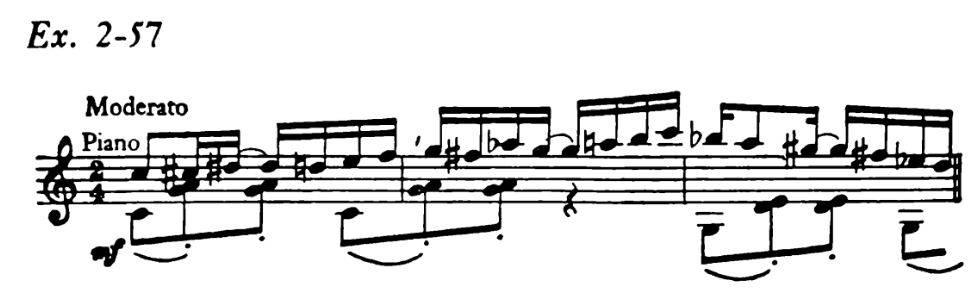
Another Persichetti prompted piano piece. This time the prompt was "24. Extend the following chromatically ornamented piano passage." The form ended up being ABACBA. Thanks for listening and I hope you enjoy and let me know what you think!
-
Fugue in d minor
Frederic Gill replied to Fermata's topic in Incomplete Works; Writer's Block and Suggestions
Here's my beginner's non-academic point of view (for what it is worth): @Fermata's Fugue in D minor sounds flawless and tasteful. The given motive is very interesting. It is rich in complexity, and intriguing because it feels 'incomplete'. It calls for contrasting complements. Also, is it suitable for a fugue where it has to be frequently repeated? It would be nice as a theme for a long development with less imitation. That's my personnal impression.