All Activity
- Past hour
-
Heya and thanks! Yeah I've been sitting on this for a bit now, I sort of had the earlier theme make its way too strongly into all new attempts at a new theme. I am not writing for a deadline so I am free to wait until inspiration hits again. Thanks for stopping by! Pyry from Finland.
-
This a very intriguing work ... I love the meter contrast and harmony. Introducing a new theme to contrast the first movement might be the way to go. The introductory material screams in its dystopian feel and needs conflict and then resolution. Mark
- Today
-
THIRD MOVEMENT!!! Just kidding; this doesn't make the cut! I wrote a little joke piece this morning. Maybe to keep myself from writing the third movement! Space Nerd Free Sheet Music by Outis for Piano/Keyboard | Noteflight
-
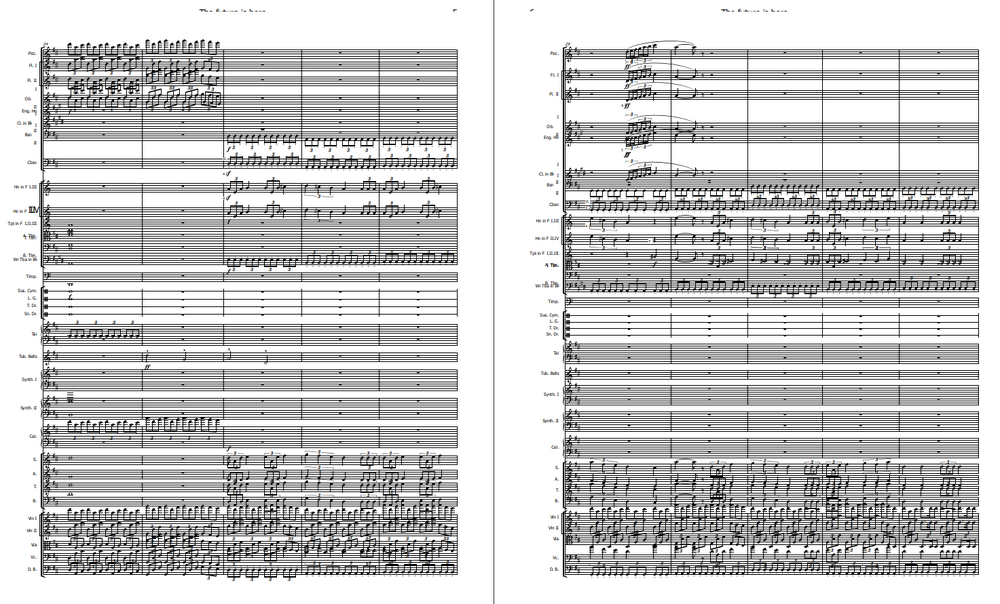
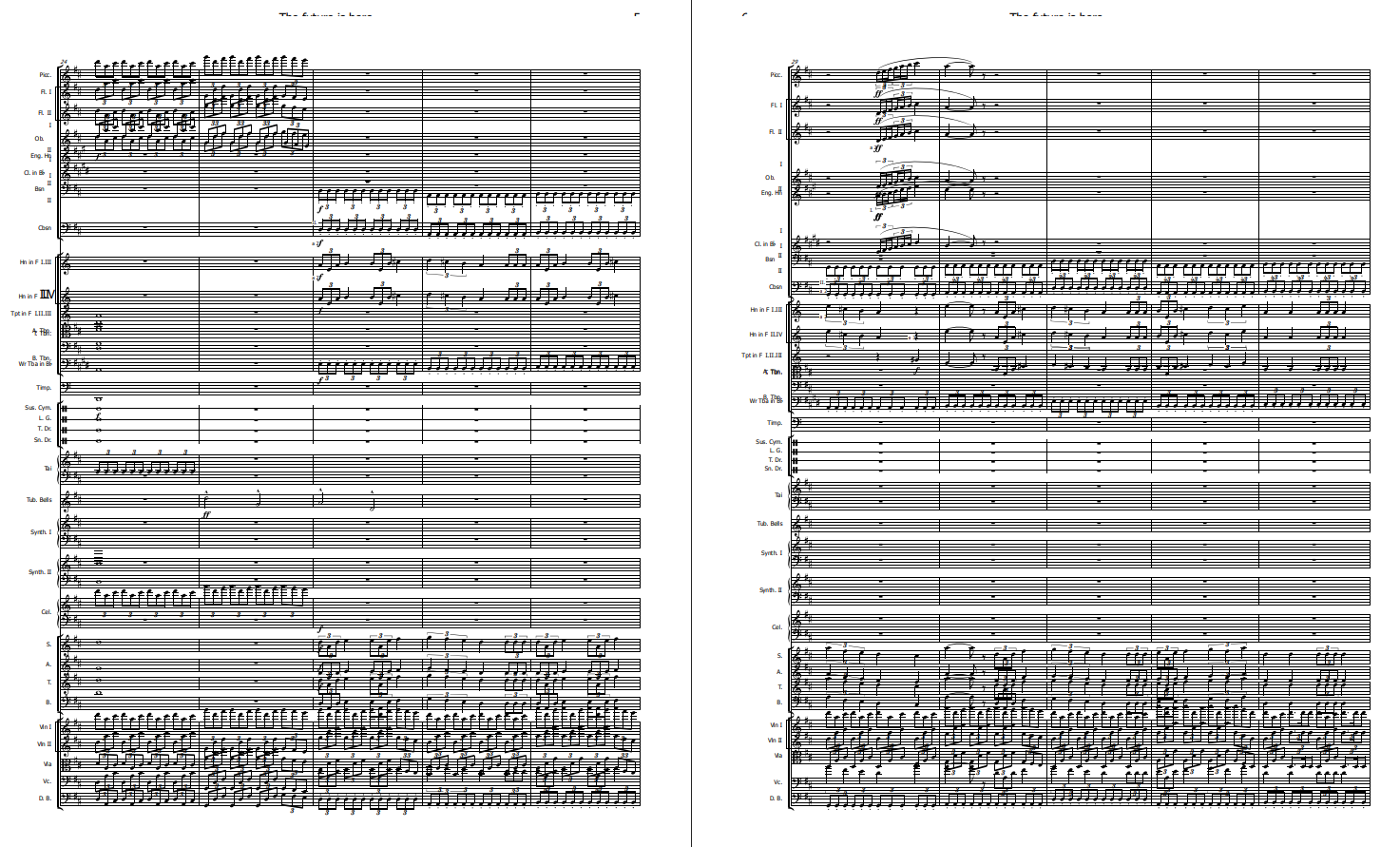
Hi there! I wanted to ask if you wanted any feedback on the work? It is very cool regardless of the time spent composing! As a brief comment, I am unsure if the score is meant to look this way: The staves are all stacked and combined on top of each other when you look at the PDF through the website. It makes it really hard to read/ process the score currently.
-
Hey Interlect! Interesting piece here; I will admit I have been seeing your increase in activity with a plethora of new submissions across the forum. However, I never see a score to look at with your music. I tried looking on your profile to see if you linked your scores elsewhere, but confess I did not find anything either. Can I ask how you go about creating these works? Do you make scores? Is this generated media instead?
-
-
Thanks for posting @Sebastian Guzman ! It's been a while since I've listened to the Liszt B minor Sonata, but I am definitely getting vibes of it here (most assuredly from your B-octave motif). Your musical language in this work does feel very Lisztian to me, which is inclusive of the harmony and the piano textures, and that I mostly do mean as a compliment. I'm curious to know what other influences/inspirations you may have had while writing this movement though, as some sections do seem to draw from other wells of musical ideas (e.g. the harmonic movements in b. 91-105 felt distinctly modern to me). I confess that I am not really in a position to offer super helpful advice but I hope you'll find this useful anyway. I also don't mean any suggestion as an attack on your writing, of course, but as an exchange of ideas that you could optionally disregard :) Exposition The B-octave motif is very reminiscent of one of the motifs in the B minor Sonata, haha. I see that the majority of the dotted rhythm in this motif is the backbone for the rhythm of the A theme, if I am correct... I noticed in your trimmed-down video you seemed to have cut out b. 54-62 from the A theme and b. 105-118 from the B theme? Admittedly, I prefer the abridged version as I thought the material in question to be a little redundant, given that you do cover well and to great length both themes in the exposition. My thematic economy side of my brain would like to think that one should only state a theme until the listener is familiar enough with it to recognise said theme when it pops up in the development. If you wanted to keep said material for symmetry/form-related reasons/other personal preferences, though, by all means do so. I do love the B theme in all of its mellow sweetness, especially its first half. The second half of the B theme feels a bit static with the repeated notes, but coupled with the rolling left hand accompaniment, it does give a sense of floating/gliding, if that is what you desired. As I said, I quite like the harmony you move through in b. 91-105. A charming change in texture from b. 154 onwards! Development The fugato start of the development seems a bit dry? I can see where you are going with the material but I'm not super convinced by b. 164-187, though I suppose some pedal would help, or varying the articulation and texture a tad more even if a fugato. I didn't quite exactly get fugato vibes from it either, given how long the statement of the theme is. This is completely a suggestion, of course, and it is up to you as to how you'd like your sonata to work, but perhaps using only the first phrase of the theme (b. 164-166) and then building up a series of entries in other voices could be rather effective. I somewhat find this example to also be a bit dry, but I like the energy build-up of this fugato moment in the development of the fourth movement of Scriabin's Third Sonata, if you wanted something similar. Interesting, from b. 178 onwards in the fugato, you introduce another voice that is the B theme, or at least an echo of it, if I'm correct? I am a big fan of juxtaposing thematic material in the development sections of sonatas, if so... The material in b. 196-215 seems a bit overly virtuosic? I'm uncertain whether there might be some significance in the chords/harmonies you use here, but I think it'd be great to insert more of the existing thematic material in here, fragmented or whatnot. Overall, the development feels short to me, not in the least because I feel like you could've pulled out your compositional chops a bit more. Given the length of the exposition, I think this deserves a heftier development with varied treatment and inclusion of all three of the A and B themes and the B-octave motif. Trying to set the tempestuous A theme or the B-octave motif into the suave atmosphere/mood of the B theme, for example, or more chopping and changing, there are a wide variety of things you could do. Liszt can of course be a great source of ideas here! Recap Nice to restate the B-octave theme. Maybe the transition from the end of the development could be made smoother? I'm not sure though. I like the recasting of the textures in the recap of the A theme, but it feels a little airy? I'm not sure if you were going for that feel, and if you were, then I am in no place to complain. I suppose you could add some deep bass notes on the offbeats to give it a bit more body and hold them with your regular pedal, or see if the sostenuto pedal could work (though it could make the right hand arpeggios rather dry). I also appreciate the A theme being a bit shorter here... With b. 236 onwards and B theme, the energy seems to drop somewhat, with almost the exact statement of the original B theme but transposed. It is once again up to you, but you could also recap the B theme in a different texture, as you did with the A theme. I felt like the energy levels ought to have ramped up a bit more moving further and further down to match the energy of b. 282 onwards to the coda, possibly? At the moment, the ending feels mildly content with itself, though I would think the large chords and dynamics would suggest otherwise. With notation and formatting, I also admit I'm not the best person to offer advice, but there does seem to be the occasional odd things, e.g. whatever is stretching out b. 122 (the rest in the upper staff can also be removed there), the clipping of text at the end of the system at b. 248-250, and the slightly overzealous floating slur in b. 288. I've been told that with hairpins, it's best practice to state exactly which dynamic the hairpin starts and ends at, including double hairpins like < so >, but I am open to corrections. Yeah, that's most of what I have to offer with thoughts. Excellent playing, by the way, I almost forgot to mention! This already looks like a difficult sonata so far with this first movement and you interpreted it very pleasingly, at least to my ears, and in a very convincing way (though I suppose it is up to the composer yourself to decide whether it was served justice, lol).
-
The future is here - Bjarke Tan - Flow 1.mp3The future is here score.pdf Here is a speed writing attempt made in one day.
-
As a chinese person, I appreciate your love for my motherland. Anyways, the music is atonal. I think that isn't the BEST way to describe this place. The structure is weird too. I liked the brief g major chord parts. Melodies Themes Motives 2 Harmony Chords Textures 1 Form Development Structure Time 7 Originality Creativity 10 Score Presentation 10 Instrumentation Orchestration Playability 8 Execution of Given Challenge 6 Taste 6 Average 7.5
-
Hi. Good job here! Weird bar 33. Otherwise perfect to me. That is rare to hear from me. Good job! Melodies Themes Motives 9 Harmony Chords Textures 10 Form Development Structure Time 9 Originality Creativity 10 Score Presentation 10 Instrumentation Orchestration Playability 10 Execution of Given Challenge 10 Taste 10 Average 9.75
-
Hiihiiii!!! This is my submission for the Spring 2026 Landscapes Competition :) For my landscape, I've chosen the mountains of Zhangjiajie, China. The first time that I saw these mountains, I was awestruck by just the sheer scale of them. Massive peaks and towers, overgrown with centuries-old moss, reaching beyond the clouds. Really just gorgeous. I wanted to try to write about them. The piece starts off zoomed outwards, depicting the sparseness of the clouds, until eventually, a melody begins to creep towards the first real theme--which I call the garden theme. The focus is on the garden now, zoomed in, it's a sort of natural oasis along the side of one of the tall mountainous pillar. It's beautiful, lush, full, until the garden begins to die as winter comes. The harmony because sparse and vague again, with large spontaneous gusts of wind... just very dry sounding overall. That is, until months later, the clouds darken, promising a heavy storm. Anticipation builds, until eventually, rain comes pouring down, so densely that it's almost like a wall. It's the first rain of spring!!! After the rain settles down, the garden comes to life again with the re-entry of the garden theme!! The piece ends as the focus zooms back out onto the clouds, and the tension finally resolves again. My goal with the piece was to try to represent the life cycle of the plant life out in the setting of Zhangjiajie. I hope you all like it !!!! AmidstTheCloudsAndFlowers.mp3 AmidstTheCloudsAndFlowers.pdf
 I have revised the program's workings considerably, to much improved effect. Here, have a fugue of sorts, a canon, and a miscellaneous piece.InstrumentalistElle changed their profile photoInstrumentalistElle joined the communityThis is a simple expression of hope. Spring - Spring.mp3 Spring.pdfBeautiful Renaissance Style Writing. Really intriguing and fun to follow. Although this next request unstylistic, I can't help but wish for articulations, and dynamics. I know blasphemy, but consider this is a "MIDI audio" competition (basically). I think secretly adding some articulations and dynamics would add and extra layer of interest.PeterthePapercomPoser replied to PeterthePapercomPoser's topic in Announcements and Technical ProblemsThought I'd throw out some more ideas: "Concrete Jungle Award" "Terra Firma Award" "Perspective from the Peak Award" If you have any more ideas don't hesitate to suggest! Or if you're already composing something for the competition and want to tailor an award for your particular landscape idea, feel free to suggest that too!
- Yesterday
bobn joined the communityWow! I actually think this piece has many qualities that make it a convincing imitation of this french baroque style, so overall, very well done. Some things I want to praise is your use of ornamentation, the tempo and time signature changes in the Passacailles, solid structure, your use of the same dotted rhythmic motive throughout both movements, and occasional, but functional dissonance. There are some sections in your piece where I think that, despite this "lute" style of French Baroque you are going for, even in the non lute sections, some of the intervals are too wide (like E4 to Bb5), to the point that even if they could be rolled, or even shared by both hands, they could be slightly unidiomatic, especially with all of the ornaments going on and the different voices, so just something to think about. Another thing I want to mention, is the lack of articulation. Sure, you have ornaments, but surprisingly, as opposed to Bach's music and other baroque composers, this is actually pretty common for the French Baroque tradition, leaving it up to the performers. Overall, I think this is a great imitation, I think you did a wonderful job on this experiment, and I look forward to see where you take this piece moving on!It has finally happened. I've reached a point where I'm good enough at mixing that I had to go back and delete all my uploads to the instanets and replace them with better-quality versions of themselves. I owe this to the fact that I've developed a couple of programs that process sound files, tweaking the loudnesses of sine wave partials and repositioning these sine waves in stereo space to make for clarity and balance. I also downloaded a program that fixes instrument mistuning. Mistuning is a near-universal fact in music, with almost all instruments possessing small or even highly noticeable deviations from proper 12-tone equal temperament. The program I downloaded fixes this issue. Taken together, these three factors--loudness tweaking, respositioning sounds in stereo space, and fixing mistuning--have taken the quality of my music to a substantially higher level (I'm particularly pleased with the tweaking of sine wave positions in stereo space, as the idea behind it is highly original and yields interesting, results; for example, instruments can frequently be heard moving or teleporting across the stereo field in an effort to find their ideal positions). Below are a few pieces that make use of this new technology I've acquired.At the request of one of my subscribers, I decided to try my hand at writing a passacaglia emulating the style of French Baroque composer François Couperin. While both my research and efforts may have proven relatively insufficient in convincingly imitating most of the intricacies found within his keyboard style to the fullest extent, I am nontheless pleased with the results of this little experiment. This work is supposed to be understood as a two-part ouverture as a whole: the first movement is comprised by a prelude riddled with double-dotted rhythmic figures very much intentionally reminiscent of other French Baroque ouvertures, specially those of Jean Baptiste Lully. The passacaille itself follows a strict repetition of the same harmonic baseline throughout the first two variations, which is then slightly altered in a kind of quodlibet by non-strict canonic imitation reaching up to 4 voices, followed by a coda almost identical to the last phrase of the prelude. Thankfully I finally found a way to switch between soundbanks of my harpsichord soundfont automatically amidst playback, which in turn allowed me to include various registers of the instrument across diverse sections of the piece, namely three: Grand Jeu (literally translatable from French as "Great Game": I 4' 8' II 8'), Petit Jeu ("Little Game": I 4' II 8') and Luth (the lute register, also commonly known as a compound buff stop: I 4' Lute II 8'). YouTube scrolling video link: French Ouverture - Prelude and Passacaille in F minor.mp3 French Ouverture - Prelude and Passacaille in F minor.pdfThanks man, I shall indeed!Chemathmusician0510 replied to therealAJGS's topic in Incomplete Works; Writer's Block and Suggestionsmodes are awesome for this ambient feel. make the chords blend into each other maj7 and min7 chords slow chord changes but harmonically diverse widely spaced but overtone rich timbres work pretty well for background kind- Last week
Hello Folks, I'm glad to be showing a little bit more music for you all. Today I'm showing a piece I wrote a while ago, but never planned on showing because Musescore can't perform it. But I recently upgraded significantly to SWAM instruments. Much less lush but more controllable, this piece was the first I wanted to do because of it's intimate feeling, and use of overtones and unusual techniques.. This piece is meant to reflect my experience of grief, specifically, the kind that surfaces while I’m trying to fall asleep. On some nights, like the one that inspired this piece, sleep feels impossible. Stress, homework, expectations—they all build up, one on top of the other, and under their weight, grief begins to surface. Suddenly, my thoughts are filled with loss. It’s not painful exactly, nor is it something I want to erase. But it carries a quiet melancholy, releasing the sadness, anger, and tension I’ve accumulated over time. In a strange way, this grief becomes a kind of relief. A way to let go of everything I’ve been holding in. Still, it lingers. It loops in my mind. Eventually, I have to let it go so I can rest. I have to keep living. I can’t stay immersed in sorrow forever. So I walk along the river, letting the sounds of the water drown out my thoughts. I walk until my legs are sore, until exhaustion replaces emotion. Then I go home, lie down, and finally sleep—my grief forgotten, at least for the night. Also this piece was one of the few I actually (somewhat) planned ahead. This is what I had planned "Walk to forget Bass Clarinet, Alto Saxophone, 1 Percussion, Violin, Viola, Violoncello. This piece is intended to in some way, describe my experience of grief, specifically while trying to fall asleep. Some nights, like the night this piece is based off of, I struggle to fall asleep. Stress, homework, expectations, all pile on top of each other, and this pressure releases grief. Suddenly my mind is occupied by grief and loss. It’s not painful, or something I want to forget. But it’s melancholic, it releases the sadness, anger, and stress I’ve felt over time. This grief is actually a chance to release all my struggles. But it goes on and on. At some point, I must forget my grief again, so I may sleep. I must go on with my life, and cannot wallow in my grief. So I walk along the river, till the sounds swallow my mind. I walk until my legs are tired and that’s all I can think about. So I go home, go to bed, and have forgotten my grief, and everything that caused it, and sleep. So how do I convey this in a piece of music? I need a theme/motif for grief: I imagine something in the alto saxophone. I think introducing it with a poking/prodding motive, like a repeated note, taken from instrument to instrument. An idea that represents the stress of life, poking my brain to the edge. This I’m not sure will work with the time constraint, and I may just begin at the next part. Then a swell and complete change to the grief motive. In this context, I imagine something legato and sostenuto, non-triatic and lacking “home”. I think the alto saxophone should appear in the high register for the first time, everyone should be in a higher register than before, which might make the prodding motive earlier less effective, but this grief motive more effective. The grief motive must have a rhythmic element to it, so that it is recognizable as key centers change, and the pitches can be moved around functionally, to allow moments of tonal beauty amongst the quartel nature of the motive. There also needs to be a nature element, an ostinato to represent walking, and getting distracted by the wind, the stars, the river. The grief motive slowly becomes less and less present until it is taken over by the nature motives. Then we sleep. A meditative ending." Walk.mp3 Izaak Thoms Walk Final.pdf











.thumb.png.8b5b433a341551e913a34392660bc95b.png)