
All Activity
Past hour
-
Today
-
An interesting question. I think that, nowadays (or for the past few decades or so), even as a professional composer, it is almost impossible to develop a unique, new and personal style. I believe very few in history were like that. Bach, Wagner, Debussy, Schönberg… in the 20th century there are perhaps more: John Cage, Messiaen, Bartók… But there are other composers of equal or greater calibre who did not introduce ‘revolutionary’ new ideas, yet who took the music that was developing at the time and made it evolve and grow. These composers also have highly recognisable personal styles (Mozart, Beethoven, Verdi, Puccini, Brahms, Chopin, and many more). We currently face a ‘problem’: we are familiar with a vast number of musical languages and systems that emerged in the 20th century, and there are many of them. I believe that, nowadays, a composer must be eclectic and must be familiar with as many musical languages as possible, drawing from each the elements that suit them at any given moment. The ability to combine all of this is a sign of a composer’s maturity. Very often, we stick very closely to a particular style, or even a particular composer, and write pieces by imitating them as best we can. That’s fine, but I don’t think that amounts to developing one’s own style. I see it as absolutely necessary, especially for learning purposes. Regarding the second point you raise. It’s true, there are a great many widely used techniques and other things that software programmes cannot do. Although they are gradually incorporating them. Of course, I can’t see a DAW or an editor handling random elements. The notation for this has been sorted out, but the software-based performance cannot be random.
-
When it comes to personal style, as a composer, it is hard to describe what that style would be. Yes, I compose ensemble pieces (rather solo or chamber) or full orchestra, too. However, period style is not going to be same. The term best fits me is "polystylist". This means I could possibly write in different styles. For instance, my Halloween piece was written for string quartet but the style 20th century. (note; I could have written a serialism written for that competition...). Currently, I working piece that sounds neo classical for the next competition. Joe Hirashi was the inspiration for the piece. My personal taste is open book. Heck. George Leigti works are always fun to listen to. And who does not want to listen a post tonal composition that has clusters and other modern jazz. :) The problem is...midi can not play back alerotical boxes and clusters. Only live musicians can. Thus, that is what trying figure out, next. How to have play back in score. (maybe use a daw?)
-
I doubt you'll get much of response to your post, primarily because of the INDOCTRINATION taught by schools and possible University's too. However,once you've had enough of that DOGMA , you start to "FORM YOUR OWN IDENTITY" which of course will be Obliterated by the masses . "You must Conform". Music that can create EMOTIONS | Urgency - Terror - Fear | & | Euphoria - Joy - Charisma | will stand a much better chance of being remembered and Respected. This is just my opinion you don't have to agree with it, and i doubt if the majority will. An example of a "SOUND" that caught my attention as a Child.

-
This is genuinely creepy! I love the lofi mixed with the distortion, soundscapes and panning. And those scraping sounds.......this belongs in a horror or thriller. Great crescendo at the end.
-
tyti-whoa joined the community
-
jmsnaks joined the community
-
It has recently come to my attention how some composers approach their music-making very technically - labeling chords, roman numerals, showing modulations etc. But this kind of approach is very much the opposite of how I write music. I studied all those technical aspects of music as well of course. But how I make music now is very much based on my gut feelings and intuition rather than technical rules. I am still tangentially aware of all those technical aspects of my compositions of course. But inspiration, for me, comes first and the technical understanding, after. How do you approach composition? Which approach do you value more? Technique or Intuition? Which comes first and which is secondary?
Yesterday
-
-
Hello @tymeomm Below you will find my review of your 1st movement. Slow introduction: If the viola is carrying the theme, then the harmony has to be above that. Ergo, instead of having 1st and 2nd at the same register as the viola. They need to be at higher register. Possibly starting G4-G6 could work. Not to high or it would the violins would not match the timbre of the viola. Also, you need to ensure, you have chord members between parts. :) I know some of these stops could possible. But i am not sure but others. One thing to take caution: beware of writing parts that come across that appear as div. (see b3 and b4)! The tonal sequence from the viola part is wonder. It is wonderful theme. Transition: I feel that you could built more momentum if could continued the sequence from the introduction with scalar passages while bass has that pattern either play pizz or another tech. Exposition: I am sure about the different tempo that occur throughout. Typically, you want to stay with one tempo, especially in the classical-romantic period. In the 20th century, where music was atonal, then it was more acceptable to use either change meters and/or tempos. Great use of borrowing material from the intro to create your musical theme for the exposition. The PT is well structured. At 87-88 that is cool effect how 2nd plays above 1st violin. That creates interesting color with in the ensemble. :) The MC lands nicely after the transition. However, I do not think you need what comes after that. A great solution is either pause after it then start the second theme or start theme right after it. Development: This section is written well, I think. Recap is solid, too.
-
Right. I’ve always thought that, from our current perspective, it’s great to be familiar with all kinds of earlier systems and languages, including, of course, those of the 20th and 21st centuries. And that these foundations can be used however one wishes. Sometimes it’s good to try writing in the style of Mozart, or Debussy, or Webern, and so on… Especially when you’re learning. But when it comes to composing, I think you have to give free rein to your creativity and use elements from the systems that resonate with you at that moment. Lately, I’ve been delving a bit deeper into Stravinsky’s rotational matrices from his later period, and I find them fascinating, so I’ve incorporated them into some of the pieces I’m working on. Best regards.
-
Thx im really glad you enjoyed the piece. Yea i think im just overly cautious about making my composition the nest it can be which includes readability. Also this isnt my first 12 tone piece ive written several and id consider myself a 12 tone composer. Yes I do break certain guidelines as I let my ear guide me as I compose and structure the piece on the piano. I recently composed a piano piece which is more traditional, influenced by Webern, and Dallapiccola.
-
Hello I’d like to comment on the first piece. I think it’s a very interesting, beautiful and original work. The impression I get is that in some parts it’s as if you had two separate works (the choir and the string quartet). In the first section (which is then repeated), some of the lines played by first and second violins become very active and chromatic, and either get a bit lost, or I don’t feel they quite fit together. I think section B is more balanced in that respect, as the strings tend to underline or accentuate the melody more.
-
Hello Firstly, I’d like to say that I think it’s a brilliant piece and I’ve really enjoyed it. I’m just as drawn to modern languages as I am to the classical ones. As for the notation you’ve suggested, I think it’s fine as it is. In this context, as long as it’s clear, whether or not there are enharmonic alterations is a secondary consideration. I’m not sure what your intention was with this piece – whether it was to draw closer to the style of expression of that Second Viennese School, or rather to use a highly chromatic language in your own way. I say this because, although the absence of stable tonal centres is evident, the way this quintet is written departs from the typical characteristics of expressionism. Things that I believe are not characteristic (and I’m not saying this is either better or worse): the use of ‘homophony’, of several parallel lines—some doubled, others at different intervals. Expressionism, when it employs chamber ensembles, is essentially contrapuntal and pointillistic. There are sections that have that effect to a greater extent. Composing within this system is by no means easy. Many people think you simply take a twelve-tone row or whatever and start placing notes, inverted rows, retrograde rows and so on… But no. The tricky bit is mastering the language to the point where you know exactly what you’re doing, primarily to control the moments of tension and release. Furthermore, cadences – not understood in terms of the functional tonal system – are also important.
-
Hi @Martynas123 ! You expand each phrase of the Diabelli Waltz with different variations so it's not just one variation there! I would rather use each of the element for one whole variation instead of using 3 different elements in the same variation. Thx for sharing. Henry
-
Hi @elmarad40 ! It does sound chaotic and dark to me esp. with the vocal line. I would want the ending to be more affirmatively dark instead of just ending halfway in D minor, probably 1 more climax before ending with an affirmative perfect cadence in D minor. Thx for sharing. Henry
-
Hi @MinGry ! I will continue with my comment. In the 2nd mov, there's the same issue with modulation as in 1st mov, which is you don't have the dominant preparation for the new C major before getting into the key in b.15, as mere repetition of a key doesn't signify the modulation. The harmonic progression for b.16-23 is I-V-IV and then back to I, which is not in the style with the V followed by IV. The IV will be better substitued by a ii-V. For the 3rd mov, the rhythmic drive is nice. B.12-15's bassline and b.68-69 RH have too many parallel fifths which will be out of style. The contrasting G major passage can end in perfect cadence before going back to tonic C major. Thx for sharing! Henry
-
Hi everyone, This composition that i present here is small in duration 1:30 minutes. It is called "Spiral Into Darkness". It is based on a new composition that i wrote firstly in the piano. It has many dark themes and melodies, which with the usage of choirs sound ethereal and otherworldy. There is also usage of percussion in an avant-garde sense. You can imagine a dark passage with a spiral staircase leading to lower and lower parts, which reflect the inner fields of the listener. I would like to hear about your opinions about it and your reviews. Spiral Into Darkness Thank you, Lampros Marantos
-
I've also read from several orchestration books that the lowest register of a double reed instrument including oboe, English Horn and Bassoon are all more difficult to control, and it's much more difficult to play lower than mp in the low register. Given the ethereal mood of the piece I agree with your treatment to use English Horn instead of 2nd oboe. Also I think it's quite common to have at least 1 Englisn Horn in every orchestra so I think that won't be a big problem in practice. Henry
-
Hi Mark, I always used to write lots of material for low oboe; but have had it repeatedly drummed into me that I should use English horn instead. So it's interesting you disagree. There seems to be a very widely held view that the lowest notes on the oboe are too obtrusive, especially in the hands of an amateur musician. I've heard this from the conductor of the orchestra I work with, as well as my tutor, and a bunch of other composers. Anyhow, I'll bear in mind what you say for the future. Alex.
-
arcaturne joined the community
-
-
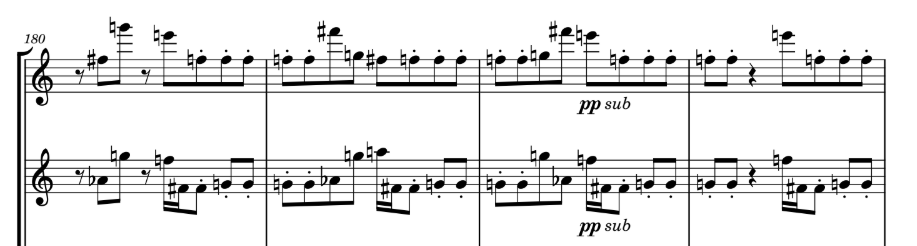
Sorry - I was confused - I thought the score you provided was a concert pitch score. It seems your mp3 has more material than the score does - are these the beginnings of a 2nd movement? There's some more things concerning articulation that I noticed like for example here: I think the notes that aren't staccato in the above passage should definitely be slurred for clarity of performance - otherwise, in sight-reading that's something that would be easy to miss. I know you include legato and slurs in many other places throughout the piece so I'm puzzled why you forgot them here. Yes - I totally agree there. I was mistaken in my whole discussion before as I was reading the score as a concert pitch score. Musically speaking my only critique is that, since the whole piece is at the same tempo, there aren't any changes in character within the duration of the piece. The whole piece comes across as a sort of 12-tone invention with many recurring and recognizable rhythmic and melodic motifs. It is interesting as that, but I think it could be so much more if there were changes of character for each different motif. I enjoyed listening nonetheless and thanks for sharing the recording!
-
-
-
Hi thx for the feedback, we usually try and avoid B#, and especially FX. Ik the 2nd Vietnamese school used them but ive been told by my Prpfessors not to use those spellings. Also yes the piece does have some tonal moments, but that's more for color. So i try nt to base spelling on the horizontal movement but the vertical. There's two many parts where id be making weird spelling choices if I did that. As for the piece being transposed I thought thats how the players read the parts? I do also have a C score obviously. Also heres the musescore mockup audio if u wanna hear it, like I said its done. Gentle Winds mp3
-
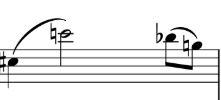
Hi @Rafael Avila ! First off, I don't know if it is customary to use a transposed score for serial works. Perhaps due to the dissonant textures and lack of key center it is preferrable to a transposed score? I personally prefer transposed scores because then you see exactly what the player sees and the logic of the enharmonics is different and customized. Btw, would you provide an mp3 of the piece as well? I've noticed from the score that some parts of it might even be perceived as tonal. Now to picking at the enharmonics. In measure 3 you have the flute playing this: Since you have a leap here of a major 7th I would spell the notes in this measure as C#, B#, A#, Fx. And since the part continues in the next measure to D# and B it makes more sense (to me) to continue using sharps here. You might think that since the harmony underneath that is basically D minor, that using your spellings would be more logical in that context. That could be true, and I wouldn't blame you for keeping it the way you have it now. But it also depends on how devoid of key the piece actually is. Is this just a short moment of quasi-tonality in the midst of atonal surroundings? Or do various key centers actually play a part in the piece and how it will be perceived by the listener? On a cursory glance at just the beginning of the score it doesn't seem particular dissonant or atonal and uses lots of consonances and octave doublings. Like I said, I am no 12-tone serial connoisseur but this seems like a no-no for a serial work. Basically - if the piece is tonal here and there, adhere to tonal voice-leading rules in those situations. But if the piece is more devoid of a tonal center then spell the pitches as logically as possible within each individual voice regardless of what the other voices are doing in a sense. That's how I would do it. Thanks for sharing and I'd be stoked to hear this piece!
-
My reason for using the English horn, is that oboes can sound quite harsh and intrusive in their low range. A bit like a duck! So I thought an English horn would have a more pleasant timbre in that range. Alex this really is a misunderstanding of how an Oboe works! Let's throw out the meme about DUCKS! The lower range/register can be as beautiful as the upper range. (just ask Dvorak). The English horn in this orchestration will not add too much. It does not have the penetration ... it is better used a solo instrument or in a small ensemble. Please no more duck jokes! Mark







.thumb.png.8b5b433a341551e913a34392660bc95b.png)