All Activity
- Past hour
-

Experimental piano duet
Alant replied to Alant's topic in Incomplete Works; Writer's Block and Suggestions
Here is a revised and extended version of this experimental piano duet as well as the score (it ends at measure 99). All feedback is appreciated - Today
-
To anyone still following this post, I made a new fresh one here. It has the link to the music; would you please provide me some feedback?
-
.thumb.jpg.a1bd070fa88caa1c83527ffe77c97a41.jpg)
I'm beginning to write a small oratorio
Cafebabe replied to Cafebabe's topic in Orchestral and Large Ensemble
Thanks for the thoughtful feedback -
I'm beginning to write a small oratorio
Cafebabe replied to Cafebabe's topic in Orchestral and Large Ensemble
Ah, I didn’t catch the reference at first, so your comment felt out of the blue and a little like mocking tbh. Now it makes sense. Rather creative -

I'm beginning to write a small oratorio
JP S. replied to Cafebabe's topic in Orchestral and Large Ensemble
Did you get the joke? Your title reminded me of “It’s beginning to look a lot like Christmas,” so I wrote a small parody. -
@Vonias I don’t think anyone mentioned this, but it looks to me like you made the initial score in MuseScore (the font looks similar, and you wrote it on a “piano”). I noticed because you talked about the aeuouae, and it seemed you tried putting that in a descant and had trouble with the ai “replicating it.” Then you input that into Suno trying to get a close audio rendering of it (you said 100% audio input), and it gave you something similar, and that produced the second score which was rhythmically correct with the audio and had correct parts (SATB and Organ). This corrects any notion that he completely used ai, and didn’t use any compositional skill. @AngelCityOutlaw I was mostly commenting to try to help you with the vowels. As a Catholic who sang chant, the “aeuouae” are actually the last vowels of the words saeculorum amen. Almost every chant ended with the “Glory to the Father and to the Son and to the Holy Spirit…” prayer, of which the final words are “forever and ever, amen,” or “saecula saeculorum amen.” It would be different from the tradition to try to use those vowels as a descant apart from the words, or those two words apart from ending the song with the whole prayer (starting with Gloria Patri). The later choral tradition was just to end pieces with a longer, flowery “Amen,” so you could try that:) Cheers, and happy composing.
-

Poll concerning AI sub-forum
Monarcheon replied to PeterthePapercomPoser's topic in Announcements and Technical Problems
Although I hold that AI music is still technically music, however unethically created it is, AI music is certainly not composed. It's more so generated, and this site is arguably about the composition of music, not the music itself (although, it seems that many users haven't grasped this). For that reason, my mind is most open to being changed on Question 2. Currently, I've selected the second option—creating a sub-forum and barring AI submissions to be entered into competitions—but if someone was to push hard for banning all AI music on account of it being against the spirit of being a composer, then it's not like I'm gonna push back too hard. However, I'm sympathetic to the idea that AI is here and will be here for a while, if not permanently, so banning it outright feels a little close-minded when there's still things to be learned from it (more socially and economically than practically), just not strictly composition. I'm seeing a lot of exceptions being made for vocals/SFX creation after something has been written and making rules that are clear and foolproof to distinguish that is going to be hell, but I think it's better to have the word of another person as to the extent AI was used rather than just trying to use an AI checker or a filter. As pointed out before, those things are really murky and spotty. I don't really care about the “emotions” behind it, because—let's be real—tons of music gets written for a paycheck with no emotion or humanity. That's not a measurable quality, as far as I'm concerned. I also don't really care about the amount of effort or time put into a piece; some things are just easier for different people. As for feedback, have you seen Google AI? It could tell me the sky is blue and I'd look out my window to go check. No way in hell is that level of intelligence going to have reasonable critiques beyond just telling me what Roman numerals are being used, which isn't analysis in the first place. -
fantasia on jingle bells (2025 Christmas Music Event Submission)
Monarcheon replied to Monarcheon's topic in Chamber Music
@chopin Glad you liked it! Yeah, the whispers of the old theme coming back was a really captivating idea for me, but the best part is that I'm sure another talented analyst could analyze it in a completely different way than I did! @Luis Hernández Thank you! @Thatguy v2.0 Nonsense, the fact that you're able to even listen to it—let alone enjoy it—means that you're worth your salt! And yes, it's why I have so much solo cello rep... I can actually play it. 🙂 @Wieland Handke Thank you so much, that's a great image! And wonderfully wholesome for something that be construed as being so eerie. My respects and humble thanks to all of you! -
I'm beginning to write a small oratorio
Monarcheon replied to Cafebabe's topic in Orchestral and Large Ensemble
Hey, this is great and has a lot of potential; I hope you keep writing! Lots of very cool moments and bits like the way you harmonize the very first “Shew me thy ways, O Lord”; vii˚7/vi–vi? How cool is that, especially since it's a lot more harmonically standard the second time around. I'll mainly focus here on “Shew me...” since it's a little easier to parse the score quickly: 1. m. 5's two-beat long semitonal dissonance is already striking enough, but having the suspension resolve upwards is even more noticeable. Not a strict problem, per se; it's just maybe a little overly noticeable. 2. m. 7, V7 without the third except in an ornamental figure, approached by 4-5 motion in first species. 3. mm. 8–9, “Shew“ is three quarter notes for a one-syllable word. There's a couple other measures where you have one syllable sung on repeated notes. 4. m. 11, unnecessary whole rest break in V1. 5. mm. 14, 17 & 22, similar issue to Point 2. Also, unnecessary breaking of the quarter rest in vocalist's part in m. 14. 6. m. 26, “O Lord” breaks the more natural setting of the scansion you had in mm. 10–11. 7. Keep “teach” as one word spelled correctly (don't double the “e”). 8. I would add some bowings; some are great, like the one you have in m. 13 in V2, but take a little time to make sure that the most natural style (down bow at the beginning of the measure, especially with all of these quarter notes) is preserved unless marked otherwise. Of course, Points 2 and 4 can be fixed with a continuo part with figures; I heard it in the background, but it just seemed to double the celli and bassi. Again, it's exciting to see where this could go! Solid start! -
Thank you all for your feedback. I have nothing to disagree with, and I will certainly put the tips into practice if I ever rework on the piece.
-
I'm beginning to write a small oratorio
Cafebabe replied to Cafebabe's topic in Orchestral and Large Ensemble
there are* -
I'm beginning to write a small oratorio
JP S. replied to Cafebabe's topic in Orchestral and Large Ensemble
“I’m beginning to write a small oratorio, Everywhere there’s notes! Take a look at the fifths and tenths, some intervals are immense, At half past three my laptop screen’s aglow!” -
I created a program that is intended to remix audio so that every sine wave component in every harmony that occurs in it is ideally panned and ideally loud. It makes use of the Fletcher Munson equal loudness curve, among other things. Here's a little remix of J.S. Bach's organ sonata that I generated to test it out. There is one small imperfection in its functionality that I can't really do anything about because there isn't any precise scientific data of the kind I'm looking for on the human perception of panning. It still produces pretty good results:
-
I'm curious how quaternions were used to generate this. I assume by a, b, c, and d, you mean the coefficients in a + bi + cj + dk, but I don't understand how thinking of this as a quaternion, as opposed to just a set of four values, is relevant to the composition process.
- Yesterday
-
Thank you for sharing this wonderful Prelude-and-Fugue piece. Since I also compose preludes and fugues, I am very excited and interested in reviewing such a pair. And indeed, I really enjoyed it and have now a few thoughts or comments which are not to be considered as „criticism“, but rather intended as an advice or idea how this beautiful piece could be improved further and finally made „great“: When listening to the prelude for the first time, I clearly recognized the Baroque style of a French overture with its double dots and 32nd runs, but there were something stylistic that differed from a typical Baroque and counterpuntual piece. Now, after listening multiple times and with the help of the other comments, I figured out that this is due to the repetition of measures 1-14 in bars 15-27, which means that up to this point there is no real modulation away from the tonic G minor. There is nothing wrong with it, but I would agree with the suggestions of @muchen_ and @Willibald to possibly change something concerning the modulation and recurrection of the material, also with respect that usually the prelude is not longer than its fugue. The fugue subject is very memorable and expressive, I especially love the „wedge-like“ ending in mm. 68, which, in my opinion, implies that the theme should not end with the first eighth note in bar 68, but should extend over the entire four bars. In the comes in bar 72, you have already quoted the “wedge,” even though this bar is a variation of the original, while in the third entry in bar 76, the “wedge” is completely lost, which I regret. In measures 80-85, 87-95, and 96-103, you have created three (or even four) sections with sequences based on different contrapuntal material—for example, quotations or parts of the theme—which would be perfect as interludes or episodes between further development (or exposition) sections of the fugue theme. And that is exactly what I would like to see: at least two further developments of the excellent fugue subject. I also could imagine a coda with a pedal point and perhaps a recurrection of the 32nd notes texture from the prelude as ending climax! With this in mind – to shorten the prelude and to extend or „complete“ the fugue – your piece could become a marvellous pair – Prelude and Fugue in G minor!
-
Daybliss.mid Daybliss.mid
-
Heyo! This came to me immediately when I saw the Marian Grotto when I was back at my Catholic college. Could you please let me know especially if the piano part could use any work, or if you think there’s a musically fitting way to reduce the range of the song? Also, is it ever too simple/boring/slow? The first video is of the whole arrangement, and the second has strings backing the melody so you can hear what it’s meant to sound like especially in the low range. Ave Maria Full https://youtu.be/Ei65cgc0m68 Ave Maria w/ Strings https://youtu.be/Z0t9bLS4dJA
-
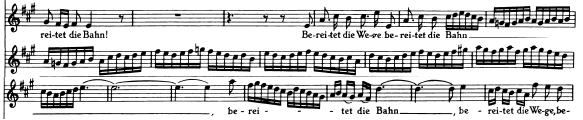
I forgot to add this last time, but I thought of this (infamous) aria when the breathing problem was mentioned. In addition, for historical reasons, this cantata is usually transposed up a semitone as opposed to down. Just look at the tessitura of this melisma! Bach must've really hated the poor soprano who had to sing this...
-
 Happy New Year to all! For my first post of 2026, here's my orchestration of Medelssohn's Barcarolle from Songs Without Words. It's more or less done; though I may add more dynamics to match the original piano work, and need to add more slurs. Current dynamics are intended for midi playback: so I will be adjusting those for real life performance. Haven't decided where to mark a2 and solo in the winds: so any tips on that would be really helpful.
-
- 1
-

-
 Still need you guys’ and gals’ opinion! Henry
 -
A short Sonata in D Major for Cembalo
Henry Ng Tsz Kiu replied to Willibald's topic in Piano Music, Solo Keyboard
Hi @Willibald! I just check out the 4th movement and it’s a lively nice rondo, I like your B minor episode inviting some contrast. Thx for your update! Henry -
Prelude & Fugue in G Minor
Henry Ng Tsz Kiu replied to Cafebabe's topic in Piano Music, Solo Keyboard
Hi @Cafebabe, I like the recurring March like turn figure in your prelude, it reminds of the D major fugue in WTC I. For the fugue, nice Dido and Aeneas like subject. If you are writing in Baroque style, usually the 3rd entry of the subject (in b.73) will be in tonic G minor instead of dominant D minor. I agree with @Willibald that there can be more appearances of the fugue subject, and to me especially there should be more appearances of the subject in the tonic G minor! Good counterpoint throughout though. Thx for sharing! Henry -
Sonata for Piano and Alto Saxophone
Henry Ng Tsz Kiu replied to mercurypickles's topic in Chamber Music
Hi @mercurypickles! For the first movement even without reading your description (I haven’t) it sounds so Brahmsian with the 2 against 3 and the Brahmsian Scherzo section, as well as the thick and more contrapuntal texture. It can well be a Clarinet Sonata if the saxophone is played with a Clarinet! (I’m thinking of Brahms’s 2 late Clarinet sonatas.) I really like the Scherzo sections with its energy. For the 2nd movement again both Schumannesque and Brahmsian, and b.28 even reminds me of Chopin’s Polonaise Fantasy where he has a similar figuration. The 3rd movement is exciting and I love the complex rhythm as you say the most. For me both fugues are more rhythmic than contrapuntal because there’s at a least a voice playing the ostinato instead of individual voices, but that doesn’t undermine it given how complex the rhythm is! Thx for sharing! Henry- 1 reply
-
- 1
-
-
Hi @Kvothe! The waltz is fine and I think you can add a contrasting section to it, probably in a major key or something. Also the false relation in b.12 sounds a bit harsh in this context to me. Thx for sharing! Henry
-
Thanks for sharing this prelude and fugue, both of them a joy to listen to. The beginning of the prelude is especially very charming. However, the passage in m. 12 and 13 (and similar ones) with those notes of different length tied to semidemiquavers in both hands running in parallel seems difficult to play, especially to get the timing right, but I am a rather bad pianist. After the cadence in m. 14/15, the verbatim repetition in m. 15-27 is not that unusual, but would have been easier to notate with a repeat sign. The following passage brings finally the modulation everyone is waiting for (you could try and modulate already in the first part of the prelude; it increases momentum as the prelude then has to find a way back) 😉 , and with it some harsh harmonies which you handle tastefully. At the end, for a short moment it sounds like the opening phrase would come back in d minor, but in a clever move, we are disappointed; the return of g minor is, however, a bit too surprising for my taste; a e.g. "motivo di cadenza" or a similar adapted cadence could be used to flesh this more out. The fugue has a good and versatile subject and I just identified three full instances of the subject (m. 65, m. 69, m. 73) and two partial ones (m. 77, m. 93); it would have been nice to have fewer instances of the sequences and more instances of the subject. But of course this is a well composed fugue, so this is more a matter of one's preferences.