All Activity
Past hour
-
Hello, @jejrekmek! It seems no one has commented yet, I wonder why. I find this track really interesting; the unique atmosphere is fantastic. Your exploration of rhythm is excellent, and I love the chaotic vibe, reminiscent of Igorrr, as well as your sense for harmony (I noticed you used some intriguing chords in your other piano pieces, too). The way the song unfolds is unpredictable as well. I see from your profile that you're around 18 years old? It’s really amazing that you’re creating such an original atmosphere at that age. To be honest, regardless of age, I don't think it's something just anyone can do. At least, I can't. However, there is one point that stood out to me: the mix feels a bit rough around the edges. I’m not exactly good at mixing myself, but let me share my impressions as a listener. Upon first listen, the volume felt too high, and the vocals were getting buried by the instruments, making it difficult to clearly hear the melody and individual instrumental parts. Personally, I think adding a bit more reverb to the vocals or positioning them more three-dimensionally within the mix would help. You might already be aware of this, but how about using plugins like "DearVR pro2" to position the sound more precisely? Instead of relying on extreme panning (left/right placement), using such tools to position instruments spatially would likely improve sound clarity and the overall mix. You might also want to lower the master volume slightly. I think your work is really original!
Today
-
Ilovebrahms joined the community
-
Have you ever wondered how composers write music for sneaky thieves, clever characters, or playful comedy scenes? In this lesson, I'll show you a simple approach to composing a mischievous orchestral theme using melody, harmony, orchestration, and rhythm. You'll learn techniques that can be applied to film scoring, animation, games, and character themes.
Yesterday
-
Hello MK_Piano, Thank you for your response. I agree that there are a lot of musical ideas throughout the movement. The introduction, for example, is a continuous flow of ideas that eventually leads to the slow march-like melody. I believe the A theme returns effectively in the recapitulation. As for the B theme, I reused some motives from its first appearance, so it is perhaps less obvious that the fast E-major section represents the B theme. I must apologize for the improper use of the tempo markings in the score. Those were mainly intended to improve the MIDI playback and would certainly be revised before a live performance. I really appreciate your feedback, and I will definitely work on these points. Thank you!
-
Hello! On first glance at the score, no, it is not suitable for piano performance. Mainly caused by the page layout and measure size. Below, I have attached some annotations for you and a separate PDF of what is normal to see for a pianist. (Girl with a Flaxen Hair by C. Debussy) Photo.pdf Tristan - Revised Fantasie [ANNOTATED].pdf
-
Wow! What a cute piece of music to have listened to. Very reminiscent of classical style and a treat to come across. This said, I do have some comments regarding the work; partially with engraving and partially with the music/form. Engraving: From what I can see, everything is playable for a pianist, and with this style, or earlier, I would put more articulation marks like slurs or staccatos. It will help us understand the dance-styles better throughout the work/ see the phrase ideas more clearly. If I were to go and play this at my piano, I would approach it as a Mozart keyboard work and focus a lot on phrasing and articulation. For my preference, since this emulating classical style, I would also use classical dynamics (p, mf, f and ff) versus mezzo piano. Form: The thing that stuck out the most was not the musical content or the form per se, but how you notated each B-section in the first two movements. While Mozart did add key signatures for some developments within his sonatas, I do not think it is necessary to change the key signatures in each movement as they are so short. (Of course, change the key sig on each movement however) This is not a challenging piece in the catalogue of piano repertoire and if I were to give my students this to sight-read, even they could get thrown off by the signature change. I think it would be better to remove the G-major signature in mvt. 1 and keep the sharps explicit. Same in mvt. 2 with the C-major section. Lastly, I do think in terms of musical content, you can mess with a more active recap (or final A in the rondo form) in each movement. Simply hearing the themes again without a change in the harmonic scheme or texture in a big way leaves each movement as a little lackluster; at least in the way they end. Here is some food for thought and I’d be curious to see what you can come up with in the future. Good Job!
-
Hello, what a lovely little work! Did you intend for this to be played on the specific type of harpsichord (French or Italian)? Depending on the builder, you can have two manuals and most come with a lute stop. I have two I can access at my university and can try it out sometime within the next two weeks. :)
-
Hi! I have some initial comments, however wanted to ask about the score PDF to place specific feedback on the score. Would you be able to share? Comments: I thought overall it was good; however, there are a lot of ideas throughout. Even with the structure chapters on YouTube, I found it hard to grow attached to one idea as it felt you would change texture every other phrase. Outside of this, the main thing that caused me pause is their overall engraving. You have various moments of duplicate information like Arco texts, dynamic markings on rests, a lot of tempo instructions, etc. With the constant tempo changes, it felt like some of them were for midi playback so you can make sure a ritardando or transition felt right in the interpretation. If you give a tempo marking, we also expect to see some sort of adjective, or if it was a general “increase tempo” instruction, to see words like “Piu mosso” or “sempre mosso”. Good work!
-
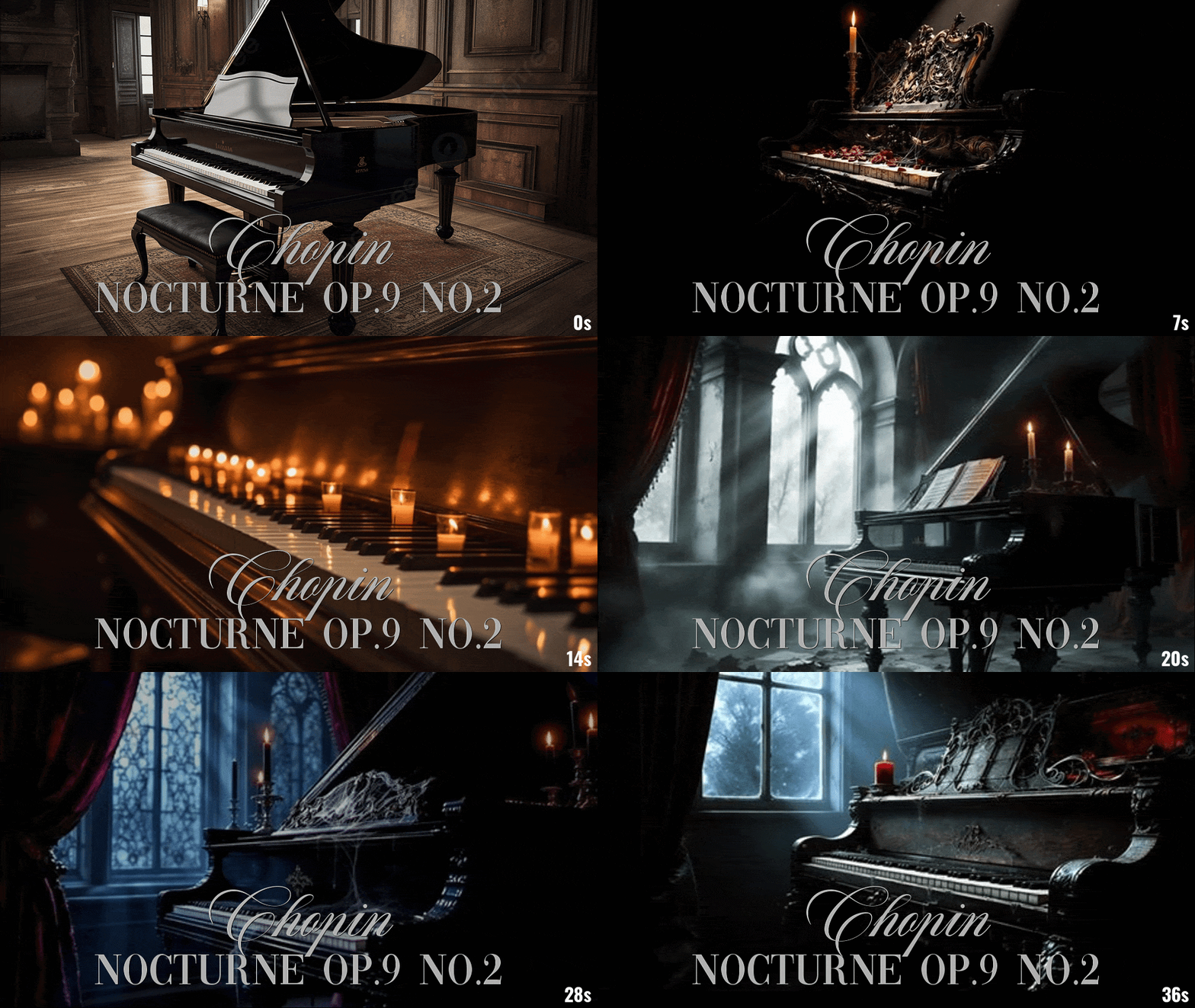
CHOPIN | Imperial Bösendorfer 97 key : rendition-import A.Nocturne Op.9 No.2 (in E Flat Major).mp3B.Nocturne Op.9 No.1.mp3 C.Fantasie Impromptu (Op.66).mp3 Nocturne Op.9 No.2 (in E Flat Major).mid Nocturne Op.9 No.1.mid Fantasie Impromptu (Op.66).mid Nocturne Op.9 No.2 (in E Flat Major).pdf Nocturne Op.9 No.1.pdf Fantasie Impromptu (Op.66).pdf
-
PeterthePapercomPoser replied to PeterthePapercomPoser's topic in Music Appreciation: Suggest Works or ArticlesMegami Tensei Gaiden: Last Bible II - Dungeon (from an SMW rom hack): LB2_-_Dungeon_3mix.mp3
-
-
Ello! This was as a small test i did with the vocal synthesizer i use to see if i could use other soundfonts with it, and it turned out pretty nice, i like this aria very much even though it has it's flaws. I hope you guys enjoy! LOB 104 Dolce Cioccolata.mp3
-
Hellooo, This is a very short galliard for keyboard with the diminutions written out, in a real performance scenario the diminutions would have been improvised by the player on the spot, but since i can't perform it and i don't have a harpsichord (yet) i just have written them note by note. Enjoy! LOB 107 Gagliarda Detta la Maritima.mp3
-
Hello everyone! This is my first complete sonatina in three movements: I. Moderato – A simplified sonata form movement that introduces the main musical ideas. II. Andante – A gentle minuet-like movement that provides a moment of calm. III. Allegro – A lively rondo that brings the sonatina to an energetic and satisfying finish! Hope you find some enjoyment in listening and all feedback is welcome! YouTube link ScI. Moderato.mp3ore II. Andante.mp3 III. Allegro.mp3 I. Moderato.pdf II. Andante.pdf III. Allegro.pdf
-
-
Thank you so much, my dear Henry ! Your comment truly means a lot to me, especially coming from someone with so great music perception and skill of composing. I'm especially happy that you noticed the Scarlatti influence. His sonatas have been one of my greatest sources of inspiration ever since I began composing, and the Binary Sonatas are my own humble tribute to his extraordinary musical world. These sonatas also hold a very special place in my heart. They are my musical diary, reflecting my thoughts, emotions, and experiences over the past few years, which makes your appreciation even more meaningful to me. Of course, my goal has never been to imitate Scarlatti, but rather to let his spirit inspire me while gradually finding my own musical voice. Your observations about the echo effects, the sudden modulations, the dialogue between the hands, and the changes of mood made me smile because those are exactly the elements I enjoy exploring the most. Thank you once again for your wonderful words and for your continued support over all this time. It truly means a great deal to me, and I hope you'll continue to enjoy the musical journey ahead.
-
Ah ah ! Chers collègues compositeurs, que ce message serve de déclaration officielle de ma participation. Je suis ravi que mon thème ait été retenu comme gagnant. Je suis sûr que vous allez tous adorer ce poème français et j'ai hâte de découvrir la musique que vous allez composer ! TL,DR: I’m in boss 🫡
Last week
-
I love the suggestions. I also didn't notice that I'd had them playing where only the instrument above the secondary was playing melody. Just sort of happened that way I suppose. Regarding piano, I would've liked to do something more for the 41-48 section for it, but for the sake of maintaining simplicity, I thought against it, as I quite liked piano playing the role of rhythmic and harmonic support throughout this score. And it seems great minds think alike ;) Thank you for reviewing! -Unc
-
Hi to all. Have just made this orchestration of my own recently composed piano work. The score is designed for midi rendition only: so I haven't tidied it for real musicians. Think the piece actually works better as an orchestral work, but I'd be very interested to hear your opinions of my orchestration choices. I think some of them could be improved. Chills (orchestral version) #13.mp3 Chills (orchestral version) #15.pdf
-
🛸 𝐔𝐅𝐎 𝐛𝐲 𝐌𝐚𝐯𝐞𝐥𝐥 | 𝐃𝐨𝐜𝐮𝐦𝐞𝐧𝐭𝐚𝐫𝐲 𝐒𝐞𝐫𝐢𝐞𝐬 : 𝐏𝐫𝐞-𝐒𝐭𝐲𝐥𝐞 UFO by Mavell Documentary Series Pre-Style.midUFO by Mavell Closing Credits.midUFO by Mavell Documentary Series Pre Style.pdfUFO by Mavell Closing Credits.pdf UFO by Mavell Documentary Series Pre-Style.mp3 UFO by Mavell Closing Credits.mp3
-
Thank you for your kindness, @Henry Ng Tsz Kiu. I'm so happy to receive a comment on this work from you. Personally, I only write reviews for works that fascinate me, so I will continue working to create something that might one day elicit that kind of reaction from others. By the way, I recently listened to some of your past work, and it was wonderful. I'm looking forward to seeing you upload new works. P.S. Thank you for telling me about Schnittke's Symphony no.4. I hadn't heard it before, so I really appreciate the recommendation. You seem to have amazing musical knowledge too! Best, Lithl.
-
🖐️ Never made the grade :
-
Hi Jean @Krisp ! I have left a few words in Youtube, and I will reiterate here that I love your orchestration! To me it's more like an orchestra playing in a chamber setting which gives different contrasting mood in different passages. The use of harp definitely makes this one a lovely romantic lied. The subject of this lied really reminds of the film "Last Year at Marienbad" when the male protagonist insisted in recognizing the female protagonist, who always refuted it. All the harmonic progression in the piece well serves the narrative structure and mood change of the poem, and to me the most magical touch is the end-the narrator admits he never truly knew her and the chords ends on a suspended B minor chord, while the fantasy continues in the harp and other instruments. This heavily reminds me of the ending of Dichterliebe when the narrator and singer abruptly ended his singing by "sinking to the Rhine" and the music continues with the piano. Truly magical touch here. Thx for sharing! Henry
-
Hi @Vasilis Michael ! This one is wonderful! Recently I finally get more in touch with Scarlatti and your piece shows heavy influence of his Sonatas: echoing of passages, abrupt and wonderful modulations, all the m.d. and m.g., dexterity and touch required to play, abrupt changes of style or mood. Yours is no less wonderful than Scarlatti's Sonatas I can definitely say. Thx for sharing! Henry
-
Hey Pabio @Fugax Contrapunctus ! I am always in awe with your contrapuntal power and this one is no exception. The perpetual modulations through the circle of fifth matches so well with the latin text of "Change is inevitable in all things. Everything flows in the balance of those who are tempestive.", as Yijin [The Book of Change] says, "The only thing unchanged is Change itself". For me just one personal thought: maybe since this starts with E major, would it be the best to end with its tritone major, the Bb major, instead of Gb major, so the changing theme of the piece would be even better reflected? Thx for sharing this wonderful piece! Henry
-
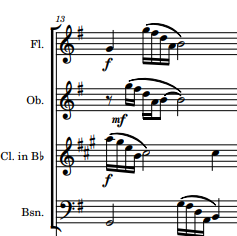
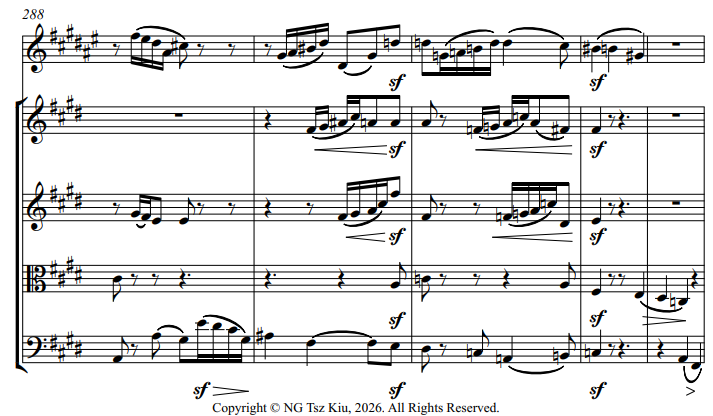
Hey Kyle @UncleRed99 ! What a lovely piece which is clearly in your style: sentimental, refreshing and lovely. I like the tone color of the whole piece, and all the solo passages of the winds. Just some suggestion of mine: first the pianist isn't given a chance to play the melody at all except b.41-44. Since I've just reviewed @MK_Piano 's October piece it immediately reminds me of his piece where there is piano solo passages. I think here you can extend your piano solo passage as well and also have the winds accompanying the piano melody. Also whenever two winds are in pair, the upper instrument (in terms of score position, not range of the instrument) always have the melody. What if clarinet and oboe playing together and clarinet gets the melody? Or bassoon getting the melody over a flute countermelody? You can think of more varieties in the instrumentation as well! Also for the recurring figure in b.13: Seeing this figure immediately reminds myself of my own Clarinet Quintet 1st mov to advertise myself lol: Thx for your sharing, and my deepest condolences to you and your family for losing a family member, as Anna accompanies you for such long years as a lovely pet and family member. Henry




.thumb.png.8b5b433a341551e913a34392660bc95b.png)