All Activity
- Past hour
-
@chopin Not gonna lie, I watched your video and I know it was well made and you are a master of your craft but I could not understand Lol. It’s like a child trying to understand what adults are talking about. Like people playing pokemon to just catch them all vs people who do competitive battling and know how to raise and breed their pokemon and have egg moves and movesets to complement their team and make their pokemon stronger than just leveling them up regularly. If you haven’t played pokemon then that wouldn’t make sense and thats how I felt when I watched your video 🤣 I know its good though lol. Like I was telling Daniel, there’s more customization to be done in suno and i’m literally only 2 weeks in to learning this tool. Some other people who have been using this tool has told me that you can really customize how your song would sound all the way to individual notes and how they sing. With AI once it learns something, it just builds on it so lets say a composer has been composing for 50 years. AI can learn all this persons skills and techniques in a fraction of the time. I know it’s unfair but that’s just how it is. A few years ago, AI could barely make videos that looked real but now, I cannot tell if a video is fake or not. I made my first music video with AI generated person and it looks real. Anyways yea, not trying to dismiss human creativity or anything cuz without humans there would be no AI but just like any other tool we have made, our tools don’t get tired, they can do more work than 1 person, they can do a lot of things. Just think of cars, planes, whatever gadget we got that has made our lives easier and cursed at the same time. I think you get what I’m saying, I just look at the facts and see where this is going. With all this said, what needs to be done is to prevent bad people from turning terminator and matrix into a reality. So yea lemme hear your songs, hopefully it doesn’t fly over my head like your video xD only people who have learned and studied certain things would understand.
-
@Omicronrg9 Thanks for the nice insight, I’m still new to suno, my creations are still simple and I don’t know all the tricks yet. Some others showed me some stuff on it and how you can literally make your lyrics play in a certain key or note, or how to make it add more feeling to words whether, happy, sad or angry. So there’s like a lot, basically I just know ABC and not the notes in between. I only started this about 2 weeks ago when Grok told me about it. The more I learn, the more my stuff will get better and thanks to your feedback, it will be better faster. The AI songs you posted sounds nice, I’m not sure what you were trying to tell me about them though? Also the AI song checkers, wouldn’t they get messed up if the AI song was just re-recorded so when the song checker checks the file, it won’t find things that was on the original file since the new file is just a regular recording? 😭🤣 Your sheet music looks cool, yea its a pain in the butt and thats probably why I didn’t bother to learn it. But you make good points. I want to hear your piece you showed me cuz looking at it does nothing for me Lol. Just looks nice. My skillset is a driver and a diesel mechanic, gamer; basically how i think is, how do i do something faster and get the same results. I know there are different ways to do something but if it gets the same result with less time then why would I do it any other way? Which is probably why I don’t learn sheet music and i rarely write tab anyways. Right now the fastest way is writing lyrics and programming Suno to play how I want it and boom I got a song. Compared to; writing lyrics, look for singers, try to learn my guitar more or just look for good guitarists then look for a bassist, a pianist, a composer, a studio engineer, a manager. Spend a lot of time looking for all this and then spend a lot of money. Then make sure everybody gets along together AND make sure the music actually sounds good AND sounds how I want it to sound like for my vision and the feeling I want my lyrics to evoke AND if the people do not get along or someone is not skilled enough then I would have to spend more time looking for other people. So yea basically with Suno, I can do all of that and save a crap ton of time and money and I don’t have to deal with different personalities and I control how I want my lyrics to sound like. There’s probably programs out there to write out my suno songs in sheet form so i probably don’t even need to learn that either. This may sound bad or terrible to you but that’s just how I operate as a driver/mechanic/gamer. When I logically lay it all out like this, to me it’s a no brainer and the fact that tomorrow I could die and if I was making music any other way, i’d be dead with my lyrics on a sheet of paper and never turned into a song. But at this moment I already have 2 albums and 21 songs out on most music platforms so if i died right this moment, the only regret would be that I didn’t finish this album I’m making right now and the world won’t hear these songs. So yea anyways that’s my thoughts on all that. Just so people would understand why I do what I do. On the sheet music thing you were talking about. We would have to engrave our sheet music into rocks or something if the internet goes down if you want it to last. Somewhere on a mountain so less chance of people destroying it but even then someone might find it and break it anyways cuz you know thats just how people are. Also, nice explanation of a composer 👌
-
Possible performance notes: Calutions is a made up word that plays nicely with its antonym of concoction. It is a collection of complementary flavors. The origin of the word came from a large spice market located in New York City called Kalustyan's. This piece is a collection of modes and scales that have a main stepwise theme, but enters in many different variations in styles. theme : March in B major A; minor variation in B B; waltz in B Dorian C; Taqsim in Phrygian D; Fantasia in B lydian E: folk dance in mixolydian F; sinister March in Locrian G; variation in E Major Pentatonic H; Gagaku in minor Pentatonic I; variation in suspended Pentatonic J; shuffle in blues pentatonic K; folk dance in dominant Pentatonic L: Taqsim in A harmonic minor M; kinda maqsum in double harmonic minor O; Tarantella in A octatonic
- Today
-

With Every Beat My Heart Knows
HoYin Cheung replied to HoYin Cheung's topic in Incidental Music and Soundtracks
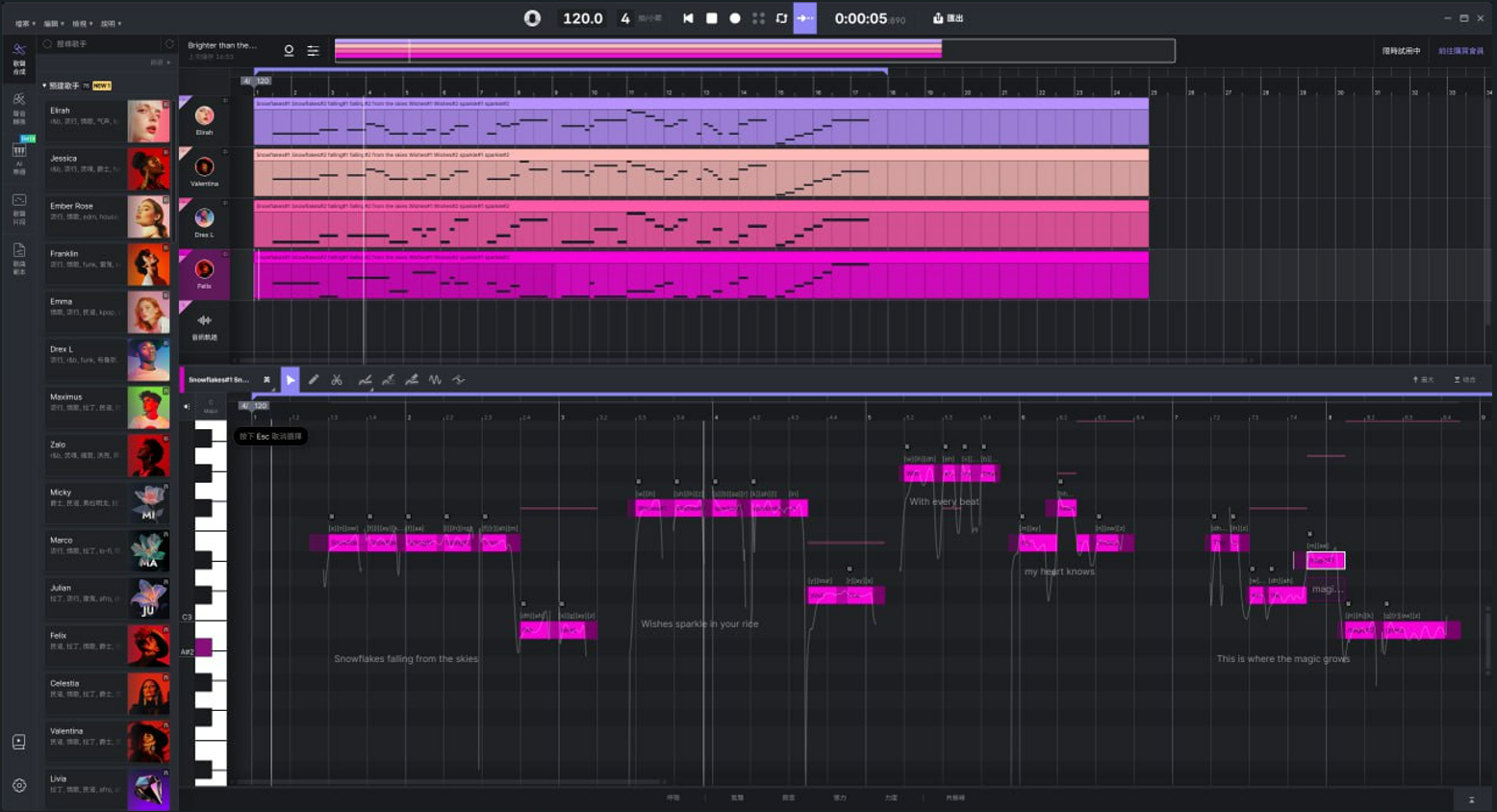
Thank you all for listening. Seems that I failed to write a proper pop song, but something belongs to me! haha. I mainly used this >>ACE Studio<< DAW where I can use AI sounds with different style (pop/ classical, female and male), and they have violin sound library, too. (No sponser/ advertisement here, I am just here to show you if you are interested) @PeterthePapercomPoser Yes, you can make it work in different languages. You input notes and add lyrics accordingly. Then the software will automatically transform them into syllables. While the system only support English and Mandarin (?) at this stage, you can trick the system by manipulating the syllables despite the "wrong" spelling (that's how I dealt with the strange pronounciations). Let's dm for more details.
-
Thank you for listening! I've been disappointed in the orchestral soundfonts I've found so far: all of them have too much vibrato which doesn't suit this style of music very much. The 8-bit soundfont is a pretty nice alternative which provides a clean sound that I like. If you (or anyone else) have a workaround for this which closely imitates the sound of HIP (historically informed performance) Baroque music then please let me know!
-
Fun! I wonder if it would make a cleaner score to change the meter and tempo in some places instead of having so many -uplets. For example, from measure 71 to the end, you have nothing but triplets in the violin part. They are never set up in opposition to a duple, so you don't absolutely have to have triplets there. Instead, you could just write that section in a 6/8 meter or a 12/8 meter, make all the triplets into eighth notes, the quarter notes into dotted quarter notes, and the half notes into dotted half notes, and then use a tempo change to get the speed to match the section that came before. It would sound exactly the same, but might look a little more intuitive on the page to performers. I like the brass interjections too!
-
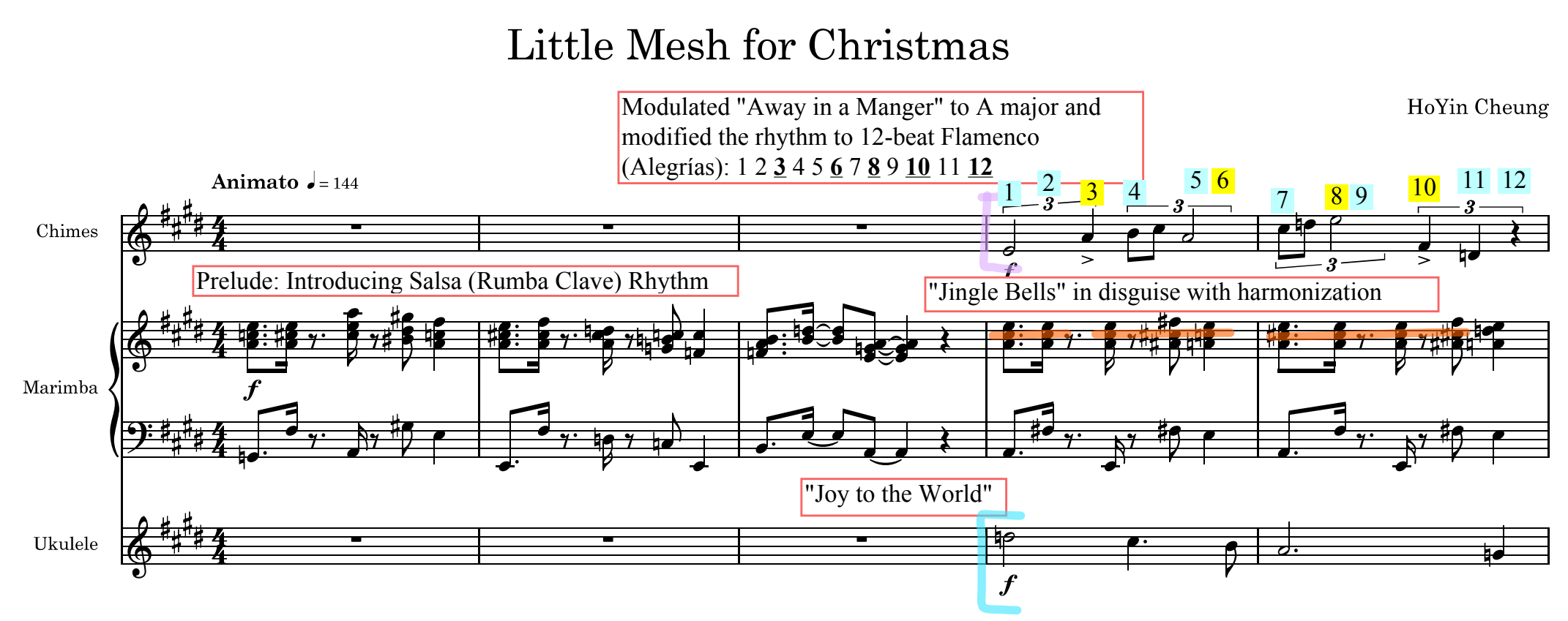
Thank you all for listening! @chopin I really hope to add some visual bonus to my audience - and more exposure on Youtube - that's why the Santa is coming! @Luis Hernández Hey, long time no see! When I was writing the mesh-up, I wanna try some sophisticated rhythm (in dance), and flamenco first comes to my mind. I hope it sounds authentic to you as I learn it from Wiki lol @Henry Ng Tsz Kiu Wow, never knew the Gamelan music and that was unexpected you think in that way! @Wieland Handke Hope you enjoyed the music! I know my music may be difficult for some of my audience, and it is always good to add some visual aids if it helps. @PeterthePapercomPoser Hey! I apologize for my bad description. I have attached my detailed annotation for your reference. I hope that will clear things up.
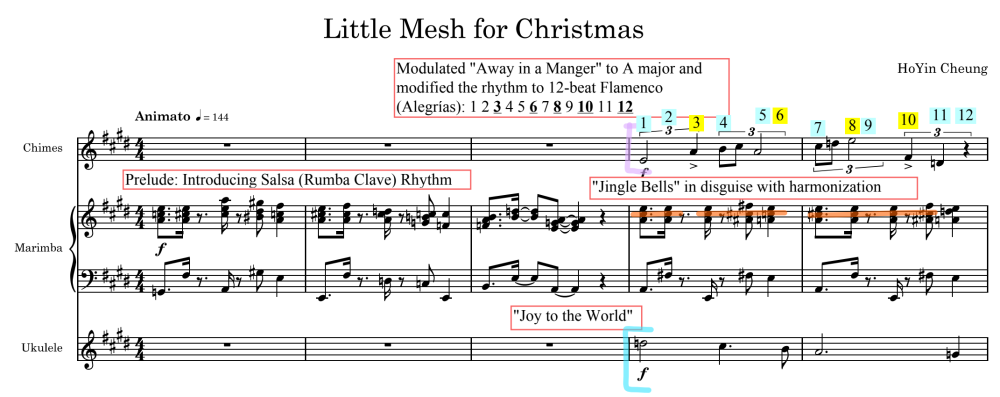
-
I'm kind of wondering the same thing myself now! I guess I tend to think of the B flat trumpet as the "default" in a brass ensemble, so when I started writing it, I started with two B flat trumpets. The first trumpet part, I realized, was going quite high, so I changed it to a D trumpet. But it would have made more sense to change the second to C trumpet for a more reasonable key signature. To be perfectly honest, I was rushing to try to finish this before Christmas, and didn't think it through properly. Thanks for listening, and happy new year to you too!
-
Beginning a chorale with a V chord on an upbeat is generally considered a mistake. Bach himself would almost certainly harmonise the first two chords as I-I (with an octave leap in the bass). The overall tessitura of your tenor and bass parts are approximately a third too low. Passing 6-4 chords (m. 2/4) and unprepared sevenths (m. 3/2) are relatively common place in Bach's instrumental music and most of his other vocal music, but not in chorales. The melodic interval of an augmented 2nd (m. 3, alto) is completely forbidden. Diminished 4ths (m. 5, alto) are on the other hand fine, but in this context it should be resolved to a G rather than a D. The minor sixth in the tenor in m. 7 can be improved by a "passing" C. There's a lack of complexity throughout. Nothing wrong with that of course, but complexity would give this more colour. Things you can consider: seventh chords that aren't just dominant sevenths, more 4-3 suspensions, 9-8 suspensions, choosing non-obvious harmonisations, harmonising occasionally in quavers etc. Of course you can ignore all of this if you're not trying to emulate Bach's style. If I were to do that personally, I'd ask myself "why" before I break these rules. Hymn/chorale writing is an extremely well established style and I'd need a very good reason to deviate from the norm.
-
The main thing about AI music is that it's predictable and boring. After the initial wow that's cool factor, it follows pretty strict templates. Sure it's getting better but compared to a human composition, you lose the creativity. Something like Beethoven's 5th Symphony could never be created by AI. I do an analysis of this symphony here, and you will see why AI can't really do this after you watch my analysis. This video actually helps answer what a composer is too. If AI outputs anything good, it's because its trained on music created by humans. This is why it is important that composer's don't lose their craft. AI music won't improve, and it will get dumber if humans stop composing!
-
That is definitely a NICE sound set and I like your harmonies very much. It may break convention a bit (I'm not a theorist, so I'll leave that to others), but it seems very singable. Bravo!
-
Hi again! I'll try. Here you go: • I don't know if it's just me, but I do listen to some gray noise when there's more instrument density, for example. • The voices that Suno and similar stuff produce, at least from my experience, sound all generic and have little to no personality. It's already a miracle that the timbre more or less is kept constant. Soon, it will be impossible to distinguish between these pieces and usual mainstream productions, specially when a guy who knows its craft takes it and modifies it accordingly. • Structurally is usually a "mess", AI is still learning that and it keeps improving. Harmonic simplicity of most songs it produces helps obscuring the fact that it's kinda bad organising material at the middle of them. They work superficially, anyway, and would work for the masses IMO. In the last example you uploaded, there was a great opportunity to repeat the chorus at the end one more time than what it does. • In some songs, instruments, voices, and stuff, appear and disappear at places strangely. Where's the flute and violin at the beginning of the piece? Later on 1:45~ I do listen to some string synths, but that's another unexpected appearance. Thing is that AI doesn't care about the internal coherence but about the output and if it works similarly to LLMs (which I don't know, because I have not delved deep into music AI bots behind the scenes) it's just making the "best guess possible" but it's not building music the way I and others would. Despite it being a way different technology, this feels to me like when Stockfish (chess bot) gets "inhuman" moves in chess, but instead of on par or better than the human alternative, music AI goes to a less convincing path. However, the way either I or others make music is not the only way, obviously. I do make scores, and then record them or tell the computer to play them for me. Some others don't make scores, they use a DAW and make the score afterwards (or not). Some others prefer recording directly and adding stuff in production. Some others use presets. And there are nuances on each way of doing this craft so, in summary, I would dare to state something like "the further away you get from the details you can tweak in each phase of music composition & production, the closer AI gets to your imitate your work". At least in my experience. And just as a personal note, I would insist in the fact that AI may only reach the complexity it needs to satisfy the masses. Here I attach some AI examples that I found on a telegram group. These ain't mine, but from people that prompted it with lyrics that AI generated as well. They're done by 3 different people but to me their differences lie in the surface. The tool is still not subtle enough, but I am afraid that I myself will not be able to tell AI songs and mainstream media songs apart. Finally, in regards of AI song checkers, they may fail in my experience. That's a game I don't play but they must be playing an interesting cat-and-mouse game. Perhaps not my call, but this is a good question. For me, a composer, or a good one, is a prestidigitator of music. Someone able to create their own music from its very conception to the smallest of details. An architect of the score. A composer can make what Suno made for you, but he chooses if he wants the guitar at ~5:20 is doing that Fsus4/Bbsus2 arpeggio, for how long, and if it should be Bb F Bb F C F Bb all 8ths or another line, etc, based on things that he put (or did not put yet) in the score. You, as the composer, decide everything. You even decide what you don't want to decide. You yourself set the variables, each and every one of them. You decide if fixing them or not and how. And you keep doing so, and get better and better at it. The key, the structure, the meter, the instruments, how and when they interact with each other... And a large etcetera. And you do not delegate: in order to make a good melody, you must study and practice how to make them. In order to make a good and convincing harmony or a good counterpoint (vertical and horizontal POVs), you do the same. Texture, color, etc. You keep learning and incorporating things you like into what eventually becomes your own set of tools that define your particular voice. Perhaps this is a radical way of describing a composer and what he does but welp, this is more or less my view on it. TAB is also music notation. Pretty useful at times. Just like with music notation overall, some despise it, some praise it. Sheet music can have TABS, staves (Here's an example of an arrangement I made the other dayThird Eye (Arr.).pdf, these are regular staves), or other kinds of music notation. It can be just chords, or indications, or entire different systems. And yeah I get learning it can be seen as a tedious task, it is what it is. Personally I love it and the main reason I got into music when I was like 4 was because I wanted to understand the symbols of a book called "the day the songs fell silent". Think that spotify may close someday, but if you have your scores secured in many formats, not only people will be able to listen to your works 100 years after, they will be able to understand them, study them, cover them, etc. Results won't be as bombastic as AI-prompting because there's a full layer of music production that I have not mentioned much that AI integrates good enough. You may have much less control over the result, but results are already eye-candy for many. My two cents. Kind regards!
-
Hello Peter thank you truly again for your comment, and helping me post this. I definitely gave the christmas medley idea a thought, but there wasn't enough time to make an orchestral draft based on those tunes. Otherwise, I think I would've missed the event completely. I decided to enter with this instead, since it is a small dedication I've been writing. Once I have the time, I may continue the draft I've been working on, which will include more complicated reharmonizations, perhaps in the style of ravel boi.
-
.thumb.png.8b5b433a341551e913a34392660bc95b.png)
2025 Christmas Music Event!
PeterthePapercomPoser replied to PeterthePapercomPoser's topic in Monthly Competitions
It is now 2026 and the Christmas Music Event is closed to further submissions! But stay tuned for the Conclusion thread to be released! -
Hi @Luis Hernández! I think I remember hearing this piece from you in some Christmas Event from year's past. I love the simplicity of this piece - it shows that you don't need to write overly complex music to write something that is quite sophisticated and brings up some quite somber and serious emotions. It also brings a sense of timelessness and constant surprise. Like @Thatguy v2.0 mentioned, I think it is better to listen to it without the score. I think in my case it also induces a kind of trance or altered state of consciousness. Thanks for sharing and Happy New Year!
-
Hey @Aiwendil! Very cool brass quintet! It's definitely very Christmassy and in an original way is difficult to achieve! I have also used a brass ensemble (a brass octet) in my 3rd Christmas Mash-up this year. You can judge for yourself whether it's any good LoL. I think your rendition is much better than mine as I just used Musesounds. I do wonder why you chose the specific instruments that you did. Why you chose the D Trumpet is obvious since the piece is in D. But why the Bb trumpet instead of another D trumpet or a C trumpet? Thanks for sharing and Happy New Year!
-
Now I'm not normally in the business of mashups, but it always bothered me that Selena Gomez's "Rock God" didn't have any rock in it. When I set out to rectify this problem, it occurred to me that the "Burn It To The Ground" riff was perfect for it already, and so...
-
Jingle Bells and Dashing Through the Snow
PeterthePapercomPoser replied to chopin's topic in Piano Music, Solo Keyboard
Hey @chopin I feel like this fragment is so short that you should have included at least one more repeat of the material perhaps with some kind of variation or switching up of the voices? Also, I'm sure you know that "Jingle Bells" and "Dashing through the snow" are lyrics from the same Christmas Carol "Jingle Bells" just in different sections. For that reason, I think it would be difficult to make a full fledged piece out of it, since you have already spent all your melodic material in the first 8 seconds. Although it is good to note that the melodies can be combined contrapuntally this way in case someone were to ever want to make use of this mash-up in some longer work (that's partially why I am doing my own Christmas Mash-ups too - in case I ever want to steal those ideas in some other more substantial Christmas piece). Thanks for sharing and Happy New Year! -
Hey again @Wieland Handke I do feel like this one is more outdoorsy and pastorale. I do hear the Bach quote clearer in this one too. The Empty Church is much more somber and quiet. This one, with is full fledged instrumentation is much more joyful and celebratory. Perhaps this one is meant for the joy of the arrival of Christmas Day, while the Empty Church is meant for the yearning of Christmas Eve? Thanks for sharing and Happy New Year!
-
Hey @Wieland Handke! I love the quiet atmosphere! Might this be a piece of music intended to be played during the Church's vespers or evening prayers? Very interesting instrumental combination. I do interpret it as music intended to set the mood for the occasion or be background for a vesper service. Because of your quote of Bach's "Where Sheep May Safely Graze" (or was it "Sleeper's Wake!"? I always get those two mixed up...) I was almost led to include my own Bach quote in my Christmas Scherzo in the Trio section of the Scherzo, but I am happy that I decided against it, as the Trio I came up with is better suited to the piece imo. Thanks for sharing and Happy New Year!
-
(Very Casual) Christmas Mesh Up
PeterthePapercomPoser replied to HoYin Cheung's topic in Chamber Music
Hi again @HoYin Cheung I find reviewing pieces like this very strange because I can hear some themes in this that sound familiar and I can't be sure if it's because your using pre-existing Christmas Carol themes or if you're varying something/mashing it up or if it's just a slight allusion to other themes. So I don't know which aspects of the composition are your own original work and how much is taken from other pieces. I have done 3 Christmas Mash-up's this year myself and I try to give the listener clues letting them know what to listen for and which Christmas Carols I'm using in my renditions. Thanks for sharing and Happy New Year! -
Hey @Vavrinec! Wonderful wintry atmosphere! I love how you change up the tempo and meter in the middle of the piece to give it an infusion of fresh excitement before returning to the scherzo, or perhaps minuet-like 6/8 section. You also cleverly leave out the string in the 2/4 part which also brings its own contrast. Great job and thanks for sharing! Happy New Year!
-
Hello @J. Lee Graham! Very nice fugue! This fugue made me realize that I could do yet another Christmas Mash-up between "O, Christmas Tree", "Hark! The Herald Angel's Sing!" and "We wish you a Merry Christmas"! They all start with either an ascending 4th anacrusis or in the case of "Hark!" an ascending 4th on the strong beat. I also love the Harpsichord here. I used to hate the sound of Harpsichords, but somehow I have learned to love them. I think the fugue is perfect for how long it is - I think if would be difficult to write a full-blown longer fugue-fantasia with this subject. Already I have to complain about your repetition of a sequence 5 times in a row between measures 28 - 37. Usually Bach would try to limit such repetitions to 3 or maybe 4 times in a row before varying them. But other than that nitpick I really enjoyed this fugue! Thanks for sharing and Happy New Year!
-
Hey @TristanTheTristan! This definitely feels like has the spirit of Christmas. Sometimes it manages this by somehow indirectly mimicking some Christmas Carols without any direct quotes. Other times it seems like it's inspired by the Nutcracker. The only thing that bothers me is the mechanicality of your rendition. People have already mentioned the mechanical nature of your tremolos and trills and stuff like that. I think all that can be fixed by writing out your trills through tuplets, making them sound exactly as fast or as slow as you want (and also having control of their velocity values). Same thing with the tremolos - you could bring down their volume with velocity values - relegating them to the intended background of the music rather than an annoying thing that jumps out at the listener. The final thing that would really make it sound so much better is the occasional use of the damper pedal. Just those things would help my impression of the piece 10-fold. Thanks for sharing and Happy New Year!
-
Nutcracker inspired final
PeterthePapercomPoser replied to Tunndy's topic in Orchestral and Large Ensemble
Hi @Tunndy! I think there's a lot of warmth to your orchestration! I love those shimmering glockenspiel and triangle ostinati. Some of the things that wouldn't sound idiomatic are the sextuplets in meas. 35. It's unrealistic for the Harp, 2nd Violins and Violas to enter on a sextuplet off-beat like that. It would be better for them to play a note on the downbeat as well if you want that to be performed together. Thanks for sharing and Happy New Year!