Leaderboard
-
Noah Brode
Members13Points367Posts -
Thatguy v2.0
Moderators5Points1,360Posts -
Monarcheon
Members4Points2,433Posts -
Leonardo C. Núñez
Members4Points70Posts



Popular Content
Showing content with the highest reputation on 08/29/2020 in Posts
-
6 pointsIN A DIFFERENT WORLD YC Composer Competition - Summer, 2020 Thank you to all of the entrants for submitting their works. Everyone should be proud for finishing their pieces at such a high general standard of quality. And thank you also to my fellow judges for their work in this process as well. The competitions are one of the most engaging features on this forum, and help 'keep the blood flowing', so to speak, so I'm very pleased that this competition turned out to be so popular. And now, without further ado, I present the final scores from our competition. MEMBER VOTING: FIRST PLACE - Bassoon Concerto No. 2 by @Leonardo C. Núñez (22 points total) SECOND PLACE - Flight of the Fledgling by @Left Unexplained (13 points total) THIRD PLACE (TIED)* - A Dream's End by @Thatguy v2.0 (11 points total) THIRD PLACE (TIED)* - Kitichi by @Rodrigo Ruiz (11 points total) *I am listing A Dream's End higher because it had a higher number of second-place votes, rather than third-place votes. Each had the same number of first-place votes. TRADITIONAL JUDGING: FIRST PLACE - Bassoon Concerto No. 2 by @Leonardo C. Núñez (140.5 points out of 150 possible) SECOND PLACE - Hope by @Maggie L (128 points out of 150 possible) THIRD PLACE (TIED) - Symphonie No. 1, III. Adagio by @Gernt (122 points out of 150 possible) THIRD PLACE (TIED) - String Quartet in D Minor, Mvt. 4 by @Joshua Ng (122 points out of 150 possible) Congratulations to @Leonardo C. Núñez for winning both aspects of the competition!6 points
-
Hello! I am totally new to composition, self-taught and doing it as a hobby only. This is also my first post on this forum and I didn't find a section explaining the rules of the forum so apologies if I'm doing something wrong! Anyway, here is my first try for writing a string quartet! Curious to have some feedback on it :) I attached an audio file and a pdf but you can also find it here on musescore: https://musescore.com/user/27118405/scores/63175783 points
-
3 pointsAwesome job everyone! My hope in these things are that the added weight of competition could bring out the best in all of us, especially with the isolation. I encourage all who participated to post your pieces as normal, I'd love to talk shop with some of you regarding your compositions. Well done Leonardo!3 points
-
3 points
-
3 points@Tónskáld @Monarcheon @Noah Brode Thank you all for making this possible. 🙂3 points
-
3 pointsMy thanks to @Noah Brode for taking the brunt of the workload off of my shoulders and successfully bringing another competition to its close. All entrants should be proud of their work and similarly pleased that your contribution is a part of all of our histories alike. An extra congratulations to those who consistently scored highly; having a panel of judges is certainly more consistent and enticing than one, and I hope we as judges along with @Tónskáld have done our part to ensure that your music was thoughtfully considered. Until next time, all.3 points
-
3 points
-
2 points
-
2 points
-
1 pointhello everyone, I am back, this is my new piece, hope you like it and welcome your commentation the video: https://www.bilibili.com/video/BV1LV411S7VX/1 point
-
1 pointThanks for everyone who voted for my piece in the competition, if people want to see it again or say something about it you can do that here. Have a nice day 🙂1 point
-
Good job Leonardo! I am very happy with these results, my first competition and first score, now I know more about what to practice. Thanks to all the judges and entrants!1 point
-
I personally don't think Coxi jumped in a particularly deep end. He has to make a go of it and his scoring shows insight. The vertical is fairly well laid out. I might have done things differently here and there but that's me, not the composer of this piece. He has plenty of scope for future adventure but this is a good opening. If anything it could be a little longer. I might have been critical of certain points like a hesitancy, and doubling (nay tripling) of the 3rd in bar 15 leading up to a cadential G in bar 16 but...but the hesitancy was an intriguing effect and the weakness of the multiple 3rds gave a thorough resolution on the G chord. (I'd have dropped the cello to D on the last beat of bar 15 but again, that's me. (These are things that the composer can rethink when he reviews this piece. Matters about when to double the 3rd and not will be picked up in studying voice leading.) His handing of the runs in bars 16 to 19 came over as clever as he moves through the harmony to get to a nice-sounding first inversion G chord in 20 correctly resolving onto the C chord - in terms of the overall key Vb - Ia. The octaves in bar 26 are a bit naughty so is the parallel 5th, albeit onto a diminished 5th - questionable but do the rules really apply here? If this was a technical exercise on 4-part harmony I'd say yes - know the rules before you break them. Ultimately, rules or not it comes down to "is it what the composer wants?" = = = I also don't equate "amateur" (particularly "amateurish") with beginner. Amateurs do something for the love of it whereas tradespeople do it to pay the mortgage. They work to order. I'm an amateur but not really a beginner, beyond the philosophical obvious that we're always beginners...creeping away from the beginning but without an end in sight!1 point
-
1 pointWhat a great representation of what the competition was going for. The score is superb, and your treatment of thematic material was awesome to follow along with (again!). You have a very bright future ahead of you as a composer, it was great to hear how you constructed such a beautifully arranged piece in a time of turmoil for you. Where others might have crumbled under your circumstances, you graced the world with art. Well done, I'm looking forward to other movements!1 point
-
1 pointThank you for uploading this. If you want, I can move it to the Hall of Fame, but only if you want. Let me know whenever.1 point
-
1 pointIt makes plenty of sense - I just can't keep myself from hearing the melody as doing it's own independent thing apart from the rest of the piece (the flute melody in measures 12-15).1 point
-
Hello everyone! This is a Minuet and Trio for Cello that I composed these days while studying the Minuet and Trio form. The Minuet is in F major and the Trio in F minor. Both of them follow the practice form of [:A:][:BA':] with 8 (A) + 16 measures (BA'). I decided to compose a Minuet for the Cello because of my admiration for Bach Cello Suites. I do not play Cello and it is my first composition for it, so any feedback related to playability or idiomatic composition is appreciated! I tried to make sure all the double, triple and quadruple stops were possible to play (I used Piston's Orquestration book and a Cello fingering chart) but, since I have never played the Cello, there might be some mistakes or unidiomatic parts. I also tried to make the Noteperformer midi Cello sound as natural as possible since solo string midi libraries tend to sound too robotic, specially when playing chords. Hope you enjoy it and thank you for listening!1 point
-
1 point
-
Amazing! Really enjoyed listening to this, I love the neo-baroque dramatic feel, it lives up to the title!1 point
-
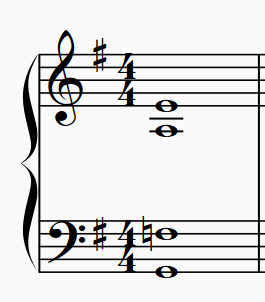
1 pointIt looks like it resolves to this chord: You could consider this an appoggiatura to an Em7 in first inversion later in the measure. However, it's kind of hard (for me at least) to hear this as being in E minor/G major with the F naturals I keep hearing throughout the next several bars. This point aside, does the rest of my analysis at least make a little sense? Like I said, its just "one" analysis and not necessarily the "correct" one. Just looking at the above, I have a hard time thinking the composer thought of each and every harmony he used having some functional relationship to G major. For me, it's a little easier to interpret it more ambiguously. Yes this is true, good point. Well...you asked 😁. I could talk all day about this kind of thing.
 1 point
 -
Hi @PaperComposer, thank you for your comment, and sorry for the late response. That does make sense to me. I'm lucky enough to have perfect pitch so I don't have to check with a reference, but I always write down the music in the key I heard it in my head. I read an article about Baroque tuning, which said that the reason that 'concert pitch' is higher now is that it sounds more intense or excited than the low A432 or even A415. I heard a recording of Chopin's nocturne op 9 no 2 where the piano was tuned a little higher than normal - I noticed that the music sounded overly bright and a little harsh. Since I created this thread over a year ago, my opinion has very much changed. Before I would say that keys had very specific emotions, but having learnt considerably more about music and explored more repertoire, my answer would now be no - I now choose keys based on the instruments and their ranges.1 point
-
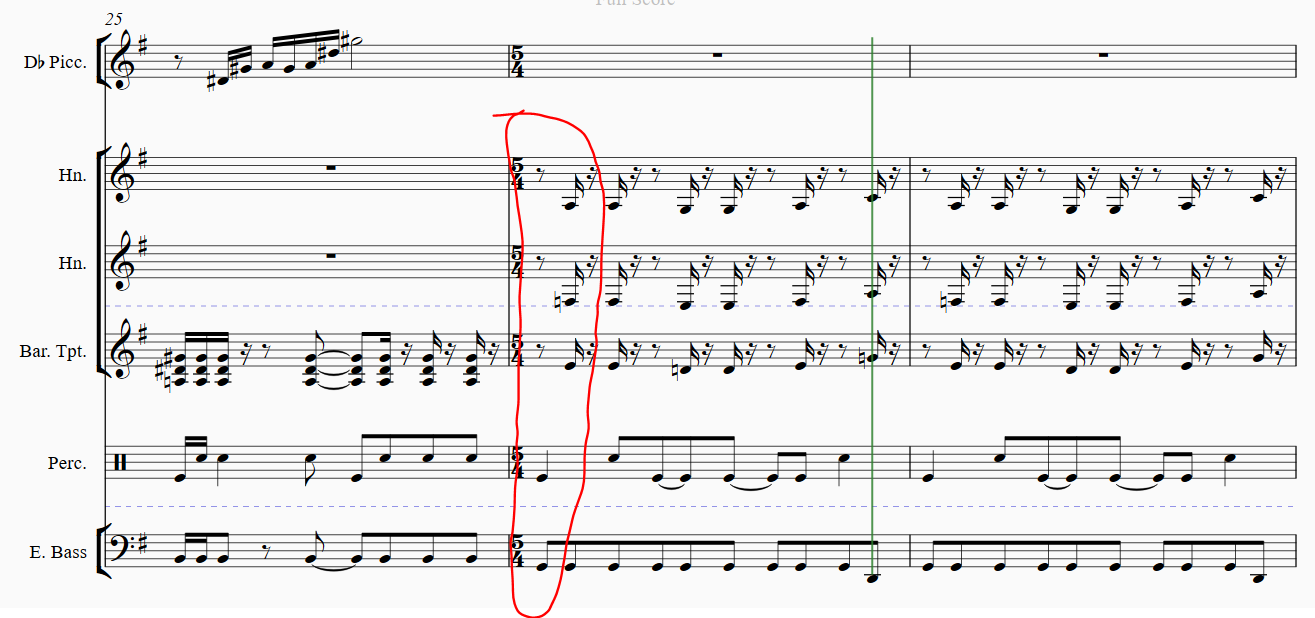
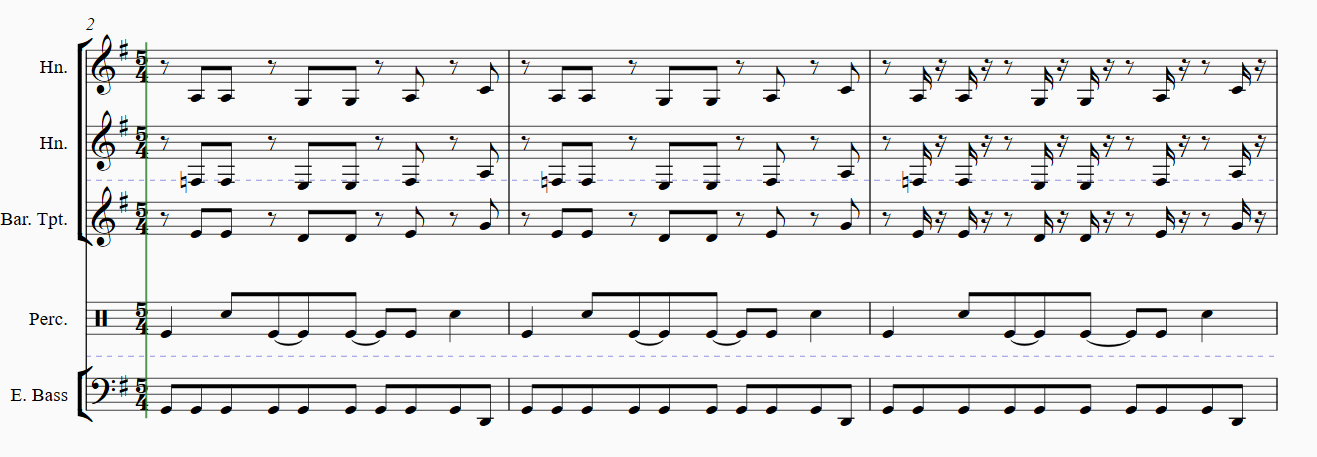
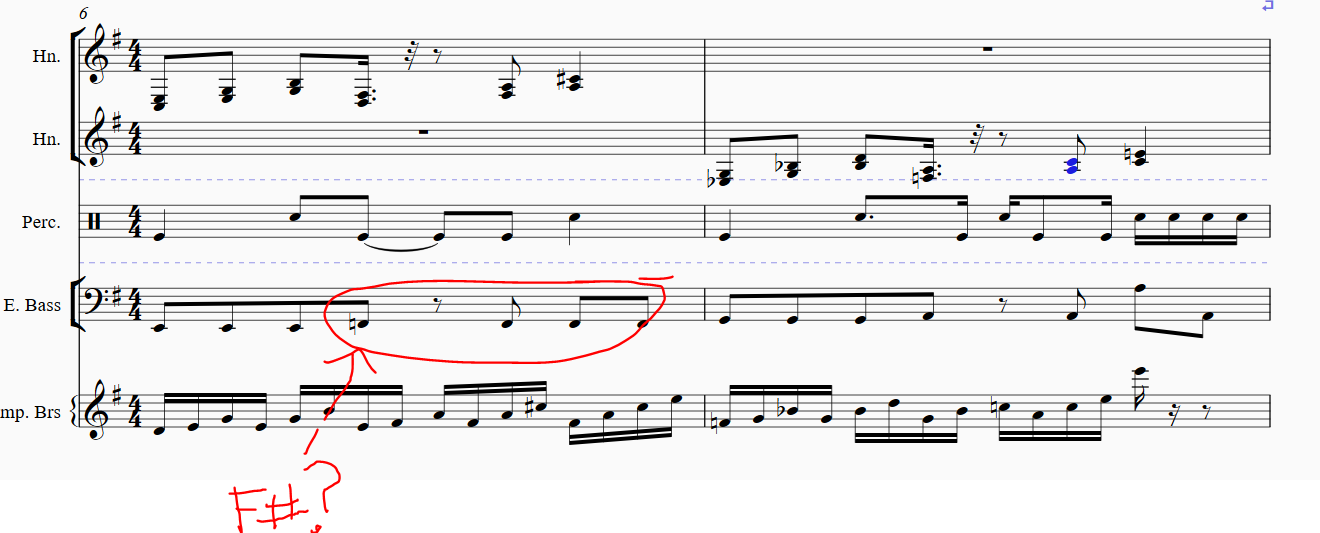
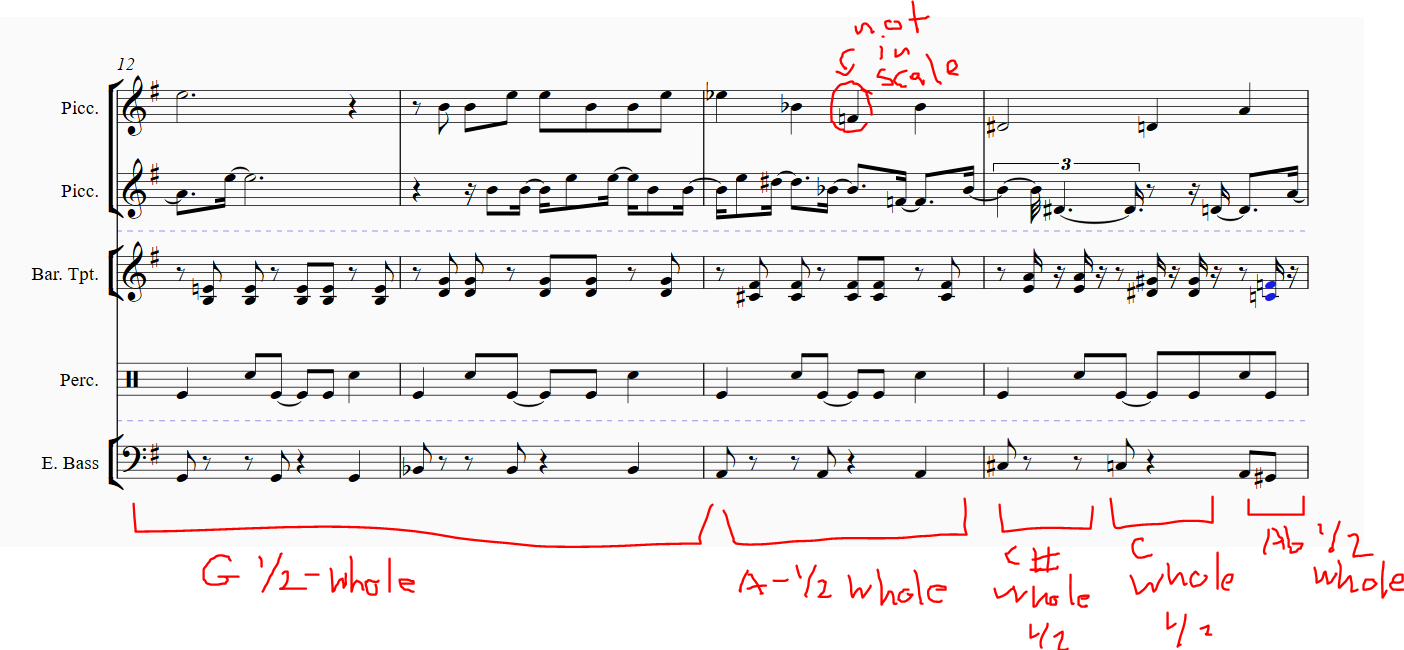
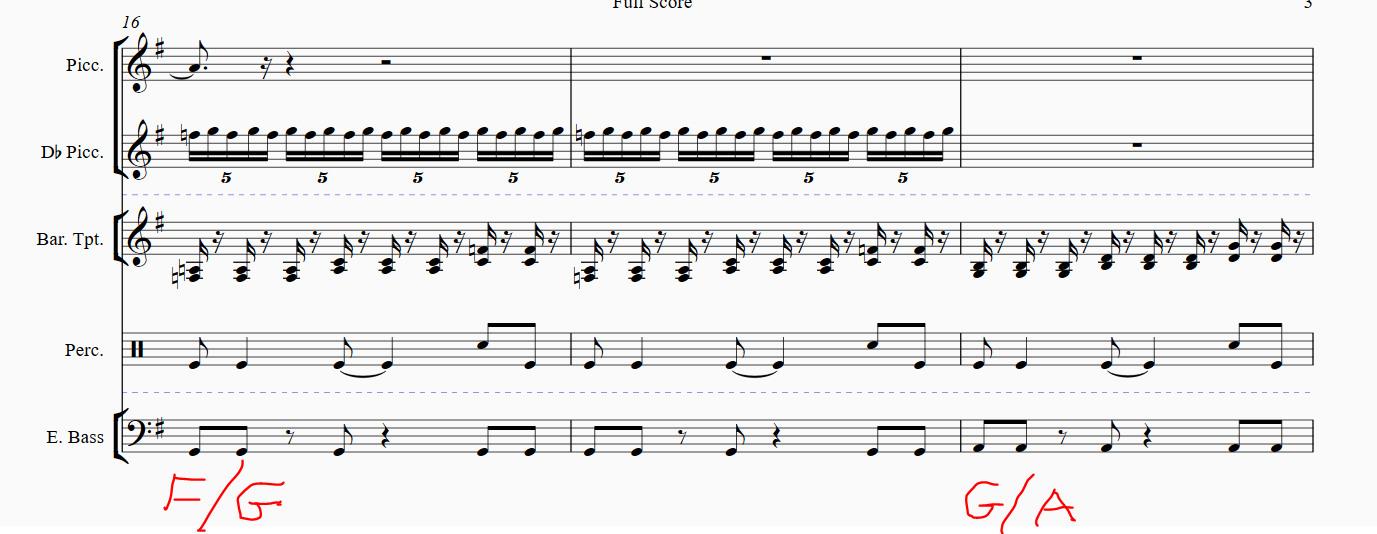
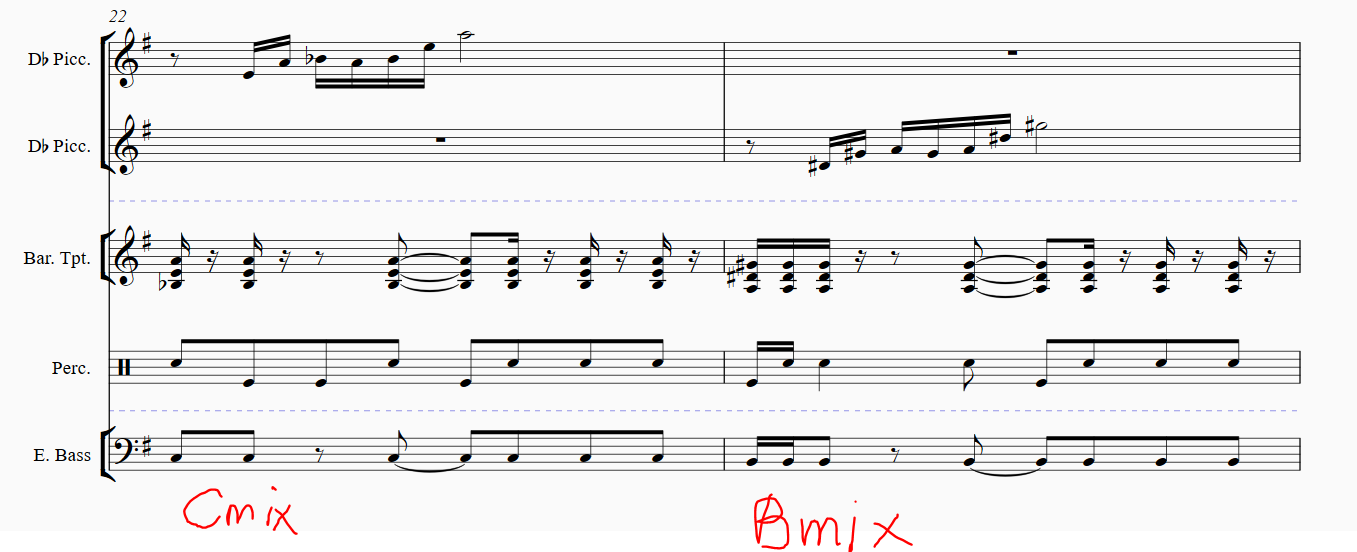
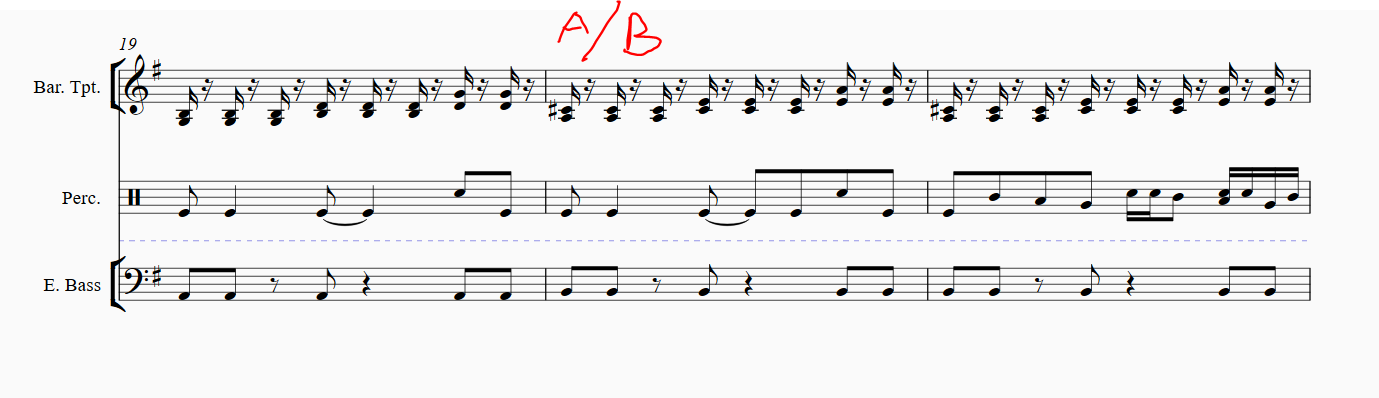
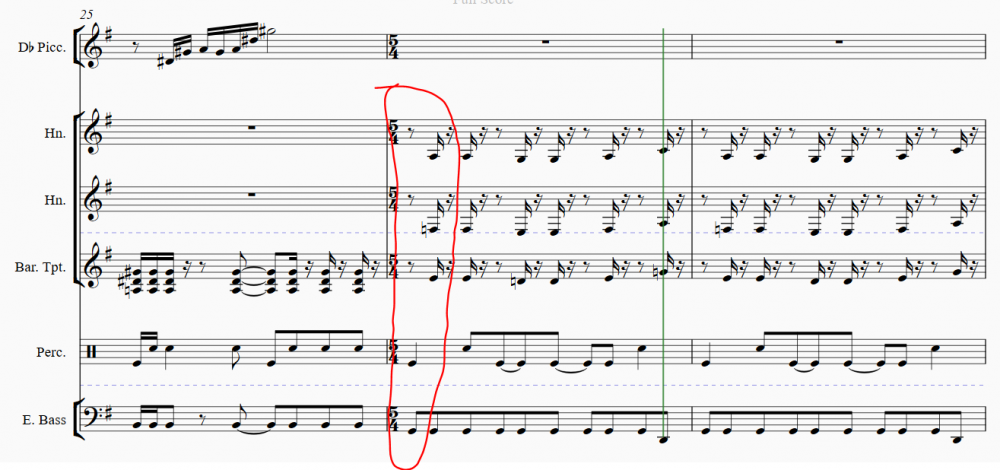
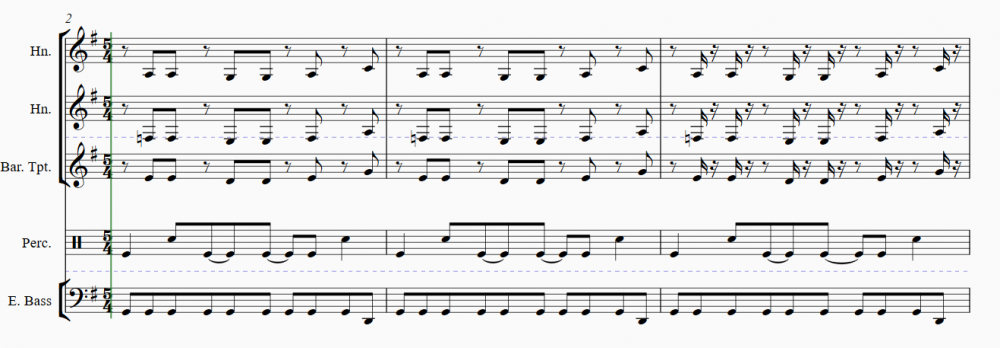
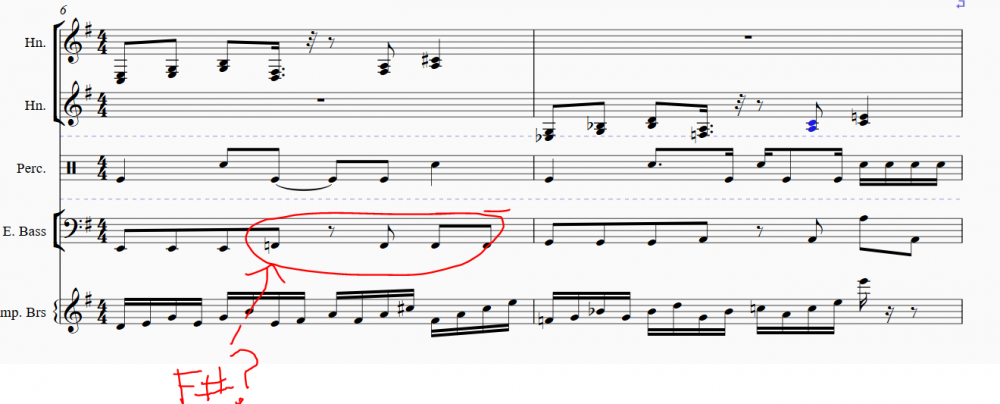
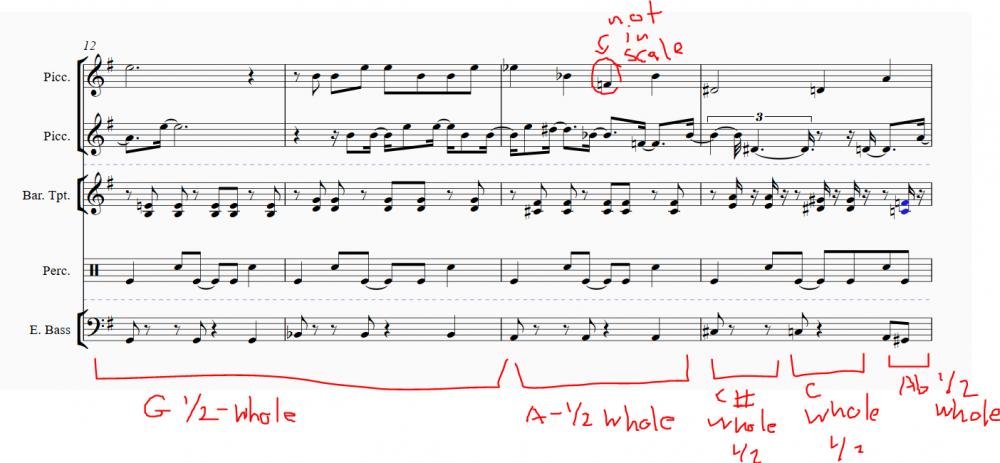
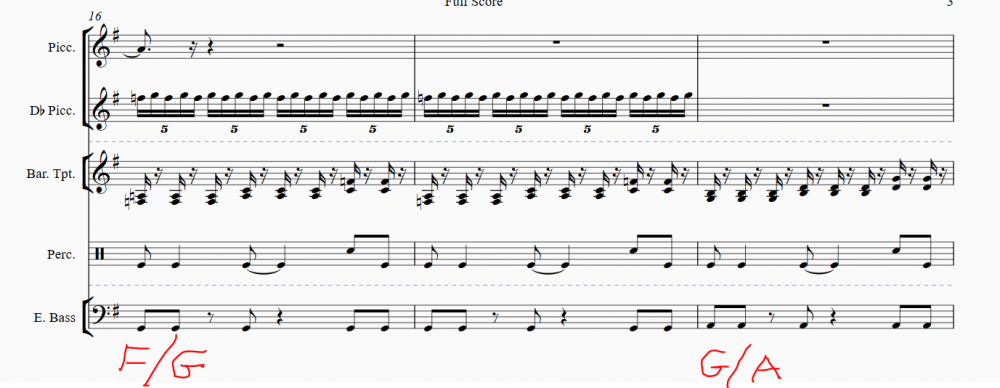
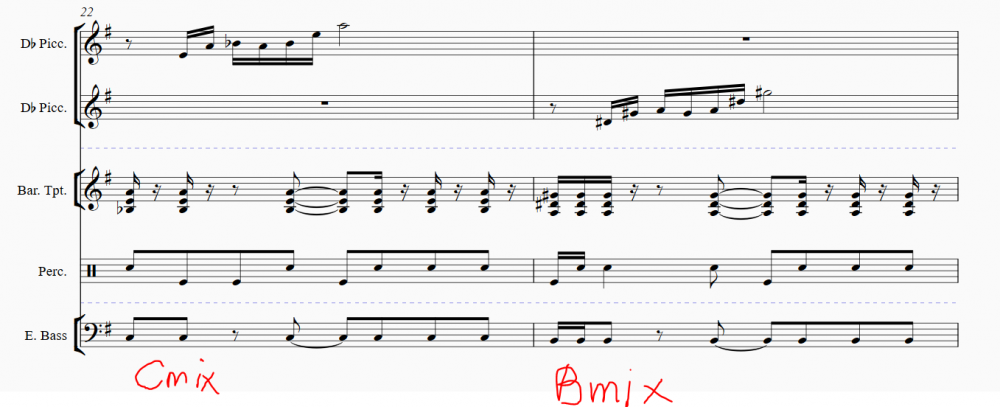
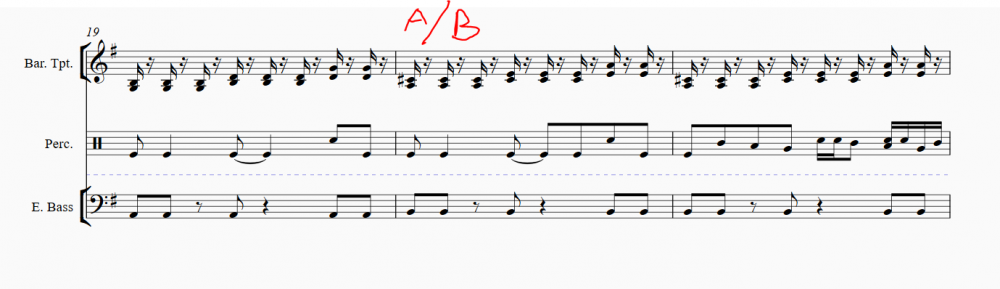
1 pointI don't know that I would think of this as being in a "key" per se. It sounds to me more like the harmony is organized around transposing similar chord structures and shaping the melody around scales that fit those chord structures. I'm curious where you got the midi file for this? There is a spot or two where I question it's accuracy... If I look at m.2-5, the bass is sitting on G while the Horns and "Baroque Trumpet" (whatever that is lol) are all playing notes that fit into either a G mixolydian or G dorian scale. There is no B or Bb present, so it's ambiguous which it could be here, but I would suppose this ambiguity is the effect the composer was going for. m.6-7 is where I question the accuracy of the midi file a little bit. At a first glance it appears that the harmony is just shifting between different Maj7 chords in first inversion. Starting on Cmaj7 on the downbeat of m.6, then moving the Dmaj7 on the upbeat of the second beat, Ebmaj7 on the downbeat of m.7, and finally Fmaj7 on the upbeat of the second beat. The only thing that throws this off is the bass plays an F natural instead of F# on upbeat of m.6, while the rest of the ensemble is playing F#'s. If the bass were playing an F#, it would fit the pattern. M.12-15 is where things get interesting. Looking at just the trumpets and bass, he shifts between different transpositions of minor triads in first inversion, with a couple of major triads in first inversion in m.15. The sequence is Em, Gm, F#m, Amaj, Abmaj, Fm. If I look at m.12-13, every note that is played between the Piccolo, Trumpet and bass in within the G half-whole octatonic scale (G G# A# B C# D E F). In m.14 he then uses the A half-whole octatonic scale (A A# C C# D# E F# G) to match the F#m chord, the only oddball is the F natural in the piccolo. In m.15 he uses the C# whole-half octatonic (C# D# E F# G A Bb Cnatural) and the C whole-half (C D Eb F F# G# A B) over the Amaj and Abmaj respectively, and finally the Ab half-whole over the Fm (Ab A B C D Eb F Gb Ab) M.12-15 is a repeat of m.8-11. M.16-21 appears to be stepwise movements of Fmaj/G in m.16-17, Gmaj/A in m.18-19, and Amaj/B in m.20-21. Notice the stepwise movement in the bass that leads to the C in m.22. M.22-25 alternates between two different mixolydian textures, first on C, then on B. The cycle then repeats starting at m.26. I think the mixolydian serves as kind of a cadential point to make it feel like the whole piece is about to resolve back to the start. The mixolydian mode has always had a cadential feel to me, likely since it associated with the V in tonal harmony, so I think it tends to serve the same cadential function here, even though in the end it resolves to a chord on G instead of an F or E you would expect from C7 or B7. The above is just the way I look at it, and not necessarily the "correct" analysis. My point is that there is a lot of music that doesn't fit into the traditional idea of a "key". When I think of something as being in G major, I expect to find chord progressions like ii V I and V IV I that emphasize G as the tonic, which I don't find here. Hope this helps. Feel free to point out any errors in my analysis.
 1 point
 -
Dude A before the I. "Mountain" That said, lovely piece. I too hear a baroque-style in this, maybe the transitions could be sometimes abrupt but overall nicely done!1 point
-
It sounds a Baroque standard. With percussive ostinato momentos. Nice.1 point
-
1 point
-
1 pointWow - this took some rather surprising turns. It creates many unexpected and lyrical moods. Some parts remind me of Zelda (the very beginning melody, and again at 3:17). A great emotional piece with lots of depth!1 point
-
1 pointIt is not my genre, but well done the composition feels “complete” and there are nice passages to give a bit of variety (e.g. 1:00) to the piece too.1 point
-
It suggests that you might be out of your depth with fugue writing. This takes an incredible amount of experience and skill to pull off properly. I myself have never written a fugue, as I do not consider myself ready for it.1 point





.thumb.png.8b5b433a341551e913a34392660bc95b.png)