Leaderboard
-
Henry Ng Tsz Kiu
Moderators13Points3,143Posts -
Omicronrg9
Moderators5Points594Posts -
Wieland Handke
Members4Points188Posts -
PeterthePapercomPoser
Admin2Points2,958Posts


.thumb.png.8b5b433a341551e913a34392660bc95b.png)
Popular Content
Showing content with the highest reputation on 09/29/2026 in all areas
-
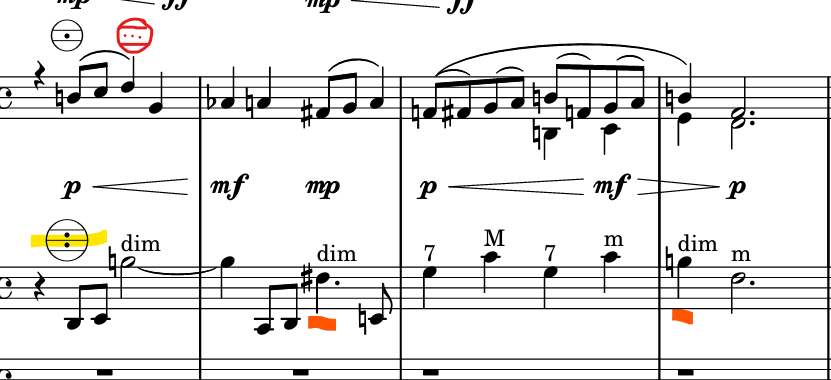
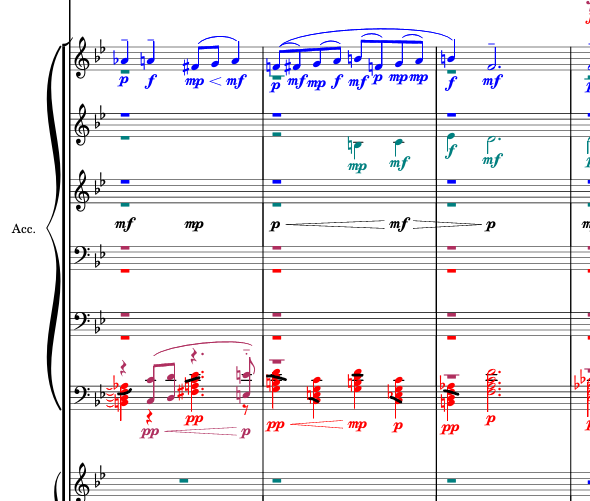
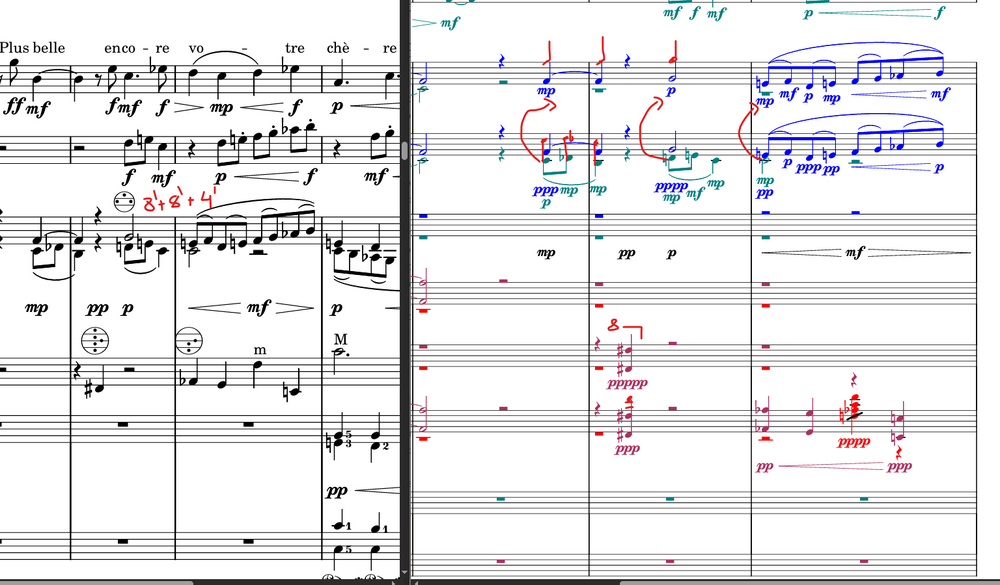
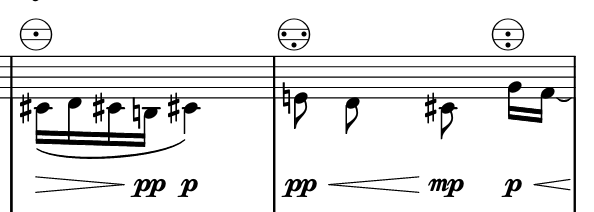
Hi! Just assessing Henry here, I guess. @Henry Ng Tsz Kiu note that accordionists overall, specially those who are amateur, or just interested in performing, will know as much as any non-player (but musician) of the ways this instrument may be properly engraved. More often than not, as it happens with many other instruments, we "convert" the information to our format on the go. I fear something similar would happen to the piece you've brought to my attention. Now, in regards of the accordion scoring of this PDF I'd say that : RH specified at the beginning of the piece do not match with the provided sounds (LH could, but I'm not certain, it sounds like a Soft Bass and it definitely has no soprano voice sounding in those very first bars that I'm discussing right after this bullet) MMM or MM for the RH are the ones you're looking for, at least judging by the soundfont which appears to be a french musette, so it's either that or open violin register. Note that no registers work for providing thirds neither accordionist spawn them on the go. I'm seeing the working score and I just don't get why there are so many notes that are just not present. Note that not all accordions have these, some 3-voice Piginis and other famous italian concerto accordion brands prefer the dry sound of the harmonium register, LMH. or 4' + 8' + 16'. Your sound is 8'+8' or 8'+8'+8', assuming it's the one you are seeking for. Chord movements by semitones are to be avoided if possible. Otherwise, you'll be inflicting tremendous pain to the accordionist, assuming Stradella system since it's the one you're using. So, without extending myself much, let's just review some examples. These are M15 to M18 if I'm not mistaken. RH register, according to the audio, should be MMM or MM as I mentioned. Bass voice doesn't sound like Soft Tenor but that's minor. What's not minor is that F#dim and Bdim are so far away from each other and from the G7 and C buttons, demanding unneeded agility. Here there's no other option than to briefly discuss voicing. The voicing on standard 6-row stradella accordions with 2 rows of basses and 4 rows of chords is root+m3+7dim (and depending on the register, that can be doubled or tripled in octaves above and below). There's no fifth sound, neither in the 7 button chord, allowing the accordionist to essentially do a Xm6 or a Xº by using the dim button and the proper bass, and some other interesting combinations. And thus, all these red notes are... Not quite accurate, to say the least. According to the register you are using in the score (soft tenor), chords should be an octave higher with the proper voicings. No chord button alone produces more than 3 notes. M/m -> 1-M/m3-5, and for the other two (7, d), you take the 5th. You can find more information about Stradella voicings here in case you be interested in making it right. I have briefly talked about this for a reason, since you're not doing the complete Xº tetrad, the symmetry of chords marked "d" is in principle broken. But since I don't think it's gonna be a problem because the F# is already being played by another instrument, in that excerpt I would change F#º by Cº, which is very close to the G an C chords you're gonna play afterwards, and also, on a similar fashion and by using a similar argument, I would change Bº → Fº. Note that similar occurences happen throghout the whole piece. Finally, there are many register changes that are not reflected in the audio at all. In fact, since the very beginning it's clear that there's no "Clarinet M" sounding, but a French musette. While I can understand the limitations because most usual accordion soundfonts come with musette or in two voices already, there are plenty of incorrect examples. Here I tried to point out some. M26-28. The "Master" register uses 5 voices in the bass buttons, 5 because the contralto doubles the alto voice in half of the octave and the tenor voice in the other half, adding to the previous Soprano (2') + Alto (4') + Tenor (8') + Basso (16'). The website I shared notes C to F in alto and F# to B in tenor, but truth be told, this depends 100% on the manufacturer. On the right hand we got a fair deal of strange stuff too. You write "Musette Imitation", which consists on 2 middle voices (8'+8', one lightly detuned forward, usually) and a voice that's an octave higher. And that's for all notes, not jut for the ones you'd like to double, sorry. What's usually the benefit of changing registers that much in a piece? Little, unless you are Gianfelice Fugazza and you know exactly, and I mean exactly what you're doing, in the context of a pedagogic piece, an étude, an example, or a concerto piece. So I can assure you that with no loss of sound quality or musicality, had you removed all RH register changes and replaced them by an open violin (8'+8') and/or a musette (8'+8'+8') register, the sound would be closer to what the audio depicts and probably to what you were seeking for, since: Accordion, yes! Any accordion? Nein! A French musette accordion, a Cavagnolo, a Mengascini. Not a dry Pigini and if you wanna be just right about the french sound, not even a Hohner would do the trick. Ah, and these are often traditionally button accordions, not keyboard accordions, but you'll find a handful of them too. By doing what I suggested, you'll get rid of difficult/uncomfortable sections. Apart from the chord issues, we'd clean up things like these: Not impossible at all. But if you don't have one of these expensive accordions (that won't sound like French musette) that come with chin switches, you'd better pray these three registers are close enough. And just in case, the other hand is busy handling the bellows. And again, your working score (which I assume you used for the audio) doesn't correctly notate the passage according to the registers of choice. That said, the piece was nice to listen to. Not my turn to evaluate it, and I don't really want to bore you further, but the "Engraving" and "Playability" parts (which are definitely related in my opinion... Something may be possible to perform but its actual playability could be demeaned by its poor engraving) would not get a pass from me, sorry Wieland. I mean: your score frontpage looks very nice, it's original, and imo shows great care for it (though, why does it say 15 of 24 if this is the XXI? Or I'm in the wrong?). So, what happened here? Why none of that permeated into the score itself? Lack of time? Perhaps indolence? Lack of inertia or eagerness cause many may not make use of it for judging? I'm sorry if I'm being hard, but I'm not ill intentioned at all here, I just do not understand. I may not agree with every engraving choice you made in your XXI Praeludium for piano solo but that shows how you could have got a way cleaner score out of this. Or maybe not? If you don't mind, Wieland: what software are you using? Musescore 4? I think this reply is long enough already. I wish you the best for this competition. May you find any of this of help. Best regards, Daniel–Ø.
 4 points
 -
Hi @Wieland Handke ! For the accordion, probably only @Omicronrg9 can talk about the accordion since he's an accordionist (I'm summoning you here Daniel). Btw, the instrumentation of this piece is almost exactly the same with Daniel's group. I think you are using an orchestral mind for this chamber work. There are lots of careful doublings of melodies and countering parts. I think the texture of this piece is the most varied in the entries I have listened to so far! What is your purpose to introduce fugato in this piece? Is it related to the narrative strcuture? Just one thing: I actually do not really like the ' pulse between the passages which I think it will hinder its flow. My favourite passage is section F when the texture and harmony are less complicated, it really gives good contrast with passages before it. I at first don't like too much of the harmony since I think the dissonance is not neccessary, but after my 2nd listening I suddenly find they are necessary to convey the melachony with the usage of accordion, good job on that! Thx for sharing! Henry3 points
-
Dear fellow composers, I’m pleased to present you today my submission to the YCF 2026 Summer Competition! I must admit, that the task of the competition was really challenging, starting from „Nothing“ and than get the right ideas for „Something“ that is reminiscent to the mood of the summer day as expressed by Paul Verlaine’s poem. The challenge. When a composer has trouble coming up with a brilliant idea for a new piece, it sometimes takes several attempts, each of which yields different individual ideas. And there are some pieces that consist of several ideas that have been “glued” together, ultimately resulting in something like a “collage song.” I’m thinking, for example, of “A Day in the Life” by the Beatles or “Band on the Run” by Paul McCartney and Wings. However, there also exists such a kind of piece in Bach’s Welltempered Clavier, the Prelude VII in E-flat major, BWV 852. That particular prelude starts with a short section with runs of 32th notes, followed by a „more serious“ part in slow motion, that reminds me at a „chorale“. The third and longest part is a fugato with two subjects that further develops the ideas from the first two sections. So with this particular Bach prelude in mind, I had thus found the model for my own prelude, which serves as the „sketch“ for the quintet finally presented here as my submission. I always start to compose the pieces for piano in order to – on the one hand, have another piece for my preludes and fugues project, and on the other hand, because I find it to hard to mix the two phases of „composing“ and „orchestrating“ together. So I have posted the piano version as a standalone piece "Prelude XXI in B flat major" on the „Piano Music, Solo Keyboard“ thread. The poem. When I came around to the second part, the “Chorale” section, I faced the challenge of treating the upper voice of this four-part harmony as the melody for a musical setting of the poem. Since I don’t speak a word of French and have no idea how the syllables are rhythmicized, I looked at Gabriel Fauré’s setting of the poem in his Op. 61, No. 7 to find out which words are pronounced or sung briefly and which are longer. As an interesting fact, I discovered that Fauré had actually chosen the same key, B-flat major, that I had chosen before. The instrumentation. Now that the decision had been made to set the poem to music, I wondered how I could orchestrate it so that it would sound like a French “chanson.” My first thought was to choose the accordion as the main accompanying instrument. And since I wasn’t sure, I Googled: “What are the typical accompanying instruments for a French chanson?”—and sure enough, “accordion,” “guitar,” and “piano” came up. In addition to these, and to take advantage of the possibility of a quintet, I use a trumpet and a cello. Both of these instruments are capable of contributing different timbres (the cello either played with a bow or pizzicato, and the trumpet either muted or unmuted), and during the poem stanzas, I always use the muted trumpet as a substitute for the human voice. The title. Another challenge. A title in French would be appropriate, but I do not really trust translation programs in such delicate situations, since I don’t understand the nuances of the possible result. Thus, I’ve chosen the simple title „Summer – A Song of Beauty and Melancholy“. The latter since the piece features more passages in minor than in major and, therefore, does not only express the joy and beauty of the summer day, but is somewhat melancholic, too. Form and structure: 00:00 (mm. 1-14) The first section is an „improvisation“ which introduces the warm key of B-flat major. 00:34 (mm. 15-29) The second Adagio section could be a „chorale“ and is used to set the first stanza of the poem to music. 01:31 (mm. 30-90) The third and longest section is a fugato based on two subjects, interspersed by further stanzas of the poem (second stanza 02:18 at mm. 48-63 and third stanza 03:37 at mm. 75-90). The first subject quotes the first four-note motif of the „improvisation“ section and develops it further, paired with the second subject, thus creating a joyful and dance-like mood. 04:22 (mm. 91-114) The piece finishes with a coda – or better to say – with a recapitulation of the „improvisation“ from the first section. Now in a more melancholic way, meandering between minor and major. I hope, you’ll enjoy it. Wieland Finally, as a kind of „non-AI proof“ I also attached my „working score“ from which the MIDI is generated. It is nearly unreadable and of cause not intended for playing but shows in detail all dynamics, articulations, agogics etc. I applied to achieve the final recording. Praeludium-XXI-B-flat-major-accordion-mix.mp3 Praeludium-XXI-B-flat-major-accordion-with-coversheet.pdf WORKING-SCORE-P21.pdf2 points
-
Yes, that would be interesting to find out what he thinks of my „funnyly placed“ register symbols and my bass notation. I think, the accordion is often too underrated, and so the challenge of that competition was a great opportunity to compose a piece for the accordion as well. I’m very glad you noticed noticed and mentioned that. Indeed, since I this year did my first exercises in orchestration for a full orchestra, I have tried to apply those experiences to the “Quintet.” So I didn’t simply take the original piano composition and translate its four-part voice leading literally to—let’s say—a string or woodwind quartet; rather, I tried to distribute the four voices among the instruments in such a way that the melodies and textures flow more seamlessly from one to the next, as is often found in the magnificent orchestrations of Romantic composers. And that’s exactly the reason - considering the ensemble as an „orchestra“ - why I have chosen an orchestral notation rather than one used in chamber music, which has led to the somewhat unusual instrument groups or families (where the brass, plucked string, and string sections consist of only one instrument each, and the percussion/keyboard section includes the accordion and piano); the bracketing of that „groups“ and the connected bar lines between accordion and piano have already been criticized therefore. The idea for the fugato came to me while I was looking for a form or a “model” for the piece. As I described earlier in my introduction to this post, I recalled the prelude from BWV 852, in which Bach apparently faced “the same challenge”—namely, moving from “nothing” to “something”—and therefore combined three different musical ideas: an introduction in a rather improvisational style, a “chorale,” and finally a fugato in which the first two ideas were ultimately developed together. And since I’m a “counterpoint guy,” I always feel comfortable when I can develop melodies in a fugal manner, even though it was difficult this time, as the flow was somewhat interrupted by the passages where the second and third stanzas begin. T So I finally didn’t end the piece with an ever-escalating fugue, but rather recapitulated the introduction, beginning at rehearsal mark F. Thank you very much. Often, you don’t even notice the dissonances yourself anymore once you’ve listened to your own piece dozens (if not hundreds) of times.2 points
-
No - from what I understand, you should lower individual tracks since lowering the master will not get rid of clipping if individual tracks are clipping.2 points
-
Melodies Themes Motives Harmony Chords Textures Form Development Structure Time Originality Creativity Score Presentation Instrumentation Orchestration Playability Execution of Given Challenge Taste 7.5 5.5 9 6 9.5 10 8.75 7.5 Avg: 7.96 Very upbeat piece easily reminds me of a summer afternoon. The intro is a beautiful opening in the classical style, very well done. Clear structure and elegantly formed themes make this a very easy piece to follow. The dynamics or audio balancing need a little work because a lot of your melodies (anything in the treble clef) sound muddled due to the lack of proper balancing. My favorite part aside from the opening, is your key changing at around 2:40. This was a very much needed change because most of your harmony was quite tame. Although the key changing was a fun deviation of your piece, modulations within key can sometimes break the monotony, so don't be afraid to temporarily venture out of key every so often.2 points
-
Hi @JDevorMusic ! Technically this should be the most complete piece of the competition! The harmony and mood are the most varied, the use of motives very notable and coherent, instruments, like @Fruit hunter noted, are extended to their utmost potential. I like your use of whole tone scale which definitely makes the music sound impressionistic and French. The piece keeps moving forward because of the varying textures when you allow some moments of quieter passages with fewer players. Like @MK_Piano I think the piece less related to the original poem and the competition theme. But this one is subjective as we all have our own interpretations on poems. But the piece stands alone well! Thx for sharing and joining the forum! Henry2 points
-
Hi fellow @latebeethoven_addict ! This piece has some really nice melody and warm mood. One thing I notice is that within section you do not modulate which make the piece less interesting harmonically. The whole piece is never in minor. Even though the poem itself is beautiful and "positive", you can add more varied harmonic color in the piece. The use of rhythm is varied enough. The passage in b.66 accidentally reminds me of Chopin etude op.25 no.6 lol! The use of high register piano fast notes in b.108 is beautiful and you capture "breeze" there really well! The ending is lovely as well. Thx for sharing! Henry2 points
-
2 pointsHi @Musicman_3254 ! I quite like the pentatonic language and the ending some very Chinese to me! But like @MK_Piano noted the piece can be more varied in terms instrumentation. More interactions between the instruments can be added and variation of textures with some more polyphony would be good. Now the piece is predominantly homophonic and sometimes heterophonic. Another thing is the change of harmony and keys. The music is mostly in Gb major with pentatonic setting which makes the piece sounds a bit monotomous and not moving forward becauase of lack of conflict and drama and dissonance (disclaimer: I love the key and setting since I exactly use the same setting for my Sextet in Gb major!!!!!). Apart from the harp issue, for the instrumentation I'm not sure the wind player can play the opening notes that long unless they have circular breathing technique. For the harp players playing glissando is a deafult, so in passages like in b.43 you should rather notate "non-arpeggio". For the score presentation, Cello never uses alto clef but you use it right at the beginning and many later passages!. For strings only viola uses alto clef. Cello only uses Bass, Tenor and Treble clef! Also I think Baritone wil prefer bass clef to alto clef. Thx for sharing! Henry2 points
-
Hi Mason! @MK_Piano (Not Mark lol) This one is a passionate entry, it for sure matches the original poem: passionate love in bright summer. I actually agree with @Fruit hunter that this one is a love song (but ofc a very good one!) No doubt you and @UncleRed99 are great friends as I see many things similar in your music: melodic, moody, simplistic, con moto and affectionate. The chamber writing is interactive with constant interactions between parts. I think there can be more variation in texture such more counterpoint between the strings: they usually move in a more homorhythmically. I think in some moments you can invite countermelodies as well. But that climax at the end is greatly achieved with the homorhythms with good variation to the original A section. Your engraving is so better than mine! One thing I also note is the key scheme of the piece: The piece is mainly in G major and E minor. Since I have listened to a lot of Scarlatti Sonatas lately, I would love to see more modulations and keys invited in the piece for more contrast, even though the contrast between G major and E minor is already quite good. WIth the less varied key scheme many of the harmonic patterns and sequence are more predictable and less surprising which to me makes the love less exciting. I may sound harsh in this review but it's all personal and I do like your work haha. Thx for sharing! Henry2 points
-
[UPDATED - OCT. 2026] The following post was a formal submission for the 2026 Summer Competition: From Nothing, to Something. Below includes a detailed and extensive explanation of the work, both in inspiration and construction. If you wish to skip, the score PDF and Audio will be found at the end. Thanks for viewing this work! [TAKEN FROM SCORE] Plus belle encor votre chère beauté - Your dear beauty lovelier still Duration: c. 6:08 Written in 2026, Plus belle encor votre chère beauté is a work for piano quartet that evokes summer and the experience of love. It was composed for the “2026 Summer Competition” hosted by The Young Composers Music Forum and is inspired by Paul Verlaine’s poem “Donc, ce sera par un clair jour d’été,” whose opening line may be translated as: “So, on a bright summer day it shall be.” The poem is number nineteen in Verlaine’s collection La Bonne Chanson (The Good Song) Find the French text and translation to the poem here The title of this work is drawn directly from the French text and has similar inspiration as the Gabriel Fauré song from his op. 61 bearing the same name as the Verlaine poem. However, this work takes the title from the fourth line of text, and unlike Fauré, this work is late-romantic in style. The musical inspiration came from two places: Tchaikovsky and his Nutcracker ballet, and a spell of improvisation at the piano. This work was created in late July and early August 2026, and during that time, I was experimenting with modal improvisation, and felt drawn to G-lydian. Specifically, the iv 7 chord you can build and find in Tchaikovsky’s music. However, I did not set the piece into the lydian mode, only hinting at C# to use for predominant and secondary function. It was also around this time I was listening to parts of the Nutcracker, where I felt drawn to the idea of harp-writing, and thus, during a period of improvisation, the foundation of this work came to be. With structure, Plus belle encor votre chère beauté is in ternary (A-B-A’) form and includes an intro and coda. The B-section acts as our development while the outer A-sections are comprised of a smaller AABA form. The principal theme stated in the A-section occurs throughout the work, where it can be heard in the introduction, coda and within the development where the piano states the principal theme in inversion. Lastly, I composed this work following the end of a relationship. In short, this work evokes those unspoken emotions I harbored and the romance I long to have one day. A day where I too can say “Your dear beauty.” (The art on the cover page is Claude Monet's "Woman with a Parasol." A wonderful piece of art!) Comments are welcome, both constructive or positive! If you enjoyed this work, leave a react, and follow my page so you don't miss any new works in the future. It's free and you can always remove it later. Thanks and see you all soon! AUDIO_YourDearBeauty.mp3 SCORE_YourDearBeauty.pdf1 point
-
I've been working on a piano sonata, and I'd like for this music to be the second movement. This music is based on a poem by Robert Frost: "The west was getting out of gold, the breath of air had died of cold, when shoeing home across the white, I thought I saw a bird alight. In summer when I passed the place I had to stop and lift my face; a bird with an angelic gift was singing in it sweet and swift. No bird was singing in it now. A single leaf was on a bough, and that was all there was to see in going twice around the tree. From my advantage on a hill I judged that such a crystal chill was only adding frost to snow as gilt to gold that wouldn’t show. A brush had left a crooked stroke of what was either cloud or smoke from north to south across the blue; a piercing little star was through." This poem really spoke to me during a time in my life when I was healing from something. It was a time when I had to be patient, not give up, continue to strive for optimism even when prospects remained dreary. It was a time when I was searching for something that used to be there but wasn't there now. Perhaps it would come again. But in that moment all I could do was keep searching for it, keep working. It was as if I was standing on a hill top on a cold, crisp day, looking out over endless miles of fields, trying to make out a little puff of smoke in the distance. This is music about healing. Healing is not pleasant when it’s actually happening. Sure it feels great once it’s done, but the process itself is slow. It requires intense patience, and often comes with pain. So this music isn’t about being healed, but about healing. I know that sometimes my music comes off as slightly strange, as if it can't decide if it is classical or modern. This piece, with all its searching and reaching, really leans into that. I'd really love to hear your feedback. I greatly value any thoughts you'd like to share. ❤️ (This was performed by Edward Cohen) Thank you! Looking for a Sunset Bird in Winter.mp3 Looking for a Sunset Bird in Winter.pdf1 point
-
Attached is my submission to the "From Nothing, to Something" Summer 2026 Composition Competition Submission. I decided to set Verlaine's original French poem for two vocalists (solo soprano and solo tenor). To fit the French vibes, I rounded out the ensemble with a trio of flute, viola, and harp. The French sound I continued into parts of the harmony, opening with chords mostly made out of whole tone scales. As for form, the tenor takes the firs stanza, the soprano second with a mixed around order of phrases, and then they sing primarily together for the final stanza. I was composing this with professional players in mind, so the parts are of a higher difficulty level. Program Note: This setting, originally created for the Young Composers Forum "From Nothing, to Something" Summer 2026 Composition Competition, casts a different light on Paul Verlaine’s summer love poem, Donc, ce sera par un clair jour d'été. With the challenge being to capture the sensation of summer, I hoped to focus in on liminal moments throughout the season. The two vocalists, being the depicted couple in Verlaine's poem, first sing individually to each other, telling of the fleeting beauty and pleasure found in a summer love. Finally the two join together in harmony, as the stars look down gently on husband and wife. Devor - Donc, ce sera par un clair jour d'été_FINAL.mp3 Devor - Donc, ce sera par un clair jour d'été_FINAL.pdf1 point
-
This piece was written for the 2026 Summer Competition. It is technically past midnight on my side, I apologise as the audio took a while, hope this can still be reviewed. Note: I named this piece directly after the poem, maybe because it's the best name I could give it, actually. It's meant to directly translate the poem into music, so I figured that would be apt for a piece such as this. It's written in a loose ternary form with a few motifs consistently coming back throughout. Each section (ABA) represents a stanza in the poem. The first section opens with a bright, jubilant depiction of a summer day, before transitioning to the beauty of the subject. Then, the middle section adds some turbulence to this nature of the love, a personal interpretation of mine on the poem. Finally, the return of the A theme is accompanied by fleeting runs like the evening wind, as the lovers gaze into the sky. Most of the rest I will leave to your interpretation of what is happening, but I do encourage physically reading the poem while listening to the piece. As for the instrumentation, the French Horn is an instrument dear to me, despite having only picked it up for slightly less than three years. Through all the technical difficulties of this piece (yes, the Horn part is playable, albeit challenging), I wanted to showcase the mellow, melodic sound of the horn as something unique. The choice of the violin, then, was nothing special, another melodic instrument to complete the lovers' dialogue portrayed thoroughout the piece. The piano, then, allows for all the word painting possibilities. It was quite a rushed piece, given my recent schedule, but I enjoyed the time spent just appreciating the loveliness of the poem. Enjoy listening! Donc, ce sera par un clair jour d'été.mp3 Donc, ce sera par un clair jour d'été.pdf1 point
-
I finally finished! I thought we were supposed to adapt the poem to be sung, so that's what I composed. For voice and piano trio! Attached is the link to the youtube video, as well as the pdf of the score and the mp3 audio. So on a bright summer day.mp3 So on a bright summer day.pdf1 point
-
on pastel skies was “commissioned” (more in this case called for) by the young composers 2026 summer competition fit this team after a poem about the serene atmosphere of the Midsummer afternoon So, on a bright summer day it shall be: The great sun, my partner in joy, Shall make, amid the satin and the silk, Your dear beauty lovelier still; The sky, all blue, like a tall canopy, Shall quiver sumptuously in the long folds Above our two happy brows, grown pale With pleasure and expectancy; And when evening comes, the breeze shall be soft And play caressingly about your veils, And the peaceful stars looking down Shall smile benevolently on man and wife. The gestation of this piece (initial thought, even before the entry of the first note) was an image of a dreamy Florida sunset over the Gulf of Mexico with this image the piece will transport you to another dimension of into the pastel pink, orange, and red opalescent skies instrumentation xylophone (doubling on glockenspiel and crotales, /w large zill bell attachment vibraphone I /w sus and Z.bell and dull metallic object (something like a Burma bell) vibraphone II /w sus and Z.bell and dull metallic object (something like a Burma bell) Marimba I /w sus and temple blocks Marimba II /w Chimes, sus and temple blocks and large, vibrating drum ( tom or surdo ect.) Very important note ^please use the official scoring system if you feel like it and if you’re able to with this piece, it helps a lot with my learning and also feedback and scoring of the music also is very important for my statistical research^ On Pastel Skies.mp3 On Pastel Skies.pdf1 point
-
1 pointThis one made me laugh. Yeah, impossible not to, I guess? 🤣 I agree, but honestly, anyone up to the challenge would do it for me, be it from the russian school or from Madagascar. Thank you for your comment, Lithl!1 point
-
Hi Wieland, Finally able to reply after some business with school/ life. Not here to do whole reply addressing all of the comments you made, but I wanted to say thank you for leaving one and the nice words you left within them. To your comment on score engraving, sizes, and more, there is a reason for all of it. Here is my list addressing them: 1. Hairpins. In classical literature, it is common to see hairpins from a composer without the outer dynamics specified. The practical implication is that the hairpin is to be executed within the bounds of the provided dynamic. I.E. if you start at a piano marking, followed by a crescendo and decrescendo hairpin, you are meant to crescendo (possibly to mezzo piano or mezzo forte) and back down to a piano dynamic. Unless otherwise specified by an ending dynamic, this would be the assumption. Even a young performer knows to get louder, then get softer, around the same of what they started. In my opinion, it is also beneficial for a performer as they can explore the bounds of such an instance. 2. Score Size. The size of the string staves comes from the following: Chamber works are performed without a conductor (most of the time). Both speaking on my own performance experience and my studying, the score for chamber works is the piano part. We read the piano staves of course, but for our role as an accompanist or collaborator, we need the other parts for clarity within the ensemble. It can also act as a reference for the other parts if they need to check something. Thus, why make the other instrument staves smaller? Well, to save space, paper, and ink! We don't want to do 1,000 page turns, nor do we need to read the other parts. Thus, you make them smaller so we can focus on the piano part without any issue. In my score, the other staves are 80% the size of the piano staves. Attached are some IMSLP links ranging from classical to impressionistic chamber works to showcase this point. All of which are from different publishers: L. Beethoven Op.11 - Gassenhauer Trio in Bb-major A. Beach Op.67 - Quintet in F-sharp Minor F. Mendelssohn Op.49 - Trio no.1 in D-minor C. Debussy CD.148 - Violin Sonata 3. Fonts. I never considered your point on older notation style, like Henle, Bärenreiter, or Breitkopf & Härtel. That and how it may help the monotony of clean or "cold" fonts you may see today. I will consider it for the future!1 point
-
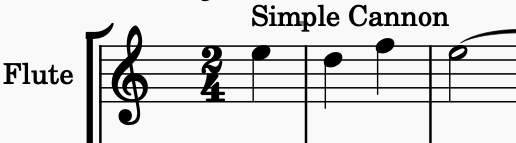
Rameau discusses how to make a simple four part canon at unison (that is, each voice entry follows unison). The easiest method involves a short melodic idea that follows a simple harmonic progression (e.g. I-V7-I). For my first try, I used this simple melodic idea: We can then add each of the 4 entries at their exact points, and realize the range of possibilities while avoiding parallel octaves 5ths. One limitation is that the final entry (where all voices are at once most likely taken by the bass part) may not correspond with established cadential voice leading conventions, unless the motif resolves from the leading tone or the 5th (as the case here). The second exercise I did was slightly more ambitious, utilizing secondary chords and greater diminution. I also embedded the leading tone in the second half of the motif in the interest of the above. Finally, as the second line approaches the V7-I cadence from the 4th (F natural) I depart from the stricter option of rising to the G (as the first part did earlier) in the interest of the conventional resolution of the V7 chord. In practice, Neidhofer & Schubert state that most imitative contrapuntal textures are neither strict canon nor free imitation but somewhere in-between. So it is quite justified to loosen the framework in such places. Play around with your own ideas... it doesn't need to be a masterpiece but at least adhere to the basic voice leading rules. I have composed canon's before but not as targeted exercises. Canon Practice.mp3 Canon Practice.pdf
 1 point
 -
A fascinating topic. And lovely examples. I’m a huge fan of counterpoint, but I learnt it to use in other styles, and the issue of parallel voices sometimes slips my mind in this Baroque or similar context. I have written a few canons at the octave, but not for four voices. However, I can think of a possible alternative method; I’m going to give it a go...1 point
-
1 pointHi Daniel! I enjoyed this piece - it has a dark, mysterious atmosphere. I'm a simple man, so when I listened to the cascade of notes at 0:35, it gave me a Rimsky-Korsakov - Flight of the Bumblebee vibe, haha. I like the start around 2:15; that is a good change that supplements more movement to this piece. This is well composed. Thanks for sharing! It would be nice if it were played in the dramatic Russian piano playing style with weight technique. Best, Lithl.1 point
-
Score PDF and Audio Download About the Piece: This piece is written for 4 soprano saxophones. It has three movements: “La soie,” “Le ciel,” and “Le soir.” Each movement is based on a stanza from the original poem by Paul Verlaine, “Donc, ce sera par un clair jour d'été.” ______________________________________________________________________________ I - La soie (The silk) ______________________________________________________________________________ II - Le ciel (The sky) ______________________________________________________________________________ III - Le soir (The evening) ______________________________________________________________________________1 point
-
Hi @Ninja Nolan ! I like the idea of using different movements to present contrast. The opening movement sounds like an introductory chorale to the piece while the last movement sounds like an ending chorale to the piece, much like the structure of a cantata. The centre movement is the main statement of the piece to me and I love the vivacity of the march, it sounds like opera buffa to me. I am expecting that after the Ab major trio the Eb major march will return as in a da capo piece. I think the texture of the piece can be more varied: mostly it is chordal except the march, and even in the march it works in pairs so rhythmically the whole piece sounds less varied. I think you can also add more contrast inside movement 1 and 3 as well, instead of only having the contrast between movements. Also it would be great if there are some coherence of materials between movements, but this point is subjective! Harmonically it's Baroque and more traditional. And for the text, I think the 3rd movement shouldn't be tragic as in your music with the corresponding stanza: And when the evening comes, the caressing breeze That plays in your veils shall be sweet, And the peaceful gazes of the stars Shall smile benevolently upon the lovers.I myself cannot link the tonic G minor with the happiness of the stanza. The 3rd movement sounds more like a contemplative reflection of something sadder than portraying peace and love in the poem. But this point is also personal and subjective! Thx for sharing! I know I am nitpicky in this comment, but I do like the music especially the 2nd movement, thx for joining the competition! Henry1 point
-
Hi @Fruit hunter ! I really like this piece, again like the last competition piece you write with percussion instruments and portray childhood (to me). This time your instrumentation is more keyboard based and I really like your usage of vibraphones with tone clusters which create a distant and nostalgic mood of the past. To me the slow sections are passages representing the attempt to get into the past memories and the fast sections are those vivid childhood memories. The passage in b.51 is so funny, it's like when the students are playing the school bell rings and the play is somewhat forcefully stopped. (Even though here it's the memory stopped) What I like less is the passage in b.131. I know you want to change the mood of the piece but the instrumentation there reminds more of a religious setting than a nostalgic setting, which sounds a bit out of place to the entire piece. Like Mike some of the passages I need to leave the earphone because of the high frequency and volume, particularly passages after b.162. I think for the mallet issue even if you can change them instantly yourself, it's always more friendly to the percussionist some seconds to change the mallets. Like @Luis Hernández said there's a lot to learn from this piece. Thx for sharing! Henry1 point
-
1 pointHi I’ve really enjoyed these pieces you’ve mentioned. Video game music and the like is a subgenre that fascinates me, but one I know very little about. I’ve carried on listening to a few more tracks. I think the orchestration is very rich and colourful. It’s true that the brass really stands out. Thank you.1 point
-
1 pointHi, the simple question is, what is your favourite ever piece of music? Mine is this, by the way.1 point
-
As a violinist, I've always felt today's musical landscape is missing something with the general absence of any modern violinist-composers along the lines of Paganini, Wieniawski, Sarasate, and so on to contribute new and exciting pieces to the repertoire. But since I'm both a violinist and a composer, I figure I might as well throw my hat in the ring and try to fix that. I've written four pieces by now, though I'd only ever performed two -- until recently, when I got to premiere the third. I composed this piece back in 2020, shortly before the entire world shut down. But recently I finally found a good opportunity to perform it, so I gave the "world premiere" on November 9, 2022. Unfortunately it was not recorded except on a phone at the back of the hall, and the massive echo made it sound pretty muddy. So I got a recording session in today in order to get higher-quality audio. Here's the end result: https://www.youtube.com/watch?v=WghXNdOc-VY The indication "harm." in the part is not me being too lazy to make diamond noteheads -- it is the notation used by violinist Roman Kim (one of my biggest inspirations and another torch-bearer of modern violin composition) to indicate the use of the forced harmonics technique he invented. It sounds one octave higher than written, is fingered exactly as written, and always lasts until the following "ord." mark. They appear at timestamps 2:15 and 3:56. While exceptionally challenging to master, they unlock some sounds that would otherwise be impossible to produce, so I think it would be interesting if the technique could become more widely learnt and incorporated into more modern violin writing.1 point