Leaderboard
-
Luis Hernández
Members111Points3,379Posts -
Henry Ng Tsz Kiu
Moderators85Points3,120Posts -
PeterthePapercomPoser
Admin53Points2,928Posts -
Alex Weidmann
Members45Points578Posts


.thumb.png.8b5b433a341551e913a34392660bc95b.png)

Popular Content
Showing content with the highest reputation since 08/02/2026 in all areas
-
(Originally written for my Substack - welcome to follow me there: https://substack.com/@markoloco95) It is not often I stumble upon music by Johann Sebastian Bach that I had not heard before - especially among his cantatas that I have grown to obsess over. Then came Zerreißet, zersprenget, zertrümmert die Gruft (BWV, 205), a lavishly scored ‘secular’ cantata with the the full might of the baroque orchestra, including three trumpets, timpani, two horns that in the opening chorus come together in such a way that resembles the festive character of his better known celebratory oratorios (his Easter and Christmas Oratorios & the Magnificat in D). My interest soon extended beyond its aesthetic appeal, however. Quite often I read the accompanying commentary to these cantatas to better understand what Bach was depicting exactly, made all the more necessary as a non-German speaker experiencing this music outside of its historical context and ~300 years later (Bach wrote BWV 205 during August 1725). Little did I know that this reading about BWV 205 would lead me down a significant rabbit hole that I now have the pleasure of sharing. The ‘profane’ cantatas Bach himself made no explicit effort to create a systematic taxonomy of his cantatas between the sacred and the secular; this was more a posthumous scholarly construction (his son, CPE Bach, was among the first to do so). Interestingly, the term ‘profane’, I learned, has traditionally been applied to his secular cantatas. A contemporaneous reading of that word may imply something that is anti-religious, blasphemous or morally corrupt - this was indeed my initial impression! Rather, ‘Profane’ comes from the Latin ‘pro fanum’, which originally designated what is ‘outside the temple’ - or outside liturgical or sacred use (Charlton, 1897). Its usage to classify his secular cantatas seems to have emerged only from 1885 - in French criticism - by one René de Récy, who states in his ‘Jean-Sébastien Bach et ses Derniers Biographes’ “une autre composition du maître, celle-là toute profane” (p 415) (another composition by the master, this one entirely profane.) The French Dictionary defines profane as “l'art profane et l'art sacré” (“secular art and sacred art”), and we have no reason to doubt that its usage in French musicological expression principally meant ‘non-liturgical’. Nonetheless, the semantics of the word remains problematic considering its historically recognized extended meaning, stated in the first edition of Dictionnaire de l’Académie française (1694): C'est une action profane & impie" (It is a profane and impious action) While it may seem that I am venturing into unnecessary abstraction, this is important context. The libretto by Picander for BWV 205 is inspired by Greek mythology. How could Bach - whose art has come to embody the pinnacle of divine Christian expression in music- also write music inspired by paganism particularly with the same quality of musical-rhetorical devices that underpin the former? On the use of classical mythology It is true that early Christian writers exercised hostility to worship of pagan deities, maintaining that practice as a falsehood. This extended to use of violence to subdue paganism in parts of Europe (the Northern Crusades, for example). Yet a remarkable amount of pagan culture was preserved through art, often explicitly since the Renaissance. At face value this is contradictory, but can be rationalised. The fact is that many of the christian clerics shaming the pagan cults from antiquity were often themselves inspired by the very writers whose works were imbued with a pagan spirit. The intellectual influence of writers such as Homer, Plato, Virgil, Cicero & Ovid, for example, on Christian Europe remained significant. The answer to this conflict was eventually through the secularisation of the Greco-Roman religions, whose deities came to represent literary figures, allegories and rhetorical symbols. By Bach's time, Christianity had already long appropriated ancient culture as an acceptable and educated symbolic vocabulary for artists to deploy in their craft. History and Text of BWV 205 The cantata was commissioned by the students of Leipzig University in tribute to August Friedrich Müller, a lecturer in philosophy and law at the university. It was apparently performed outdoors near Müller’s house in the Katharinenstraße - many magnificent townhouses were built in the baroque style during the early 18th century on Katharinenstraße and regarded as the most magnificent street in Leipzig. Café Zimmermann on the Katharinenstraße where many of Bach’s secular cantatas were first performed Picander’s libretto depicts a mythological clash centred on Aeolus, the Greek ruler of the winds, and his seasonal release of autumnal storms. He takes the storm episode from Book 1 of Virgil’s Aeneid, in which Juno, wishing to prevent Aeneas from reaching Itality, travels to Aeolia and asks Aeolus to release the winds against the Trojan fleet. In the book, Virgil describes Aeolus as a sovereign ruler who keeps the winds imprisoned inside a vast cavern in Thrace, struggling against their chains and reverberating the mountain. He retains their passions and rage and without his governance, the world would be swept away (Packowski, 2007). The libretto of the opening ‘Chorus of Winds’, with English translation: Zerreißet, zersprenget, zertrümmert die Gruft, Tear up, burst apart, smash to pieces the cave Die unserm Wüten Grenze gibt! that sets limits to our rage! Durchbrechet die Luft, Break through the air Dass selber die Sonne zur Finsternis werde, so that the sun itself may turn to darkness Durchschneidet die Fluten, durchwühlet die Erde, cut through the tides, rage through the earth, Dass sich der Himmel selbst betrübt! so that even heaven is distressed. Aeolus, a Greek god of the wind How Bach Depicts the Winds in the Opening Chorus (Chorus of the Winds) Bach makes extensive use of contrary motion - instrumental lines moving in opposing directions - in the opening chorus. From bar 5, for example: From Bar 5 (violins & viola): 2nd violin and viola descending in thirds against the rising first violin part From bar 16: (flutes and oboes): contrary motion again emphasized, with wind parts moving in opposing directions. From bar 20: more elaborate example imitative counterpoint in the minor, dominated by contrary-motion scalar figuration: the bass, strings, oboes and flutes each play their own contribution to the counterpoint in unison. The effect is a flurry of independent and contrasting motifs, much like the motion of a violent storm. Some 'word painting' highlights The passage contains remarkable word painting, in which the ‘Zerreißet’ (English: tear up) is presented as though torn to pieces through fragmented imitation with staggered entries. Its three syllables are separated into short attacks, interrupted by rests (depicting the winds as scattered and violent) before consolidating into a cadential block. It is also interesting to see the cadence on ‘Gruft’ (denoting the prison or cavern) is set in longer, more stable notes. From Bar 29: ‘Zerreißet’ (tear up) before consolidating into a cadential block Starting with “Durchbrechet die Luft” (“break through the air”), the B section immediately provides a contrast to the earlier fragmented assaults of “Zerreißet”. Here, Bach gives way to a homorhythmic pattern as though perhaps the dispersed winds have now combined into a single current, before descending to a cadence in F minor as the sun turns to darkness. From bar 85: Durchbrechet die Luft, Dass selber die Sonne zur Finsternis werde, (Break through the air so that the sun itself may turn to darkness My final highlight From Bar 102: “Durchschneidet die Fluten, durchwühlet die Erde, Dass sich der Himmel selbst betrübt!” (cut through the tides, rage through the earth, so that even heaven is distressed.) Look at how how Bach treats "Himmel selbst betrübt" ("Heaven is distressed") , here. Bach prepares a cadence in b minor, but on "-trübt" he abruptly shifts to the dominant (f sharp minor). Notably his vocal writing suddenly shifts to a perpetual type of motion, while the continuo retains the rapid scalar motion that maintains the image of turbulent wind. The passage finally closes with an end to the B section in the key of F sharp minor. Together, this f# minor passage is evocative of a mighty storm that gives way to cadential consolidation. And contrasted with the restorative de capo (return to A section) that follows, Bach juxtaposes - almost theatrically - the cosmic consequence of the destructive power of the wind where even the heavens are plunged into distress, and with their original demand to "tear, burst and smash" the cavern containing the winds. Closing remarks From hearing this work for the first time last month, this has evidently become quite a rabbit hole. Notwithstanding Bach's sheer genius in his use of musical rhetoric to depict these classical myths, what's perhaps more interesting his that this rhetoric closely resembles that which he applied in his sacred cantatas. It demonstrates his ability - and indeed willingness and adaptability - to transfer musical-rhetorical techniques between both sacred and secular contexts. Being less familiar with his secular cantatas, for me this has added a new dimension to Bach and which deserves much more exploration. Indeed, it appears that his secular cantatas have received relatively less analytical attention from Bach scholarship, which I suspect has historically been drawn more strongly to the theological and devotional significance of his sacred works. Sources Académie française. (1694). Le dictionnaire de l’académie françoise. Paris, Vve de J.B. Coignard. Internet Archive. https://archive.org/details/bub_gb_VEw4AQAAMAAJ Charlton, L. (1879). A latin dictionary Lewis and short. Internet Archive. https://archive.org/details/in.ernet.dli.2015.147309/page/n1459/mode/2up For "Profanes", see Page 1459 Paczkowski, S. (2007). A Polonaise Duet for a Professor, a King and a Merchant: on Cantatas BWV 205, 205a, 216 and 216a by Johann Sebastian Bach. https://www.bachnetwork.org/ub2/paczkowski.pdf Récy, R. de. (1885). JEAN-SEBASTIEN BACH ET SES DERNIERS BIOGRAPHES. Wikisource. https://fr.wikisource.org/wiki/Jean-Sébastien_Bach_et_ses_derniers_biographes6 points
-
Hello everyone! The following post in my formal submission for the 2026 Summer Competition: From Nothing, to Something. Below includes a detailed and extensive explanation of the work, both in inspiration and construction. If you wish to skip, the score PDF and Audio will be found at the end. Thanks and talk to you all soon! [TAKEN FROM SCORE] Plus belle encor votre chère beauté - Your dear beauty lovelier still Duration: c. 6:08 Written in 2026, Plus belle encor votre chère beauté is a work for piano quartet that evokes summer and the experience of love. It was composed for the “2026 Summer Competition” hosted by The Young Composers Music Forum and is inspired by Paul Verlaine’s poem “Donc, ce sera par un clair jour d’été,” whose opening line may be translated as: “So, on a bright summer day it shall be.” The poem is number nineteen in Verlaine’s collection La Bonne Chanson (The Good Song) Find the French text and translation to the poem here The title of this work is drawn directly from the French text and has similar inspiration as the Gabriel Fauré song from his op. 61 bearing the same name as the Verlaine poem. However, this work takes the title from the fourth line of text, and unlike Fauré, this work is late-romantic in style. The musical inspiration came from two places: Tchaikovsky and his Nutcracker ballet, and a spell of improvisation at the piano. This work was created in late July and early August 2026, and during that time, I was experimenting with modal improvisation, and felt drawn to G-lydian. Specifically, the ivø7 chord you can build and find in Tchaikovsky’s music. It was also around this time I was listening to parts of the Nutcracker, where I felt drawn to the idea of harp-writing, and thus, during a period of improvisation, the foundation of this work came to be. With structure, Plus belle encor votre chère beauté is in ternary (A-B-A’) form and includes an intro and coda. The B-section acts as our development while the outer A-sections are comprised of a smaller AABA form. The principal theme stated in the A-section occurs throughout the work, where it can be heard in the introduction, coda and within the development where the piano states the principal theme in inversion. Lastly, I composed this work following the end of a relationship. In short, this work evokes those unspoken emotions I harbored and the romance I long to have one day. A day where I too can say “Your dear beauty.” PERSONAL NOTE: For me, the connection to this text, and now to this piece of music, is very personal. By the time this post goes live, my last relationship, of more than a year, ended a month ago. I will leave my thoughts on the matter with this: while rare in occurrence, being in the throes of thought can make the weight of longing feel immeasurable. However, amidst the satin and silk, this piece came to life. To add some fun for the competition, and incase people worry the music is not playable, I can assure you everything on the page works and is practical. However, better to put money where my playing is. A few hours before posting, I decided to record myself playing the work and trying out things. I originally improvised it on piano and this was one of the few times I tried to mimic what is on the page. It is not 1-to-1 and I made certain liberties in performance, however, this was fun to do! (This YouTube video is not my official audio entry for this competition. MP3 for score can be found below. Also, my camera was not in focus during the take... grrr) Thanks for reading, and I hope you enjoy! (The art on the cover page is Claude Monet's "Woman with a Parasol." A wonderful piece of art!) AUDIO_YourDearBeauty.mp3 SCORE_YourDearBeauty.pdf5 points
-
5 pointsWhen it comes to personal style, as a composer, it is hard to describe what that style would be. Yes, I compose ensemble pieces (rather solo or chamber) or full orchestra, too. However, period style is not going to be same. The term best fits me is "polystylist". This means I could possibly write in different styles. For instance, my Halloween piece was written for string quartet but the style 20th century. (note; I could have written a serialism written for that competition...). Currently, I working piece that sounds neo classical for the next competition. Joe Hirashi was the inspiration for the piece. My personal taste is open book. Heck. George Leigti works are always fun to listen to. And who does not want to listen a post tonal composition that has clusters and other modern jazz. :) The problem is...midi can not play back alerotical boxes and clusters. Only live musicians can. Thus, that is what trying figure out, next. How to have play back in score. (maybe use a daw?)5 points
-
5 pointsHi! I am continuing my revision on my old work. This is the 2nd movement of my Clarinet Quintet in C minor, which is completed 4 years ago and I'm revising it. Thx to my friend @Thatguy v2.0 for making the audio! To me this is probably the worst movement in the piece, but only because it's the most one dimensional one: After the discovery of despair in the 1st movement, I started to fall into confusion and craziness of despair. Ironically this movement is written in a neat Sonata form with the structure presented below: 0:00 First subject, exposition. Start right from the despair Eb-D-C-B motive in quick Scherzo time to represent the fury and confusion of despair. Clarinet joins in 0:31, still playing at the despair motive, and in 0:33 the whirling figure using despair motive signifying the confusion is introduced. 1:27 Transition, exposition. I like this pizz. theme myself for how sarcastic it is. 2:34 Second subject, exposition. In F minor. A more "reasonable" theme finally with major keys visited, although finally succumbed to the confusing despair. I always go to F minor instead of G minor for the secondary key of a C minor movement for its darkness. 3:46 Development. Continue with the confusion by quickly modulating to different keys. I really love the 3:59 passage with a Brahmsian turn to a German sixth chord in 4:09! The fury ends with a "transcended" sadness in Neapolitan C# minor in 5:20 with a clarinet solo, but sarcastically laughed off by pizzicato strings in another Brahmsian German sixth. 5:49 First subject, recapitulation. Excitement reduced after a suffocating development. In 6:02 obviously I learn from Beethoven's 5th for that famous solo oboe passage. I love how fierce it is in 6:38. 6:47 Transition, recapitulation. Shorter than exposition's transition. I hate exact repetitions. 7:25 Second subject, recapitulation. Same as the one in exposition except in tonic key. Notice how relative major Eb major is finally used with some emphasis for the very first time in the piece, as the confrontation of B flat carried by E flat major and B natural by C minor of the despair motive would be the main battlefield later on. 8:38 Coda. One last cry and I am exhausted by the despair, thus ends the movement in tired pizzicato chords. Only with this exhaustion do I have the motivation to excavate the true reason behind the despair, which would be the main theme for the 3rd movement. Here is the score and youtube video of the movement : (For YT)Clarinet Quintet in C minor 2nd mov Final Version 20260707.pdf Harmonically I deliberately play with chord progression of augmented triad keys to reinforce that particular chord both horizontally and vertically, as well as resonating with the despair motive. Hope you enjoy this one and offer some critique to the movement! P.S. This is the 1st movement of the remastered version of the work: Henry Clarinet Quintet in C minor 2nd mov Final.mp35 points
-
I'm not done with the score for this yet: so please forgive the sloppy notation. Just hoping to get some comments on my orchestration choices before I finalise it. I know there are arrangements of this piano work for various ensembles; but I couldn't find one for symphony orchestra: so I thought I'd make one. Hope you enjoy listening! Rachmaninoff - Elegie in E♭ minor (orchestration) #26 (midi).mp3 Rachmaninoff - Elegie in E♭ minor (orchestration) #26 (midi).pdf5 points
-
5 pointsI don’t think that you—as a composer at this level, as here at the YCF—should try too hard to develop a personal style, since it seems impossible to me to even intend to do so; for, on the one hand, “almost everything” already exists in terms of musical forms, systems, and languages, and on the other hand—even if one of us were the absolute genius who shapes and influences an entire era—he would unfortunately never live to see it, since such groundbreaking developments are usually only recognized decades or even centuries after the composer’s death. With that said, one should not bother much about it, since a personal musical language actually develops almost automatically as long as your composition exercises and works aren’t too “random,” you follow a consistent approach in your work, and try to incorporate only a few influences from different musical styles or languages into your next piece, rather than imitating a specific style in one piece and then switching to the style of a completely different composer or era in the next. After a year of being a member here on the forum and participating in three competitions or events, I think, I could identify some composers based on their “personal style”—for example (this is a very arbitrary list and by no means exhaustive …): @UncleRed99 – famous for the „warmth“ in its pieces, its chord progression and beautiful utilization of woodwinds. @Fruit hunter – very interesting percussion pieces. @Fugax Contrapunctus – everything about fugues and canons in an extremely thorough, intellectual (and even theoretical) way. @HoYin Cheung – mostly atonal pieces, especially for strings. @L.S Barros – influenced by renaissance and baroque, often utilizing brass ensembles and perhaps myself – counterpoint composition technique, voice leading, and mixed with influences from the 20th century, always starting as piano piece, but more and more orchestration examples ... Maybe for one of the next contests, we could make the submissions anonymous and award badges to the reviewers who correctly guess the most composers… (perhaps a silly idea).5 points
-
5 pointsHello my friends! I’m happy to present my Binary Sonata No. 26 to you as well. I hope you enjoy it!5 points
-
5 pointsIt has recently come to my attention how some composers approach their music-making very technically - labeling chords, roman numerals, showing modulations etc. But this kind of approach is very much the opposite of how I write music. I studied all those technical aspects of music as well of course. But how I make music now is very much based on my gut feelings and intuition rather than technical rules. I am still tangentially aware of all those technical aspects of my compositions of course. But inspiration, for me, comes first and the technical understanding, after. How do you approach composition? Which approach do you value more? Technique or Intuition? Which comes first and which is secondary?5 points
-
5 pointsI’ve just finished my Serenade for String Orchestra, a piece that ended up having a rather unusual composition history. Some of the material goes back to 2021, while the first two movements were written mostly in 2024, and I finally completed the work this August with the Elegie and Finale. It wasn’t originally conceived as a single continuous project, but over time the different ideas seemed to belong together and eventually became this five-movement serenade: Präludium, Scherzo, Intermezzo, Elegie and Finale. Despite the different periods in which it was written, I think it ended up having a fairly consistent character—mostly light and calm, with the Elegie providing its more introspective moment. I. Präludium — A calm, pastoral opening that establishes the overall character of the work. II. Scherzo — A very fast and light movement, providing the most energetic and playful music of the serenade. III. Intermezzo — Relaxed and flowing, almost like a leisurely walk, without becoming overly reflective. IV. Elegie — The most introspective and melancholic movement, gradually building towards a more intense emotional climax. V. Finale — Begins with a tonally unsettled, march-like introduction before breaking into a bright and joyful A major conclusion, with brief returns of material from earlier movements. Hope you enjoy it, and I’d be very happy to hear any thoughts or feedback! Serenade.pdf5 points
-
Hello everyone, I am back to feature an overhauled work of mine: The Tuckasegee Flyer. CONTEXT: Originally written in 2024 by commission from my friend, Brody, this work was meant to accompany a YouTube video series he was creating. Two years later, and during this summer, I felt in a trough of composition. I have sketched a lot of ideas for themes or independent phrases, however, I had no passion or inspiration to make them into full pieces. So, after looking through my file system, I looked through this work and immediately, I had ideas. This work is an orchestral depiction of what it feels like to ride behind a steam locomotive as seen or felt by a passenger. If you would like to know more specifics and a longer explanation of the work, go to the 3rd page of the PDF (which is listed as page 1 due to the front and back of the cover page). Thanks for viewing my score and taking a listen! (Comments welcome) This work in its current state would not have been possible without the support of friends and fellow composers. Big thank you to @UncleRed99 for his help with understanding brass ensembles as well as non-YCF composer @Arbolav for his help in the development. You two elevated this piece and I am forever thankful! The Tuckasegee Flyer_AUDIO.mp3 The Tuckasegee Flyer_SCORE.pdf The Tuckasegee Flyer_SCORE.pdf The Tuckasegee Flyer_SCORE.pdf5 points
-
5 pointsI really liked the replies and I couldn’t agree more. The ultimate purpose of music, as has been pointed out, is, I believe, to evoke emotions, whatever they may be. And taking it to extremes, whether one relies solely on inspiration or bases everything on theoretical and technical considerations, the result will be ineffective. I don’t think there’s a single composer, including in pop music, who has achieved any real success by relying predominantly on one or the other. Many pop musicians don’t have much technical training, but they have teams behind them who make up for all that. Relying solely on inspiration and intuition is like a surgeon who operates with great talent but knows nothing of anatomy. Conversely, an anatomist cannot operate on the basis of theoretical knowledge alone. These are inseparable aspects for any composer of even the most basic calibre. And as has also been said, ultimately it becomes a naturally interwoven process. The idea, the inspiration, can come from a great many sources, but technical knowledge allows you to greatly improve the result in every respect. I also believe that, nowadays, many composers are eclectic and draw on elements from various musical languages, depending on what they think will work best for what they wish to express. I don’t know – the broader the range of resources, the more varied and better the results can be. It’s like being a chef with 10 ingredients or with 100.5 points
-
5 pointsGreat topic! I would personally argue the two are inseparable. Sure some may choose to emphasise one over the other as more important although that creates a false binary, and probably reflects their experience and training. Music is a form of human expression that is built upon a language that has been continuously shaped according to technical innovations, fashion and the political, economic and social conditions of the time. I'd argue that the syntax of that language, with enough training and application, becomes second nature - much like how we speak our native language. That is the intuitive aspect of producing music and which has greatest utility when producing an outline. The obsession with Mozart's compositional process, given his mythologized status, has helped us understand he produced his music by completing the outer parts first and I expect that has been the common practice across the board. Obviously, this still requires technical knowledge and proficiency in a plethora of domains not limited to form, structure, voice leading, and manipulating tonality; but is nonetheless a relatively free part of the overall process where 'inspiration' is most relevant. Much of what follows, in my opinion, is the process of adding complexity to that foundation. And this is where one's technical competencies really tend to shine: through orchestration decisions; enriching the voice leading and counterpoint between the various parts; the manipulation of ideas; and ultimately shaping of your ideas into a compelling construct capable of engaging your audience successfully. For me, the latter is often the most technically demanding, with increasing difficulty in accordance with structural complexity (compare the task of writing a conventional minuet with an opening movement to a suite in sonata-allegro form). Artistic inspiration without technical competency will have a tendency to lead to art that has 'potential' - at best - for the need of further refinement. And technically competent expression that lacks 'humanity' - so to speak - will may result in mechanical and uninspired art. AI music can sound a bit like the latter. There is a useful analogy that likens the depth of knowledge in music theory to that of an iceberg. The deeper one gets, the more abstract the concepts. But mastery of those deeper realms will provide the composer with a wider variety of tools to apply. One cannot simply be inspired to write a 4 part fugue; they would not get very far if they tried...5 points
-
5 pointsHello @PeterthePapercomPoser! Let's see, by "technical composition," do you mean things like deciding beforehand to resolve to a major chord here or using a diminished chord there to create a darker mood? Or perhaps composing using mathematical formulas? In any case, I personally feel that it’s best to use whichever approach fits the moment. For instance, even when inspiration strikes, I often fail to give it shape because I lack the necessary skills. At times like that, or when I have no inspiration at all, I’ll compose based on technical principles instead. Sometimes that process sparks a new idea, and the reverse happens too. Of course, if you consider a technical breakthrough to be a form of inspiration itself, then we’d really need to clarify our definitions, though perhaps this isn't the place for that. Sadly, I’m not a gifted composer, I just do it for fun, but I enjoy both methods because each is important and has its own unique appeal. Personally, I find it satisfying when I start with technique and end up creating something that matches what I envisioned. (And sometimes, creating something unexpected too!) Best, Lithl.5 points
-
Hello fellow composers! I wanted to share a short piece I wrote called Coastal Wind. With this piece, I was trying to evoke an open shoreline with gentle motion, changing light, and a calm but restless sense of wind over water. The instrumentation is small orchestra: string section, double woodwinds, and horns. The piece is in a simple A–B–A form. The A section, in A-flat major, features a woodwind duet melody over cello arpeggios. The B section shifts to B major and moves the melody into a darker, lower register with cellos, basses, bassoons, and low horns, while the arpeggiated motion moves into the woodwinds and violin harmonics create a soft background shimmer. The opening material then returns, and the piece ends quietly as the cello arpeggios gradually fade away. I tried to keep the harmony and form fairly clear, and focus more on creating a distinct atmosphere than building a large dramatic arc. I wanted the piece to have motion and energy, but still feel calm, lyrical, and restrained. I’d really appreciate outside ears on the composition, orchestration, mockup realism, balance, phrasing, use of register, or simply whether the coastal/wind-like atmosphere comes across. Thanks in advance! Coastal Wind Score - CONCERT SCORE Ver1.pdf4 points
-
Hi all - I’m back from a bit of a musical hiatus/summer break, and I wanted to share my latest orchestration project: Fauré’s Nocturne No. 1 in E-flat minor. Some of you may remember an earlier orchestration of this piece posted on the forum by @Alex Weidmann which I also reviewed at the time. That version gave me some ideas and eventually inspired me to try orchestrating the piece myself, although I ended up taking my own approach to it. I still think this is a surprisingly difficult piece to orchestrate. E-flat minor is not the friendliest orchestral key, particularly for the strings, harp, and transposing instruments. The piano writing also contains a lot of overlapping lines and inner details that cannot simply be transferred directly without the texture becoming too heavy. As an additional challenge, I limited myself to a relatively small chamber orchestra: two flutes with piccolo doubling, oboe, English horn, two clarinets, two bassoons, two horns, harp, and strings. I was thinking loosely of the scale and transparency of Ravel’s orchestration of the Pavane pour une infante défunte, rather than trying to imitate its sound directly. My goal was to preserve the intimate, nocturnal character of the original while passing the melodic material between solo winds, divided strings, and occasional string soloists. I also tried to avoid using the harp as a constant substitute for the piano, saving it instead for color and continuity. I’m interested to hear what everyone thinks. The score and audio are attached—thanks for taking a look! Nocturne No. 1 in E Flat Minor - Flow 1.mp3 Full score.pdf4 points
-
4 pointsLithl, I think about this all the time. In some ways, I think that pure music has been mostly "solved". As an avid chess player, it's like seeing Magnus Carsen play chess. He often just doesn't even bother with the best opening theory (which is once again...pretty much solved) but rather uses his innate abilities to play slightly weaker lines and grind the advantage out. But yeah, in pure musical terms...even if something is solved, I think there is plenty of room for innovation and individual expression. I think perhaps it was Schoenberg that said something like, "plenty of good music in C major remains to be written?" But yeah, I hear you man. Personally, I feel like it's hard to tell apart really scrafty music and music that sounds like scraggy if that makes sense. I sometimes feel I like need a PhD in music or some formal training to appreciate some of the music that sounds like scraggy. On the other hand, as you have stated, I sometimes feel because of the low barrier to entry to write and share music, there is a lot of really scrafty music out there that people should probably just keep to themselves. To your point about pushing buttons and getting novel sounds, I disagree about how you view this somewhat. Obviously as musicians, our greatest asset is our ears. And even if we are not directly making the sounds and even able to perhaps replicate the sounds on our own...music will always be music. At least that's what gives me hope as a composer. If it sounds cool and good, then it was worth it all along. Just my 2 cents, thanks for articulating some feelings about composition and starting a discussion.4 points
-
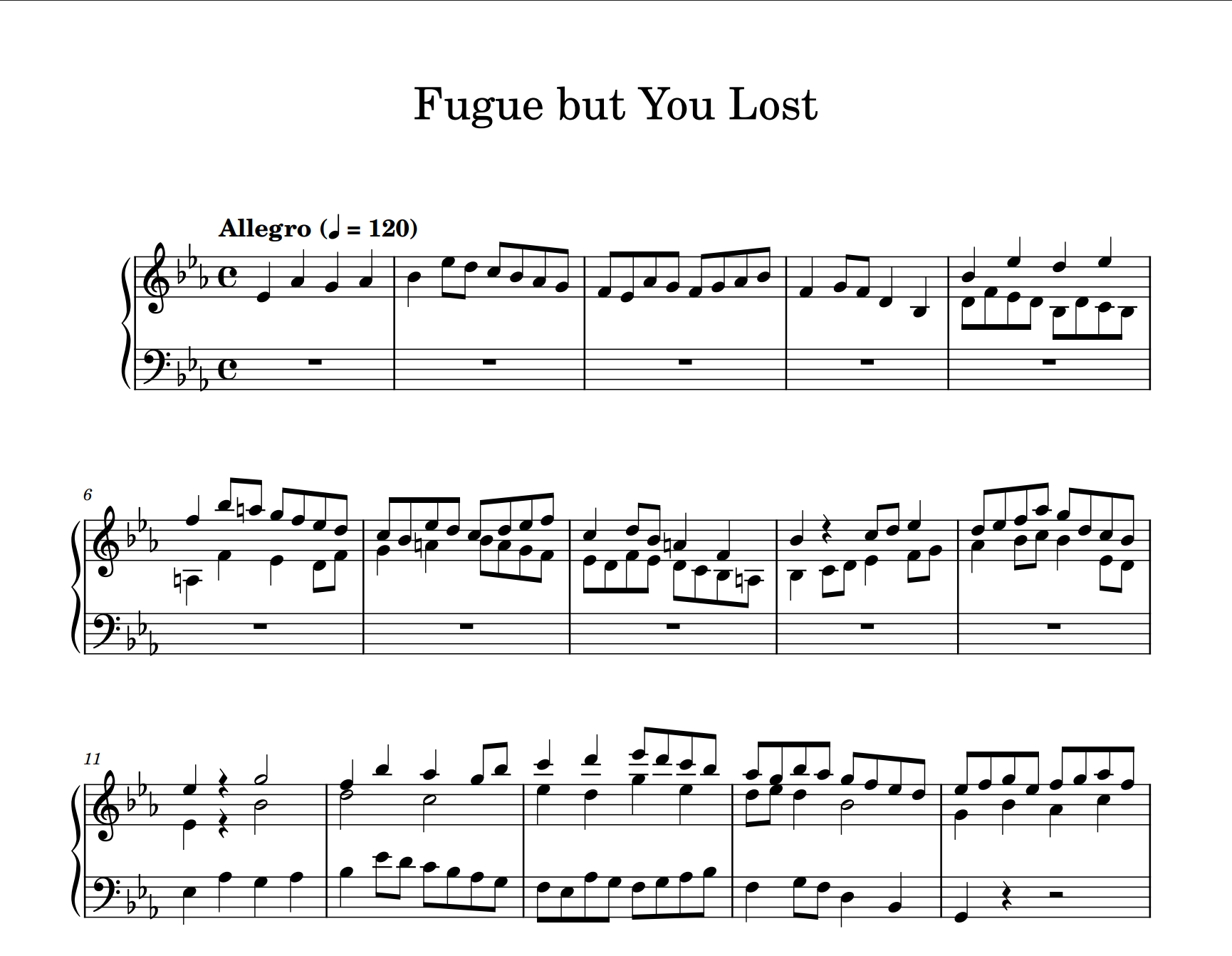
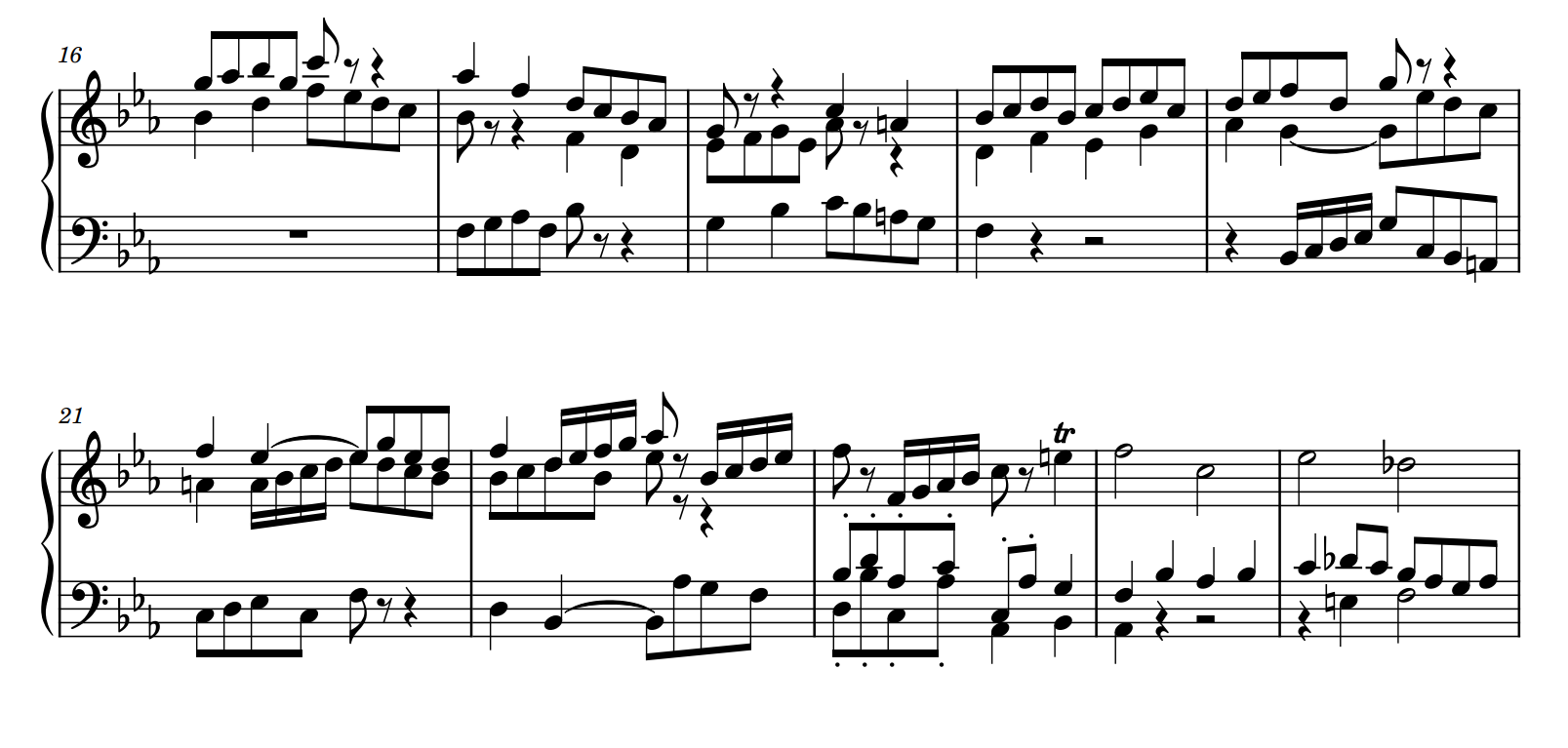
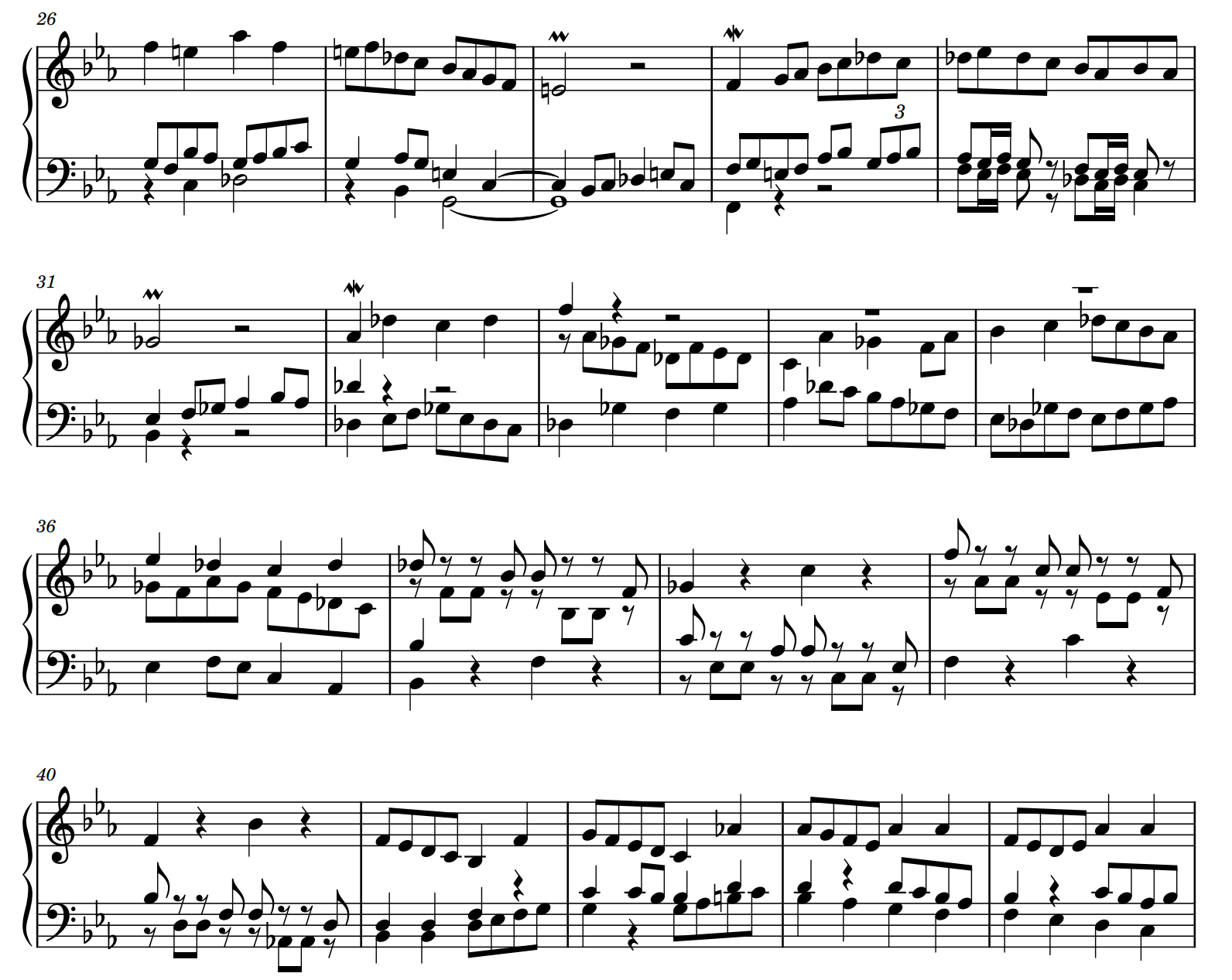
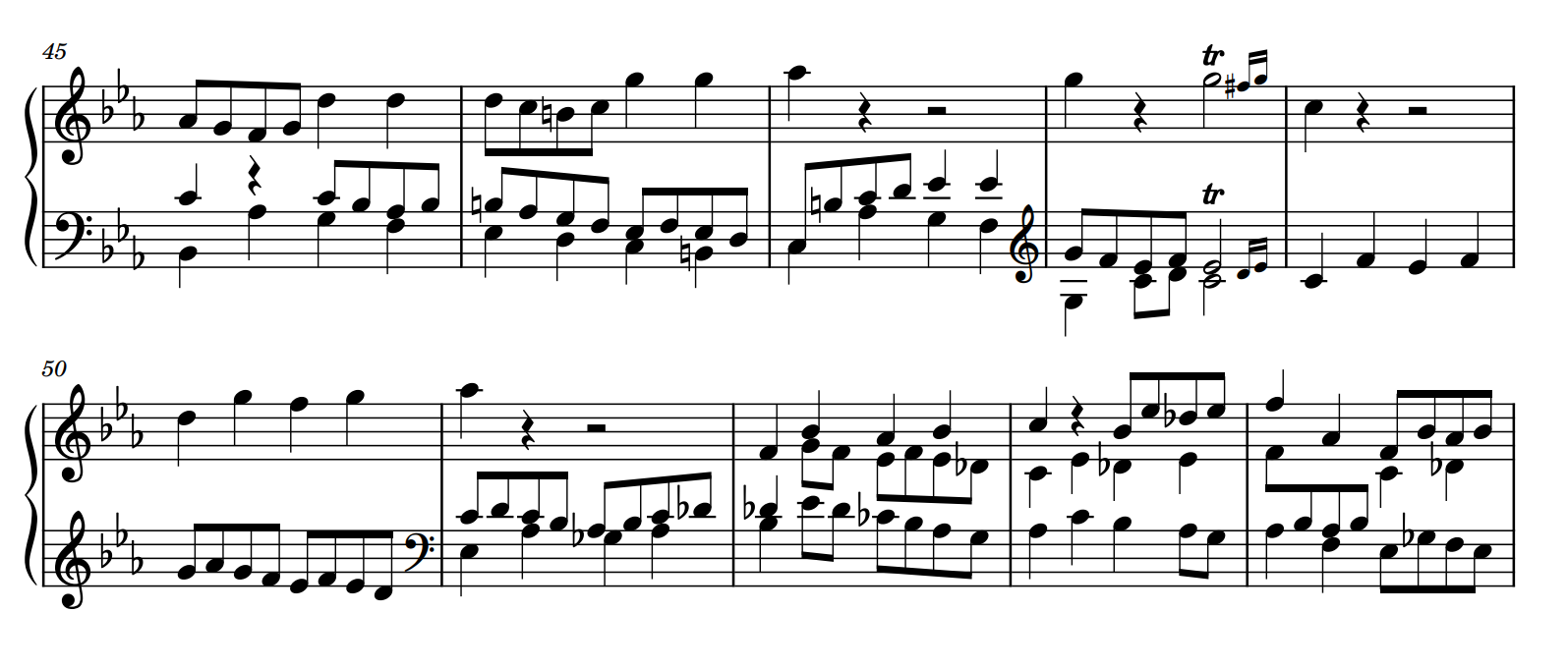
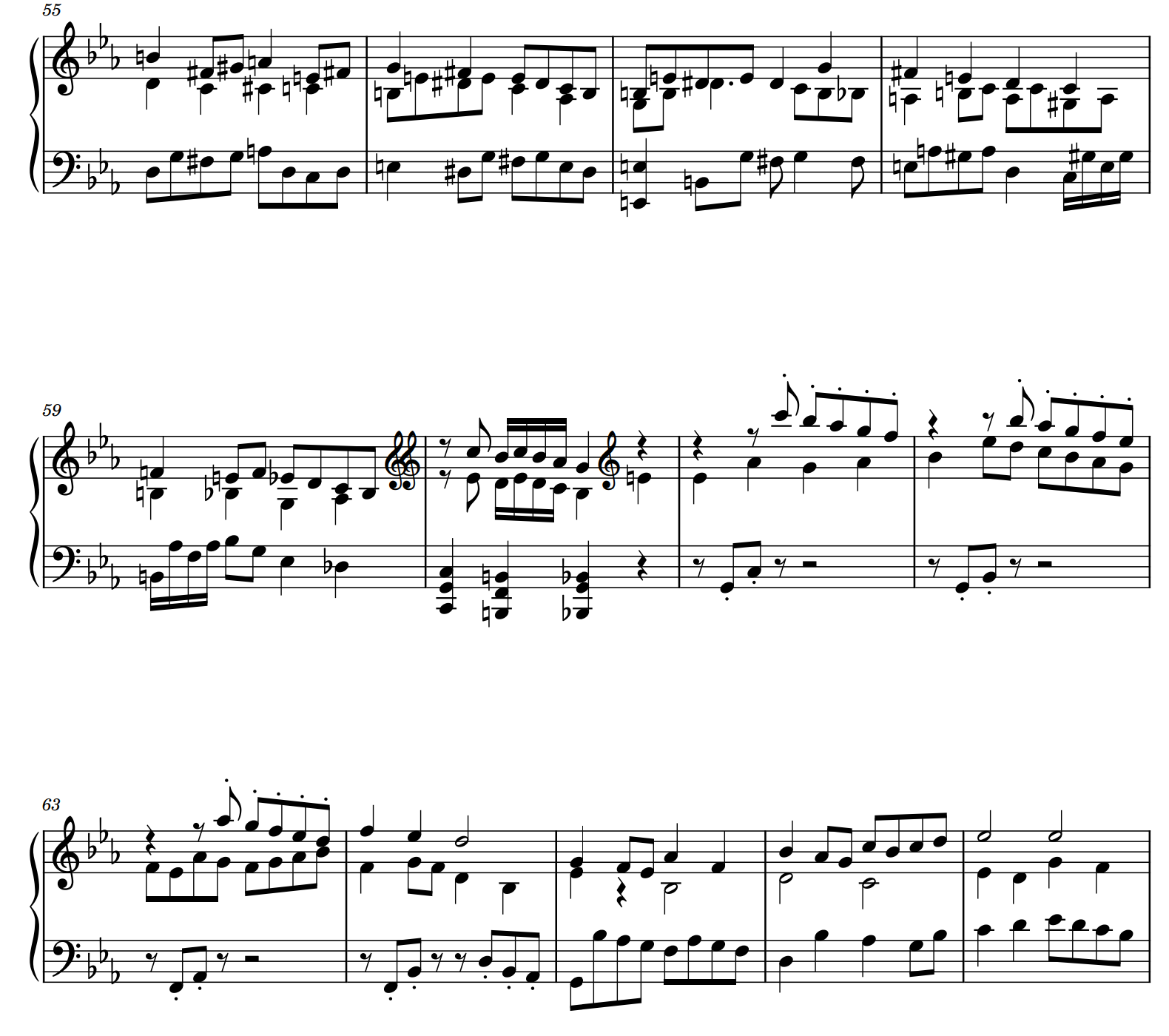
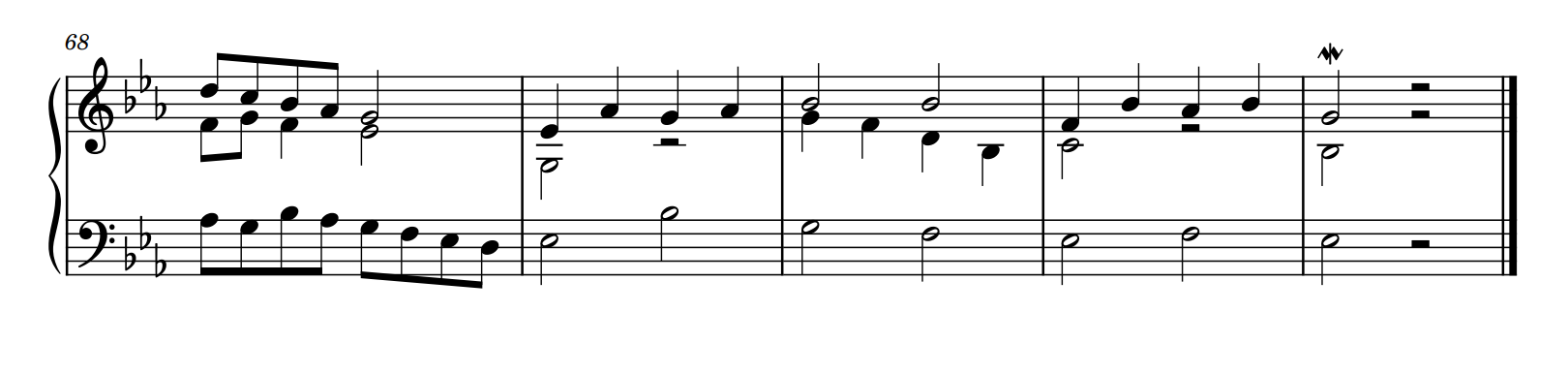
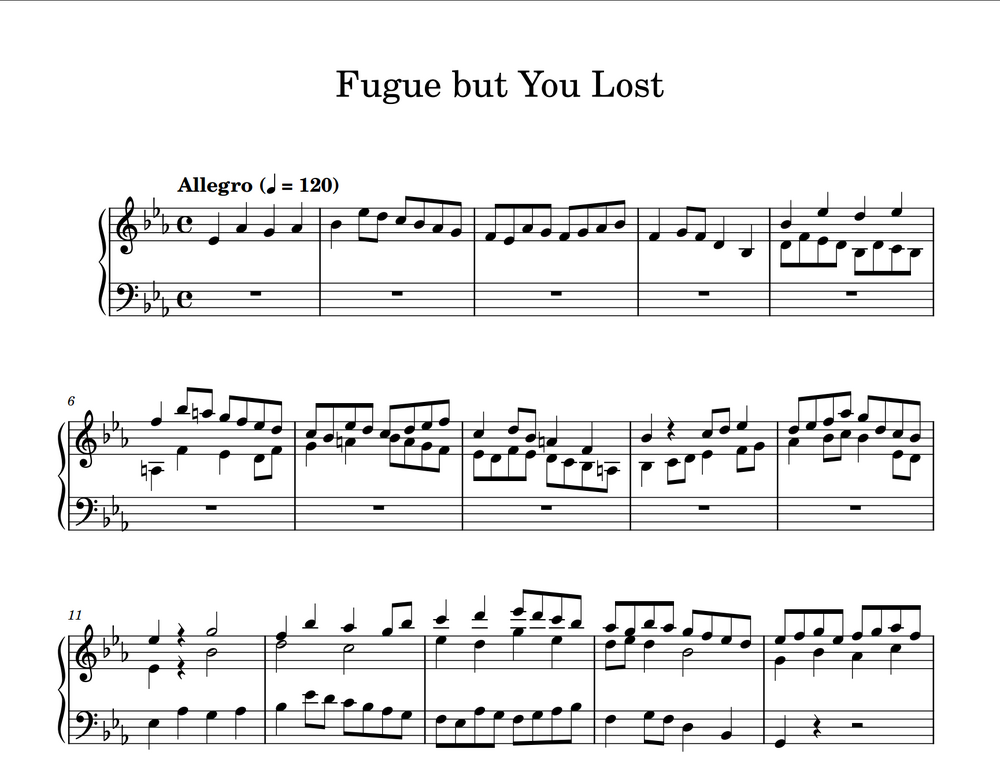
4 pointsAnalysis!!! Title+Bars 1-15 So, firstly, the title is just 'Fugue but you lost'. Where is the composer name? Also, I recommend (personal preference) saying something like Fugue on the theme of 'Insert something'. Writing 'Fugue but You Lost' kind of makes it seem unprofessional. (You have told us the reason behind it.) I like how you wrote Allegro (♩= 120). It gives an approximation of practice tempo (♩= 96) if this were to be performed. You never know. The beginning phrase (Eb Ab G Ab) makes it feel like Ab major a bit. I like how it is disguised. The whole opening phrase (bars 1-4) is is completely playable and musically intresting. Good job. Trouble starts at Bar 5, where you expect the performer to be Rachmaninov. Or Liszt. Or an alien. one of these three. Please do keep in mind that normal humans cannot reach such like the compound minor 6th in the first beat of the 6th bar. If instead you meant to split up in the two hands, however, then please delete or hide the rests. Do mind the parallel movements in the section. In Bar 11, a third voice is introduced effectively. We have heard the theme in two voices before. but now, it is also in the third. I would like point that the rests on Bar 11 Beat 2 feel completely unnecessary, and should just be a minim. (starting on the first beat). Bars 16-25 Bar 16, we have this nice ending to the ascension of a single hand. I do not believe that a rest is important here, as the notation should best kept simple and human-legible. By Bar 20, we already have semiquavers. Nice use of rhythm to add texture, although I don't really like Bar 23, with all of those staccato notes in the bass, although I love how you reused the main theme in the bassline of Bar 24. Bars 26-44 (Page 2) In Bar 26, you continue the development beginning at Bar 24. I really like this bar, and also the two bars right after. I don't really like the triplet in the bass of Bar 28. It feels unneccasary, and perhaps, a single G would do better. The following might sound better on a real instrument, so I will leave it as it is. It is a unique idea. Bar 31, that upper mordent could change to a lower mordent and the lower mordent in Bar 32 can change to an upper mordent. It feels more 'optmistic'... I don't know... Something tells me that is better. I also love how you came back to the theme in Bar 32. *passage from bar 33 to bar 36. Not too interesting.* Bar 37 introduces one of my favourite matierials in the whole fugue. You have used repeated notes to it's best extent at the best time you can in this fugue. Tremendous. This continues until Bar 41. Bar 41 feels too chunky. Bars 45-54 The passage from Bar 42 to Bar 46 is not bad, but Bar 47 is GOLD. That hesitation at the end of the bar feels like you are hanging on the side of a cliff. You reannounce the main material (I lost the game) in Bar 49-50 explicitly, but notice your great use of it in other places too, such as the bottom voice in 51, the top voice in 52, the second half of 53's top voice and the full bar of 53's middle voice. You also sneaked in even more in Bar 54, with that inverted material in the voice, and at the end of the bar you top voice, if you take out the bottom voice, only quarter note values found, you get Ab, F, Eb, F, which is also the inverted material! Absolutely ingenious section! Bars 55-67 (Page 3) Ok. Transition metals are Scandium Yttrium Lutetium Lawrencium Titanium Zirconium Hafnium Rutherfordium Vanadium Niobium Tantalum Dubnium Chromium Molybdenum Tungsten Seaborgium Manganese Technetium Rhenium Bohrium Iron Ruthenium Osmium Hassium Cobalt Rhodium Iridium Meitnerium Nickel Palladium Platinum Darmstadtium Copper Silver Gold Zinc Cadmium Mercury ... I did all of that as a joke... So anyways, you transition into a lot of different keys, I won't keep up. This goes from bar 59. I don't know what happened in bar 60. I guess I missed Sheet Music War 1 (SMWI). Seriously. Why are there 2 treble clefs? do you require such notation? Can't you just use a Tenor Treble Clef thingy? Also, there is something weird happening from Bar 61-63, but it sound good and seem playable to me so ok then. Bars 68-72 The rest is just a coda, which is good, but you could improve it by extending the note length of the final chord. Overall, it is a nice, cool, piece that has some potential! Congrats! -TristanTheTristan
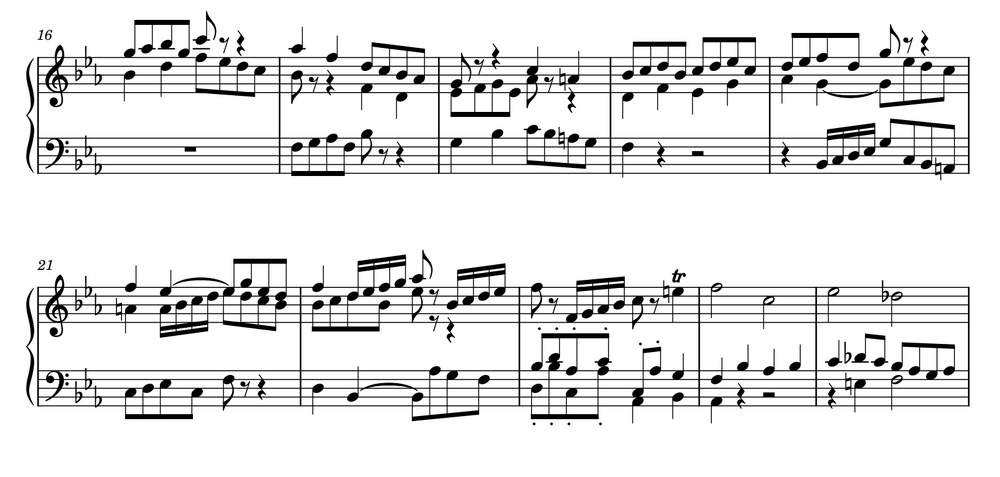
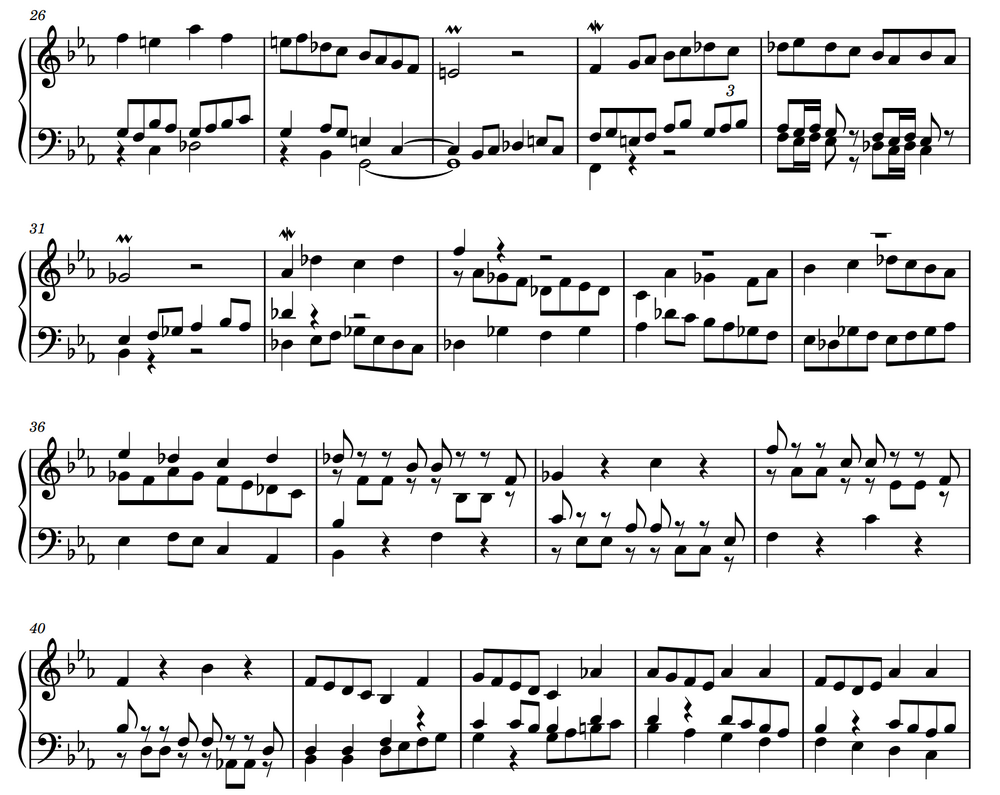
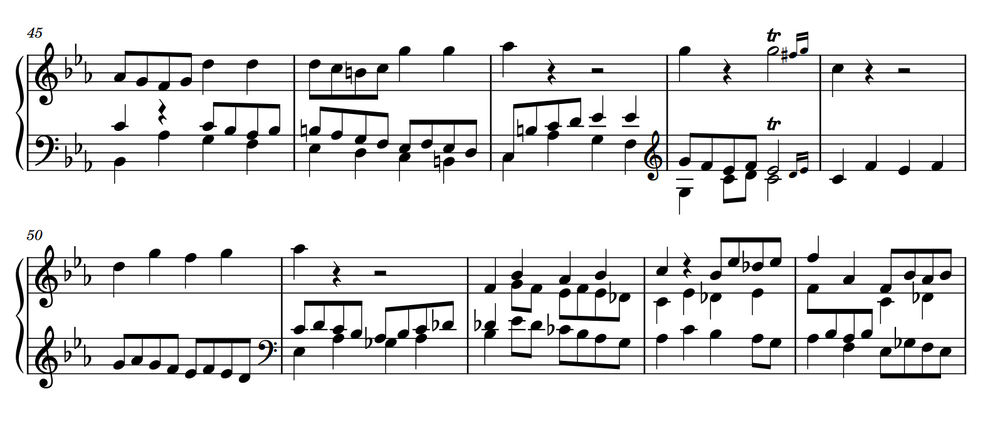
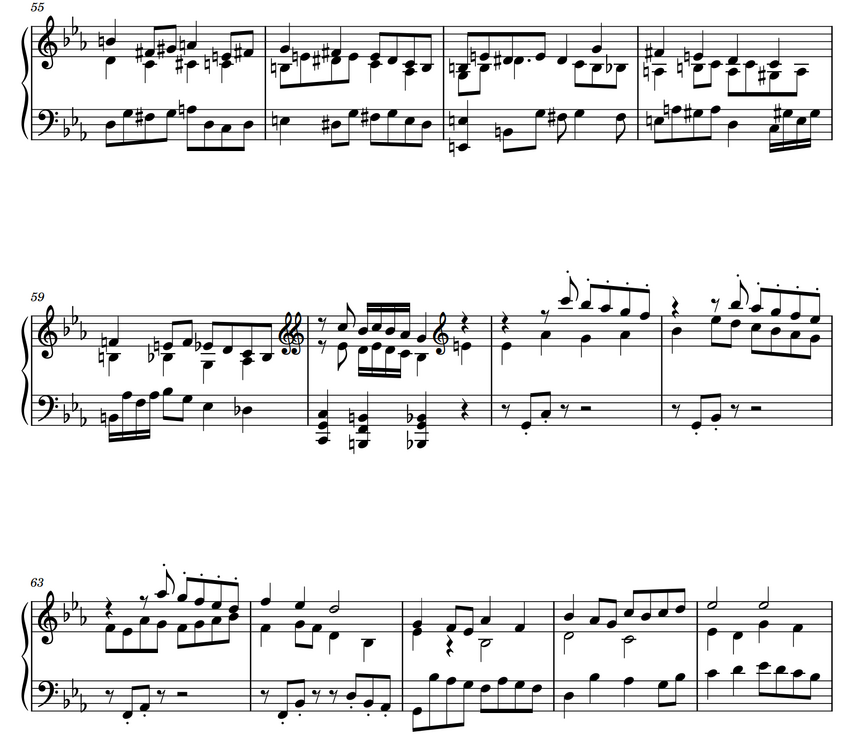
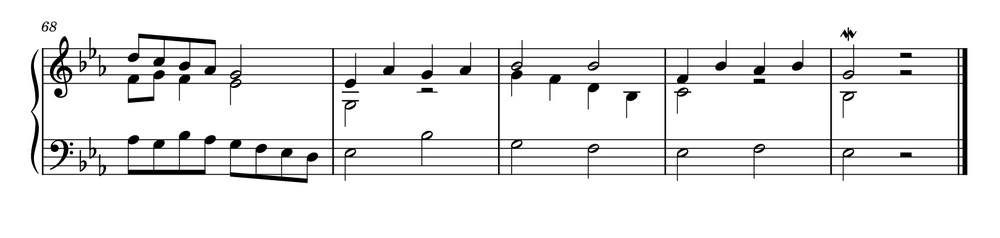
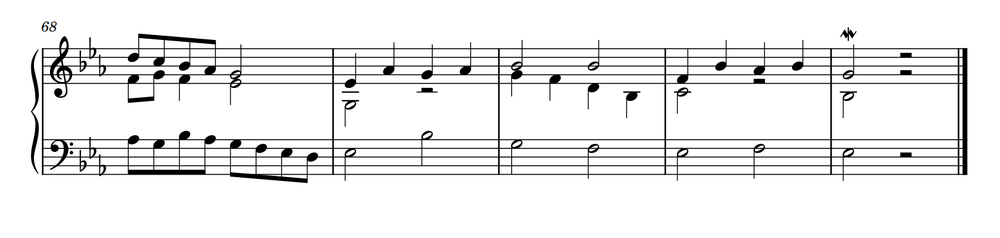 4 points
 -
4 pointsHello @Martynas123, I enjoyed your scherzo—it shows good compositional instincts and creativity! Here are my comments: Score legibility: The first thing I noticed is that your piece is not in G major at all (as implied by the key signature), but D major. Bars 25-39 should have the G major key signature, on the other hand. Additionally, the Ab in bars 34-38 should be changed to G#, is its the third of an E major chord. This is a bit more far-reaching—but I’m convinced that your piece is in 4/4 rather than 3/4, excluding the middle section from m. 25-39. I took the liberty of re-notating the first few bars in that way: The left hand in bars 40-49 should be notated in treble clef for consistency. I would have you consider revising the pedal markings, as some of them conflict with chord changes as well as staccato articulations. I would actually omit them entirely — they’re not really necessary in this piece. I liked your use of staccato markings! You might consider adding slurs as well on some of the figures you’ve left unmarked. Hairpins are also good to bridge some of the abrupt dynamic changes and lead to climax points. Some of your minims had staccato markings, which shouldn’t be the case. I don’t think the middle section needs to be marked “Minuet”. Since this is a scherzo, you could mark it as “Trio” instead. Compositional decisions: The form itself is well thought through! I see an A section (m. 1-24), a contrasting B section with transition (25-39), and a recap of the A section with short coda (40-62). The contrast of different tonalities is good too. I would omit the one-bar moderato introduction—it doesn’t really connect to the rest of the piece, and the dotted crotchets are unnecessarily complex to read. Since the A and A’ sections have a lot of repetition inside them, I would the omit the repeat bars in those parts. Otherwise the repetition gets a bit tiring. I would suggest revisiting the middle section—the harmony feels a bit incomplete, starting on a second inversion tonic triad and ending on an unaccompanied tonic note. That’s my main feedback on the piece. Great work overall! I’m curious—what’s been your compositional training so far? Have you studied any harmony/counterpoint/form, or are you mostly self-taught?
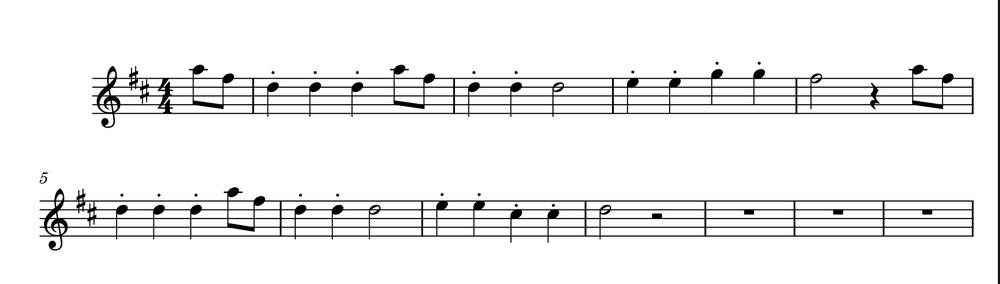 4 points
 -
4 pointsHello @latebeethoven_addict ! This fugue has a nice idea. The theme is very good. Analysis!!! Title+Bars 1-15 So, firstly, the title is just 'Fugue but you lost'. Where is the composer name? Also, I recommend (personal preference) saying something like Fugue on the theme of 'Insert something'. Writing 'Fugue but You Lost' kind of makes it seem unprofessional. I like how you wrote Allegro (♩= 120). It gives an approximation of practice tempo (♩= 96) if this were to be performed. You never know. The beginning phrase (Eb Ab G Ab) makes it feel like Ab major a bit. I like how it is disguised. The whole opening phrase (bars 1-4) is is completely playable and musically intresting. Good job. Trouble starts at Bar 5, where you expect the performer to be Rachmaninov. Or Liszt. Or an alien. one of these three. Please do keep in mind that normal humans cannot reach such like the compound minor 6th in the first beat of the 6th bar. If instead you meant to split up in the two hands, however, then please delete or hide the rests. Do mind the parallel movements in the section. In Bar 11, a third voice is introduced effectively. We have heard the theme in two voices before. but now, it is also in the third. I would like point that the rests on Bar 11 Beat 2 feel completely unnecessary, and should just be a minim. (starting on the first beat). Bar 16, we have this nice ending to the ascension of a single hand. I do not believe that a rest is important here, as the notation should best kept simple and human-legible. By Bar 20, we already have semiquavers. Nice use of rhythm to add texture, although I don't really like Bar 23, with all of those staccato notes in the bass, although I love how you reused the main theme in the bassline of Bar 24. (Only doing this amount so far. Still in work.)
4 points
-
4 points@MK_Piano has provided some very creative ideas for the possible badges for the "From Nothing, to Something" Summer 2026 Competition! Check them out: "L'alchimiste Award"- for the most imaginative transformation of the text into music. "Dans l’Esprit de Verlaine Award" - for the piece that best captured the spirit of Verlaines poem. "The Poème d'Amour Award" - reserved for the piece voted to have best captured the sensation of love. "The Évocation Award" - reserved for the piece voted to have best captured the sensation of summer. Of course, don't forget that there will be 1st, 2nd and 3rd place awards as well. And all the participants will receive a participant award while all the reviewers will receive an ardent reviewer badge in one of three tiers. Don't forget that the competition ends September 24th! We only have a month left! Of course - let us know what other badges we could award to the winners of this competition! We're going for French names of the badges/awards to accord with the French poem that the competition is based on.4 points
-
4 pointsThank you for sharing this video @Luis Hernández! I completely agree with the sentiments expressed in it. Exactly — I think one thing that the twentieth century taught us composers is that not all innovations have the same generative potential, for opening new directions. You cannot create anything meaningful by simply negating what came before, or appropriating it with irony, approaches that reduce history to a museum of dead artifacts. Developing a personal voice requires building upon models, which can be quite diverse and individual in character especially in today’s globalized society. To be a truly contemporary composer, (i.e., con-tempo, “with the time”) you need one foot firmly in the past, and one foot ahead in the future. To quote on of my favorite writers on aesthetics, Jacques Maritain: It is indeed true that there is no necessary progress in art, that tradition and discipline are the true nurses of originality; and it is likewise true that the feverish acceleration which modern individualism, with its mania for revolution in mediocrity, imposes on the succession of art forms, abortive schools, and puerile fashions, is the symptom of wide-spread intellectual and social poverty. And yet the fact remains that art has a fundamental need of novelty: like nature, it goes in seasons. And Baudelaire, himself considered one of poetry’s greatest innovators: It is clear that systems of rhetoric and prosodies are not forms of tyranny arbitrarily devised, but a collection of rules required by the very organization of the spiritual being: never have prosodies and systems of rhetoric prevented originality from manifesting itself distinctly. The opposite would be far more true, that they have been a help to the blossoming forth of originality.4 points
-
4 pointsI wanted to share this reflection entitled ‘ORIGINALITY IN ART’ (the trap of wanting to be original). It is by Agustín Calabrese, a great composer and teacher. The video is in Spanish (he’s from Argentine), but I’ve transcribed almost all of it and run it through a translation tool. I think it offers a lot of insight on this subject. We must not worry about being original. At the very least, we must not consciously seek originality. Being the first to do something is not, a priori, a virtue. Claiming to be at the cutting edge today, or even believing that this is possible, makes no sense whatsoever. For the past few decades, we artists have had a global view of the entire history of art. That was not always the case. Bach was discovered and rediscovered several times, first by Mozart and half a century later by Mendelssohn. It is impossible to take things to an extreme that has not been explored before... [...] ‘Adolescent’ avant-garde impulses lead nowhere and fizzle out of their own accord; they are like a snake eating its own tail, and one cannot build in that direction. True innovations are rooted in tradition and build upon it. Innovation as something that breaks with a previous tradition, disparages it and treats earlier practices with irony is an anomaly of the twentieth century. In a healthy culture, styles evolve and transform progressively over a long period of time. Eighteenth-century positivism and the Enlightenment have led to the arts being evaluated using a method appropriate to the sciences. As if art were required to progress indefinitely. This doesn’t mean we have to repeat things that have already been done, but the only way to be original is to be true to ourselves. We shouldn’t write music that we think is politically correct or that people expect of us. Every person is a unique blend of tastes, influences, stories… If we let it flow without worrying about belonging to a particular movement, we will inevitably create something new.4 points
-
4 pointsThat’s absolutely true. It all depends on what we mean by ‘personal style’ (or simply ‘style’). One thing is clear: everyone tries to find the language, the techniques, the systems, etc., that suit them best, and to write music within that framework. But I don’t think anyone on this forum can claim to have a personal style that makes them unique and distinctive. That doesn’t mean there aren’t excellent composers. In fact, on the current scene, I don’t know of any composers who have that sort of style. I know of plenty of music that’s based on previous stories, and it’s brilliant.4 points
-
4 pointsHello @CrystalCanon, I noticed with appreciation that you’ve thoroughly read my last two posts and thus noticed the contradiction between what I said here in this thread—that one shouldn’t “try too hard to develop a personal style”—on the one hand, and my “recipe for a personal style” in the second post, on the other. But to be honest, I didn’t mean that ironically. Perhaps, however, I misunderstood what is meant by “style.” If “personal style” is defined as how one is perceived or recognized as a composer by “others” (e.g., the audience), then I wouldn’t worry too much about it, since one has little or no influence over that. On the other hand, I think it’s important to develop a “consistent approach” or a “recipe” that you feel comfortable with when composing, and that allows you to create your pieces successfully. That’s the kind of “personal style” I mentioned in my other post. But perhaps this is somewhat different from the ideas summarized and discussed in this thread—wouldn’t it be worth for an own topic?4 points
-
Thank you all for the feedback! The past couple of days have been busy, so I’m only just getting around to responding. On the choice of key @Luis Hernández I did consider transposing the piece to E minor to make it more comfortable for the musicians. Ultimately, I decided against it because I think the key contributes to the harmonic “color”—something that becomes even more significant in orchestration. Speaking from a string player’s perspective, the reduced resonance from open strings and the frequent need for vibrato help reinforce the piece’s somber, melancholic mood. There are also contrasting sections that modulate to more string-friendly keys, such as G major. In those passages, I use open strings and natural harmonics to make the contrast more pronounced. @Alex Weidmann , speaking as a semi-professional string player, I’d say it’s definitely playable. That said, it’s an uncommon orchestral key and creates plenty of intonation challenges for the ensemble. I can also confirm from experience that orchestral players generally aren’t too thrilled when they see a key signature with five or more flats or sharps! Orchestration choices Thank you for the detailed feedback, @Luis Hernández I agree that I may have written the English horn parts a little too high in places. Honestly, if I’d had the option, I might have scored the piece for two English horn players, since the instrument’s tone and timbre fit the atmosphere so well. Strangely, I’ve never been especially fond of writing two oboe parts—but maybe that’s just me. You’re probably right about bars 52–53. My intention was to thin out the upper octaves so that the viola-and-cello octave line would come through more clearly, with the upper voices adding a kind of “shine” to it. In a live performance, I think it could work reasonably well, depending on the strength of the flute players. I’ve been using Dorico since Finale went bust. I used its automatic condensing feature for this score, but I’m not always happy with the choices it makes. I usually go back and manually condense or uncondense the parts, but I didn’t have time to do that for this piece.4 points
-
4 points@CrystalCanon I think the current landscape of academic music is complicated. On the one hand, the few major venues that remain play it safe and, yes, every now and then, they programme something from the 20th century. Contemporary composers are rarely programmed, and often these are commissions that result in a premiere and little else, with a few exceptions. Ideally, more opportunities should be given to this contemporary music. Another issue concerns composers who build their careers within a closed environment such as music academies or conservatoires, where they have access to musicians to perform their works. As for the idea of learning from all sources and styles, that’s only logical. But it strikes me that many people have little or no interest in listening to, let alone learning how, other styles work. What strikes me even more are those who, when writing music, limit themselves to imitating very specific periods, whilst showing no interest in anything else. And I also agree with your final point. Each person’s preferences influence their objective compositional style. I, for example, thoroughly enjoy the Baroque, the style galant and Romanticism, though I’m less keen on Classicism. And I’ve studied everything from the Renaissance right through to rotational matrices… Yet my preference is for the modern language of music, from Impressionism onwards. In order to start doing something in that vein, I’ve had to spend a long time learning (with great pleasure) about tonal music, and I still enjoy it to this day.4 points
-
4 pointsA question Do you think that any piano piece, for example, could be adapted for an orchestral version? Or perhaps there are certain formats or styles that wouldn’t work well in this context? Please feel free to give examples Best regards4 points
-
4 pointsMy dead young composers, I think it is time to list resources I enjoy reading and am reading. I will start with more accessible to new composers then go to most advance ones. Every composer, under their toolbelt, should have firm understanding tonal harmony. While the millions of books on the market, it is probably difficult to decide which one to use. This is where your undergraduate course helps you. Professors have thier prefence. Mine used "tonal Harmony" However, if you want to get jump, I suggest two books: Fux treatise on species counterpoint, and Tchaikovsky treatise on harmony. Schoenberg also wrote two books on harmony. Be warned: Schoenberg book on Harmony is like reading book on philosophy. Traditional harmony is fine, but we are currently in modern era where that pushes the boundaries. Thus, book on 20th century harmony should the follow up. There are two books that go through this! I think Peter is going through one. He would reccomded that one. I have that one. And I would agree with his assestion about it. I would also suggest picking up book on Alan Forte and "The music of Bela Bartok" Understanding musical style is important as writer. Therefore, Charles Rosen books "The classical style" and "The romantics" are a must. He links Bach to each period. Speaking of Him, he wrote about Sonatas: Sonatas forms. (I hear there are 3 vol set about sonatas, but his book is more concise). Now to onto musical forms: Analyzing Classical forms and Sonata theory. Both are great books. But start with Schoenberg book on composition. I hope this well you. Also, score study. Share your works as you learn. And choose the best path that works for you. Orchestration is the final step! Rimsky-Korosky, Adler, Brant.4 points
-
I think it sounds absolutely brilliant. And it’s an impressive piece of work, especially the detail with which you’ve crafted the strings. I also really like the fact that ‘it doesn’t sound like a piano at all, but rather like an orchestra’. And yes, I did want to make a few observations which, as I say, are just that – my opinions. Firstly, I’ve already mentioned the question of key. E flat minor is a brilliant key for the piano, but it’s one of the worst for the orchestra. Berlioz said as much in his treatise, as did Rimsky-Korsakov in his. I don’t know, it seems there’s a bit of a fear of transposing the work a semitone up or down, as if it were sacrilege or as if we were straying terribly from the composer’s intention. I believe that if we’re orchestrating, we have to make the best decisions to ensure it sounds as good as possible. But I’ll say it again, it’s up to each individual. The second point is the choice of the English horn as an instrument throughout the work. It’s not that I think it’s wrong, but I do wonder whether it’s really necessary. Apart from specific cases (Impressionism, etc.) where it can serve as a distinctive ‘colour’ instrument, in the orchestra I believe it is an instrument of extension and should only be used when the two oboes cannot cover the lower register. The opening line, for example, could be played very well by a second oboe. In other instances, even where it is possible, I feel the English horn is in a rather high register. Thirdly, another instrument where I would sometimes have assigned its part to a different instrument is the flute. In bar 15, it is in a low/very low register and will be completely drowned out by the English horn, even with the flutes in A2. I can see the intention to add a different colour to that phrase, which is why they’re doubling, but I’m not sure – in this case, I would have doubled the C an octave higher with a clarinet, for example. The octave doubling of the A-flat flute in bars 52–53… There, Flute 1 completely drowns out Flute 2 because it’s in its brilliant register, and Flute 2 is doing its best. One of the things I was taught on the woodwinds is to try not to double at the octave with the same instrument, because the difference (imbalance) in tone and volume is very great. It’s better to double with another instrument whose range in that other octave is optimal. Well, please excuse all this, as these are minor details in the context of such an extensive and beautifully crafted score, which sounds absolutely marvellous. Finally, a question: what software do you use.... In bars 73 and 74, the clarinets haven’t been condensed I don’t know if you do this manually or if the condensing is automated. I sometimes have those problems and when the programme won’t...4 points
-
A 7-voice canon I have been recently working on with the intent of following the rules of counterpoint while employing a somewhat unorthodox usage of extended harmonies and tonally-adjecent suspensions, featured heavily in the minor 2nd intervals produced by the maintained rhythms of each subsequent entry in the opening section. The text corresponds to Bible verse Matthew 28:5, translated as follows: "But the angel said to the women in response: 'Do not be afraid, for I know that you are looking for Jesus, who was crucified'." The addition of the initial "et" conjunction to the Latin text is not present in the Vulgate version of this passage, however its inclusion was deemed necessary to accommodate for the prosodic adaptation of the entire verse across the whole piece without disturbing the flow of the initial suspensions. The choice of the text was based around Bible verses mentioning angelic contact, and more specifically those containing the phrase "fear not"/"be not afraid" as a more secular reference to the niche Biblically-Accurate Angel meme trend which inspired the compositional concept at the core of this piece. YouTube video link: https://youtube.com/shorts/um0jb9Y8iJ4?feature=share Canon at the 2nd a 7 in F-sharp minor.mp3 Canon at the 2nd a 7 Et respondens autem angelus dixit.pdf4 points
-
Hello A number of interesting topics. I’m speaking from a position of inexperience and, more to the point, as I’m still learning, so all of this is just suggestions or other possible options. As I said, it sounds brilliant as it is. Firstly, the issue of transposition for orchestra. I agree with what your teacher (your piano teacher, that is) said. But I think we need to consider making things easier for the instrumentalists. Another point is that it doesn’t really matter to us. It’s going to sound the same, at least in the context of virtual instrument libraries. But the reality is that in this key of E flat minor, it’s more complicated for the strings because there are no open strings; they have to ‘press down’ with their fingers all the time, losing resonance, and so on… I can see problems for the harp too, because being tuned to six flats puts a lot of strain on it. And changes may be more difficult. I think the woodwinds would be most comfortable with this. This key is rarely used in the orchestral repertoire, and I think it’s sought after for dark, tragic, profound tones. Perhaps it would suit something like the Elegy. As far as I’m aware, in the symphonic repertoire, the only works in E-flat minor are by Russian composers: Prokofiev’s Symphony No. 6, Rimsky-Korsakov’s Symphony No. 1 (which he himself transposed to E minor later), and a few others. The other issue, that of arpeggios… You see, in my orchestration classes and seminars we’ve discussed this quite a lot, as well as Alberti basses, etc… How do you adapt them for an orchestra? As I said in my previous message, a literal translation can, of course, work, because there are instruments capable of playing those arpeggios. However, we’re now dealing with an orchestra. It doesn’t have to be a single instrument that does everything. The important thing, I believe, is that the rhythm is clearly marked (with accents and pizzicato, for example), and that the figures are in the appropriate pitches and note values for each instrument. This is also where the question of how faithful one wants to be to the original score comes into play. That’s down to personal preference; we can be very literal, or we can take the main ideas and create an orchestral version. It’s true that for some scores I find it less appropriate to take liberties (for example, when orchestrating Baroque counterpoint), I’ve written these few bars in one possible arrangement, which I’m sure could be improved; I also think it would sound softer on the strings, especially with mutes. Haha, in the very first lessons I had on all this, we worked on Mozart and pieces like that, precisely to translate those piano accompaniments into something else. Cheers. Proyecto.mp3
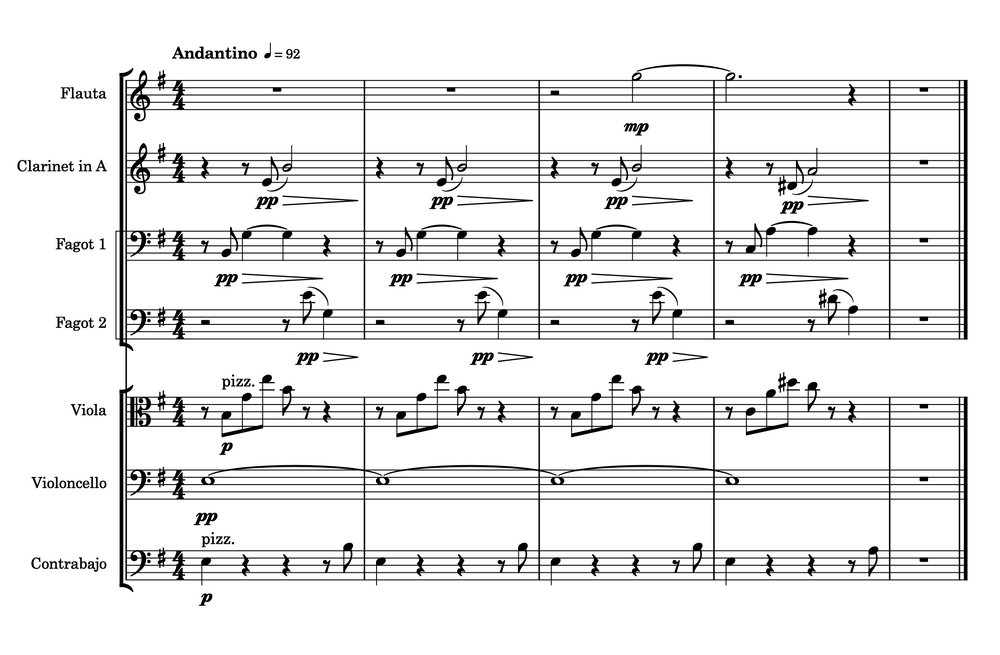 4 points
 -
4 pointsOh! These are great badges! Thank you @PeterthePapercomPoser and the support team! I like the designs for "Synthesizer Wizard," "Gentlefolk," and "Stimulator" are especially wonderful! Very nice! Also, adding this text to the first post in this topic ( @PeterthePapercomPoser's post listing the awards) might make things clearer! By the way, there is someone I would like to nominate for a badge, so I’ll take this opportunity to mention it here. Person's name: @Vasilis Michael Badge: Meticulous Composer Topic for the badge: https://www.youngcomposers.com/t50201/sonata-no-26-in-a-major-binary/ Reason: I think the piano composition itself is crafted with incredible precision—including the interplay between the left and right hands. Furthermore, the piano playback is really amazing; the articulation and sound clarity reflect that same meticulous attention to detail, which is why I wanted to award him this badge. His pieces are always wonderful, after all :) Best, Lithl.4 points
-
4 pointsI started this few years ago and posted a couple pieces of this suite before. I had intended to finish it but set it aside and hadn't worked on it in a while. I finally cam back to it a few weeks ago and decided to finish it. It's based on the Hans Christian Anderson story of the Steadfast Tin Soldier. My goal was to write each piece in 3/4 timing, as I don't often use that timing and to keep each piece to less than 4 minutes (thought the finale is just over 5 minutes). I included a description for each piece to describe the action. I. The Tin Soldiers Play War There were once twenty-five tin soldiers, born of the same old spoon. The little boy lined them up together, all splendid in their uniforms of red and blue. They all looked the same, except one. He looked a little different as he had been cast last of all. The tin was short and, in turn, so was he. But there he stood, as steady as his brethren. The little boy marched them around the table, clashing them together and making booms like cannons and musket fire. II. The Paper Ballerina’s Dance He lined them up to protect the model castle and the other small toy figures inside. One of those was a little paper ballerina, with a fluffy gauze skirt and a glistening jewel around her neck. The little tin soldier thought to himself, “I would so love for her to be my wife, but maybe she’s too grand for me. She lives in a castle, and I have only a little box that I share with twenty-four other soldiers.” He hid behind a little box, steadfastly watching her as the other soldiers continued to play. III. The Soldier and the Ballerina’s Pas de Deux When night came and the children went to bed, the toys came to life and began to play on their own. The little tin soldier moved toward the ballerina and offered his hand. To his surprise, she did not reject it; she clasped his hand, and the two began to dance. As they whirled around the table, they looked into each other’s eyes and knew they had found their true love. IV. The Jealous Goblin But in the shadows lurked the goblin who lived in the jack-in-a-box, and he was not pleased with what he saw. For he thought the ballerina belonged to him and did not appreciate this newcomer taking his place. He approached the soldier and said, “Keep your eyes and hands to yourself.” He pushed at him, but the tin soldier stood stiffly in his spot. As the goblin stalked away, he said, “Just what till tomorrow!” V. The Soldier Falls from the Window The next day, maybe by chance or maybe because of the goblin, the little soldier ended up on the open window ledge. Whether it was a gust of wind or a goblin spell, the little soldier fell three stories to the ground, landing between the paving stones. VI. The Journey on the Paper Boat He lay there all night till two boys found him and placed him on a little boat and sent him sailing down the river. The little soldier thought about his dear ballerina and if he would ever see her again. The stream began to move faster and faster, carrying him toward the drain to the sewer. VII. The Escape from the Sewer Rats The tin soldier found himself floating through the sewer. Suddenly, a group of rats came toward the water, demanding that the little soldier pay a toll for passing through their land. They scurried around to find debris to throw at the boat. The little soldier tried to steer the boat around them, but it led him into a fast-moving tunnel and through a drain that led out to sea. The boat turned over and the soldier fell into the water. VIII. The Fish and the Surprise Inside Before he could sink to the bottom, a passing fish swallowed him and the little soldier found himself in the fish’s belly. He moved back and forth as the fish swam. All of a sudden, the fish began to move wildly and then fell still. He then heard loud noises coming from outside before turning quiet. A knife suddenly cut through the fish’s belly and before the little soldier stood his former master’s cook. He had miraculously found his way home. IX. The Reunion and the Fireplace The little soldier stood on the table, his paint worn off, but he still stood as stiff as ever. Across the table, he saw his ballerina, his love that he thought he would never see again. His heart was filled with so much regret for the time together they had missed. But lurking in the shadow was the wicked little goblin. He would not let the little tin soldier take his girl away. Maybe by chance or maybe it was the goblin, but one of the children picked up the soldier and threw him into the fire. The goblin danced in delight of his victory, but suddenly a gust of wind blew the paper ballerina into the fire with the soldier. The next morning, when the fire had died out. The maid saw in the ashes a tiny tin heart, and at the center was the jewel that the ballerina wore. Joined together, as one. 14 The Tin Soldier's Play War.mp3 15 The Paper Ballerina's Dance.mp3 16 The Soldier and the Ballerina's Pas de Deux.mp3 17 The Jealous Goblin.mp3 18 The Soldier Falls From the Window.mp3 19 The Journey on the Paper Boat.mp3 20 The Escape from the Sewer Rats.mp3 21 The Fish and the Surprising Dinner.mp3 22 The Reunion and the Fireplace.mp34 points
-
I think I posted this one in the past, however, whether I did or not doesn’t matter… lol I wrote this arrangement something like 2 years ago. At that time, after having decided to revisit it, I believe I wasn’t all that great with harmonies. I’ve decided to re-voice the chords in this score, and have utilized some of my new playback sounds to create a much better listening experience with this one. Let me know what yall think. I believe I’ve been able to embody the patriotism, and somber nature of what the bugle call Taps was written for. taps.mp3 taps.pdf4 points
-
4 pointsWhen it comes writing, I like to write from structural point of view. Think analyical as I write (melodic form, hamorny, musical form, counterpoint, etc). That way, I can try to a cohesive composition. The recent piece I wrote I went through and looked for motive i could use for ending section. :)4 points
-
4 pointsAn interesting question. I think that, nowadays (or for the past few decades or so), even as a professional composer, it is almost impossible to develop a unique, new and personal style. I believe very few in history were like that. Bach, Wagner, Debussy, Schönberg… in the 20th century there are perhaps more: John Cage, Messiaen, Bartók… But there are other composers of equal or greater calibre who did not introduce ‘revolutionary’ new ideas, yet who took the music that was developing at the time and made it evolve and grow. These composers also have highly recognisable personal styles (Mozart, Beethoven, Verdi, Puccini, Brahms, Chopin, and many more). We currently face a ‘problem’: we are familiar with a vast number of musical languages and systems that emerged in the 20th century, and there are many of them. I believe that, nowadays, a composer must be eclectic and must be familiar with as many musical languages as possible, drawing from each the elements that suit them at any given moment. The ability to combine all of this is a sign of a composer’s maturity. Very often, we stick very closely to a particular style, or even a particular composer, and write pieces by imitating them as best we can. That’s fine, but I don’t think that amounts to developing one’s own style. I see it as absolutely necessary, especially for learning purposes. Regarding the second point you raise. It’s true, there are a great many widely used techniques and other things that software programmes cannot do. Although they are gradually incorporating them. Of course, I can’t see a DAW or an editor handling random elements. The notation for this has been sorted out, but the software-based performance cannot be random.4 points
-
The members have voted in the poll and decided upon a theme for the next competition - "From Nothing, to Something"! This competition has no monetary awards - only kudos and badges. We are inviting the members/competitors to review and to participate in the creation of the badge awards that will be dispersed at the end of the competition! So if you have any ideas for particular badges that would accord with the kind of music that will be submitted for this competition and the theme of this competition, let us know in the List of Manually-Awardable Badges thread and we will take your ideas into consideration! Please reply to this thread to declare your intent to participate in this competition! The winners will be determined by popular voting polls! The duration of each piece should once again be between 3 - 7 minutes. Reviewing the entries will once again be spearheaded by the members/competitors at large. You are free to use the Official Competition Reviewing Template or you can review the entries in any way you see fit or create a template of your own making! Thank you for whatever time and effort you are able or willing to give towards reviewing the competition entries! There will be tiered "Ardent Reviewer" badges given out for this event: Featherweight Reviewer - for reviewing 33% of the entries Welterweight Reviewer - for reviewing 66% of the entries Heavyweight Reviewer - for reviewing 100% of the entries We are instituting a policy of not allowing any AI generated works in the competition. Because of this you will be required to detail how you created your piece and submit a PDF score or midi file for the perusal of the staff and members at large. The musical entries to the competition are final once submitted. This is for the sake of consistency of reviewing (so that each reviewer reviews the same piece of music without any changes). Instrumentation: As per the poll, the competitors will be tasked with writing a piece for a mixed trio/quartet/quintet of individual instruments/players/singers. Deadline: As per the poll, this competition will take 2 months, so the deadline to participate will be Thursday, September 24th, 2026. @MK_Piano's theme for the competition can be found below: What greater challenge of a composer than to take nothing and turn it into something! Your goal is to take the text from Paul Verlaine’s summer poem “Donc, ce sera par un clair jour d'été,” (So, on a bright summer day it shall be) and turn it into a piece! This poem is short, but filled with evoking images of the season of summer. It is read as a love poem, and Verlaine felt the winds and sun of summer amplified the affection he felt for his admirer. When you write, we ask that you focus on what summer brings to you as it did for Verlaine. Using this text, you must create a musical work that best captures the sensation of summer. What was nothing but words on a page, will be turned into a beautiful work of music by your hand! Attached is the poem in English: So, on a bright summer day it shall be: The great sun, my partner in joy, Shall make, amid the satin and the silk, Your dear beauty lovelier still; The sky, all blue, like a tall canopy, Shall quiver sumptuously in the long folds Above our two happy brows, grown pale With pleasure and expectancy; And when evening comes, the breeze shall be soft And play caressingly about your veils, And the peaceful stars looking down Shall smile benevolently on man and wife. The poem in French and English Entrants to the competition thus far: @MrBelegro @Fruit hunter @Ninja Nolan @Kvothe @TristanTheTristan @MK_Piano @Matthew M @GMoneywroteasong @therealAJGS @Musicman_3254 @Some Guy That writes Music @UncleRed99 @Wieland Handke @Mooravioli @latebeethoven_addict Here is the submissions thread for the competition where participants are encouraged to post links to their composition (rather than posting their piece directly into the pre-existing topic - make your own dedicated topic so the members at large can review your music there):3 points
-
Hello everyone! This post marks one of the few solo piano pieces I have created. As a classical pianist myself, there is a certain abrasion to writing for the pianoforte that I have come across. It has a special connection to me for my own expression, whether it is by performance, teaching, or discussing. To write for it alone is a daunting task as I hold a lot of respect for the composers who came before me. This said, I wish to present Sternenliebe to you all. Written in 2025, this work captures passionate love. It was my letter to an admirer, however, our connection was never realized by the time I left for a new chapter of my education and career. Attached on the manuscript was this message, and when reading it now, the more I reflect on what could have been: "Not a day will go by where I don't think of you. Not a night will go by where I wouldn't wish to see you. This piece is my reminder that each time you look to the sky, I am under the same stars looking back hoping to embrace you again. When you hear me play it, know it's because I am thinking of you." I hope you enjoy this nocturne I have created! If you want a little more information on the structure of the work, you can find it on page 3 of the document (marked as page 1). Lastly, besides the score, attached is a video of me playing it! SCORE_Sternenliebe.pdf3 points
-
3 pointsWow, my friend, thank you so much for this! ❤️ I honestly didn’t expect it, and it means a lot to me. Being described as a “Meticulous Composer” is a particularly meaningful compliment, because I really do care deeply about the smallest details in my music — from the interaction between the hands and the articulation to the harmonic choices and the overall character of a piece. I’m especially touched that you chose the Sonata No. 26 as an example, but even more by the fact that you see this quality throughout my work. After all, these pieces are a very personal part of my musical journey. Thank you again for your kindness and support, my friend. I’m genuinely grateful to have my music appreciated in such a thoughtful way. ❤️3 points
-
A magnificent piece: I love it! Especially the way it combines Baroque counterpoint with a modern harmonic language. The only problem is, it's unplayable in places. Bars 28 and 35 to name but two examples. Human hands cannot reach all those notes! Also Page 2 would benefit from having the left hand in treble clef most of the time; otherwise you have too many ledger lines to read. The notation is generally quite confusing to the eye. This is partly down to the voice allocations. Bar 47 is a good example. The lower notes in the right hand would be far easier to read if they were merged into the left hand. The upper notes in right hand voice 2 should be in voice 1, and the B natural is unplayable. Definitely worth revising this piece to fix these problems, as I think the composition is very good. It would be a difficult piece to pull off; but could be made playable for sure. Btw, the audio sounds strangely muffled sometimes. Not sure what's happened there? Anyway, hope that helps. Alex3 points
-
3 pointsAs per @Lithl 's suggestion, some new badges have been published! Yes - good point! If you wish to anonymously nominate someone for an award, you can message any of the staff privately and we will take your nomination into consideration!
 3 points
 -
3 pointsHi @Vasilis Michael ! Another great work my friend! That Neapolitan F major resolved to E major in 0:40 sounds so magical to me. I would describe your style as a mix of Schubert and Scarlatti! Both composers are magical in their modulations and you too! Henry3 points
-
3 pointsMy dear friend, thank you so much from the bottom of my heart for this wonderful comment! ❤️ I’m incredibly happy that you enjoyed the sonata, and even more so that you noticed so many details in the music, from the dynamics and tempo transitions to the interplay between the two hands and the way the music leads towards its conclusion. These are things that are very important to me when I write. And what you said about my scores—that you can somehow sense the thought and warmth behind their creation—really touched me. For me, a score is not simply a way of writing music down; it is a part of my thoughts and a little piece of myself. And as for Scarlatti, your comment is an enormous compliment to me, because his music has had such a deep influence on this part of my musical journey. 😊 Thank you again for your kindness, for taking the time to listen to my music so carefully, and for continuing to find something of your own in it. I truly appreciate it my friend! ❤️3 points
-
Hi @MK_Piano ! A really exciting and enjoyable piece! I have a lot to learn from your scoring and engraving and orchestration skills. The energy level in the outer sections is so well maintained which reminds me how vivacious you are in real life and here. I thoroughly enjoy this one, as this is not something I can compose. I don't have this kind of energy level myself and hence nothing similar to show in my own pieces. My favourite section is the middle section. It's real nice contrasting section featuring woodwinds when the outer sections are predominated by brass and strings. The counterpoint here is better than the outer sections too haha, because in the outer sections you feature more homophony and octave doublings which is apt to the steam theme too! And then some of my subjective thoughts: I think there is a bit unbalance in b.47 Rehearsal no. F to modulate to D flat major. Maybe an 8 bar phrase will be better than the 6 bar phrase now, but that's my personal thought. Also, I think you can have more prominent changes in the last A section, other than the key which is the most obvious change. Yes the orchestration is varied there and the texture is even thicker than the exposition, but I think you can slightly change the order of events in the recap, and change the modulation plan, since you modulate from Eb to Db major in the exposition, modulating from F to Eb major sounds similar to me so the heightening effect by modulating is weakened to me. I think ending in Eb major is the right option as to maintain the same key for the beginning and end, so you can begin in a key other than F major in the start of section L, which gives another advantage for having another modulation apart from the middle section, which is also in F major. P.S. Huge props to you @UncleRed99 for bringing @MK_Piano here! Definitely vitalizing the forum much more haha! Thx for sharing this wonderful piece! Henry3 points
-
3 pointsThis^ My thoughts exactly3 points@MK_Piano and I have been composing together / critiquing one another's works for a time before either of us were apart of this forum. I recently brought him onto it, as a way for him to share his works with you all, when I am unavailable to give insight on what he is working on. Although, he is much more Theory-Literate than I am, on account that he actually followed thru with his music education, unlike myself, who dropped out of school back in 2018 😅 But yes, we have brought up the idea a couple of times, and even started something, but never followed thru with it, I think, simply due to incompatibility in terms of scheduling. We will likely get around to it, some time. But for now, consider many of our works to be collaborations in and of themselves. We've contributed something to many of eachother's scores, be it small or large contributions, we've had a hand in one another's work in some fashion for a time, now. :)3 points@MK_Piano, you’ve created another wonderful piece! The way the composition unfolds right from the opening is fantastic. The section starting at 0:55 reminded me of the sound of a steam train whistle; it has a real sense of momentum, and the percussion works well, too. The part starting at 1:55 is a particular favorite of mine—the melody is so memorable. The calm section that follows at 2:25 is also excellent; the piece really tells a story. I’m sorry I can’t offer any specific advice regarding the sheet music or technical details. By the way, it looks like you and @UncleRed99 get along really well! I’d love to hear a full-scale collaboration between the two of you someday :) Best, Lithl.3 points3 points@Henry Ng Tsz Kiu Thank you for all the insightful feedback! Definitely agree modulation could be cleaner especially and some small mistakes with voice leadings all around. Still am very new to writing long form , but am currently working on my second sonatina and I am kind proud of it so far haha Really looking forward to hear what you think of it! Especially since I felt a lot braver than my first work so i took more risks which I'm sure will also result in more things that can and will go wrong haha. Once again , appreciate your feedback! @Kvothe Appreciate the feedback! Definitely agree with overall comments. I think a lot of issues that are apparent here are being solved in my next work which i hope to finish in the upcoming weeks!3 points3 pointsMy reason for using the English horn, is that oboes can sound quite harsh and intrusive in their low range. A bit like a duck! So I thought an English horn would have a more pleasant timbre in that range. Alex this really is a misunderstanding of how an Oboe works! Let's throw out the meme about DUCKS! The lower range/register can be as beautiful as the upper range. (just ask Dvorak). The English horn in this orchestration will not add too much. It does not have the penetration ... it is better used a solo instrument or in a small ensemble. Please no more duck jokes! Mark3 points