All Activity
- Past hour
-
Thank you very much
-
 It's been too long! I thought I would share this piece written for my theory and composition class at Berklee. We were asked to work with a couple of "exotic scales" from a selection including the whole-tone scale, the octatonic scale, and modes other than those derived from the major scale. I felt drawn to the Lydian Augmented and Spanish Phrygian modes. I ended up with a contrapuntal rock instrumental in rough ABCA' form. The A section is in B♭ Lydian Augmented, the B section is in G Spanish Phrygian, and the C section an unbroken transition into D Spanish Phrygian. Finally, I modulate with the common tones D and A back to B♭ Lydian Augmented, for the A' recapitulation. The title (Iridescence) was inspired by my understanding of modes as a concept. With many modes sharing the same collection of notes, the tonic note that each mode centers on is what makes it unique -- gives it a unique color. And, iridescence is when something appears in different colors depending on the angle of viewing. I see that as a fitting metaphor. The artwork is my own, made with ProCreate. I didn't paint it for this track, but as a birthday present for my mother, inspired by Kate Bush's song "Kite". She is a massive fan of Kate's and introduced me to her when I was a little girl. I rediscovered her recently and I've been spending a lot of time with her early work. My current favorite album is Never for Ever...whose influence I thought was bleeding into this track. So, in the end there is some relation. 🙂 I hope you enjoy! Any feedback on both the mix and composition is more than welcome. ~ GP P.S. I was required to include a detailed score for the assignment. It might be too precise for a rock track in general, but if enough people are interested I will upload that, too.
 -

Who wants to help on a Lied?
TristanTheTristan replied to TristanTheTristan's topic in Collaborative Works
I think I got the idea for n.2! -
Gwendolyn Przyjazna changed their profile photo
- Today
-
.thumb.png.8b5b433a341551e913a34392660bc95b.png)
Prelude in C# minor
PeterthePapercomPoser replied to Alex Weidmann's topic in Piano Music, Solo Keyboard
Hello @Alex Weidmann! Nice mysterious Prelude! I'm surprised that @Henry Ng Tsz Kiu hasn't reviewed it yet since it's in his favorite key! 🤣 I have a few technical nit-picks: I've recently changed the way I write for piano through Musescore Studio 4 which I think might benefit you to hear about. If you favor the Musesounds Piano as I now have come to prefer, then in order to have more control over balance between the most important melody notes and less important background chords/figurations, you could actually load up two (or more) separate pianos and change the way they're displayed in the Layout section of the program (by deleting the bass clef portion of the right hand piano and deleting the treble clef portion of the left hand one). Then, not only will you be able to change the balance between the hands in the mixer, but you'll be able to give separate dynamics to each hand - an amount of control which you would lack with just one grand-staff track. Although you'd have to put in pedal marks for both tracks, and hide them in the top track. As well as hiding dynamics that are redundant. But I think bringing out the most important notes in each chord and passage will greatly improve at least my impression of the work. Another thing is the tempo. I noticed that you're trying to create a sense of novelty through the use of unusual rhythms and meters. I think it could be even more effective if you included an ebb and flow to the tempo by simulating a sort of constant rubato with choice accel.'s and rit.'s here and there. I can refer you to examples in my own catalog if you'd like, where such rubato gives a very satisfying result (at least in my opinion) and cases where the piece would suffer greatly from the mechanicality of the rendition if not for the rubato. Some places to consider including an accel. and rit.: bar 30 accel. into 31 I think would be a nice paired with that crescendo you already have. Other than that, nice job! I also question the interruption of the expected 4/4 flow of the beginning melody with the 9/8 measure - I think that's unnecessary. Thanks for sharing! -
On playing this through myself tonight, I noticed a few further corrections and cautionaries that were required. So here is my latest version of the score.
-
This time I wrote a piece inspired by an exercise from Chapter 2 of Persichetti's "20th Century Harmony" on Scale Materials for 2 Bb Sopranino Clarinets and Bb Bass Clarinet. The prompt was "14. Construct a canon for three clarinets in which each performer plays a different synthetic scale on a different tonic." Synthetic scales are scales that are "specially constructed, often non-traditional scales created by altering, adding, or omitting notes from standard diatonic (major/minor) scales." I chose to use the written C Acoustic Scale, F Ukrainian Dorian Scale, and B Phrygian/Dorian Scale. I've been told that I should have perhaps tried to choose scales that would sound more harmoniously with each other. But, funny enough, that's exactly what I was trying to do. I didn't choose scales at random but tried to tailor each part of the canon to the previous material by improvising a scale and only later figuring out what scale I was using. But let me know what you think! Thanks for listening!
-
- Yesterday
-
Favorite Musical Book Quotes?
PeterthePapercomPoser replied to PeterthePapercomPoser's topic in Composers' Headquarters
Again, I have another quote from Gary Lachman's "Beyond the Robot: The Life and Work of Colin Wilson". And if you've gotten this far, thanks for reading! -

2-part invention in counterpoint
Frederic Gill replied to Frederic Gill's topic in Piano Music, Solo Keyboard
I found the whole piece (by Weeles) in 'Suits of lessons for the Harpsicord or Spinnett, 2nd work'. It's on p19, in 'Book 2. Complete Score.PDF 5 MB' link: http://en.instr.scorser.com/CC/Harpsichord/Sheeles%2C+John/Suites+of+Lessons+for+the+Harpsicord+or+Spinnett.html -
2-part invention in counterpoint
Frederic Gill replied to Frederic Gill's topic in Piano Music, Solo Keyboard
I know that the poor quality of this hastily published pastiche has had a bad impression on you about my capabilities. Yet I have spent quite some time on Goetschius' book 'Melody Writing', division one, done over 200 exercises (attached the table of content). The material of division two, ch. XXIII-XXXI (unessential or embellishing tones), was covered in Material Used in Musical Composition. Remains ch. XXXII-XXXIV to consider. Do you think the book is comprehensive for my needs? -

2-part invention in counterpoint
Fermata replied to Frederic Gill's topic in Piano Music, Solo Keyboard
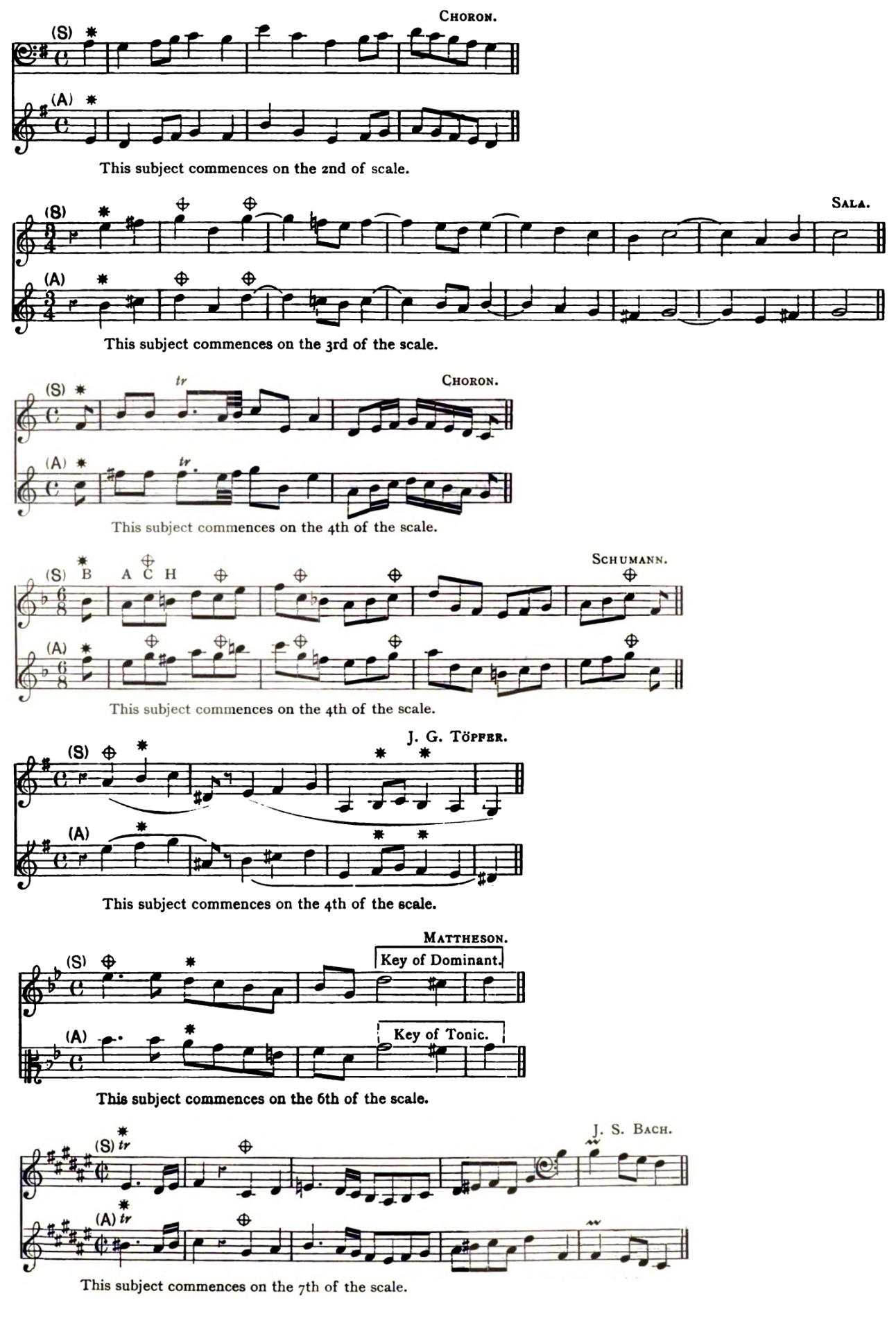
The fugue subjects are from Marchant's collection 500 Fugue Subjects and Answers, which you can also find online. It was a very long time ago when I studied counterpoint; my teacher recommended Jeppesen’s Counterpoint, which I used. It deals with 16th‑century vocal polyphony, but the fundamental principles remain valid in later centuries as well. From a didactic point of view, I would definitely start with the vocal counterpoint idiom—either Renaissance practice or the tonal counterpoint foundations laid out by Fux. I would only move on to Baroque / Classical instrumental practice (such as the approach in Goetschius’s book) after you’ve mastered the basics of pure voice leading.- 30 replies
-
- 1
-

-
- invention
- counterpoint
- (and 1 more)
-
I finally learned how to make glide notes and might've overused them a bit 😅 the main chords that you hear in the start are made of music notes, and then adds harpsichord and piano. the song itself kind of sounds medieval from my instrument choice but that's kind of on purpose. I added an arpeggio and an octave change to the chorus to add some needed depth too. this is by far my best work. I first thought of something like witch town when all I had was the barebones chorus and it didn't really sound that good for a piece, but it was all I had. then I thought of night of the small town but I wanted some synonyms so I thought of dawn of the city. the whole song gives off some halloween- ish vibes but Its way past that competition took me about 5 days and probably around 4 - 6 hours in total
-
2-part invention in counterpoint
Frederic Gill replied to Frederic Gill's topic in Piano Music, Solo Keyboard
Thanks for the original score of the fugue. I will transcribe it and listen to it. And I’ll keep the page of themes for the future. Who knows if one day I'll be capable of composing good fugues, lol. If I may ultimately ask again: Do you have books or authors to recommend to me? Thanks. -
2-part invention in counterpoint
Frederic Gill replied to Frederic Gill's topic in Piano Music, Solo Keyboard
(1) Yes the 4th surprised me, but I blindly trusted 'my' Pr. Goetschius. It is strange that he proposed this piece with all those defects and limitations. (2) Thanks for the example. I’ll look at it. Actually, I will modify further the motive for my own sake, adapted to the ideas I have tried to develop so far with the original. I’ll create a new posting with that. (3) My appreciation of your version was just a matter of subjective taste. I never stated it was incorrect or wrong. You like what you did. I don’t. Some member found what I did sounded good, another found it irritable. Every brain has it’s own sensitivity. Even the physical body has specific resonance frequencies. It shows up when you sing. I’m particularly a B flat, lol. (4) About the imitation at the 5th, I just wanted to figure out what you did. Is it a ii6? If not then what did you do? -
"Night Train Home" I wanted to write a jazz instrumental but never studied jazz technique before. So I dug into jazz theory three weeks ago and began writing my first jazz quintet! I wrote all the chords and notes and performed the virtual instruments on keyboard. Except drums which started with midi loops that I heavily edited. No AI. Comments welcome!
-

2-part invention in counterpoint
muchen_ replied to Frederic Gill's topic in Piano Music, Solo Keyboard
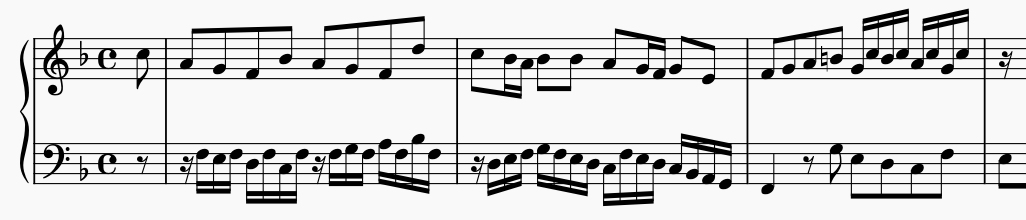
I suppose a subject beginning on the 4th is as about as allowed as an interrupted cadence in a chorale. You can find them every now and then but they are so exceedingly rare in the oeuvre. This fugue would also be the second part of an overture, following a perfect cadence in F. So the issue of your subject establishing the key centre is no longer significant. If one were to compose a standalone piece, the 4th would most certainly be raised to a 5th, then un-raised in later entries as tonal answers. How embarassing. Fixed below!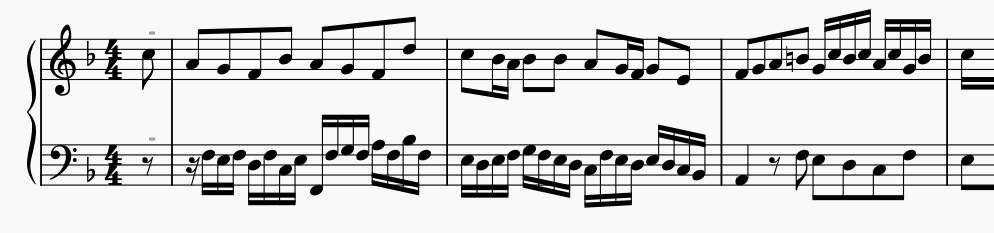
-
2-part invention in counterpoint
Fermata replied to Frederic Gill's topic in Piano Music, Solo Keyboard
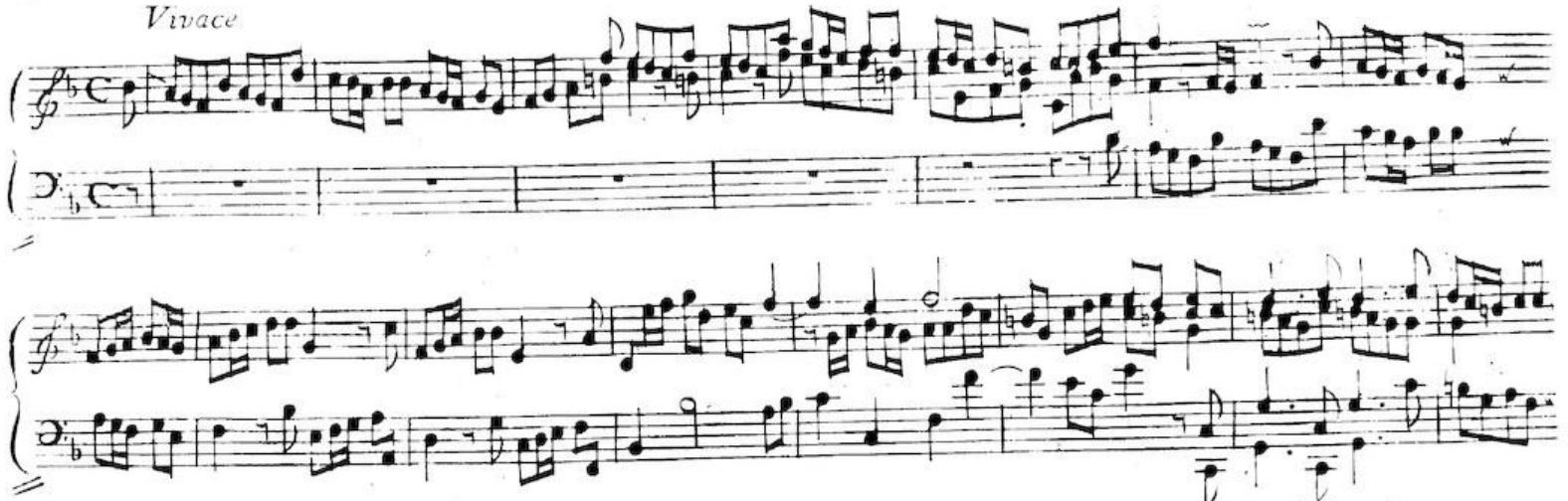
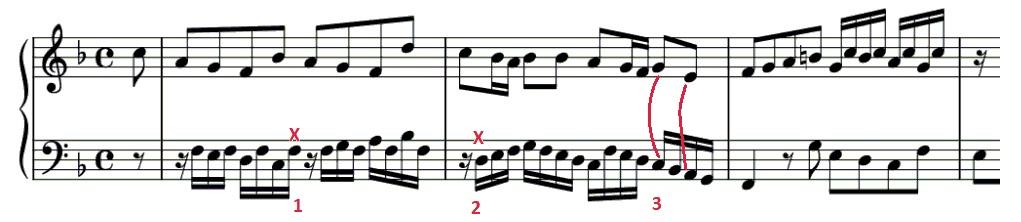
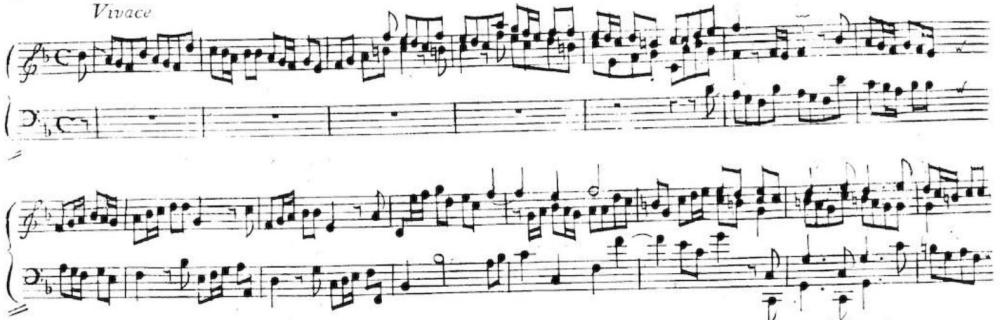
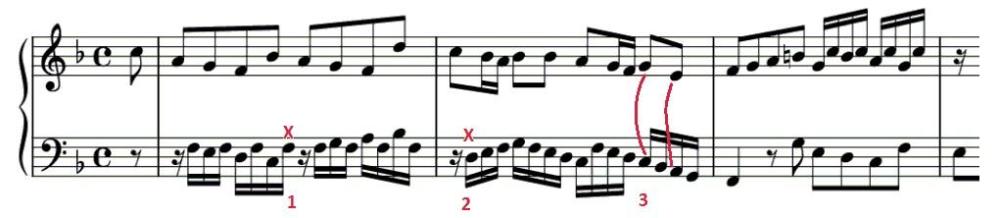
Well, it is a fugue subject that begins on the 4th degree of the scale. And in fact, fugue subjects can begin on any scale degree, not only the tonic or dominant (see examples below). I'm also pasting the original fugue exposition here to show how it was actually realized by its author. I'm sorry, but this is neither invertible nor correct counterpoint. 1) The C against the B-flat would work as an implied root-position dominant seventh harmony (or as a third inversion when the subject is transposed below the countermelody). The repeated F's could be interpreted as figuration over a tonic inner pedal point, but they undermine the effect of the implied dominant harmony. That marked F should really be E instead, even if it disrupts the figuration. 2) You leap down to D, resulting in an unprepared dissonance. That D could work only if the C above were treated as a suspension. That C in the subject implies either a dominant or a tonic harmony. 3) These intervals produce perfect parallel fifths.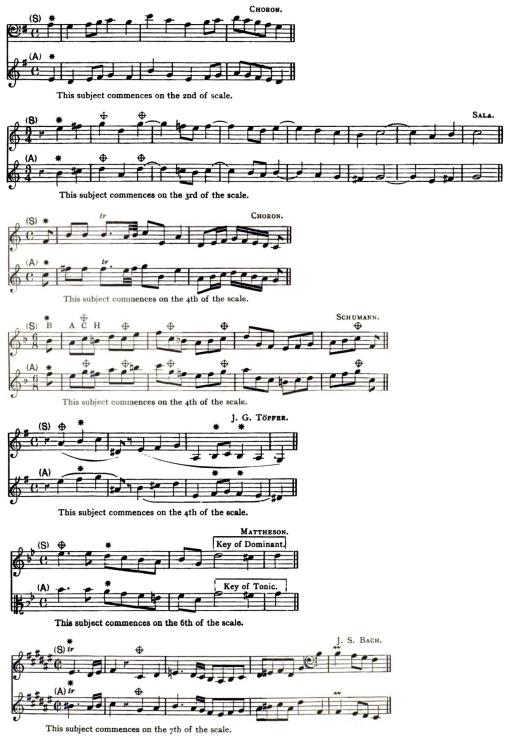
- Last week
-
2-part invention in counterpoint
muchen_ replied to Frederic Gill's topic in Piano Music, Solo Keyboard
No invention themes/fugal subjects begin on the 4th degree of the scale. The theme does recur throughout but it also must be stated at the beginning of your piece, and here, the presence of the 4th degree is detrimental to establishing the home key of your piece. If you wanted to write an invention you would raise this note to the 5th degree instead. The themes of inventions are based on simple and common harmonic gambits (I-V-I, I-IV-V-I, I-VI-II-V and so on). This theme strongly suggests I-IV-I-IV in the first bar which I have never seen before in a theme/subject. It's nonetheless possible to write an invention here, but it'd require a few tricks. A possible solution for the countertheme is: The anacrusis has been raised by a tone, as discussed before. Note the presence of an inner pedal F in the first bar. This serves three purposes: it strongly establishes the tonic key, it introduces the semiquaver rhythm to be used throughout the rest of the piece, and it reimagines the otherwise problematic I-IV-I-IV progression as a simple decoration of the tonic chord I. The second bar uses scalic passages, and is essentially a decorated dominant chord V. Together with the first bar, what would be an otherwise very unwieldly theme (if harmonised at quaver or crotchet speeds) is now a simple I-V gambit. There is a nice phrase ending at the beginning of bar 3 with the bottom F reached by the bass. The counterpoint here is fully invertible. There's much material here that you can take for your episodes: the scalic passages, the lower mordent-like figure found in bar 2 of the main theme, and the bariolage introduced by the inner pedal in bar 1. Bariolage especially is an absolute motivic goldmine that you can and should exploit in the episodes. It's C and B-flat. Also this kind of dissonance, treated this way, is completely allowed. Take a look at BWV 773 (Invention No. 2) for some beautiful examples. There's nothing wrong with the fast passing vii6. No. Note that the imitation enters 2 crotchets earlier compared to the other solution. You can in theory not do this, and write a 2 crotchet-long continuation, but this is unnecessary for imitation at the fifth here, and therefore slightly inelegant.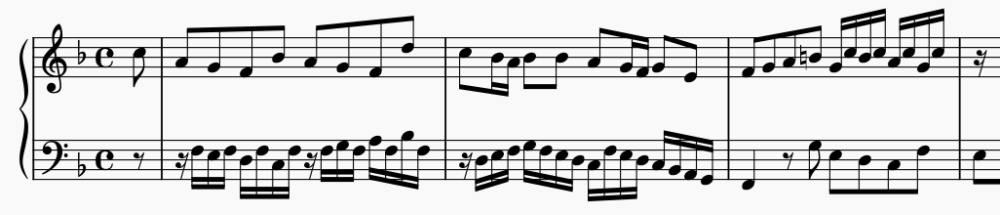
- 30 replies
-
- 1
-
-
- invention
- counterpoint
- (and 1 more)
-
2-part invention in counterpoint
Frederic Gill replied to Frederic Gill's topic in Piano Music, Solo Keyboard
(1) You’re right, #20 was not in the list of exercise 11B. I interrupted music study for 3 years due to health & family issues and while recently reviewing my material I wanted to practice ‘small invention’ again. So I looked at those motives in 7A which I had not used yet. I was not aware that this motive would not be good for a whole small invention. Is there a technical reason why, beside those I mentioned earlier? (2) I understand that C:I-I7 / F:V7 || I is more explicit about the existence of a modulation than a plain C:I / F:V. But {C,B} sounds too dissonant to me. In the following bar, the trick of a rest + F-E-F resolves the problem with the 1st ‘sticking out G’ in bass, but it inserts a fast passing vii6. At that tempo (105bpm) I find it sounds disgraceful. (3) I didn’t imitate at the 5th…or modulate into the 5th, like F(C)-C. However if I did, I should insert a chord (like ii6) between C:I and it’s return at the next bar. Is that what you wanted to show? -
 Unique and very calming. The crescendo and decrescendo throughout gives the piece an interesting sense of grounded emotional instability.
- 1 reply
-
- 1
-
-
2-part invention in counterpoint
muchen_ replied to Frederic Gill's topic in Piano Music, Solo Keyboard
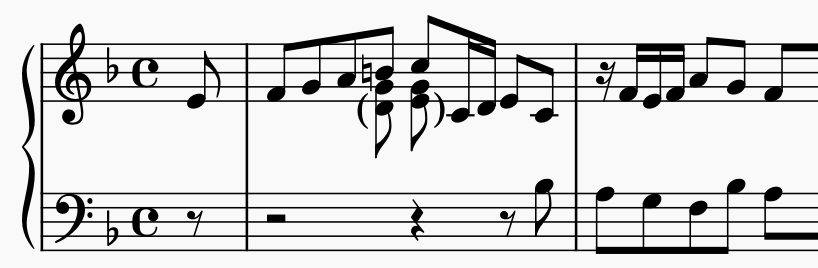
Where in the book does it ask you to use this specific theme as the basis of an entire 2-part invention? For imitation at the octave: This is essentially the same approach as yours: the last two crotchets trace out a C major chord, and the first note of the imitation introduces a B-flat. Together this forms a dominant seventh chord in the key of F, leading us back to the tonic key in the following bars. If you were to harmonise the sharped 4 then you'd use some kind of dominant-tonic chord progression in the key of C, an example of which is shown above. If you were to write a countertheme then it would naturally follow this harmonisation. For imitation at the fifth, the "correct" solution is surprisingly simple: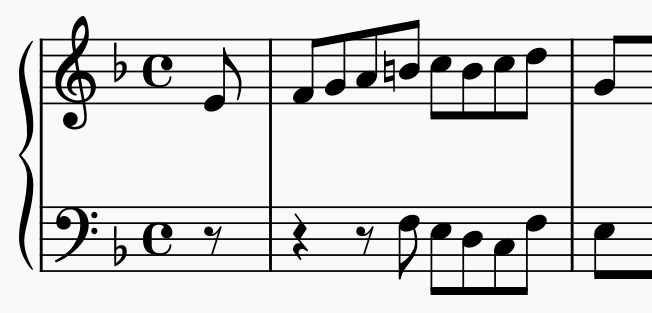
-
 PROGRESS 4 feel like i was on a roll this past couple of weeks cus this is going to be the last progress update until i will eventually upload the whole entire thing as one piece !! short analysis: this section is basically the repeat of B. with a couple of changes: b.221-246 is now in a major mode and it is lighter. some figures are developed here as well (intro section 2' makes an appearance on b.376). this is a step forward toward piecing the main theme together. however, this quickly gets interrupted on b.380, returning to the original texture. it has the same melody but with stanza from the previous climax (b.329). along with that, one final important line is added: let me fly! this line marks a climax, which is teased in the subsequent bars (viola b.375, sax b.376). the climax also comes with an ascending leitmotif (b.395, sax, which is just the Look to the sky motif in an upward arpeggiated line) that signifies the sung line, let me fly! this then transitions into the return of intro section 2'. however, instead of restating b.55 on b.409, the piece finally states the full main theme, as it is similar to the original song. this leads to the penultimate climax (b.441) of the entire piece. one that will then transition into the final section. hope you all enjoy listening to this one !!!
 -
2-part invention in counterpoint
Frederic Gill replied to Frederic Gill's topic in Piano Music, Solo Keyboard
Hi Henry. (1) The book asked to start small invention exercises with one voice only... (2) about 4th#, look at my recent answer to Munchen. (3) Ok. it's a F:V7, but the D in upper voice make it ambiguous with a V9 or IV. Yes that's not very good. In the previous bar I have a F:I6-... so I would not go for a I64 as you suggest, unless the very motive prescribes it. (4) Yes, I forgot to put a '# 'on the previous C in lower voice for indicating my 'episodeless' modulation. Thanks for noticing me! (5) Can I ask to you as well what would you do with the 4th# in bar 3: a transient modulation (in every occurence of the motive, as I did) or an altered chord? Thanks for your feedback.



.thumb.png.1e2763f479362bbb522da50d31ef2e50.png)