
All Activity
Past hour
-
Hi everyone, This composition that i present here is small in duration 1:30 minutes. It is called "Spiral Into Darkness". It is based on a new composition that i wrote firstly in the piano. It has many dark themes and melodies, which with the usage of choirs sound ethereal and otherworldy. There is also usage of percussion in an avant-garde sense. You can imagine a dark passage with a spiral staircase leading to lower and lower parts, which reflect the inner fields of the listener. I would like to hear about your opinions about it and your reviews. Spiral Into Darkness Thank you, Lampros Marantos
-
I've also read from several orchestration books that the lowest register of a double reed instrument including oboe, English Horn and Bassoon are all more difficult to control, and it's much more difficult to play lower than mp in the low register. Given the ethereal mood of the piece I agree with your treatment to use English Horn instead of 2nd oboe. Also I think it's quite common to have at least 1 Englisn Horn in every orchestra so I think that won't be a big problem in practice. Henry
-
Hi Mark, I always used to write lots of material for low oboe; but have had it repeatedly drummed into me that I should use English horn instead. So it's interesting you disagree. There seems to be a very widely held view that the lowest notes on the oboe are too obtrusive, especially in the hands of an amateur musician. I've heard this from the conductor of the orchestra I work with, as well as my tutor, and a bunch of other composers. Anyhow, I'll bear in mind what you say for the future. Alex.
Today
-
arcaturne joined the community
-
-
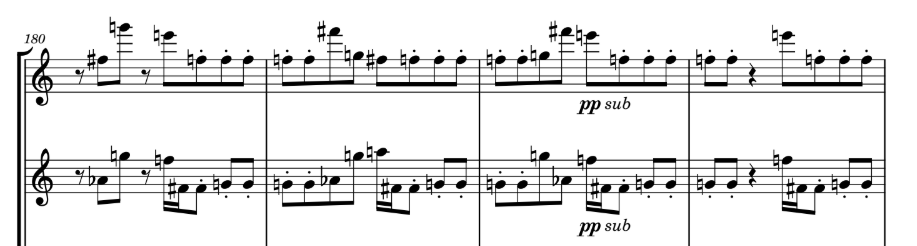
Sorry - I was confused - I thought the score you provided was a concert pitch score. It seems your mp3 has more material than the score does - are these the beginnings of a 2nd movement? There's some more things concerning articulation that I noticed like for example here: I think the notes that aren't staccato in the above passage should definitely be slurred for clarity of performance - otherwise, in sight-reading that's something that would be easy to miss. I know you include legato and slurs in many other places throughout the piece so I'm puzzled why you forgot them here. Yes - I totally agree there. I was mistaken in my whole discussion before as I was reading the score as a concert pitch score. Musically speaking my only critique is that, since the whole piece is at the same tempo, there aren't any changes in character within the duration of the piece. The whole piece comes across as a sort of 12-tone invention with many recurring and recognizable rhythmic and melodic motifs. It is interesting as that, but I think it could be so much more if there were changes of character for each different motif. I enjoyed listening nonetheless and thanks for sharing the recording!
-
-
-
Hi thx for the feedback, we usually try and avoid B#, and especially FX. Ik the 2nd Vietnamese school used them but ive been told by my Prpfessors not to use those spellings. Also yes the piece does have some tonal moments, but that's more for color. So i try nt to base spelling on the horizontal movement but the vertical. There's two many parts where id be making weird spelling choices if I did that. As for the piece being transposed I thought thats how the players read the parts? I do also have a C score obviously. Also heres the musescore mockup audio if u wanna hear it, like I said its done. Gentle Winds mp3
-
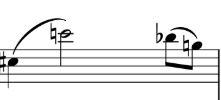
Hi @Rafael Avila ! First off, I don't know if it is customary to use a transposed score for serial works. Perhaps due to the dissonant textures and lack of key center it is preferrable to a transposed score? I personally prefer transposed scores because then you see exactly what the player sees and the logic of the enharmonics is different and customized. Btw, would you provide an mp3 of the piece as well? I've noticed from the score that some parts of it might even be perceived as tonal. Now to picking at the enharmonics. In measure 3 you have the flute playing this: Since you have a leap here of a major 7th I would spell the notes in this measure as C#, B#, A#, Fx. And since the part continues in the next measure to D# and B it makes more sense (to me) to continue using sharps here. You might think that since the harmony underneath that is basically D minor, that using your spellings would be more logical in that context. That could be true, and I wouldn't blame you for keeping it the way you have it now. But it also depends on how devoid of key the piece actually is. Is this just a short moment of quasi-tonality in the midst of atonal surroundings? Or do various key centers actually play a part in the piece and how it will be perceived by the listener? On a cursory glance at just the beginning of the score it doesn't seem particular dissonant or atonal and uses lots of consonances and octave doublings. Like I said, I am no 12-tone serial connoisseur but this seems like a no-no for a serial work. Basically - if the piece is tonal here and there, adhere to tonal voice-leading rules in those situations. But if the piece is more devoid of a tonal center then spell the pitches as logically as possible within each individual voice regardless of what the other voices are doing in a sense. That's how I would do it. Thanks for sharing and I'd be stoked to hear this piece!
-
My reason for using the English horn, is that oboes can sound quite harsh and intrusive in their low range. A bit like a duck! So I thought an English horn would have a more pleasant timbre in that range. Alex this really is a misunderstanding of how an Oboe works! Let's throw out the meme about DUCKS! The lower range/register can be as beautiful as the upper range. (just ask Dvorak). The English horn in this orchestration will not add too much. It does not have the penetration ... it is better used a solo instrument or in a small ensemble. Please no more duck jokes! Mark
-
Hi I composed this Wind Quintet, its 12 tone and I was wondering if anyone could help with checking the spelling. The piece itself is done and my main concern is now making it as readable as possible. The score is also transposed. https://drive.google.com/file/d/1z2Rklc0NyWTGlxcjtitSqk2fFByDzm_f/view?usp=drivesdk
Yesterday
-
Thanks Henry! I'm really pleased you like this work, because I wasn't sure it was any good. I actually tried to use con sord. on the violins; but then I discovered the little CTRL-T speaker thingy has disappeared. So I can't access that setting anymore. Seems to be some kind of bug within MuseScore, and it only manifested after the latest update. Weirdly it's only affecting this project. When I load other projects, the little speaker comes back. Not sure how to put this right? I guess some of those notes are probably too high for the violins without using harmonics; though I haven't actually checked. Glad you like the bassoons combined with harp, as I wasn't sure about that orchestration. Hopefully they can play those big jumps across the break; but I'm not 100% sure about that either. My time signatures are a bit all over the place in this piece, and I will be simplifying those at some point. Thanks again for your review! Alex.
-
Many thanks for listening Mark. The doubled oboes actually just come from my standard orchestral template. I was too lazy to correct the staff label! So I only envisage a single oboe playing most of the time. My reason for using the English horn, is that oboes can sound quite harsh and intrusive in their low range. A bit like a duck! So I thought an English horn would have a more pleasant timbre in that range. You're probably right about the bass clarinet. I just thought it might blend better with the regular clarinets.
-
I entered an international competition in Italy. How do you think this piece would be perceived in the Italian vocal music composition competition scene? Is there anyone familiar with how works like this are evaluated in Italy? It has never been premiered with live instruments, never been published, and has never won any awards. This is my first time participating in a major competition, so I'm not really sure how it all works.
-
-
-
That's a separate technique. The xylophonist I wrote this for can only really play two mallet style. Four mallet is more common for vibraphone. As for the piano countermelodies or solos -- nothing is set in stone as for this composition, so I will add a few of those shortly. Thanks for your feedback and advice!
-
Hi @MinGry ! It's a really good attempt on a Classical sonatina style and I think you capture the style. I think for the 1st movement you can pay more attention on voice leading and harmony. In b.12 the G major melody is played on top of a C major chord which would be out of style. I think the modulation to G major in b.13 is not successful because you don't introduce V/V before modulating, you are only repeating the G major chord and suddenly have the music enters G major. Usually the music either have V/V chord before getting to V, or have an imperfect cadence ends with a medial ceasura before going to the dominant key. Forb.30, 32, 34 and 35 I will have F# instead of F natural of the semiquaver figure. Thx for sharing and I will check the remaning movements. Henry
-
Hi @Some Guy That writes Music ! I am not gonna comment anything on scoring or engraving since it's my so weakness and @MK_Piano will comment on that anyways lol. I have zero experience in arrangement too so my following comment is merely subjective. I think the beginning can really be accompanied by a harp. Will you think of having the piece in C minor? Then the violins can play the melody with the lowest G, and I think that will be stronger than the viola melody unless it's played by its C string. i personally would want that intensity of tone with the lowest string of either violin or viola given how beautiful Sibelius's melody is, but it's just me 😛. I actually think of having the b.33 melody played by English Horn AND cello as well as I love the high register of cello haha. I think for the catastrophe in b.45 polyrhythm can be introduced with some triplets and sextuplets (and possibly quintuplts too) beneath the semiquaver figure as to capture that effect in the original piece. For b.59 I actually think of the melody played a single horn as in Brahms' 3rd Symphony to capture that solitude, since strings is always used before for the melody. Thx for sharing this arrangement! Also, thx for introducing this piece, it's fxxingly beautiful! Henry
-
Hi @Alex Weidmann ! To me this one is a fascinating work and I agree this one would be better in an orchestral setting when there are so much color available. You are very good at creating etheral color with the winds and harmonies as always. I love the color and timbral contrast brought in b.18; I'm not sure whether it will be difficult for the bassonists to play the wide leap though as I'm not familiar with the instrument. There are lots of really high notes for the strings: will you add artificial harmonics and con sordini to them as well? I think it will make it sound even more ethereal and mysterious. Really enjoy this one, thx for sharing! Henry
-
-
Hi @Carl Koh Wei Hao ! What a wonderful piece! I really enjoy it! This would really make a very good salon piece. The atmosphere is well created. I love the piu mosso parts which is clearly very idiomatic and Chopinistic! I also like the modulations in the middle part, especially the false recap in Gb major in b.163 and a magical return to Eb major in b.191! However I agree with @Grant Weep that the climactic phrase in b.198 should sustain longer, and then have the return of the A part in b.204 to be in a louder dynamic with more exciting rhythm beneath. I love that piu mosso in b.219! Thx for sharing this wonderful piece! Henry
-
Hi @MrBelegro ! The xylophone is well chosen for nostalgia of childhood! I think you can add some melodic parts to the piano as well, and on top of that xylophone can play 4 notes at most at the same time so it can be an accompaniment as well. Some countermelodies can be added too to allow an interaction between xylophone and piano. Thx for sharing! Henry
-
Hi @ferrum.wav ! I like the fast section in the middle, and I do think the composing technique is up to your standard of your past works. However I don't know why but I have to agree with @Some Guy That writes Music and @MJFOBOE that the piece is a bit monotomous to me. Maybe it's about the colour thing: previously your marvellous works are all orchestral pieces so there are a lot of colour to play with, but in chamber music setting you have much less color to change and have to focus much more on the overall structure of the piece. Although one thought is that the repetitveness and monotomy of the piece represents how the daily life works. It's my subjective comment of course and nitpicky tho =.= Thx for sharing! Henry
Last week
-
i have started doing some revisions on this, adding extra variations on the repeated oboe part (and some on the piano). hopefully this will fix the repetitiousness and make it more interesting but not entirely make the themes unrecognizable. should be finished in a few days !! funny you mentioned that. i had listened to that and strauss' oboe concerto and checked out how they treat the oboe before i composed this lmao thanks for the feedback guys !! glad you both enjoyed it





.thumb.png.8b5b433a341551e913a34392660bc95b.png)