All Activity
- Past hour
- Today
-
I don't know. Due to its repetitive and diatonic nature it sounds like a copy of Phillip Glass (first two movements) and Carl Jenkins (third movement) to me. And the violin part is relatively ineffective, it's just a slightly exposed solo of concert master above the orchestra. It lacks certain ammount of longlasting interest. This is the type of music I'd listen to at home as a background but I'd not be really looking forward to hear such one at live concerts.
-

Persichetti Exercise 2 - 8 for Clarinet Quintet
chopin replied to PeterthePapercomPoser's topic in Chamber Music
This is a good motif, supported by interesting harmony! This would work well as a jazz piece. All you'd have to do is change up the harmony, and add some drums. But the rhythms and theme can remain the same!- 1 reply
-
- 1
-

- Yesterday
-
Hi Everyone!, Acceptance is the first multi instrument character piece I have written. It is part of a broader concept: a Cycle of Death, in which I explore the theme of mortality across three pieces: Denial, Acceptance, and Rest. Using the Dies Irae as a harmonic backbone. In this piece, each instrument has a distinct role: The piano represents the truth of death that must be accepted. The flute embodies the human conversation with oneself: longing, hoping, and ultimately accepting. The violin and cello symbolize the path toward acceptance, guiding the listener through the journey. It was very fun composing this! Especially love bars:29-36 and 53-60 Let me know what you guys think! Hope you enjoy it! YouTube link Acceptance.mp3
-
- 1
-
-
The 12/16 at the end? NEAR the end, I mean, m. 35
-
I hope you all enjoy this new work. All comments/feedback welcome. Thank you
-

As the sun descends - Large Orchestra + SATB Choir
Symphonic replied to Symphonic's topic in Orchestral and Large Ensemble
Dear Mark, The motivation/intent to for creating this piece was because composing keeps me going. There is a lot in my heart and mind which I would like to convey to other people. -
As the sun descends - Large Orchestra + SATB Choir
Symphonic replied to Symphonic's topic in Orchestral and Large Ensemble
Dear Mark, Thank you for your comprehensive and kind words. Yes, I do give some time for each segment to blossom. Though, I am always aware of trying to keep the attention of the audience and inject a sense of unpredictability - a change in direction. It is a fine balance. Yes, to my regret, there is quite a lot of distortion in this recording. That is my error. I very much enjoyed your analogy of looking at a long piece as a journey through a beautiful English garden. It has been three years since I returned home to England. Although I was born and raised in South-London where beautiful English gardens are not exactly readily found. -
 MinGry joined the community
 -
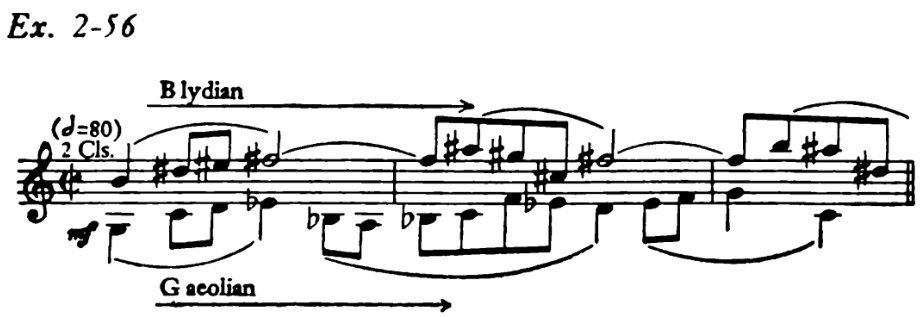
I come to you with yet another piece prompted by an exercise from Persichetti's "20th Century Harmony" - Chapter 2: Scale Materials. This time the prompt was "11. Extend the following polymodal and polytonal passage." I chose to change the instrumentation to Bass Clarinet and Sopranino Clarinet as I thought that increasing the distance between the voices would preserve their individuality. I also heard the bottom voice as being more in C dorian rather than in G aeolian. But for the end of the piece I defaulted to a kind of linear cadence rather than ending each voice on its individual tonic. Thanks for listening and I hope you enjoy and let me know what you think!
-
.thumb.png.8b5b433a341551e913a34392660bc95b.png)
Favorite Musical Book Quotes?
PeterthePapercomPoser replied to PeterthePapercomPoser's topic in Composers' Headquarters
I have another musical quote from Gary Lachman's "Beyond the Robot: The Life and Work of Colin Wilson". And if you've gotten this far, thanks for reading! -
Hello, this is my first time writing for choir. I am being commissioned by a local middle school to arrange Umbrella. I have just the bridge and a final chorus to add, but I wanted feedback. My background is percussion so I don't want to accidentally make anything to jumpy or impossible. Please be specific in critiques, I'd appreciate it! Thank you!
- Last week
-
Piano. Fortepiano, musically. Or gravecembalo col piano e forte.
-
Just a little theme I wrote for my girlfriend! Thank you for listening!
-

Invention in Db for Piano
Frederic Gill replied to PeterthePapercomPoser's topic in Piano Music, Solo Keyboard
Comment: Rhythm: you have many unaccented dissonances (4th beat), before consonances at bars (1st beat). According to my books, the cadential effect of this breaks the flow. But as part of a repeated design, it creates a shift to the left in the rhythm. Another element that creates a shifting effect is the (10) suspensions on 2nd beat. Interesting that when you heard my v1 for the 1st time, you were caught by the Bb in me1, on 3rd beat, and questioning about the key being Db (major) or bb (minor). Because in your compo you’ve put more ‘accent’ on the 3rd and 4th beats and opted for a more minor & dissonant approach. This is highlighted in your final cadence. In contrast, my compo has a ‘dancing’ rythmic pattern (quarter notes on almost all 2nd beats). In me10, the last Cb you put (? for sake of symmetry with the ongoing sequence and the following one?) makes a 1st parallel aug4th with the next (accented) interval. I find that a plain C sounds better with the upper voice and the new key (f?).- 1 reply
-
- 1
-
-
Just came back to this piece... Appreciatable. I took an inspiration from one of the rhythms.
-
 Found this in a box, partially chewed by mice! 1989, age 20. I wrote a lot of very short choral pieces as a youngster, trying to get something published...if I find any more worth entering, I'll do so in this thread. Aaronic Benediction Free Sheet Music by Robert C. Fox for Various Instruments | Noteflight
 -
Well, I would start learning harmony. Soyar´s advice is excellent. By harmonizing simple, short known pieces, you will get the hang of it. At the same time, I recommend you to learn the theory, in order to understand why things work or do not work I also suggest that you should invest in a keyboard, and hook it up to a computer with a notation program (e.g.Musescore). This setup could be the easiest way for a practical study of harmony using different chords. You can store, compare and playback your work any time. Moreover, you can always see the score of your work. It is important to obtain a skill in notation and reading scores. At the same time, you can start writing (play) some VERY simple, short melodies. Then, continue with harmonizing your melody. Start with chords, and when you are satisfied, you can go for variations (for example make arpeggio´s of the chords, add a bassline etc. This is the way I started. In principle, you can do all this by yourself. There are on-line courses in composition, but mostly, I find them of limited value. Instead, I would recommend you to find a teacher.
-
 Fruit Punch joined the community
 -
Hi, I love the arrangement!!! Can I please ask if you can also send the PDF version of this arrangementof the separate part so I can try to play it!!! Thanks!!!
-
 This thread needs more activity
 -
 Yeah you did, as I don't have the time nor energy to make another year review anymore now lol!
 -
Add Your Own Composition-Related Maxim.
Henry Ng Tsz Kiu replied to luderart's topic in Composers' Headquarters
"Be Honest" -
I like it because it is different. It's 'you'. In the result, it shows your own inspiration, more than mine. But It's like being schoolmates taking the same course, lol. I'll take the time for analizing the score and get back.
- 5 replies
-
- 1
-
-
- invention
- counterpoint
- (and 1 more)
-
 For further context This is the last and final movement of the whole entire series. The whole entire suite took me from December 2022 to the January 2025. Which this may have took the longest, if not the betrayal or the origins. The rejection for some reason took me the least amount of time, though it was the most important movement. This is where all problems are resolved, if not further extended. Plot summary for those who need it: This final movement reflects the aftermath of deception, betrayal, and manipulation. Ross finds unexpected support as Fiona and the Girls take his side, offering moments of solidarity amidst the chaos. Aldric continues to plot, holding meetings and spreading misinformation, particularly misleading Clara, who is unrelated to the unfolding conflicts. At a gathering, Ross’s attention turns to Isolde, whose flirtations pull him into a state of confusion and emotional conflict. An interlude offers a reflective pause, followed by the sunrise—a moment of fragile hope. Tension peaks as Aldric reveals a secret, testing Ross’s courage. The Rejection Rings are mockingly forged, representing the last remnants of Aldric’s manipulative control. Ross confronts Aldric, struggling to reclaim his dignity and agency. A few days later, Aldric arranges a civil meeting with Ross, only for the portrait of Aldric to be used as a tool of public humiliation. In this final act, the dynamics of power, trust, and social perception are laid bare, closing the cycle of conflict and leaving Ross to reflect on all that has passed (important crotale to marimba playability). Since this project was divided by other projects most of the percussion parts aren't constant in variant number the first movement had for mallet parts if there are any extra remaining people, then quick mallet changes could be performed by them.
 -
2-part invention in Db
PeterthePapercomPoser replied to Frederic Gill's topic in Piano Music, Solo Keyboard
Hi again @Frederic Gill! I decided to write my own invention based on the same motive here: Let me know what you think! -
@Frederic Gill inspired this one. He wrote an invention as an exercise from one of his Counterpoint books on the same motive that you can hear here: I was inspired by his attempt so I decided to give it a try myself. Thanks for listening and I hope you enjoy and let me know what you think!
- 1 reply
-
- 1
-