All Activity
- Past hour
-
Hi @Aiwendil! I will review your Concerto a movement a time. This one is for sure very high spirited Classical Concerto reminds me of Mozart and early Beethoven. The energy and motion is very driving throughout the whole movement, motives very coherently used and the opposition between C major and minor is well noted, and the double exposition structure for a classical Concerto is well manage. The modulations within the development add much variety to the harmonic colour, and the interplay between other instruments is lovely. The modulation to F# minor in b.236 is a pleasant surprise to me!, it’s a great way to create crisis before resolving it in the cadenza. Just one question, will you add a concluding trill to signal the end of the cadenza? Thx for sharing! I will review the remaining movements. Henry
-

Persichetti Exercise 3 - 52 for Piano
Henry Ng Tsz Kiu replied to PeterthePapercomPoser's topic in Piano Music, Solo Keyboard
With the accelerando it sounds like Mario music, but later on it sounds like Prokofiev with those dissonances! - Today
-

Is This Violin Chord Possible?
Churchcantor replied to Churchcantor's topic in Announcements and Technical Problems
Yes, probably weak as opposed to your suggestion, and I changed it. Last movement of my D Minor String Quartet. -
Is This Violin Chord Possible?
Henry Ng Tsz Kiu replied to Churchcantor's topic in Announcements and Technical Problems
I am not a violinist myself, I think the chord is playable but only less effective on a violin. I think the chord would be more effective on a guitar or piano! It definitely fits my hand to play it on a piano haha! -
Is This Violin Chord Possible?
Churchcantor replied to Churchcantor's topic in Announcements and Technical Problems
I knew that didn't look right...really, after 38 years, writing an impossible violin chord! I can forgive myself for an unplayable guitar chord once in a while... -
Is This Violin Chord Possible?
Churchcantor replied to Churchcantor's topic in Announcements and Technical Problems
Thank you! -
Is This Violin Chord Possible?
Henry Ng Tsz Kiu replied to Churchcantor's topic in Announcements and Technical Problems
The chord would have to be played by splitting and with your inversion, only A5 and D6 with be played as the final chord and leave a barer sound. With F#5 and D6 it definitely sounds fuller! -
I've written another composition/song prompted by an exercise from Persichetti's "20th Century Harmony". This time it is for women's choir. The prompt was "Compose an original piece for women's voices (SSA) featuring chords by fourths. Other textures may be included. Use the following text, Psalm 107: 'They mount up to the heaven, they go down again to the depths: their soul is melted because of trouble.'" Thanks for listening and I'd appreciate any comments, suggestions, critiques, or just observations!
-
Parking lot, parking lot, You are what all I've got Please give me a shot And don't act like an AI bot!
- 1 reply
-
- 2
-

-

-
I made a song for my sister. I asked what to call it and she said "I don't know so I took that phrase and put it through a fancy and long for no reason translator and It gave me something really long, so I shortened it to "shrouded in obscurity" also, this is the last short and effortless song I will make, because I'm trying to make better quality music.
-
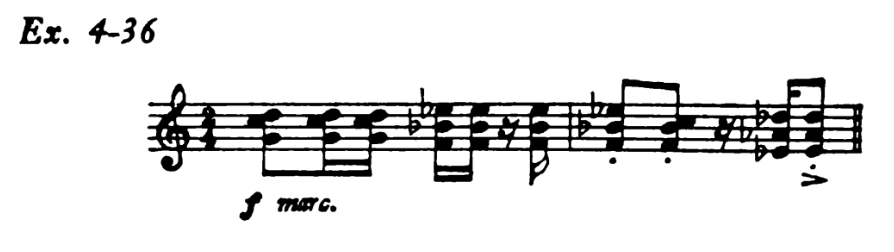
I come to you with yet another quartal exercise from Persichetti's "20th Century Harmony" - this time for a trio of Trumpets. The prompt was "4. Continue the following passage for trumpets preserving the general character." Thanks for listening and I'd love to hear any of your comments, suggestions, critiques or just observations!
-
Is This Violin Chord Possible?
Churchcantor replied to Churchcantor's topic in Announcements and Technical Problems
I don't know, what about my inversion? If I had a violin, I'd try it out, very badly...🤪 -
Is This Violin Chord Possible?
Henry Ng Tsz Kiu replied to Churchcantor's topic in Announcements and Technical Problems
Why not write with A4, F#5 and D6? - Yesterday
-
This sounds like an interesting and inventive subversion of a waltz. I'm curious why you describe it as two movements, though. I guess you're considering a new movement to start at m. 106, but it's in the same tempo and style. Also, you probably know this, but the stuff in the right hand at m. 158 and forward would normally be written as tremolos. I assume you wrote out the notes so that the notation software played it back correctly, but in such cases I'll usually prepare separate versions of the score for playback and for display.
-

Piano sketch or not for orchestrating and composing
Kvothe replied to Luis Hernández's topic in Composers' Headquarters
I have heard that JW does use 8 staves, too @PeterthePapercomPoser. Writing out a sketch would help me. I am slowly learning orchestration (Adler's Tome is a lot to take in). My recommendation would be: master piano writing! 🙂 -
Is This Violin Chord Possible? Free Sheet Music by Outis for Violin | Noteflight Just askin'. I have been writing music for 38 years, but I am not a string player. If possible, could not be sustained...
-
Oboe Concerto
BlackkBeethoven replied to BlackkBeethoven's topic in Incomplete Works; Writer's Block and Suggestions
So I took some time away from the piece, and I let it rest for a bit...Now I have more material, but I'm editing some of my original harmonies P.S - My horn part sounds TERRRRRIBLE b/c I think I transposed it wrong, but I'm posting anyway b/c I'm kind of happy wit how it sound overall so far Notes: - Wanting some more cinematic harmonies & fullness - Smoother modulation -- the chord progression I was going for : (descending line in 6ths over the top of the chord changes) Ab6 - Abmaj7 - Abm6 - E (#11) - Bmaj7 (7-6 suspension) - Smoother inner lines (aiming for 3rds, but idk if this is getting the desired effect) - How to incorporate the other instruments in a way that's smart and adds to the piece oboe.pdf -

Persichetti Exercise 4 - 40 for String Quartet
chopin replied to PeterthePapercomPoser's topic in Chamber Music
Very modern sounding, and I can definitely hear the influence of the pentatonic scale. The harmony makes this scale not sound so sing songy. Nice use of key changing, and after the musical phrase I like how you descend down the scale (such as around 0:36 and 0:39).- 1 reply
-
- 1
-

-
.thumb.png.8b5b433a341551e913a34392660bc95b.png) Hi @Luis Hernández! I personally use different numbers of staves to sketch things out for orchestra depending on how far I am in refining my material, what my needs are or how big the orchestral forces I'm sketching out are going to be. If I'm sketching out for a string orchestra I usually don't need more than 3 staves (treble clef, alto clef and bass clef). If I'm expanding the string orchestra sketch for a bigger orchestra I use 6 - 8 staves: 3 staves for the strings, 2 for winds, 2 for brass, and 1 for percussion. Finally, if the score is really complex I will write things out for a full orchestra partiture upwards of 16 staves. But I rarely use just a 2 stave piano score for an orchestra - for me it's too small. I've heard that John Williams uses 8 staves when he sketches out his film scores. Great topic!
Hi @Luis Hernández! I personally use different numbers of staves to sketch things out for orchestra depending on how far I am in refining my material, what my needs are or how big the orchestral forces I'm sketching out are going to be. If I'm sketching out for a string orchestra I usually don't need more than 3 staves (treble clef, alto clef and bass clef). If I'm expanding the string orchestra sketch for a bigger orchestra I use 6 - 8 staves: 3 staves for the strings, 2 for winds, 2 for brass, and 1 for percussion. Finally, if the score is really complex I will write things out for a full orchestra partiture upwards of 16 staves. But I rarely use just a 2 stave piano score for an orchestra - for me it's too small. I've heard that John Williams uses 8 staves when he sketches out his film scores. Great topic! -
Hi @Bjarke! Is this the piece you messaged me about? I think it is quite melodramatic trying to keep such a high intensity and drama without any relief. I don't personally perceive any "climax" because of the constant high intensity. You could create contrast by varying the tempo/tessitura or the thickness of the chords. Currently the chords are voiced so thick all the time that the thickness comes across as the most salient feature of the music and the sense of melody is lost. Also about the tempo - there are few classical pieces of music that are at this tempo and intensity that still manage to keep a sense of being sublime like classical pieces are usually expected to be. Is there any particular reason you're trying to write this piece at such a high intensity/tempo? It isn't conducive to musicality imo. Because of this the cohesiveness of the melody also seems lost to me - the melody seems arbitrary with random seeming modulations. Most importantly there's no sense of tension and release without any sense of cadence nor harmonic resolution. That's my perception of the piece. Thanks for sharing!
-
I don't know how to add instrumental music nor do I know how to post videos on here.
-
 Context: composition of an orchestral work or, at least, a chamber piece. Do you first use a sketch for solo piano? What advantages would this have? With the whole range of software and virtual instruments available, the temptation (and reality) of composing directly for the orchestra is very strong. As an amateur composer who makes music purely for intellectual pleasure and for the senses, and also because I am partly self-taught and partly formally trained, I confess that the small pieces I have written have been without a piano sketch. By piano sketch, I do not mean, in this case, a reduction for piano that is idiomatic for the instrument, even virtuosic. I mean a sketch that captures the basics: structure, harmony, melody, rhythms, accents. I consider my training in classical and modern harmony to be very good. In counterpoint, quite good. But lately I have become interested in orchestration and, in turn, trying to structure a work of a certain length (without going overboard for the moment). And in this sense, I think that the piano sketch can be very useful and not a waste of time. In relation to this, I am also doing the opposite: orchestrating fragments or small pieces for solo piano. What do you think?
- 2 replies
-
- 1
-
-
- orchestration
- composition
- (and 2 more)
-
Where is the music itself? The pitches and stuff? This would be nicer if I could listen to it. Thank you!
-
Hi @Uhor! This one looks like works written in Absolute Serialism with the very precise rhythmic division, but they do not sound as random as them actually quite refreshing to listen to! Thx for sharing. Henry
-
Persichetti Exercise 3 - 50 for Woodwind Quartet
Henry Ng Tsz Kiu replied to PeterthePapercomPoser's topic in Chamber Music
I find this one refreshing to listen to and easy to follow due to the sequences!
.thumb.png.1e2763f479362bbb522da50d31ef2e50.png)