
Leaderboard
-
Tónskáld
Members3Points653Posts -
Leonardo C. Núñez
Members2Points70Posts -

Jean Szulc
Members2Points324Posts -
Left Unexplained
Members2Points613Posts

Popular Content
Showing content with the highest reputation on 06/12/2020 in Posts
-
1 point
-
1 pointThis is a tone poem inspired by a work penned by Icelandic poet Jónas Hallgrímsson in 1843. His poem speaks to the frailty of life, the uncertainties that threaten us, and the watchful eye of God. The imagery evoked here is of a lone seagull flying out across the sea under moonlight, who meets his untimely demise in the jaws of a lurking shark. The phrase "Máninn er hátt yfir sæ"—the moon is high over the sea—anchors each stanza of the poem, providing a sense of steadfastness against an otherwise bleak tale. This I chose to be the title of the tone poem, and I hope the proceeding aural onslaught captures the evocative imagery of the source poem. Do let me know your thoughts and feelings about this work. The harmonic language is my own, but I sometimes question whether it suits its purpose in storytelling... Even if you don't feel qualifed to comment on the technicalities of the piece, your insight into the tone poem's emotional depth (or lack thereof) is just as valuable to me. For those with more theoretical savvy, I've also attached the score and would greatly, greatly appreciate feedback regarding that. I've tried to make it as succinct as possible but I know I've overlooked things. Thanks in advance for your thoughtful input!1 point
-
1 pointI am writing my first sonata. This is just the bginning. I hope you listen and give me suggestions (listen until the music stops; the rest is draft).1 point
-
1 pointgreat peace, i think the playback doesn't do the piece justice! I think IRL it would sound absolutely amazing. I honestly don't even know what i would do to make it better, other people have said the right things i think. anyways, keep going and have a nice day1 point
-
Hello there! I created a Fiverr gig in which I final format your scores so that you can distribute it online. This means I'll take your score after you finished working on it, and will add a custom designed cover, whatever piece of text you need, etc. and turn it into you could distribute in a professional manner. I work with multi-part works, as well as small scores. As every project is a little different, feel free to contact me directly through Fiverr to let me know of the specificities of each project and perhaps ask for a discount. If you want samples of my work, most of my scores here in the forum were formatted through the same manner. I also have a bigger portfolio on Fiverr, so feel free to check it out! Anyways, here's the link for it: https://www.fiverr.com/share/YLBajK Thank you all for your attention!1 point
-
@Left Unexplained You'll get there very soon, man. Thank's for commenting 🙂1 point
-
1 point
-
1 pointThis is very true! (And the default is usually to play it divisi.) But I honestly think it has more to do with how others perceive you as a composer. If a composer neglects to clear up points of confusion, he may very likely be perceived as sloppy or lazy. Plus, it comes across as courteous to the orchestra: "Ah, here is a composer who put himself in our shoes and thought about how we might interpret these passages." Be kind to your orchestra, and your orchestra will be kind to you. 🙂1 point
-
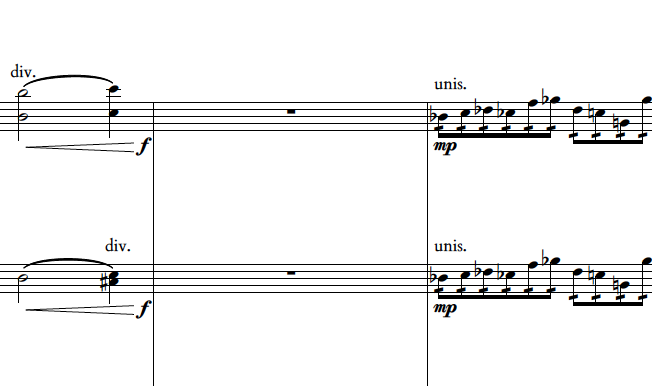
1 pointSo, here are some pointers regarding the score. The most consistent error I found was that the string parts don't indicate whether chords of notes should be played divisi or non-divisi. Since the stringed instruments are capable of polyphony (i.e., striking up to 4 notes at once), it is important to notate whether you wish for the chord to be spread out among the players or played as a stop, like so: (These are the staves for Violin I and II, respectively.) Notice how "div." is written as technique text when the notes split, which indicates that half of the players should play the top note, and the other half plays the bottom. When they come back together, it's helpful to write "unis." above the notes. Page 1— I think you misspelled the clarinet part. In Dutch, the spelling is "Klarinet" (you have "Klatinet"). Bar 2, Bass: going from a slurred bow to a pizz note is impractical unless you want the player to do a left-hand pizz. In that case, a "+" should be placed above the note Bar 2 and beyond, bass & celli: the half-note pizz will be a bit troubling for players, who are used to seeing pizz notes as quarter notes (or less). When they see the half notes, they may be wondering if you meant to indicate arco (as I did). If you're wanting the pizz effect to be sustained over a half-note beat, I would change those notes to quarter notes and put the expression text "l.v. sempre" beneath the first passage. Or just leave them as quarter notes and be done with it. Bar 10, woodwinds: it's a good idea to put a dynamic marking in between those hairpins so the players know how loud they're supposed to play Bar 11 & 12, Fagot: the first G and E... are those to be played "a2" or by only one of the parts? Bar 14, strings: do you want that slide played as a glissando (a very deliberate slide) or portamento (a more subtle slide)? It sounds more like portamento in the playback. While strings can perform glissando, it's more common (and faster) to perform portamento, which seems more appropriate between the two 8th notes in your piece. All strings: there are a few passages where you have a pizz note immediately followed by an arco. In practice, it takes a few seconds for a string player to adequately adjust between the two articulations. I would try to avoid that as much as possible and leave at least a quarter note rest in between the switches. Okay, that's probably enough for now (sorry it's so much!). Please let me know what questions you may have as you look over these tips. You've done a great job; I hope you don't get discouraged reading these!
 1 point
 -
1 pointHow are you liking Notion? I used it back in the day but switched to Sibelius. I liked the sound samples better on Notion but making a score look good was way easier with Sibelius. I dig the piece!1 point
-
1 point
-
Hi Markus, wow, that's a very deep analysis what you did. I've been analysing some classic Allegro-Sonata movements in the last few days, but just focusing on the formal structure...Yours is much more complete 😅. Thanks for sharing it!1 point
-
1 point
-
1 pointThat's a very imaginative piece. Lots going on. Great job. What did you use for playback? Oh, about your score, it would be better to include instrument designations at the beginning of each system. Just abbreviations. Makes it easier to make sense of.1 point
-
1 pointHere is the fifth prelude in my set. A very virtuosic prelude. as I view D major as the virtuosos key. also quite heavy and at least in my opinion fun to listen too. Please leave thoughts down below 🙂1 point
-
1 point
-
1 pointThis is an incredibly on its own, particularly in expressing the core theme of the poem of the frailty and uncertainty of life. However, I have to say, it regards to portraying the story of the poem I'm not sure I could really "see it" due to the lush (and well done) orchestration that to me would fit a more grander scene.1 point
-
1 pointYour description heading the topic is most apt. The piece reflects the tensions, the mood, the chill very well. It's murky, dark, threatening but for all that, beautiful. The close, the way it evolves from bar 147 toward the final sustained chord before fading out completely is superb. No point in adding to the comments already made. Just one small technical one: Bar 137, it would be difficult to get a ppp out of a bassoon playing that deep in its register. Excellent work. Hugely atmospheric. A pleasure to listen.1 point
-
1 point