Leaderboard
-

Henry Ng Tsz Kiu
Moderators6Points3,143Posts -

Guardian25
Members3Points159Posts -
ComposedBySam
Members2Points180Posts -
Luis Hernández
Members1Points3,401Posts




Popular Content
Showing content with the highest reputation on 01/07/2023 in all areas
-
1 pointThis is an old piano piece I dug up from years ago (again) that I finally decided to salvage and finish. It's a little rough around the edges but I think that goes without saying with this kind of harmonic style/language. Although I did not actually intend this to be fully atonal - it is quite dissonant and not for the faint of heart! (I mean the bridge is falling down after all - right? LoL) Thanks to @Thatguy v2.0 for helping prepare this rendition in his DAW with a superior piano vst! He probably spent upwards of 4 hours perfecting everything about this little piece that I could pick at! Although our partnership was not without its minor strife I am eternally grateful for his help (even if I seemed at times ungrateful and demanding - sorry!) Thanks for listening and for any constructive observations, comments or critiques you'd like to make! Edit: I've included the original mp3 I exported from Musescore 4. I didn't use Muse Sounds because it wouldn't perform my velocity changes. Thankfully the MS Basic Piano soundfont did take my velocities into account and I added Muse Sounds reverb to it.1 point
-
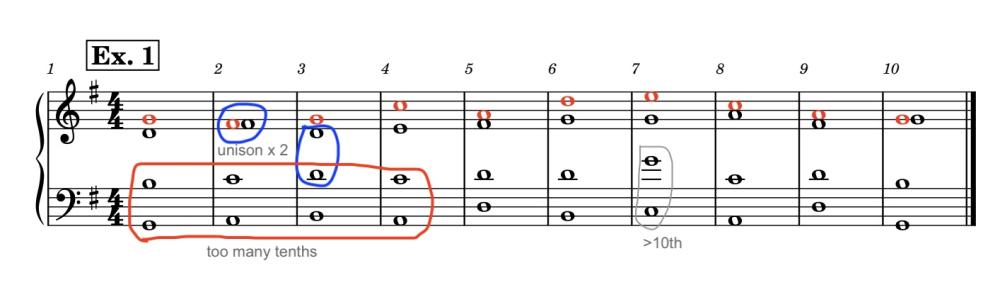
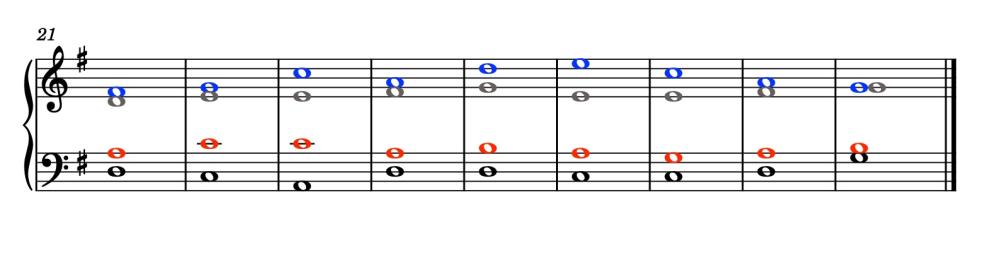
Here are Four 4 Part 1st Species Counterpoint Exercises that I did. The given melodies are highlighted in red. Any feedback would be appreciated! 🙏1 point
-
4 voices makes it much more difficult. In the first one I have some suggestions: Too many equal intervals in a row (10ths) Two unisons together An interval bigger than a 10th I tried another solution, which is not perfect, of course. Good exercises!
 1 point
 -
1 pointLmao this is insane, great satire. Well mixed and polished, *chefs kiss*1 point
-
1 pointYes you're right. The german sixth chord used would have a sharp 4th there. I really appreciate your valuable feedback regarding this and will correct these in the future. Thank you for listening 🙂1 point
-
1 pointThank you for clarifying so many things to me! I really appreciate the feedback 🙂1 point
-
I think it's ok for all 4 exercises now! Congrats!1 point
-
Updated! I missed those two interval in ex.3 being that wide!1 point
-
I think all of them are good! Except I'm not sure in the opening chord of ex.3, will the interval between alto and tenor too wide? There's a parallel octave between soprano and bass in b.6 to 7 of ex.4. though.1 point
-
1 point
-
I would like to know how strict the rules for the counterpoint you base on. E.g. some stated that tritone is forbidden between any voices but you have tritone in b.3 and 4 of ex.2. Some even say that no similar motion from an imperfect consonance to a perfect one since there will be a hidden fifth in it. I don't remember much for the rule though😅. Can you provide the rules you based on?Thank you! Henry1 point
-
1 pointI love this variation. It is developed throughout the piece, not some static variations that changes only the accompaniment. In each of the variation the character, the handling of the theme and motives, texture, rhythm, tonality, harmony etc are changed. This give great variety to the music. Really great job here. I love the 7/8 bars in b.2 and 4, as it pretends to be a 4/4 one and just fool me with 1 quaver deducted. The chords with interval of nine from b.14 onwards will be really difficult to play, though it can be played. I love the variation in b.36. It pretends to be a Chopin Nocturne but not in its core. There are some "wrong" notes (in the context of Chopin) in it which are funny! The section in b.67 really gives me the feeling of Chopin prelude in A minor, though a funny version of it. And I love the Bartokian ending! What a funny and great piece this is! Henry1 point
-
1 pointYou really use an interesting form here! So from what I can get from the score, section I starts from measure 1 to 35. Actually, I think that can be divided into 3 other smaller sections that have different textures. I especially like the one with the staggered octaves, or ninths. Then it gets interrupted by the loud arpeggios to like this serene section where it suddenly sounds all tonal and stuff, or from what you typed on the score "eerily serene". It gets interrupted again from section I but this time it's much shorter and it leads into this mysterious chromaticism porridge section. Then it just goes off to the end. I really like that I can hear different textures. Like, the textures are different enough that it can shine on their own. It's not the usual kind of variations form, but I think it works for the subject matter. After all, the bridge is indeed falling down, or has fallen down. It's just down there now. On the bottom of the river. Anyways, great piece!1 point
-
1 pointThis doesn't seem atonal at all. Definitely has a harshness to it -but not really fully dissonant. I like the different textures you venture into. I'd have to say my favorite section was measure 36. I think this material could have been played with more here. Very nice!1 point
-
1 pointVery nice and sweet sound! Nice waltz in the middle section! I would love to add the penetrating sound of oboe as well, especially in the middle section and b.67! I would mark the B flat in b.42 and 43 in A sharp though for an augmented sixth chord. Just wanna ask: Will the slur from b.46-69 too long for the string players, or will be ok? I agree with Luis and Composaboi on that point. Would a Clarinet in A better than the one in B flat to prevent that six sharp key signature in the middle E major section? Very nice work especially it's your first one! Congrats on that! I hope I can write like this in my first one though! Henry1 point
-
1 pointA great first foray into writing for choir! A couple of thoughts if you want to develop this further: 1. Your soprano part goes too high. You really only want to write notes that high if you are composing a commission for a particular super-soprano soloist who you know can hit those notes and do it gracefully. For the average choir, writing to around a G above the staff for sopranos is about right. If you add a second soprano line in that section, so the lower-voiced sops have something lower to sing, you can stretch the upper part a little. (But not this much!) Another option is to add an accompanying instrumental part and give those upper notes to the player. You could write a piano accompaniment, or add a solo instrument like violin or flute. 2. Find a text! Choral singing is about poetry and the beauty of what is being said, as well as the beauty of how it is said. The only time you hear a choral sound without a real text is movie soundtracks. (It's fine if that's what you want to do, too, but then you'll want to specify if people are singing "ooh" or "aah" or some other filler syllable). Part of the challenge of writing for choir is fitting the notes to the text or the text to the notes well, so if you are working on writing for choir, think about working on that skill as well. 3. Finding your text will help you figure out how to split those long notes up with logical places to breathe. You may want to make a whole note into two half notes on repeated pitches, with each note belonging to a different syllable of text, or remove a tie and do the same thing. Try singing your way through and feel where you want to breathe. Your intuition will probably be pretty good. 🙂 This has a lovely ethereal sound. Try listening to some choral works to get ideas about how to use text and build sound. Here's one I like a lot that has a similar slow cathedral sound, but with funkier harmonies and more parts. The text translates to " O Master of all living, bestowing priceless gifts upon us."1 point
-
I'm highly against this, but it no different than samples being used in rap music and other electronic art forms. Would have been cool to cut the sax out or just have it play hits so we could hear the piano get some time to solo.1 point
-
1 pointI'm no vocalist myself so I'm afraid to comment badly on the voices, but I do think the choir might suffocate singing the long notes ! 😱 I think a one beat rest will be enough for them to breathe, so maybe just add one before changing a note will be fine, and that does not affect the music much! Henry1 point
.thumb.png.8b5b433a341551e913a34392660bc95b.png)