Leaderboard
-
Thatguy v2.0
Moderators3Points1,360Posts -
PeterthePapercomPoser
Admin2Points2,961Posts -
ComposedBySam
Members2Points180Posts -
Luis Hernández
Members2Points3,401Posts

.thumb.png.8b5b433a341551e913a34392660bc95b.png)


Popular Content
Showing content with the highest reputation on 01/20/2024 in all areas
-
I originally thought of starting a topic called "Why do you compose?" But a quick search reveals 5 pre-existing topics that have repeatedly asked that same exact question over the years here at Young Composers Forum: So if you want to know why people here compose just peruse those old topics... Just kidding!!! 🤣 But seriously - who do you compose for and what do you expect? I mean it's obvious that composers and people in general are social creatures and yearn for the approval of others around them. Or do you completely ignore other people and society when you write music and yearn only to express your own inner inspiration? For me I think the old sociological truism of "Society in Man" applies. I feel that societies popular musical tastes have to some degree become my own so when I compose music I reflect in that music some of the popular (as well as more unpopular) musical norms. So of course from my own perspective, I just write music for fun (and that goes with my musical philosophy about music in that I believe that all music is basically playful). I write for my own enjoyment but I consider that to be in common with my contemporary audience which I feel some satisfaction in saying has to some degree also enjoyed my works. But it could also be a detriment if a composer composes for attention seeking or places other's opinions above their own. What do you expect from others? Do you have healthy boundaries? How do you react if someone expresses an unfavorable opinion of your music? And how important are the opinions of others in your musical self worth as a composer?1 point
-
It depends on what you're doing. How much theory background do you have? I would get familiar with all your major and minor scales, it'll really help. You spell chords with sharps or flats depending on the scale, and the letters of the scale ALWAYS go in order. So in A major, you would NOT have A B Db D E F# G# A. See how I skipped the letter C? We don't want to do that. Now if you're talking about using chromaticism, or going to non-chord tones, or whatever else, what you say is true. You want to use flats going down, and sharps going up. HOWEVER, this is not the case with what I pointed out. Chord tones are different, and we'd want to revert back to our scales. This isn't always the case, but it's where I'd start out if I were you so you can keep track of what you're doing. Later on, you might use the Db depending on what the other notes around it are doing. Sure there are outlying examples of this that might be contradictory or confusing, but if you stick with this and practice that, the rest will begin to make more sense. My guess is you were viewing your music horizontally, but not vertically. Always watch to see what kind of harmony your melody is intertwined with to avoid clashes and such. 👍 I'm not a string player myself, but I would rather have the music sound more like I want it to than to fear slurring wrong. I'd write your slurs, and if they're wrong, hey, you get to learn how to do them better from feedback or critique. The forum-god @chopin just made a video about slurs, you would probably find this useful. Especially check out the music by some dude named "Vince" on the video, he's my favorite.1 point
-
Hi It is a work of impressive intensity, which reminds me of Metamorpohosen by Strauss.1 point
-
1 pointThis is actually the first time I composed a piece completely on paper. Just played around with a cute theme I improvised some days ago.1 point
-
1 pointYes, it totally gives the feeling of classical also because of the timbre of the piano.1 point
-
Because, I suppose, I was musically brought up 'that way' I started composing as a means of expressing things beyond words and the static of fine art. Communication then. I also adhered to much of the semiotics of music - cadences, keys, emotional devices, timbres, to make communication possible. But soon I sensed the arrogance of expecting others to bother with my outpourings. So now it's become more for fun; a thing I do, ready to put some before an audience (even if a virtual performance at a local 'interest group') but with no expectation that anyone will take any notice. It's why I keep in touch with light music. As an amateur orchestral player I had resources available to perform such work with the advantage of key and regular rhythm making it easier to play. Less about seeking fame than joining in. I have no wish for fame in this modern world when it's probably better to stay below the parapet. Although covid and huge rises in administrative costs have closed down my local orchestra there's one in an adjacent town where I occasionally play. I hope my local one starts up again. So now about half of my output is more for my own use. Occasionally I hit on something that might be suitable for public performance but I think my composing days are almost up. Results have become more abstract, development more difficult. A college professor I happen to know claims I never take music seriously. Perhaps he's right. After an enthusiastic start I gave up college and turned to a different 'profession'. Interest in fame and recognition waned. You can only be famous these days as a successful pop band or film hack (if Zimmer allow you). There are thousands of people composing now all aiming for something on the spectrum from 'for myself' to fame. So now I expect little (from an audience) but still write to say something about 50% of the time. The other 50% is me musically talking to myself!1 point
-
1 point
-
Hi guys! All of us here are composers, whatever level we are in. However everything has its beginning (and hopefully not end). We all have our first experience of composing, and start to compose more by having that first experience as the basis and build ourself up, whether by skills, knowledge, experience or taste. I would like to ask, why and when do you first begin composing? What is your inspiration of it? How do you compose when you may not have adequate tool and theory to back you up? I wanna share my own experience. I started learning piano when I was 10 years old, a relatively late age. Then after months or a year or so, I suddenly had the impulse to imitate Beethoven's Moonlight Sonata, since it was the first classical piece I had ever listened to, alongside his no.13 and noi.15 Piano Sonata. I remembered I knew nothing on composing and therefore just wrote some mess out, which might resonate with some of Beethoven's passage LoL, in a naive way. I didn't even have staff paper at that time, let alone PC and computer program to write the music out. I just wrote with the letter names on top and the note value under it like this: A G# Fx G# Crotchet Crotchet Semibreve Minim (in note, not words) I have already forgotten that piece, but that experience is unforgettable. There's no reason for me to begin composing, since no one has ever taught me so, but I still do that and luckily I am still composing. Really wish you guys can share your first moments of composing to us! Henry1 point
-
I started composing right after the last exam of my primary education. I started learning piano and joining band at around 13, 2 years bf this exam, when I here and there had the desire and inspiration to compose, but never manifested them. I started off with drawing those fives lines on paper as a substitute for actual printed " manuscripts ". This was partially becos I did not know how to get a proper manuscript paper and also cos I wanted this endeavor to be secret. Later on, I got tired of it and wanted to get actual manuscripts to write on, using the excuse of writing music notes. Eventually I had known how and where to get them myself. Those are v cheap and simple music manuscript notebooks, which are A5 sized. Then as I had written more and more, I began buying the A4 sized notebooks and small stacks of spare manuscript papers for drafts and/or movability. I have only used pencil and eraser, and no pen and what nots. Thus began three years of composing on paper... bf my years of musical stagnation due to academics and an ironic revival of my music composing in software in govt service, which gna end soon. This is elaborated in this other thread - I still have the very draft of the very first piece - which is so difficult to finalize due to confusing timing and key and deciding on both the time signature and key till today. I still wanna re-create that piece becos it sounds rly interesting and adventurous. Hope I'll be able to do so asap! These first few pieces were kinda all like that- weird, almost atonal, kinda without a fixed time signature, before me more or less settling down on more disciplined, but also more rigid, grounds. And yes, I haven't even decided on their titles lol... So yes, I still remember those pieces, but this still has been really relatable: Thanks for the sharing and discussion!1 point
-
1 pointNice piece - kinda sounds like an interesting mix of Sibelius' thick, powerful chords and Debussy's jumpy, playful rhythms and melodies.1 point
-
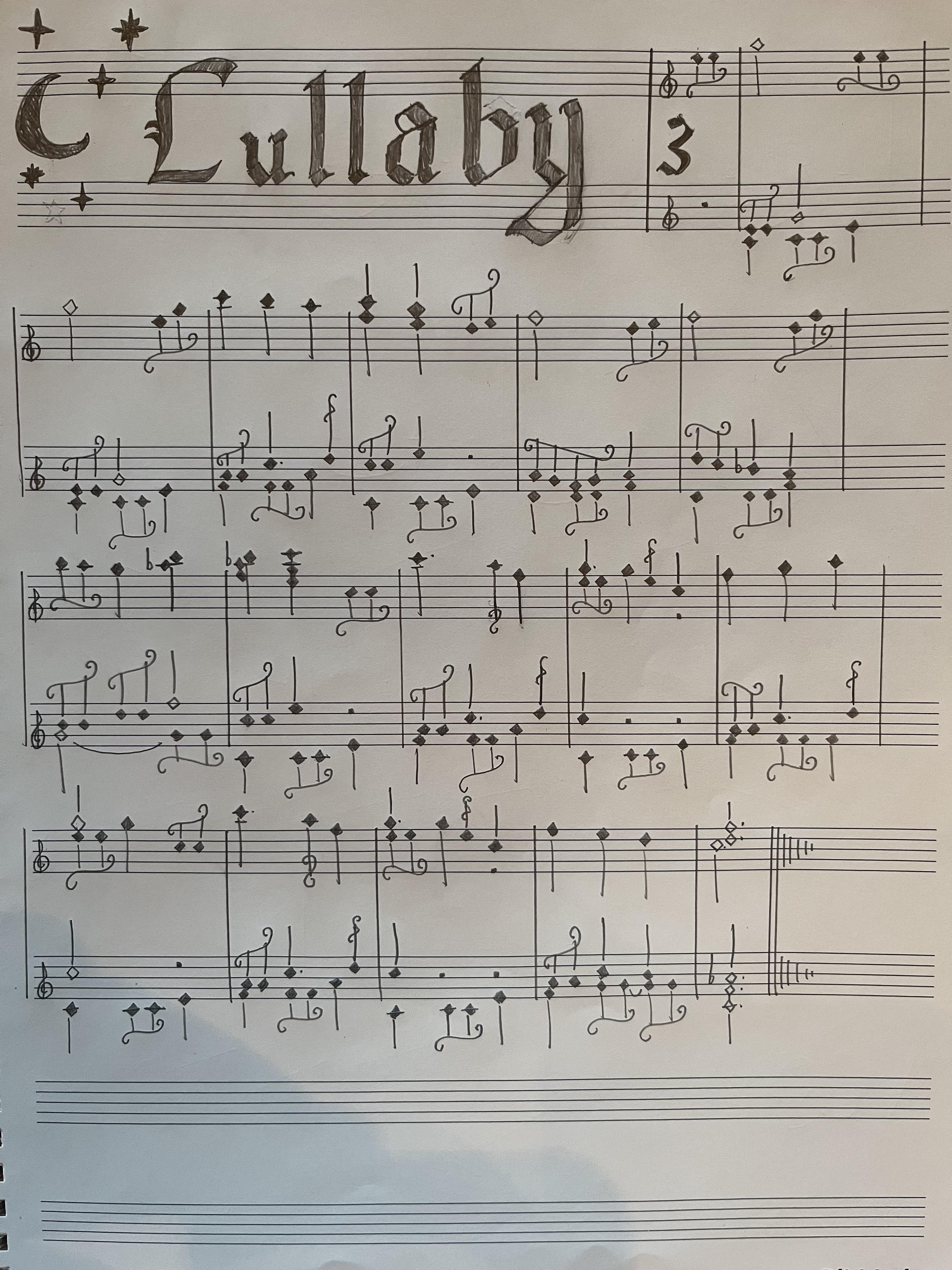
Thought I'd try this out with that progression i made. THIS IS VERY BAD PROBABLY BUT I TRIED.Lullaby Variation.pdf1 point
-
This is definitely a piece I had to listen to a few times, because of its complexity. But I enjoy complex music, so this was easy for me to do! There's so much dissonance in this fugue, and I'm actually quite amazed at how smooth you were able to make this sound. Your sudden and deliberate key changes really help to keep the listener engaged in my opinion. Here's what happened when I came across the key changes. I had to go back and listen again and again to hear how you were able to execute your modulations. I tend to do this a lot with new music for my own knowledge. I love it! The amount of expression in this fugue is also unbelievable. Dynamics in music are so very important, and I hope the Young Composers of this forum can learn from this. As far as your melody, the repetition of your main theme in your fugue definitely helps guide the listener throughout this piece. And you know what amazes me the most? Your smooth transition to the pentatonic scale at the 7:00 mark. I had to go back several times and listen to your execution. It's these techniques in music that keep a listener engaged, especially in longer works such as this. While this is a very complex piece musically, it's actually quite easy to listen to, and the re-listen value is very high. The reason for this is because there's so much that can be learned and absorbed from this piece, but impossible to do in one go. My piano works are basically the same...they are not meant to be listened to just once, because of how much is going on in them. I just gave you some good watch time because I listened to this piece about 4 more times while reviewing this work. I'm impressed at how well you compose and play for the piano, and now I'm even more impressed at how well you compose for the chamber orchestra.1 point
-
The chord progressions are fun, and it definitely starts out promising. If you are having trouble filling in a melody to this progression, you might want to try coming up with the melody first. I find that it's much easier to "harmonize" an already existing melody, than it is to fit a melody to a specific chord progression.1 point
-
1 pointWow great job! I think you're really honing your harmonic and melodic prowess with this piece! It's very well conceived and there's nothing awkward about it! This is a side of you I haven't heard! Congrats and I hope you write more on paper while being even more adventurous harmonically! This classical piece is pretty cute! Thanks for sharing.1 point
-
Hi there A couple of things you could try for movement 2: - watch enharmonics: for example, bar 5 violin is Db, it should be C# (part of A chord) - the melody is always in the violin, maybe toss that to another instrument. Possibly give it some harmony using a counter melody or something (your other instruments are mainly playing block chords. - use slurs! It'll really help with your phrasing, as well as articulating the notes differently. Do you want any of this to sound legato? Hope that helps! Feel free to share some insight for other composers here, they'd love to hear what you have to say, even if it's just a "hi, I don't know what to say other than I really enjoyed this."1 point
-
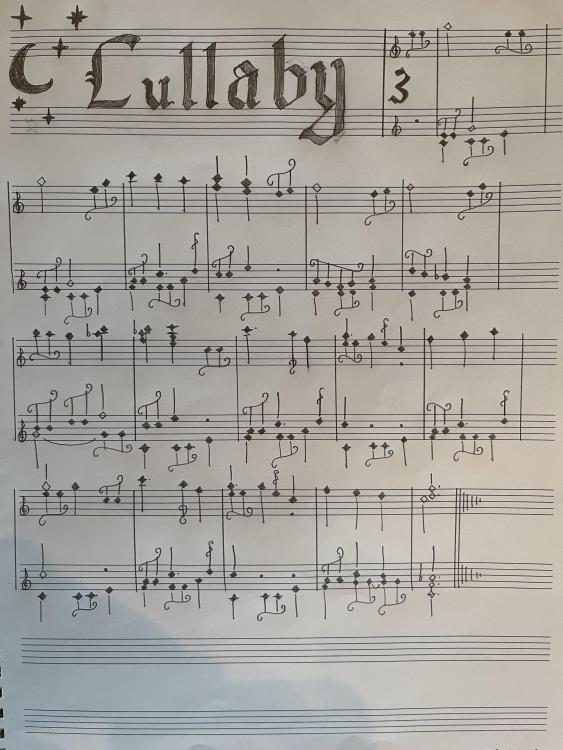
Here's my submission It's harmonically simple which made for easy application of the stretto-like things, and I also feel like the simple harmony made the last chord stand out better. I think I got the idea for the figure that appears here from one of Byrd's variations in his setting of "The Hunt's Up", which is not a lullaby but a wake-up call, so kind of ironic there (and you could find the hunt's up on my youtube channel if interested.)
 1 point
 -
Thank you! It is an honor to have this bring to mind such a lovely piece. Appreciate the listen!1 point
-
1 pointAs an amateur mandolin player myself, I'm always intrigued by unique approaches to instrumentation. Turning the piano into a "mandolin" supported by a fake orchestra sounds like a creative and imaginative project.1 point
-
1 pointFirst movement was the most intriguing for me, and the ballade-like form works well, the atmosphere of the first movement is set for me, it is a very entire experience. The second movement is short but contemplative. Were you perhaps tempted to make the second movement longer? But I felt you have stopped at the right length. It made me feel peace. Third movement I cannot appreciate well... maybe it is the problem with MIDI, the sheer repetitiveness is very distracting for me. In the right hands it might just sound a lot better. I think the piece will benefit from a dedicated coda/codetta section though. And again, the first sonata I posted on this forum isn't my first. I'm not professional by any means, but sometimes you just got to make more things happen, then you will create more and more and eventually masterpieces!1 point
-
1 point
-
1 pointNice piece. The tremolo is a nice way to imitate the sound of a mandolin. It has a slightly neo-baroque feel. if the mandolin part can be played it would make a nice arrangement for small baroque orchestra1 point