All Activity
Today
-
A friend of mine requested that I write something with a tuba part, so I wrote centered around the tuba. A link to the score: https://musescore.com/user/118018538/scores/35329313 A Joke for Tubists.mp3
-
Hello MinGry! I see that you have written a nice little piece, that i wouldn't describe as a sonatine. This is because a sonatine is Usually multi-movements Not ternary form, but instead Sonata-Allegro form, which has three distinct themes in the exposition, which goes from I-V (usually and you did that well) and also usually repeats. Then comes the development and reprise which you did well. You have a nice first theme, that actually seems to plain. The whole piece is basically just a mezzo-piano. You might have been able to develop the textures better by using more dynamics, and using more staccato maybe. You could have also had more layers of complexity. Good job on exploring a new style as a composer! Keep improving! Tristanthetristan
-
-
-
-
for around 5 to 6 months
-
Well, thank you. 😊😇😊 Many have heard my music. To answer your first question, it was a mixed bag: some say it was their "most favorite" of all student compositions, while others said "don't give it to an orchestra". (Flattery much? Ha. 😏) In a three-judge panel at my university's blind Spring Competition for Composers, the first threw a.... kind of.... thoughtless textbook criticism at me, one which I've heard countless of times being used on composers. It does loosely align with your own sentiment, only worded less positively (almost sounding as an insult dressed up as constructive criticism; backhanded constructive criticism, if I may): that my music was a "plethora of ideas that didn't develop". He felt that my music was "meandering without a sense of direction"; that my "future focus" can be on "where the music goes and why". (I don't think you yourself had mentioned anything about lacking direction and development overall; just that my flight-like move from one point to the next made it hard for you to really know what the motifs were; but was overall a joy to listen to. Correct me if I'm wrong, which I can be, but I'm guessing that you at least realize some decent sense of direction and why it went that way, correct?) What irritated me about this judge is that he completely distegarded just how much effort I had spent developing and honing the very items he says my music lacks (direction and development); dismissing it as if it was another sadly-advertised unseasoned student piece. He had three weeks and a half to look at 5 scores; the other four of which are not nearly as long and nearly as hard as mine. (Believe me: we student colleagues share our music during comp seminar. I saw the files they uploaded the hours before the deadline!) And, the best thing he could come up with is "plethora of ideas that was 'meandering' and 'didn't develop'." (Thanks much for actually taking time to assess my music?) But then, the second judge from this competition was on the complete opposite end of the opinion spectrum: she "absolutely loved" the "unique and innovative" techniques in my score that "haven't been devised before." Her companion compliments focused on my use of harmonic progression; and how everything invoked a massive mythical imagery. She was only concerned about the way I deployed irregular rests in my 5/4 measures: that it could produce a lot of visual "clogging" in the individual part scores. (She wouldn't have known that, in the part scores, the irregular distribution of 5/4 rests was only on those first measures of exposure; any proceeding measures in that same musical period were given multi-measured rests; as I trust my performers got the beat down, after seeing the first measure of said-irregulsr rests.) Above these, she was very intrigued and eager to learn what the programmatic narrative was. (There was no word from the third judge; which I found suspicious. He/she may have "disliked" my music so much, the potentially aggressive comment in it could not have been forwarded to me by the composition chair; who told me that the third did not respond. Why wouldnt a judge response?... This is what I predict had happened to my third comment.) ~~~~~~~~~~~~~~~~~~~~~~~~ I think, over all, one main common consensus among (almost) everyone who had commented so far had zoned in on the "moving too quickly from one idea to next". (And, again, wofn it's a stream of consciousness type of composition, that's one element that should be anticipated.) After that, it's all up to individual biases. ~~~~~~~~~~~~~~~~~~~~~~~~ All that aside, in regards to your second point (which addressing it was enmeshed into my addressing thr first: You didn't answer my questions regarding the definine motives that I stated were the Tone Poem; nor did you answer my question about Stravinsky's "Rite". 😁
-
Hello everyone! I come to you with my first piece produced on my new Acer laptop that runs Musescore smoothly! I have taken the opportunity (before I always had a school chromebook so I couldn't do this) to download Cakewalk Sonar DAW which allows me to open all my old .wrk project files from back when I was using Cakewalk Home Studio over a decade ago. So, if you can't tell by the title, this is one of my juvenilia that I dug up from way back when I used to compose into the sequencer. Back from around 2008. I intended it to be a mix of styles between classical and jazz, hence the corny title 🤣. I use blues scales, extended harmony, altered chords and polychords - all in a way that is intended to be "classically jazzy". I hope you enjoy this piano trio and let me know what you think! Thanks for listening! Jazzical Piano Trio.mp3 Jazzical Piano Trio.pdf
-
Yesterday
-
Welcome to the forum! Let be one of the first to say hello and congratulate you on this endeavour. All of us know how hard creating a convincing and satisfying piece of music can be, let alone an original one! You are off to a great start, one of which not all adults can do. I enjoyed listening to your piece. This said, I do have initial comments and a deeper set of specific annotations I would like to share later. Here are my initial comments: The ensemble balance is too similar for too long. Violin 1 & 2 dominate the piece, and the other strings just act as support versus having a convincing conversation/ role in the piece. Use of whole notes is more than okay. If you like it, then keep them! This said, having a lack of pulse in the texture can make the music feel stagnant. Some of the other comments you have received may have been coming from this angle. To add, since the violins dominate the music over the course of 4 minutes, it makes the listener "zone out" as nothing major changed to their ear. Do not forget about slurs! As a string player, remind yourself that the use of a slur conveys bowing information. Even if you are not as aware as the other bowing styles, using slurs is a great way to showcase bowing information. The context of the music will inform them whether to up-bow or down-bow. Creating motion. To help the "stagnant" nature of the piece, one way to create motion is this: When the melody is slow, move the accompaniment. When the melody is moving, slow the accompaniment. Doing this will help drive the piece forward in a simple manner. Using rests for effect! While Barber's Adagio for strings is wonderful, remind yourself that even in such a thick and lush piece of music, he used silence for effect. Not all instruments need to play at the same time, nor do they always need to play in the same octave. You have the whole string section to move and pass ideas around. Strings can do double stops and divisi playing. It's another way to create an effect as using silence will elevate the moments you use all the sounds or all the instruments. Keep up the good work!
-
I decided to not waste my life and compose something*. Sibelius crashed so I used musescore. This song is meant to sound not evil or phonk. I spent around idk like maybe 30-40 hours on this piece in total? I tried to use some "counterpoint" but since I am not good at music theory I have no idea whether I did it correctly. I used caesura's 3 times in total. Again I don't know if that's correct or not. Also, some voice crossings are in there, but I couldn't find it. I honestly have no clue how polished the piece is, it's one of my first 10 pieces. I started it in like 8th grade and finished it this summer (going into 9th grade) in case anyone decides to comment on how dogwater my skills are. Also, first time using tremolo in any piece. I play violin well, CM'd like 2 years so I'm PRETTY sure the violin portion is playable and well, but I have 0 clue about the other parts because I don't play any of the other string instruments. Most of the song is in the last part.... another issue probobly That said, well, I would like some feedback. ESPECIALLY in these spots: 1. Middle section, I don't know why I wrote it but, is it fitting? It's slow and not very "elaborate" and also it's placed weirdly IMO cause it's like supposed to be in the middle, but it's also not really centered. the part after it is MUCH more than the first portion. It's like centered but not centered but also centered but technically not centered but also IG kind of centered, but like it's not really centered. 2. Whole notes. I know like barber do it often especially in adagio but a bunch of people I saw in like online threads saying like that whole notes are generally not good? IDK I personally don't mind it too much but yeah. 3. counterpoint, I feel like I messed it up bad, but then I don't know how to improve it 4. dynamics. I know there is MASSIVE room for improvement because, yeah, it's really bad Structure. I never studied structure before, so I have no idea what is what. I TRIED to use like ABA but the second A portion is very off balanced. So the structure is trash and could use much improvement Thank you for your critique in advance, and thank you for your time. *I'm composing because I broke my nvidia rtx 5090 and now I can't play games at 1000 fps so I quit entirely dawn-and-nightfall.mp3 Dawn-and-nightfall.pdf
-
Hengyi joined the community
-
Thank you very much for your in depth a detailed review!
-
-
Hello The important thing: a massive piece of work... Very interesting, it really draws me in, and it’s very well presented; the sound is brilliant. I must admit that variations aren’t really my favourite genre, but then again, when there’s quality, there’s quality. One thing I particularly liked is that, although some of the variations are very short, the transitions between them are, on the whole, very well executed. That gives it continuity, within the nature of the genre: variation. I’ll just mention a couple of things: One is a matter of personal taste: all those fast sections – vivace, presto, prestissimo, etc. – tire me out a bit. But as I say, that’s subjective. And another thing – this I do find a bit odd. Bars 20 and 24 in the first variation… My ears and brain weren’t prepared for that. Mind you, I’m no stranger to dissonance, but it has to be in context. Those extremely strong minor second dissonances – there aren’t any more powerful ones in the entire consonant tonal environment – sound like a mistake. If they’d been set up, if they were repeated… but like this, so suddenly and in isolation… You could have used other, more subtle dissonances here and there… Yes, we sometimes think that in music ‘anything goes’, but well, in moderation. Later on there are sections that include dissonances, but they’re well contextualised. Congratulations on your work.
-
James McDonald joined the community
-
Hi again, Congrats on finishing the Tone Poem. I am going to listen and examine the score once more. You are correct I only wanted to highlight the last part of the quote in regards to the leitmotif. As you highlighted ... English horns are not the same as Oboes. During a rehearsal the conductor most probably will balance the piano against the English Horn. As per me I see the English Horn as a solo instrument within the ensemble because of its tonal/projection/character. In a larger context its uniqueness can be lost as a line in a full orchestration. Mark PS: I enjoyed your pun about my criticism not being fully developed! Okay, I reviewed the work again. I am curious to know the feedback you have received from your mentor"s? I still feel the ideas move about too quickly in a thick orchestration .... I feel there needs to be room for the music to breathe to lead and give the listener a moment to connect. For me this didn't happen.
-
By the way, I just wanted to clarify that the red notation in the first motif's diagram is not supposed to mean anything. That's just the colored layer being displayed in Finale: the second layer.
-
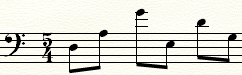
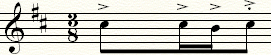
You list the entire description of what a Tone Poem is typically is considered to be and to contain (edited); almost as if I'm guilty of not accomplishing the very bullet points contained within. I very much realize that that wasn't what you meant. It certainly gives that impression. 😁 But, more pertinently, Let me ask you: how many leitmotifs are there in "Rite of Spring"? Furthermore, in regards to the most famous introductory Bassoon motif, which defining presence is what "Rite" is known by: how many times does it transform and gets developed? Or, does it get developed? Furthermore, would you have known whether it was developed, and how it was, upon first second, or even third listen? ~~~~~~~~~~~~~~~~~~~~~~~~~~~~~~~~ Now, let's get back to "Myst": (added in edit) How many times do these motifs come back, in various form? ~~~~~~~~~~~~~~~~~~~~~~~~~~~~~~~~ Also, consider the following arc'd quintuplet motif (from my Tone Poem): middle-low pitch leaped highest pitch second higest pitch third highest pitch leaped lowest pitch (lower than the first middle-low pitch) How many times does this motif get transformed and varied? (One variation includes switching around the orders of the first, second and third pitches in the peak of the arc. Did you catch it?) ~~~~~~~~~~~~~~~~~~~~~~~~~~~~~~~~ Have you noticed that the A-Section's themed melody became a part of the B-section accompaniment, the B-section's melody became a part of the C-section's accompaniment, and the C-melody was actually the materials that made up the A-section's accopaniment? (It's not a ~~~~~~~~~~~~~~~~~~~~~~~~~~~~~~~~ Please do take all the above into consideration. lol Not to humorously twist the usage of the word in this context, but you haven't really developed this point very much. (What exactly are some things that make it "interesting and creative"? But, I appreciate the compliment. I agree fully. And, I'm sorry the MIDI played the piano part back too loudly. (I could be wrong, but Oboes usually have a pretty dynamically penetrating quality about it. At least the Oboe does. If the English Horn needs to be louder, I'll simply let my conductor know. We shall see in the first rehearsal of this edition 2.5 in about 5 days; which compositional summer program I'm in is the explanation as to why I've been rather slow at responding to this thread myself.)

-
Of course, it was a treat! In my opinion, I think in terms of creating motion, it makes more sense to try simple things. Pulsing eighth notes or quarter notes. In terms of orchestration, creating effects of sustain or replicating the piano sustain pedal is a good goal to try. I don't have source material now off the top of my head, however, I may reply back tomorrow (for me) with some sources. Using French horn or trombone to hold sustain notes around Middle C and another instrument to pulse the same pitches on any note duration is a simple way to create the illusion. If not the brass, doing so in the strings is another way. Lastly, to not over complicate my words, keep it simple. If you have the melody sustaining, have the accompaniment move. If the melody is moving, pull the accompaniment back.
-
Hello @MK_Piano , It's an honor to get such extensive feedback, and I'm especially thankful for your notes on engraving in particular. As a string player, I know how much notation matters for performers, and I'll be sure to make those changes as I revise (though I don't anticipate this piece seeing a live orchestra any time soon, especially as an amateur composer). I fully agree that this piece is pretty texturally monotonous, and think that I'll need to continue studying scores to gain a better grasp on orchestration, texture, thematic development, and the likes. Thank you again for your time, knowledge, and the depth of commentary you've provided! I was wondering if you had any particular suggestions for creating more motion throughout the piece, and if you know of any particular scores/treatises that I might be able to study and make my piece more effective (I'll do lots of listening/studying on my own as well) -- I would definitely like to develop more robust parts for the brass and other areas that I haven't quite done justice.
-
Hello! Over the last few days, I’ve listened and looked at the score quite a lot. I felt it within my interest to analyze the score. The attached PDF is culmination of my annotations and comments. If you have any questions, I’ll do my best to answer! Good work! A. Ko - Poem for Orchestra [ANNOTATED].pdf
-
GMoneywroteasong replied to GMoneywroteasong's topic in Incomplete Works; Writer's Block and Suggestions@TristanTheTristan Here it is! https://musescore.com/user/118018538/scores/33357896
Last week
-
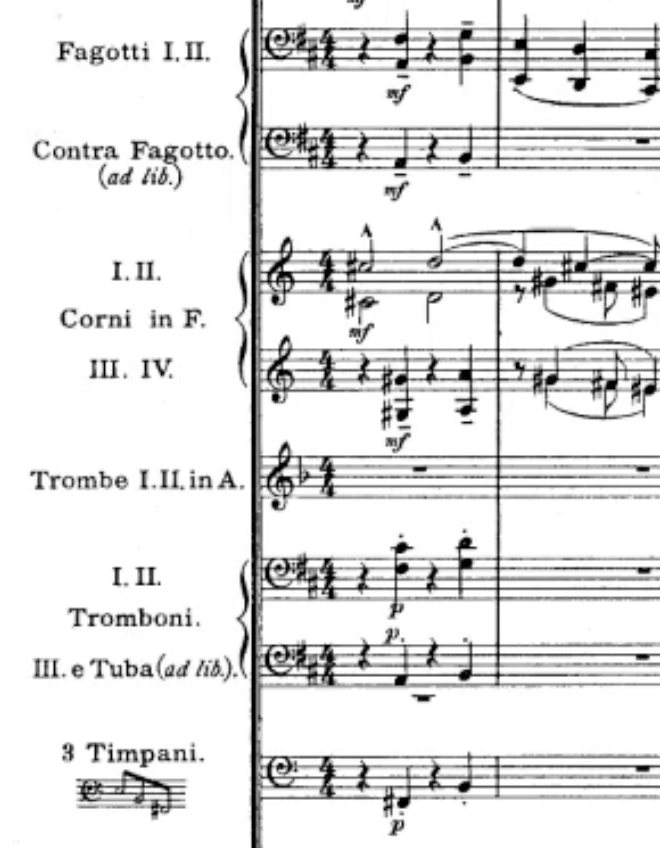
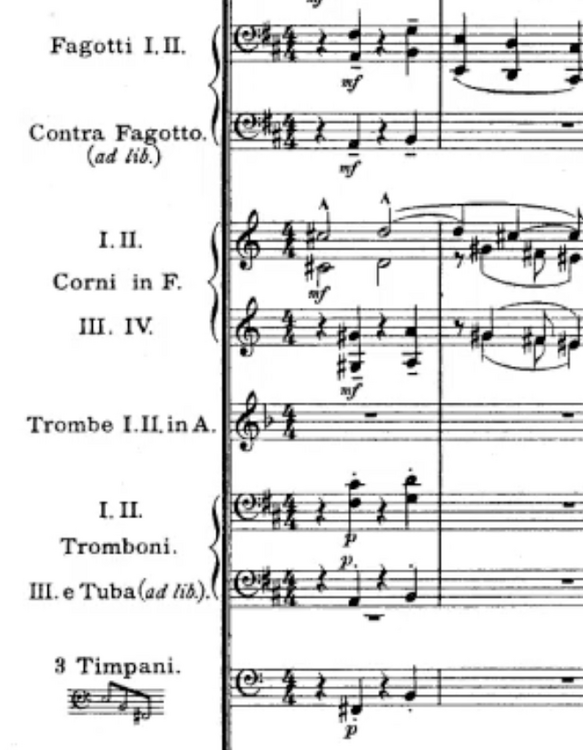
Let me add something, even though it goes beyond the specific work in question; by chance, I came across an example just today. This is part of the first page of E. Elgar’s Concerto for Violin and Orchestra. A dense piece… Note that for the contrabassoon and the tuba it says ‘ad lib’ (ad libitum). This does not mean that these instruments should ‘play whatever they like’. It means this: -Optional instruments: The contrabassoon and tuba may be omitted. -Lack of players: If the orchestra does not have them, the piece is performed as normal. -Conductor’s decision: The conductor decides whether to include these instruments. This is what I was referring to earlier. Best regards.
-
Ok then, Sometimes it's 6 weeks, other times it's 3 months, but the longest is probably this, which from start to end was 10 months and 6 days. (42 weeks 6 days, nearly a year)
-
yw
-
dudeeee this is the coolest sh*t. ive never had a work dedicated to me before and with words from my own old poetry writing too? i'll have a lot more to say but for right now like, thank you so much!!!





.thumb.png.8b5b433a341551e913a34392660bc95b.png)