All Activity
- Past hour
- Today
-
 Hello everyone, I am new to this website. I am an amateur composer and would like to share a piece with you that I composed last year. Any feedback is appreciated. MK
 -

Symphony no 1 in A minor (I) March
Musicman_3254 replied to Musicman_3254's topic in Orchestral and Large Ensemble
I think I've had around 1 year of composing -
Okay, thank you!
-

Symphony no 1 in A minor (I) March
Bjarke replied to Musicman_3254's topic in Orchestral and Large Ensemble
That make sense. But i would still recomened starting with smaller orchestra in the start. Because that will give you far more control over the orchestra later. If you have complete control over smaller ensemble and can impress the listner with that the full orchestra will only add to that. Also a tip from Mike verta: Don't over orchestrate. Only orchestrate what it really needs(something i my self still practice) How many years of experience composing/orchestrating do you have?(just curious) I would recomend taking a look at Ravels: introduction et allegro pour harpe flute clarinette et quatuor a cordes. He seems to do a lot with a small ensemble and sometimes make it sound like a full orchestra. -
Symphony no 1 in A minor (I) March
Musicman_3254 replied to Musicman_3254's topic in Orchestral and Large Ensemble
I was trying to make a symphony a bit like what Gustav Mahler would make, that's why the orchestra is so large -
Symphony no 1 in A minor (I) March
Bjarke replied to Musicman_3254's topic in Orchestral and Large Ensemble
I looked at the score. My advice regarding symphonies would be first master traitional symphonies ideally with traditional orchestra (a whole lot smaller orchestra) in the cannon style of classical or late romantic style before even attempting experimental or innovativ music. How can you invovate without a good foundation of the tradition? Brahms spend 21 years on his first symphony and beethoven so i heard spend from sketching to full orchestra 30 years on his symphony no 9. A symphony is not something you should be doing lightly. I don't say this to be rude but just to give some perspective on the symphony. If you comfortablely can craft a symphony that stand along side Beethoven for example or at least immitate the form style and orchestration then and only then I would say you should try something like this. Also how are you going to get this performed in the future with a orchestra so large? Compose for the musicians not the computer. I would also recomend sketching on a single staff or piano sketch. This is to make something more idiomatic and playable. Only after the whole piano sketch is complete then orchestrate. -

solo guitar Minimal Microtonal Solo for Guitar on the 21st of Jan
PaavolaPyry replied to PaavolaPyry's topic in Chamber Music
Hi Henry! The microtones are only sort of marked in passing and occasionally on the score as I wrote the score for the player. The tuning of the guitar string is what gives the microtonality to the score, so in an effort to not overcomplicate the score I tried to show them as little as possible. As the subtitle says, the G-string is tuned 20 cents high and the B-string 10 cents low. I could also write an analysis score in which all the microtones are visible, but I felt like player-wise this solution felt more organic. But tell me if you disagree, I don't fully know if I made the right decision😅. And indeed initially it was improvisatory but I sometimes do this thing where I first improvise and then try to repeat my improvisation 6-10 times. After a while I land at something, and this is where I landed yesterday :D. Thanks for the kind words and the review ❤️ -
Those are very kind words coming from such a skilled composer as you! I guess I was just in the proverbial zone when I wrote this. Usually I'm much slower, though that often has to do with me getting distracted or losing interest in a project only to return to it later. With this concerto, I managed to stay very focused and worked on it nearly every day.
-

Persichetti Exercise 4 - 37 for Piano
chopin replied to PeterthePapercomPoser's topic in Piano Music, Solo Keyboard
I can see why you struggled though, the motif is not the easiest. But this is one of your best exercises so far in my opinion, because it encouraged out of the box thinking for this one.- 1 reply
-
- 1
-

-
.thumb.png.8b5b433a341551e913a34392660bc95b.png) Another Persichetti prompted piano piece! I struggled with this one the most thus far. The prompt was: "6. Continue the following idea for piano." Thanks for listening and I'd appreciate any of your comments!
Another Persichetti prompted piano piece! I struggled with this one the most thus far. The prompt was: "6. Continue the following idea for piano." Thanks for listening and I'd appreciate any of your comments!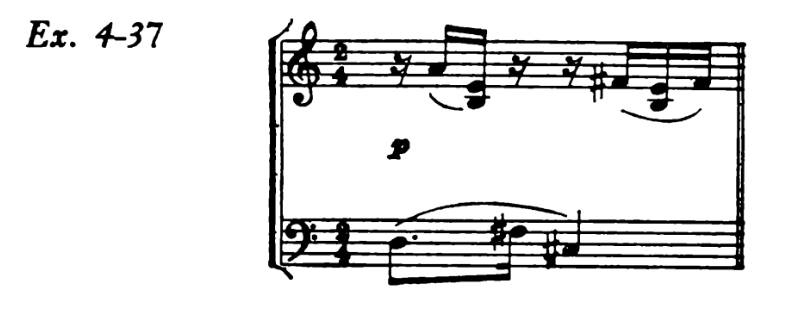
-
I am immensely envy of you for this; how can you write this Concerto with this quick progress and bear such a sweet fruit?! I have never been able to do that! Either I take too much time, or I write trash!
-

Persichetti Exercise 3 - 50 for Woodwind Quartet
Aiwendil replied to PeterthePapercomPoser's topic in Chamber Music
This is quite nice. I like Persichetti's book but I've never done the exercises in it; you're making me kind of want to give them a try, though! - Yesterday
-
Thanks very much! The Hummel concerto (as well as the Haydn) was very much in my mind when I was writing this. It took me a little over a month to compose this; I think I started it in early November and finished mid-December. I have no contacts at all in the music world, so no, I'm afraid there's no way this would ever be performed.
-

solo guitar Minimal Microtonal Solo for Guitar on the 21st of Jan
Henry Ng Tsz Kiu replied to PaavolaPyry's topic in Chamber Music
Oh I must have overlooked them! I am getting old now......- 4 replies
-
- 1
-

-
- minimalism
- acoustic guitar
- (and 2 more)
-

solo guitar Minimal Microtonal Solo for Guitar on the 21st of Jan
Alex Weidmann replied to PaavolaPyry's topic in Chamber Music
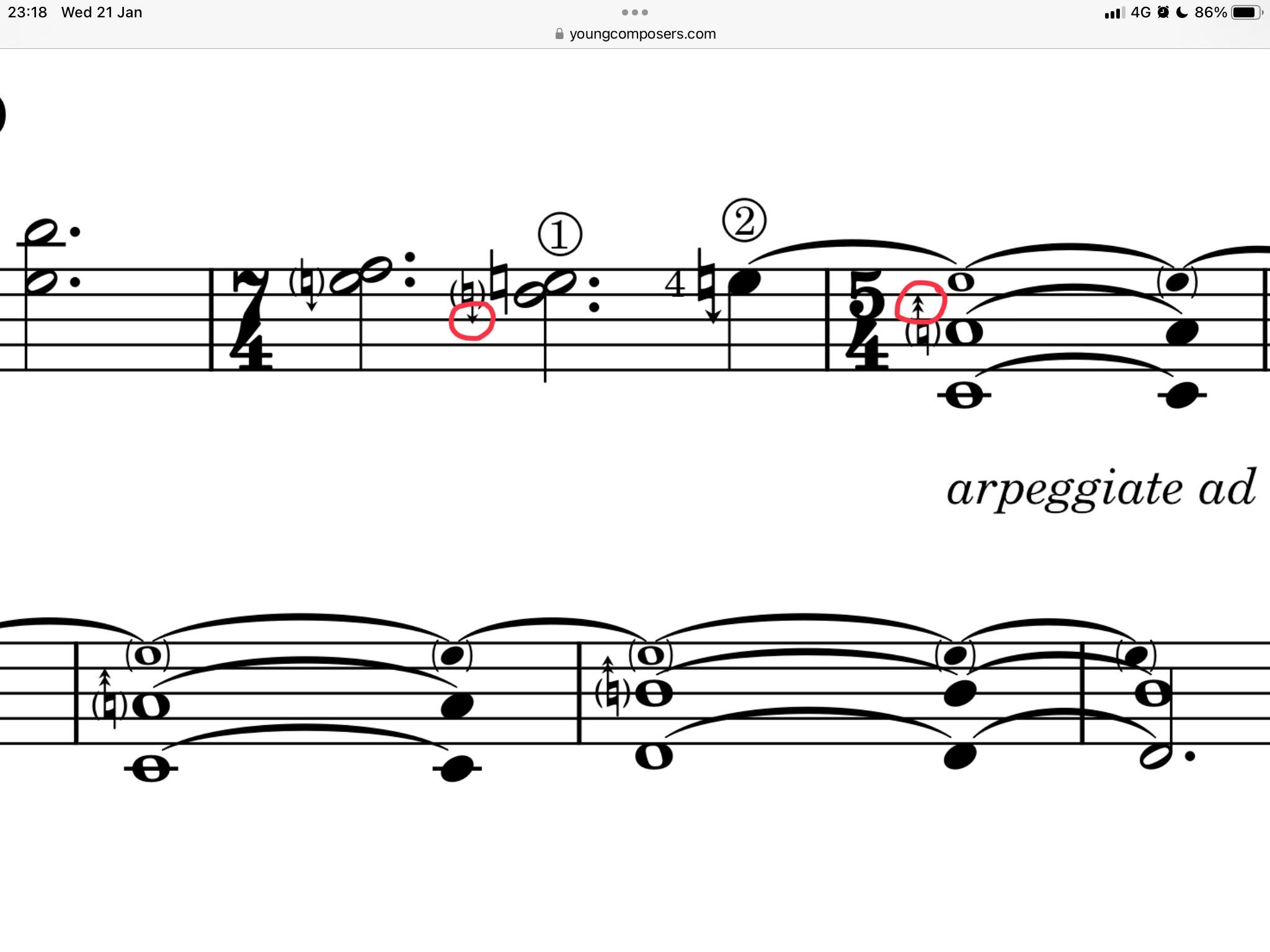
I see them. They're the tiny little arrows attached to the accidentals (see image below).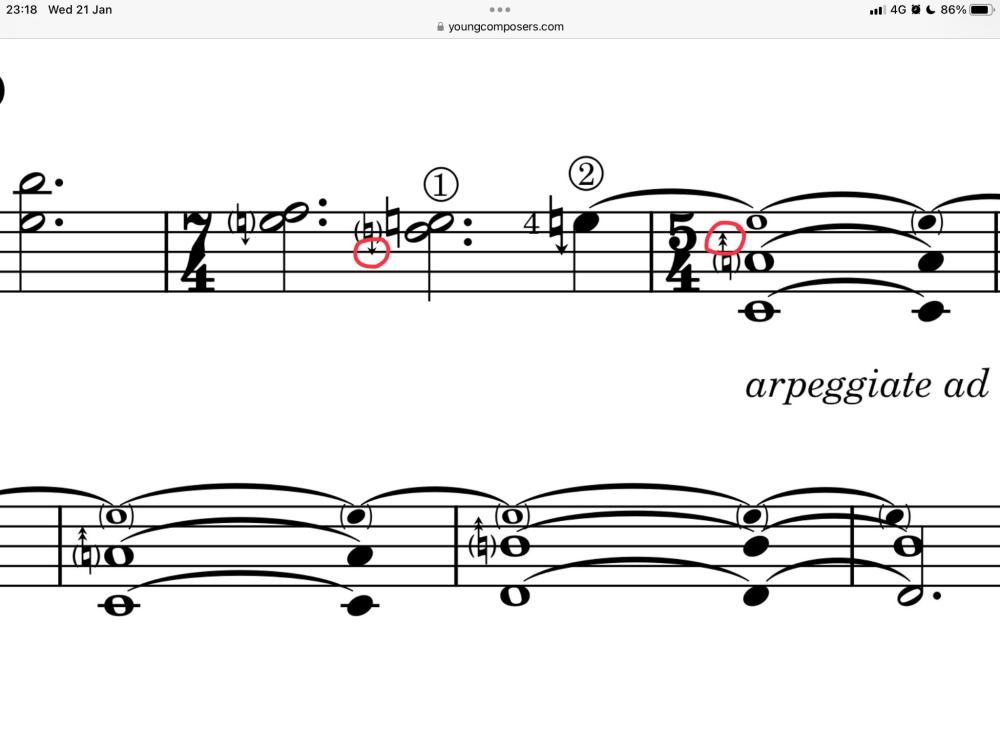
- 4 replies
-
- 3
-
-
- minimalism
- acoustic guitar
- (and 2 more)
-
shrouded in obscurity
Henry Ng Tsz Kiu replied to therealAJGS's topic in Incidental Music and Soundtracks
Hi @therealAJGS! It does sound obsure but I quite like it! Maybe adding more instrument change to it would be great as well! wow, I never write anything effortless! Henry -
Persichetti Exercise 4 - 36 for Brass Trio
Henry Ng Tsz Kiu replied to PeterthePapercomPoser's topic in Chamber Music
A really nice fanfare! You certainly preserve the general character till the end without sounding artificial at all. You maintain the 027 set and quartal chords very well and the trumpet makes the more hollow sounding chords full. I myself might write for 3 flutes here. Thx for sharing! Henry -
solo guitar Minimal Microtonal Solo for Guitar on the 21st of Jan
Henry Ng Tsz Kiu replied to PaavolaPyry's topic in Chamber Music
Hi @PaavolaPyry! It does sound improvisatory with all the sudden chord progession but I like it. Nice playing as well! To me it sounds like a Lute Baroque prelude in more modern chords. I am sure @PeterthePapercomPoser would like the piece as well as he wrote a lot of microtonal pieces, and @Thatguy v2.0 wrote many great guitar pieces. I hear some of the microtones but don't see them on the score, will you add them on the score? Thx for sharing! Henry- 4 replies
-
- 3
-
-
- minimalism
- acoustic guitar
- (and 2 more)
-
What an enjoyable concerto for trumpet. The theme of the opening movement reminded me of Hummel's trumpet concerto's opening movement's theme. Bravo. I wonder how much time it took you to compose it. Also, are you trying to have it performed?
-
Thanks to @Churchcantor, @Henry Ng Tsz Kiu, and @bkho for listening! I'm quite gratified by your comments, because I really am quite happy with the piece.
-
This is my "Three Sententiae for Glissotar, Op. 386", a piece I composed last year. The glissotar is a newly invented instrument that is a version of the Hungarian woodwind instrument "tarogato" but with the distinction that the notes are not determined by holes as in most woodwind instruments but, as in string instruments, by pressing the fingers anywhere in the range; and glissandos are possible. I had to create a new soundfont for it in order to be able to make this mp3 version. I have provided a description of 'sententia' as well as of 'glissotar' on the title page of the score.
-
Quite an impressive work. Honestly compares quite favorably to my ears at least to the classical trumpet concertos which I tend to find forgettable. Bravo!
-
Martin Kristek joined the community
-
Persichetti Exercise 4 - 5 for Women's Choir
chopin replied to PeterthePapercomPoser's topic in Choral, Vocal
Very serene, and sad at the same time. I feel like this style can be a candidate for some Zelda music perhaps. Or maybe a segue scene in an RPG game. Peaceful, yet you can tell there's still friction in the air.- 1 reply
-
- 1
-
-
Get musescore studio. I use that.
-
Any feedback is largely appriciated. Thanks in advance.
-
- 1
-