All Activity
Past hour
Today
-
Karlsson changed their profile photo
-
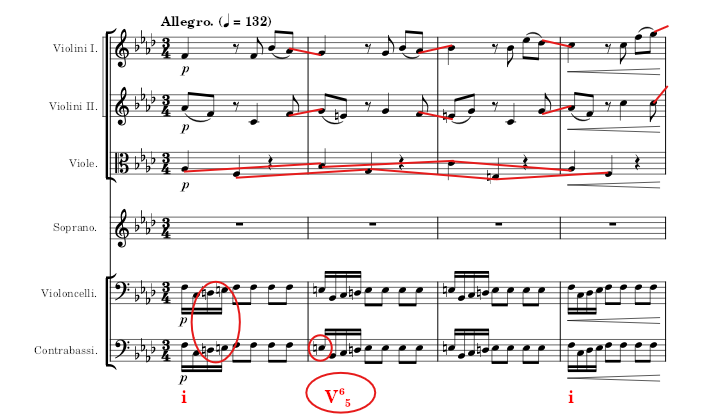
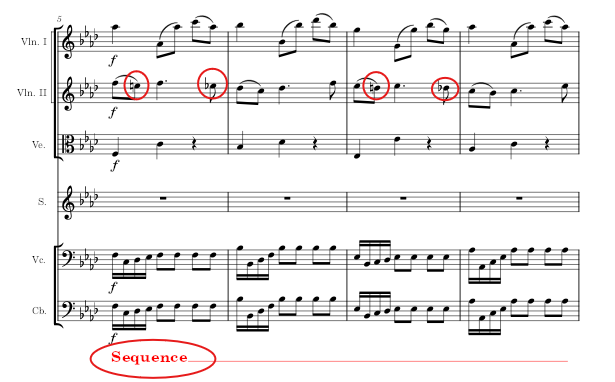
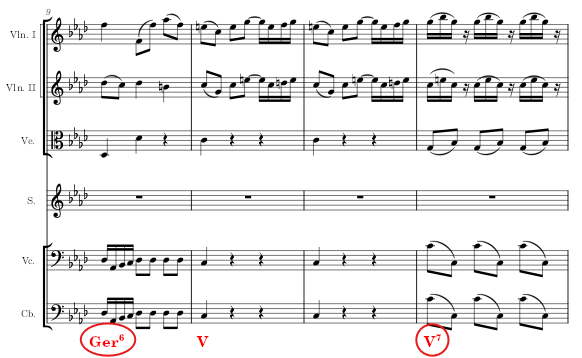
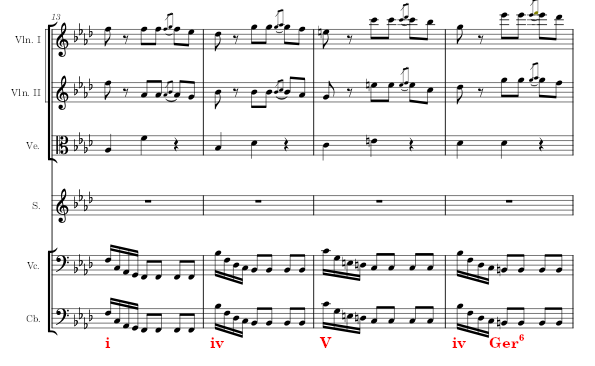
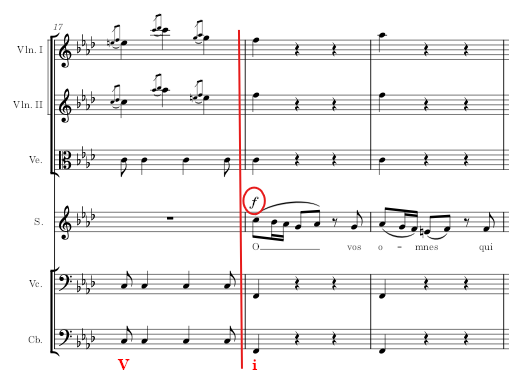
Ok, so to help you understand what I'm trying to say, I've copied and reworked the first 18 or so measures with tonal music theory in mind whilst trying to maintain a baroque aesthetic. Notice in my rework what I have done. This is how I would have done these first 4 bars had I written this piece. I have relabeled the Roman Numerals to better reflect the harmony that you suggested (which was simply i-V65-i). Also notice I have included dynamics at the beginning of the piece, as well as a metronome marking, and I've nixed the solo violin as I felt it was redundant. I have revised the second violins to not interfere as much with the first violins; see how they overlap much less. This provides melodic and harmonic clarity. Look also how the bass line now has the scalular run in melodic minor, which means it includes the leading tone for F-minor, making the tonic feel stronger. I also made the beginning of the 2nd bar in the bass an E-natural to bring about better harmonic clarity (dominant chord in first inversion). Finally, notice how at the ends and starts of each new measure, the lines cadence to each chord with smooth voice leading. This next system had a very nice sequence over the circle of fifths. The biggest changes I have made was to raise the leading tones, which makes the harmony clearer. I have also changed the Roman Numeral analysis, since much of the harmonies you analyzed would actually not be functional. This would simply be labeled as a sequence. The next system felt imbalanced because of the premature resolution. I decided for this example to extend the dominant pedal, and I believe it had a great effect. I also adjusted the harmony to better reflect what you implied, which would be some augmented 6 chord (your analysis said VI and then later, VIb5, however, the functionally since it leads into the dominant, it would be augmented 6. In the second one, there was no flat 5 present, instead the 5 was actually raised, making it a Germain 6 chord. In the future, be sure you understand chord functions.) Here I have continued to adjust the notes to match the harmony you implied. In particular, I found the parallel 4ths to be problematic and changed them to parellel 6ths. Finally, here I felt that the music began to lose momentum, so I simply cut out a few bars. Note the entrance of the soprano has a dynamic marking, and it appears above the music. This is so it doesn't interfere with the lyrics. Also be sure to divide the syllables properly and know that the "____" marks the ends of words being sung over multiple notes, and the "-" only occurs between syllables of the same word. Your usage of both of these is very inconsistent and unclear. And note how I simplified the line to make it slightly easier to read and sing. The rest of the piece has similar issues throughout. In terms of playability, I have already explained that the soprano is too fast and intricate and especially goes too high for this speed. Here is a great chart for vocal part ranges. choral-ranges.pdf Slightly simplifying the melody, especially removing the appoggiatura, should help. As for the violins, you mentioned they may go too high in some areas. They do not, the range is fine. What bothered me were these huge leaps. However, having checked with a violin player, these are actually doable. The changes I've made are obviously free to take what you like and discard what you don't. The important thing to keep in mind is that the music has proper voice leading, and clear harmony. My revision does improve it, but there are other ways to improve it besides what I did. Just remember to study voice-leading and harmonic function more in depth, and you'll be golden OVosOmnesReworkAndAnalysis.mp3

Yesterday
-
What version of Sibelius are you using? I'm using Musescore 3.7 Evo and for me it's just a simple "small" checkbox 😬. Last time I used Sibelius was 10 years ago or so. Can relate to this. Happened in some sonata of mine, I just don't remember on which one lol. Best regards!
-
Fafa joined the community
Last week
-
welltemperedcat joined the community
-
I have things that were started and put in the drawer 15 years ago that I still plan to get back to. We are fortunate to have so much more time (probably) than composers of the past, thanks to progress in medicine and public health. Eat your broccoli, take your time, and with luck we all may eventually have a few pieces that we are really proud of.
-
bestminicat joined the community
-
UNSELFmusic joined the community
-
Hello Young Composers, I am sharing Three Knocks by UNSELF, my independent musical project in melodic metalcore / emotional post-hardcore. I write the lyrics myself and define the musical direction. Suno is used to generate the music and vocals. Listen: https://too.fm/or4r4rb I would appreciate honest, specific feedback on the lyrics, whether the chorus is memorable, how convincingly the vocals communicate the words, and the overall sound. If you think a section loses momentum or the vocal delivery does not work, please point to the moment and explain why. Constructive criticism is welcome. Thank you for taking the time to listen.
-
Hi Everyone! I've been sick for the last month and to be honest, it’s been quite hard to be productive. During the downtime, I ended up writing three short, lyrical piano pieces inspired by Felix Mendelssohn. I tried to keep them quite short and simple hope you find some joy in their simplicity! I would love to hear your feedback and opinions on it! Songs Without Words No. 1.mp3 Songs Without Words No. 2.mp3 Songs Without Words No. 3.mp3 Songs Without Words No. 1.pdf Songs Without Words No. 2.pdf Songs Without Words No. 3.pdf
-
Pacoleo - El Castillo de La Asomada Hello. This is the first original piece I’ve composed for piano. I also mixed and mastered it myself in my DAW, so any constructive feedback regarding the composition or the music production is welcome. Synopsis: A composition for solo piano inspired by the castle of the same name, built in the 12th century. This nationalist-style piece reflects the strength and vigor of its builder (Ibn Mardanish, “the Wolf King”) by combining elements of Spanish nationalism and Islamic tradition, which are in turn embellished by impressionistic coloristic techniques. Thank you for listening.
-
Pacoleo joined the community
-
-
"This is one of my adagios. I’m purposely not posting a YouTube link and sharing a Spotify link instead, because I feel that this music doesn't really need visuals and it's better this way. The translation is not mine as I don't speak English, but I hope my thoughts are conveyed accurately. "For those who don't have access to Spotify, I am uploading the MP3 file here." B1 (Op.39 Adagio E-moll).mp3
-
-
Aresfir joined the community
-
-
-
-
-
left hand is octaves, right hand 1245 shift 1245 shift and so on. Good luck! -TristanTheTristan
-
"This is a track from my first vinyl album, where I first tried blending soft rock with classical elements—something that later evolved in my second vinyl album." "Later, I fed this composition into an AI and tasked it with changing absolutely nothing in the melody, harmony, and style. If you're interested, I can drop that here too." This is a Google translation. I hope it conveys what I intended to say.
-
Hi everyone, I'm a developer, and I've been building MaestroNote, a free music studio for Mac, iPad and iPhone. It's now in beta, and I'd love to hear what student and amateur composers think of it. It has three modes: Play, Analyze and Compose. On iPad, you can write notation by hand with Apple Pencil. It's free, and you don't need an account It works offline and syncs between your devices through iCloud There's no AI in it; it's simply a tool for you to use To be upfront about where it stands: It's a beta, so there will be rough edges There's no PDF export yet (it's on the list) Handwriting requires an iPad with Apple Pencil running iPadOS 17 or later Does writing by hand fit how you sketch ideas? What would you need for it to become part of your composing or studying routine? And what feels confusing or missing? If you'd like to try it, you can sign up for the beta here: https://maestronote.app Thanks for reading. I'm happy to answer any questions in this thread.
-
Jony joined the community
-
-
-
Firstly I appreciate greatly the feedback given. It was not intended for there to be 3 violin sections but rather 2, with Violin 1 being a soloist which is evidenced I believe with the middle section where it is labeled solo. Perhaps I should have written Violino Principale for greater clarity. You correct on the roman numeral usage which I had to track where I was harmonically. I am aware that isn't included in a final score. I realize my compositions with vsts and seeing that I had not yet included a keyboard accompaniment I decided on "cleaning it up". I also thought it would better help with any feedback or critiques to show more openly my thought process. The other numbers are not figured bass. They are merely scale degrees which like the roman numerals helped me track my harmony/motifs. As for the rest you may be very well correct. I did hope the bass line at least is written idomantically or certain antiphonal elements in the violins. I will agree that my violins may have reached too high in some areas. And for the vocals I may have leaned to heavily into a violinistic approach. The harmonic langauge was not an attempt to imitate the renaissance style. Simply what I have observed from Vivaldi's and Sardelli's violin concertos and vocal works. As for the text I explained my intentions/desired effect in the description of the post. I understand the main presentation for this text and would agree my approach would likely not fill well in a mass setting. Perhaps it is far too extreme but I did wish to lean into a more operatic approach and my background is mainly with vocal synths(Vocaloid, Synth V) so my ear may be too accustomed to harsher music.
-
This piece confuses me... Why are there 3 violin parts and not just 2? 2 violin sections, 1 viola section, 1 cello section, and 1 bass section is the norm. Writing for nonstandard ensembles is fine, but using a standard ensemble, in this case string orchestra, but with minor ordering differences just 1. makes it look like you don't know what you're doing (and you demonstrably don't) and 2. makes it significantly harder to have your piece performed. Who's going to have a string orchestra with 3 violin sections? No one. Why are there numbers all over the page? Roman numeral analysis is for... well, analysis. You don't include it in a score, and the other numbers I guess might be for figured bass, but that's not how you do that? Learn how to do something before doing it is generally a good rule of thumb. The instruments are not written for idiomatically. Those leaps in the violin in the middle of the piece are way too big. The soprano part is also WAY too hard, even for a professional soloist. It has super technical and absurdly fast extended passages in the very high range. If you gave this to a soprano, she'd would absolutely refuse to do it. Some of the harmonic choices are also odd. You seem to be wanting to do an imitation of a renaissance style, but it's just not achieved very well. It lacks the right harmonic language. I'd expect more raised leading tones, piccardy 3rds, etc etc. There are people on here that are much more familiar with this style that may be able to provide more specific feedback, but it sounds very messy to me, not elegant like the music of the time. Finally, the music doesn't match the text at all. The text is beautiful, solemn, contemplative, and the music just isn't. Why? I sing gregorian chant for a TLM parish, I'm very familiar with motets and liturgucal/sacred music, and this just isn't something I would choose to include at mass. I wouldn't even include it in a secular program. It's just not that well put together or though out. I would take more time to study the ensembles and instruments you write for, including vocal ranges. Also look into studying counterpoint, doing species counterpoint exercises, and harmony of the period. Studying galant schemas might also be beneficial for you. And most importantly, study scores! If you don't know how to notate something, reference a (modern print) score. Clearly you are amateur and young (young composers, haha) so don't worry. You will improve, probably quickly, but you need to spend more time studying theory and practicing with study pieces and exercises.
-
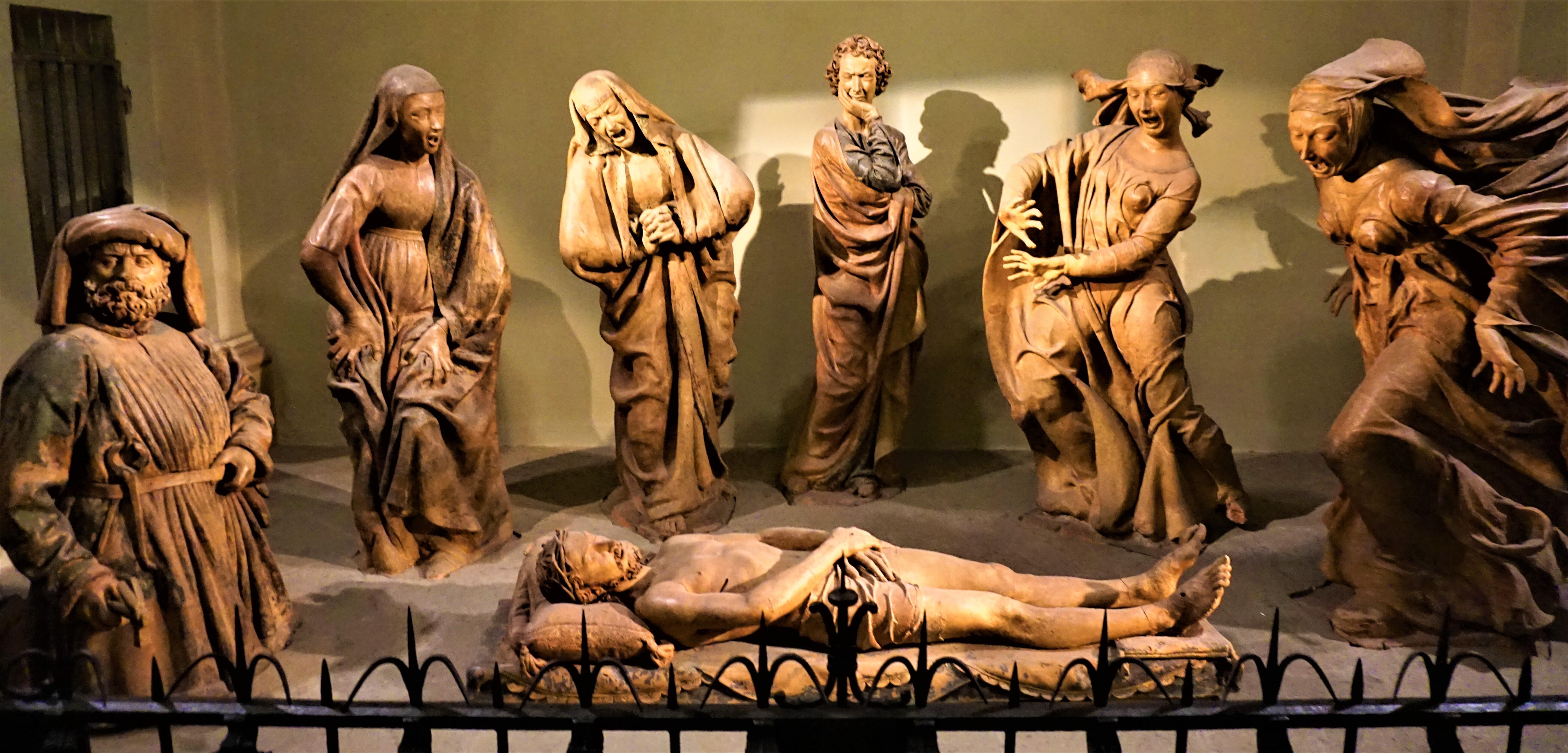
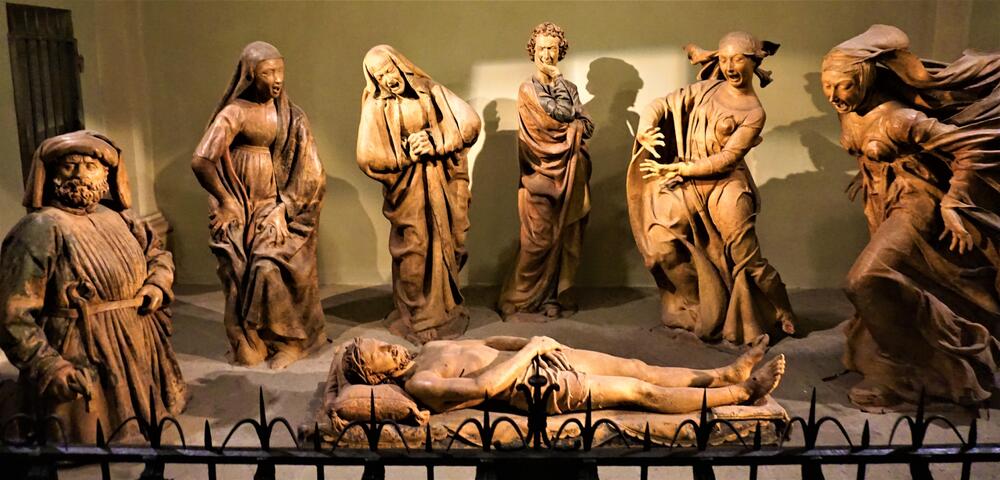
Hello. This is my first post here, presenting hopefully the first of many sacred solo motets and religious pieceso vos omnes sheets.pdf. I am very inspired by the italian masters Antonio VIvaldi and Federico Maria Sardelli. This is a sacred solo motet for soprano, strings, and continuo based on the Latin Vulgate translation of Lamentations 1:12. I really wanted to capture the raw and shocking horror of the suffering and death of Christ, the Son of God for the sins of men. The same shock that Dell'Arca captured so masterfully in his statues of the Lamentation for the death of Christ. Hopefully my work has served that well too. O vos ómnes qui transítis per víam, atténdite et vidéte: Si est dólor símilis sícut dólor méus. Atténdite, univérsi pópuli, et vidéte dolórem méum. Si est dólor símilis sícut dólor méus. English Translation: O all you who walk by on the road, pay attention and see: if there be any sorrow like my sorrow. Pay attention, all people, and look at my sorrow: if there be any sorrow like my sorrow. O vos omnes- M.M..mp3
-
jtalbert joined the community
-
I present to you my next cantata - "Laudate, pueri" (Ps 112) for tenor, flute and basso continuo consisting of 6 parts. It's rather short and for small ensemble, but it has a chance to be played in real life - until then computer playback will be added. It's meant to lighter than my previous cantata, with more concertante technique used... The first part is a dialog between two soloist, the second (and fifth) is tarantella-like with basso ostinato. Third and fourth i wrote what I had on my mind XD. Fifth is fugue (or fugato to be exact i think) with soloist doubling the theme entries. Any tips and feedback welcomed! Laudate, pueri.pdfLaudate, pueri.mp3
-
Haha, indeed, we are influenced by what we listen, we all are... Nevertheless, I would definitely encourage you to continue the journey, and exercise your composer skills on this work you started, by introducing some melodic phrases. My (limited) experience in composing clearly shows that the journey is hard, but really fascinating.
-
Wow... Thank you very much. I had this "theme/figure" in my head for so long and it felt familiar, but I didn't know where did it come from, so I thought it's mine :D. Now I know, so I think there is no need to reinvent the wheel (especially by Bach), so I better leave this theme to Him, cause he just does it better :) It's really interesting how we can subconsiously "compose" something already made
-
Hi @Josquins turban , I tend to agree with MK, it's a little too repetitive, even if the patterns you chose, and the harmonic progressions are nice. It somehow reminded me of Prelude No.6 by Bach - BWV 875 --> if you don't know the piece, check it out, it's interesting how much variety of rhythms and melodic materials he can use. This can definitely give you some hints. If I had to elaborate on your work, I would typically introduce some slower melodic material in bars 4, 12... before returning to your transition material (yes, I think that's my feeling, you have good transition material, but I don't feel there is a theme sticking out...) Thanks for sharing and do share the evolutions, I'm keen to see how you've decided to make it evolve! Julien





.thumb.png.8b5b433a341551e913a34392660bc95b.png)