All Activity
Past hour
-
awesome. I’ll do this in two parts my initial thoughts and then I’ll revisit the score and I’ll try to find things to pick out and to justify some rankings which could be positive as well so don’t get scared. Anyways, I kinda like the idea of this kind of acting like a sandwich with the bread, acting like this nocturne sort of like hymn sort of statement. and then a more wild, more tonically free section. I definitely appreciate the dissonance news here and the initial thought that I couldn’t even swap away was the frustration that you may have gone through, which may have caused this intentional dissonant harmony as a composer myself I also have gone through this sort of phenomenon so treated kind of as “key smashing”. I also appreciate the orchestration as well with the blending within the trumpet with its muted parts with the accordion, and also the blending within the guitar and cello making the sound simultaneously the same instrument. The one lick pic about the orchestration though is that I could barely really hear the cello on its own and pick it apart however, though this should be treated as a good thing, so you have your own justification for that. I also liked how you did some of the program notes and your ideas with putting “lyrics” to the trumpet part and also achieving that singing voice quality with the instrument that’s not the voice the accordion was especially a nice touch as it’s going to buff your originality score in your orchestration score by tons anyways the only concern is the bow changes which should be achievable due to the low tempo, but just making sure that people will most likely start to miss notes and parts getting cut out around pages 6 to 10 in the cello part. The supplemental techniques and fingerings provided are appreciated. I always enjoy that pedagogical style that you provide. score - MelodiesThemes Motives Harmony Chords Textures Form Development Structure Time Originality Creativity Score Presentation Instrumentation Orchestration Playability Execution of Given Challenge Taste 9.6 10 9.1 9 10 8.675 9.8 9.75 average: 9.49 magnificent job here definitely going to be a memorable piece of this competition the only thing I would say though about why your orchestration score got a little bit off was just because of the bow changes, however, though they could possibly be possible. anyways, amazing job.
-
Hello @Markus Boyd, thanks for sharing this beautiful baroque inspired prelude for acoustic guitar! Congratulations for the good scoring. Unfortunately, I had needed this a few weeks earlier, since I also featured an acoustic guitar in my last composition (for the ongoing 2026 Summer Competition). I hope that I did not cause many playability issues there, since the part is mostly single-voiced. That would be great, already excited. Yes, pieces in 3/8 are wonderful for their beautiful and thriving character, but that meter has – in my opinion - always the inherent danger from constantly listening as „hum-ta-taa, hum-ta-taa, hum-ta-taa“. There are a number of recordings of, for example, the opening choir and the choir „Herrscher des Himmels“ from Bach’s Christmas Oratorio, which suffer from that problem to be as rhythmically monotonous, regardless of the tempo. However, in your prelude this is not the case, perhaps since the repeated staccato eights are (wisely) used sparsely.
Today
-
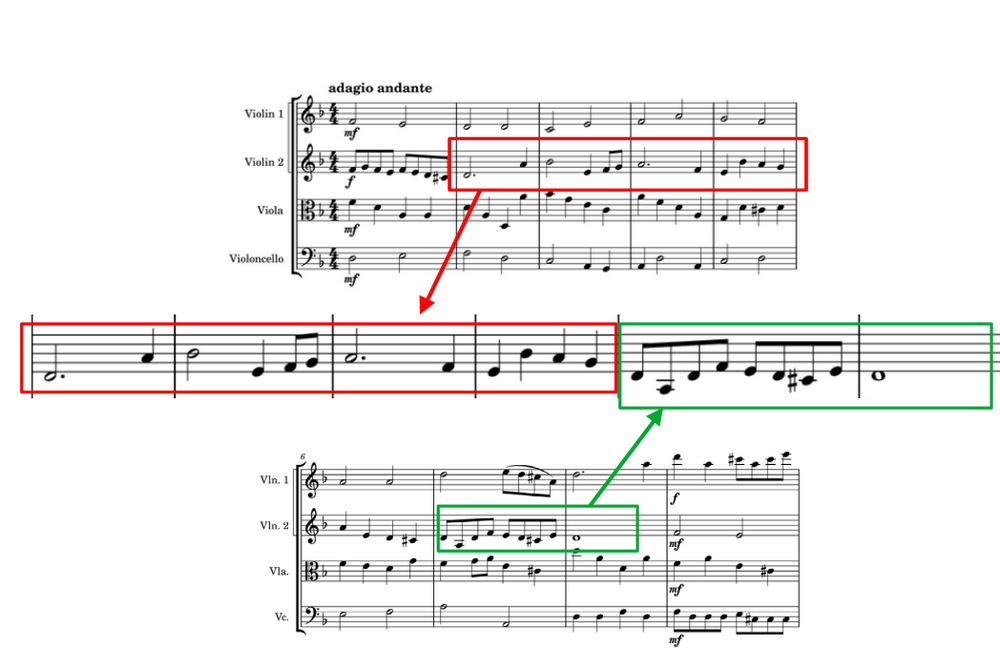
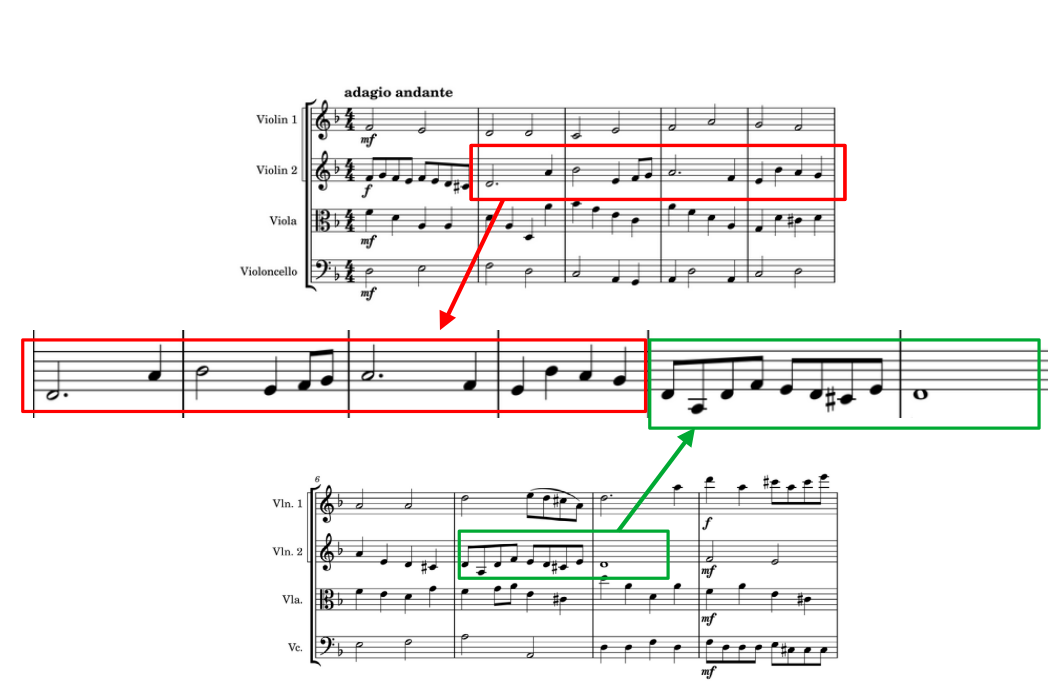
Hello @Woofi_9, since you are (relatively) new at this forum, first my warm welcome! Whenever one posts an unfinished piece – what I think is here the case due to the title and the plenty bars at the end with rests only – there is a good chance to receive rich feedback with usually polite suggestions for improvement. So I very appreciate @MK_Pianos explanations on „Melody and Harmony“ which are not only intended and useful for you, but for all readers of the forum. I can’t compare myself to him because I don’t have an entire „tutorial“, but only a repost with some considerations about „Rhythm and Texture“ which, I think, supplements Mason’s explanations. I intentionally just did not listen to the piece and am focusing only on that I am seeing in the score, trying to formulate my concerns and suggestions – however the piece might sound fine. A string quartet consists of four individual instruments, usually playing a single voice (and, furthermore, of four individual humans). Thus, it perfectly fits for a four-part-voice leading where each voice is „independent“ and „equal“ to each other. Such kind of music is called „polyphonic“ or even „counterpuntal“ music – the opposite to a musical „style“ that consists of a (prominent) melody voice and (subordinate) accompaniment. I think, your piece is a kind of this approach. However, we do need a memorable melody and rhythm, often called a „theme“, which is played multiple times (sometimes unchanged like in a canon or fugue - or otherwise slightly altered) by all instruments throughout the piece. So the role, which instrument is most prominent and which are the accompanying ones changes, finally creating variety. And there I’m coming now to my concerns or „criticism“: I can’t recognize such a memorable „theme“ which I would usually expect at the beginning of the piece in the upper voice. Instead, the Violin 1 has a somewhat repetitive texture with repeated half notes for the first 6 bars. Although the piece has enough distinctive textural motifs (each one bar long), they are not distributed well enough between the voices resulting in that the same motif is repeated too often by the same instrument (for example, the Cello in bars 9-14). My suggestion is, to take the one-bar motifs and create a „theme“ from them. In the example below, I have taken two passages, snippet them out and glued them together to create such a „theme“ from then which I would consider to distinctive enough. (Note, that I didn’t take care of the melody, i.e. the pitches and didn’t bother how it would sound, it is a rhythmic or textural example only). I would start with that „theme“ in Violin 1 and would repeat it at least two times (or better three times to involve all four instruments) thereafter by other voices. The other instruments should than apply rhythmical motifs which are contrary to that bars of the theme, meaning where the theme has a slow motion, the other instruments should have the faster motion – and vice versa.
-
Dear Acerylio, Thank you so much for such a thoughtful, detailed, and appreciative review! I was genuinely delighted to receive it and have read it several times. I was actually aware that I had not made enough use of the English horn and its particular qualities in this piece. To be honest, I originally intended to write the piece for two oboes. It was mainly because of the final section, where the very last note falls just below the oboe’s range, that I eventually decided on this instrumentation. Perhaps I was also a little too hesitant to create a greater contrast between the registers of the two voices, as I did not want to disturb the feeling and character of the piece. I actually tried several times to move the second voice into a lower register in other passages, but somehow it just did not sound right to my ear. So in the end, I decided to leave it as it is. This is my very first piece for oboe and English horn, and I am only a beginner hobby composer, so your feedback is all the more valuable to me. If I decide to revise the piece at some point, or to write something new for these instruments—or for strings, for that matter—I will definitely keep your advice in mind. Once again, thank you very much for your time, your knowledge, and your thoughtful and helpful feedback! Warm regards, Yevgeniy
-
Here is my contribution to the "From Nothing, to Something" 2026 Summer Composition Competition:
-
Dear fellow composers, I’m pleased to present you today my submission to the YCF 2026 Summer Competition! I must admit, that the task of the competition was really challenging, starting from „Nothing“ and than get the right ideas for „Something“ that is reminiscent to the mood of the summer day as expressed by Paul Verlaine’s poem. The challenge. When a composer has trouble coming up with a brilliant idea for a new piece, it sometimes takes several attempts, each of which yields different individual ideas. And there are some pieces that consist of several ideas that have been “glued” together, ultimately resulting in something like a “collage song.” I’m thinking, for example, of “A Day in the Life” by the Beatles or “Band on the Run” by Paul McCartney and Wings. However, there also exists such a kind of piece in Bach’s Welltempered Clavier, the Prelude VII in E-flat major, BWV 852. That particular prelude starts with a short section with runs of 32th notes, followed by a „more serious“ part in slow motion, that reminds me at a „chorale“. The third and longest part is a fugato with two subjects that further develops the ideas from the first two sections. So with this particular Bach prelude in mind, I had thus found the model for my own prelude, which serves as the „sketch“ for the quintet finally presented here as my submission. I always start to compose the pieces for piano in order to – on the one hand, have another piece for my preludes and fugues project, and on the other hand, because I find it to hard to mix the two phases of „composing“ and „orchestrating“ together. So I have posted the piano version as a standalone piece "Prelude XXI in B flat major" on the „Piano Music, Solo Keyboard“ thread. The poem. When I came around to the second part, the “Chorale” section, I faced the challenge of treating the upper voice of this four-part harmony as the melody for a musical setting of the poem. Since I don’t speak a word of French and have no idea how the syllables are rhythmicized, I looked at Gabriel Fauré’s setting of the poem in his Op. 61, No. 7 to find out which words are pronounced or sung briefly and which are longer. As an interesting fact, I discovered that Fauré had actually chosen the same key, B-flat major, that I had chosen before. The instrumentation. Now that the decision had been made to set the poem to music, I wondered how I could orchestrate it so that it would sound like a French “chanson.” My first thought was to choose the accordion as the main accompanying instrument. And since I wasn’t sure, I Googled: “What are the typical accompanying instruments for a French chanson?”—and sure enough, “accordion,” “guitar,” and “piano” came up. In addition to these, and to take advantage of the possibility of a quintet, I use a trumpet and a cello. Both of these instruments are capable of contributing different timbres (the cello either played with a bow or pizzicato, and the trumpet either muted or unmuted), and during the poem stanzas, I always use the muted trumpet as a substitute for the human voice. The title. Another challenge. A title in French would be appropriate, but I do not really trust translation programs in such delicate situations, since I don’t understand the nuances of the possible result. Thus, I’ve chosen the simple title „Summer – A Song of Beauty and Melancholy“. The latter since the piece features more passages in minor than in major and, therefore, does not only express the joy and beauty of the summer day, but is somewhat melancholic, too. Form and structure: 00:00 (mm. 1-14) The first section is an „improvisation“ which introduces the warm key of B-flat major. 00:34 (mm. 15-29) The second Adagio section could be a „chorale“ and is used to set the first stanza of the poem to music. 01:31 (mm. 30-90) The third and longest section is a fugato based on two subjects, interspersed by further stanzas of the poem (second stanza 02:18 at mm. 48-63 and third stanza 03:37 at mm. 75-90). The first subject quotes the first four-note motif of the „improvisation“ section and develops it further, paired with the second subject, thus creating a joyful and dance-like mood. 04:22 (mm. 91-114) The piece finishes with a coda – or better to say – with a recapitulation of the „improvisation“ from the first section. Now in a more melancholic way, meandering between minor and major. I hope, you’ll enjoy it. Wieland Finally, as a kind of „non-AI proof“ I also attached my „working score“ from which the MIDI is generated. It is nearly unreadable and of cause not intended for playing but shows in detail all dynamics, articulations, agogics etc. I applied to achieve the final recording. Praeludium-XXI-B-flat-major-accordion-mix.mp3 Praeludium-XXI-B-flat-major-accordion-with-coversheet.pdf WORKING-SCORE-P21.pdf
-
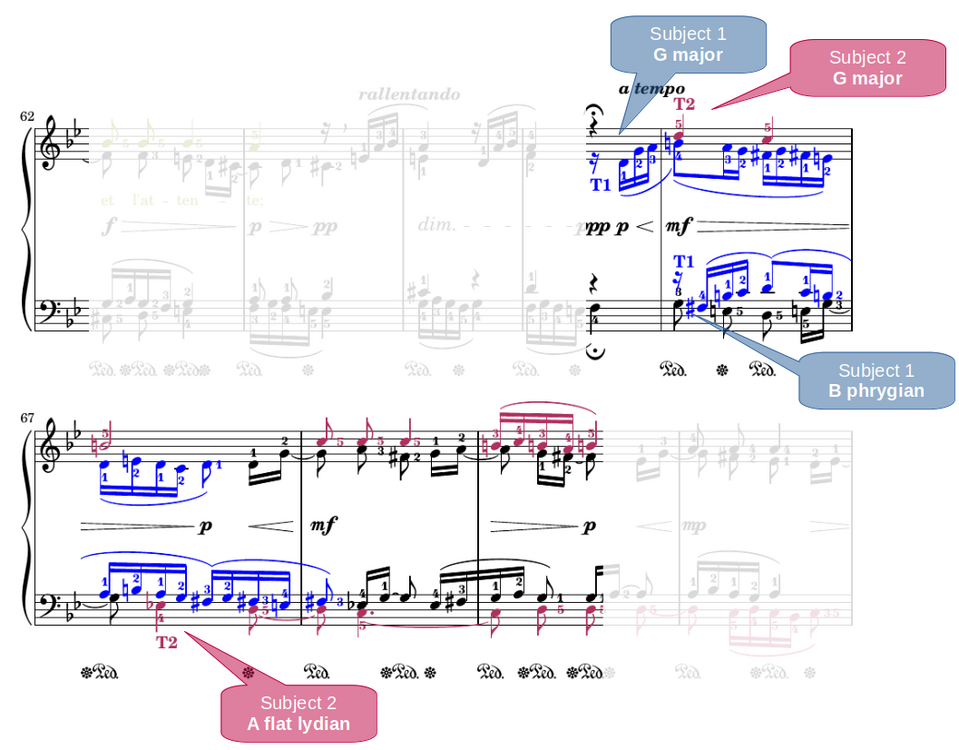
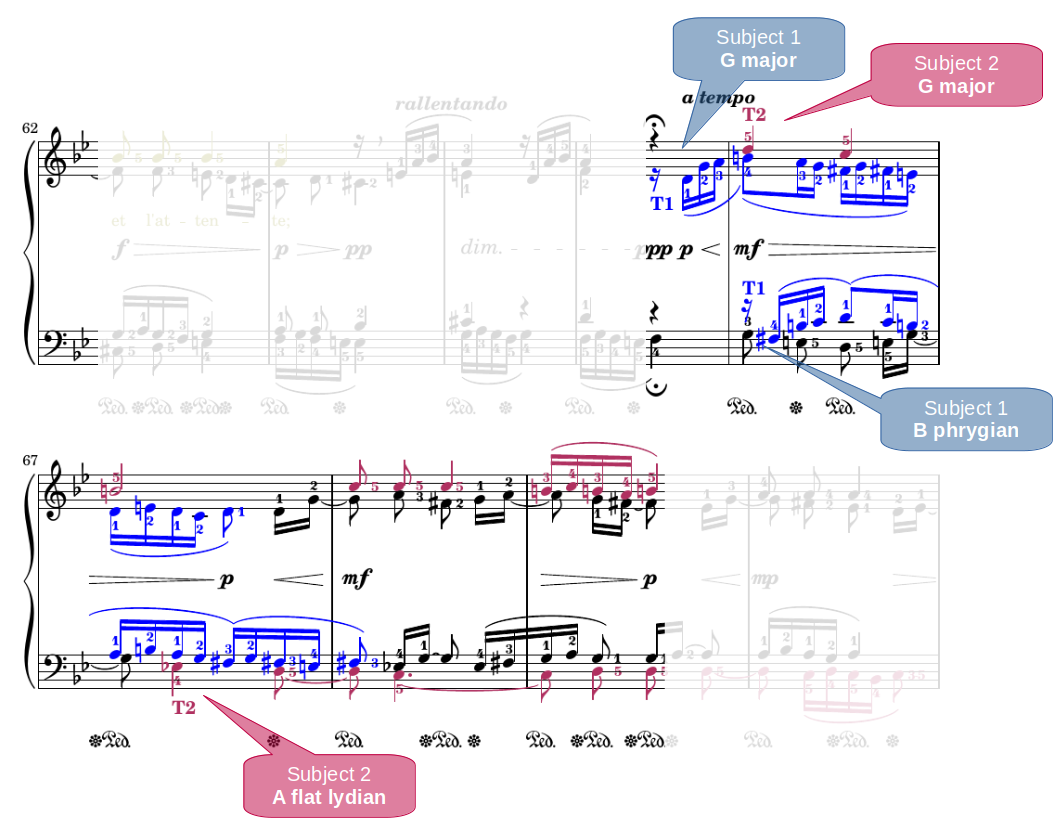
Thank you, for that example. I find it interesting, that phrygian and lydian fit so well together. I usually thought that was caused due to they are the both „extremas“ in mood – lydian the brightest one and phrygian the darkest (if taking the unusual locrian away ...). But the occurrence of all 12 chromatic steps in this combination was new to me and might be the better argument. There is, perhaps, another example for the usage (or even abuse?) of modes within a piece of tonal music – which I think is merely used for „technical reasons“: Transposing a fugue subject, which is initially major or minor, to one of the other modes. I first heard about this “trick” when I read an in-depth analysis of Shostakovich’s fugues (Op. 87) in comparison to the fugues from the “Well-Tempered Clavier”: Shostakovich often uses fugue subject entries in modes, whereas Bach does not. Ever since then, whenever I encounter harmonic problems with my fugue subjects while creating the counterpoint—especially when composing strettos—I always try to figure out whether I could alter some of the pitches in the original subject so that they fit better with the respective harmony or key, but by no means arbitrarily; rather, in such a way that the subject is “correctly” transposed into one of the other modes. Here is a short passage of the fugato in my Prelude XXI in B flat major, whichs tonality in the four bars is around G major (with also harmonies in C minor and D# major). However, the four subject entries in this stretto consist of Subject 2 in G major (soprano) Subject 1 in G major (alto) Subject 1 in B phrygian (tenor) and Subject 2 in A flat lydian (bass) which altogether finally stabilize the above mentioned G major tonality of the section. (Interestingly, there is also a combination of phrygian and lydian here – while not on the same pitch). p21--bars-65-69.mp3
-
Today I present the next prelude from my 24 preludes and fugues project. I composed it during the last few weeks as the „sketch“ for the current YCF Summer Competition „From Nothing, to Something“. For those who are not familiar with that competition (yet), the task is „to take the text from Paul Verlaine’s summer poem “Donc, ce sera par un clair jour d'été,” (So, on a bright summer day it shall be) and turn it into a piece!“. So the major challenge of this competition was not only to move from “nothing” to “something,” but I also tried to find a musical form that could capture this process of “searching”: When a composer has trouble coming up with a brilliant idea for a new piece, it sometimes takes several attempts, each of which yields different individual ideas. And there are some pieces that consist of several ideas that have been “glued” together, ultimately resulting in something like a “collage song.” I’m thinking, for example, of “A Day in the Life” by the Beatles or “Band on the Run” by Paul McCartney and Wings. However, there also exists such a kind of piece in Bach’s Welltempered Clavier, the Prelude VII in E-flat major, BWV 852. That particular prelude starts with a short section with runs of 32th notes, followed by a „more serious“ part in slow motion, that reminds me at a „chorale“. The third and longest part is a fugato with two subjects that further develops the ideas from the first two sections. With this particular Bach prelude in mind, I had thus found the model for the form and structure of my own prelude: 00:00 (mm. 1-14) The first section is an „improvisation“ which introduces the warm key of B-flat major. 00:34 (mm. 15-29) The second Adagio section could be a „chorale“ and is used to set the first stanza of the poem to music. Since I don’t speak a word of French and have no idea how the syllables are rhythmicized, I looked at Gabriel Fauré’s setting of the poem in his Op. 61, No. 7 to find out which words are pronounced or sung briefly and which are longer. As an interesting fact, I discovered that Fauré had actually chosen the same key, B-flat major, that I had chosen before. 01:31 (mm. 30-90) The third and longest section is a fugato based on two subjects, interspersed by further stanzas of the poem. The first subject quotes the first four-note motif of the „improvisation“ section and develops it further, paired with the second subject, thus creating a joyful and dance-like mood. 04:22 (mm. 91-114) The prelude finishes with a coda – or better to say – with a recapitulation of the „improvisation“ from the first section. Now in a more melancholic way, meandering between minor and major. I hope, you’ll enjoy it. Wieland Praeludium-XIII-F-sharp-major-with-coversheet.pdf Praeludium-XXI-B-flat-major-piano-abbey-steinway.mp3 Praeludium-XXI-B-flat-major-with-coversheet.pdf
-
Thank you, very much. I just had to read that sentence twice before understanding its significance (because I’m not so familiar with Brahms): You are completely right, I tried to involve the hymn not as prominent (and rhythmically unchanged) in the upper voice, but rather use its melody as support for the harmonies and the texture of the prelude! The other approach, to use the melody from the anthem as a „cantus firmus“ can be found in the corresponding Fugue XIII in G flat/F sharp major.
-
https://youtu.be/WIhxGSZg3o8?is=r0hzizjIDZH48DkL There is no obligation or pressure from me to respond. I just hope you found it constructive. Learning the art of composition is a processes of continual refinement over years of practice. Perfectionism is our enemy; and hindsight is our therapy.
-
@Markus Boyd Sorry, it's not that I've dropped the conversation (because you've cornered me into a checkmate!! ha! ... It's a light-hearted kid, folks. Don't take me seriously.😁). This conversation started around the time my semester at my conservatory started getting piled with academic pursuits and assignments. (Graduation recital prep. and all that jazz!) This weekened, I will get back to you on your points; which I've read.
-
Hello. A brilliant piece of work. I have to say I really liked it. It strikes me as fresh, well-crafted and natural all at once. I think the three movements complement each other. There’s just one thing I wouldn’t have done – though this is purely a matter of personal preference – and that’s repeating the opening section in the first movement. I know it’s a sonata, but this sort of piece, with such an ‘progressive’ musical character – constantly adding new elements and moving forward – doesn’t need a literal repetition. Besides, the length of the movements is just right. The first movement reminded me very much of one composer: Charles Ives. Mind you, I’m not drawing a direct parallel, as that composer’s textures were quite intense. Well, one always tries to find points of reference. And I love Ives. I found the second movement beautiful – nostalgic at first, and reflective in the second part. And the third… I liked the twist you’ve introduced here, which (this time, YES, in my view) is a neoclassical-neobaroque homage. Congratulations on your work.
-
Hello @Seni-G! I apologize for straying from the music itself, but I wanted to start by mentioning your profile picture. It is absolutely lovely! How are your children and family doing? I imagine the kids have grown quite a bit by now. It captures musical elements and family life beautifully—and the fact that you’re smiling at your child rather than looking at the keyboard is wonderful. That photo truly embodies the feeling that "Everything In Its Right Place," haha! As for the piece itself, the two people above have already left such excellent comments that there isn't much left for me to add in depth. Regarding the Allegro, I got a vibe reminiscent of Kapustin—especially around the 0:04 mark. I’m sorry I can’t recall the specific track right now, but if I find it, I’ll edit this post to include it. Of course, the note density and tempo are different. It’s packed with ideas—including the development around 6:49—but I did feel it was a bit long for a casual listen. It might be good to try condensing it—prioritizing the elements you most want to express, trimming the rest, and ensuring a smooth flow. Of the three movements, the Largo was my favorite. I imagine that if performed on an actual piano, the nuances of the timing and pauses would come through beautifully! Best, Lithl.
-
Hi! I enjoyed listening to this work! I like the second movement, which is a bit reminiscent of Mozart's Violin Sonata, but don't take my ears too seriously, haha. The second movement has a nice tempo, and although the style is different, it somehow evokes the atmosphere of a village from Lord of the Rings; it's bright and lovely. I'll listen to your other works when they're uploaded! Best, Lithl.
-
Hi @SergeOfArniVillage ! I really liked these pieces too! But what really drew my attention is what you said here: I re-listened to the 5th Prelude with this "Who will sum-mon Ba-gag-wa?!" lyric in mind and it brought so much more meaning to the music! LoL .. I think this qualifies under a special technique of melody generation called "melodic mining". It can be used to produce lyrics for music as well, especially with the natural rhythms of the words. But in this case "melodic mining" can be used to turn common everyday phrases into melodies by "mining" their pitch and rhythmic content and transcribing them into melodies. So from that perspective, I especially found this prelude interesting! The 8th Prelude certainly sounded furious! Also quite a notable use of the Locrian mode if I am not mistaken! It's hard to write in that mode without implying a different tonality/modality but you managed to pull it off! Possibly due to the strong featuring of the bass riff that strongly emphasizes the repeating E's. Now, looking at the score I realize that you have a G# mixed into the riff which means it's not exactly Locrian, but close! Prelude 9 certainly sounds "spacey". I could totally see this as an accompaniment to an astronaut in their space suit serenely floating through the emptiness of space. Thanks for sharing these and for giving us some backstory about how they were created!
-
@Wieland Handke Thank you for taking time to listen and provide such thoughtful feedback! I liked the idea of making preludes in the style of rotating circle of fifths, but with my own twist. For example, the 3rd prelude being both the G Major and E Minor prelude (like two mini-preludes combined into a small "whole" prelude), and playing around with ending pieces on 9ths, (so B Major in 9th prelude ends on B#, leading to the C# minor ending, which was planned from the 1st prelude). A lot of this was written with a "let's see where this goes" mentality. I like the feeling of writing music as though it's part of the creation process. A lot of times when I write music, it feels like I take the first step or two, and then the music (which is starting to form it's own "person") makes its own suggestions of where it wants to go, and back and forth, until it's finished. (And you're right, I really need to add a few clefs to certain ledger lines so it's easier to read!) @Grant Weep Thank you as well, for giving your thoughts and feedback! I like adding different levels of "spice" to my music. One day, I want to write some over-the-top spicy music, but I find it really hard to do so, because I want to write music that's both accessible and deep, and the more spice that's added, the more difficult it is for it to be accessible as well. That's a challenge that's on my to-do list to attempt. I actually can play these pieces! If I practiced, anyway. I haven't bothered to perform any of my own pieces -- it takes a great deal of work and repetition. But these are in my technical ability, yes. I occasionally do give descriptive names to my pieces, but these days, usually they are just given generic names. But sometimes I do have certain specific inspirations, ideas, or stories as to why a piece got created, or it's written the way it is. For example, I was having terrible writer's block as early as the 4th prelude. So, here I was, trying to get literally anything going -- making a series of preludes, and I'm already stumped at the 4th one, with nothing rattling around in my noggin. After a while, I thought, "what about musically portraying "beating head against wall?" So, super loud, brick wall octaves buffeted by crashing wave arpeggio figure? It felt weirdly right, and honest, and I just went with it. I mean, that isn't what the music's "about", but it's what inspired its existence. 5th prelude, I saw a cat on Instagram named Merv who could summon the demon "Bagagwa", and it amused me so much that it was the inspiration for the 5th prelude. Ms 8, lyrics are, "Who will sum-mon Ba-gag-wa?!" Cracks me up every time I hear it. 8th prelude, I started thinking of key words that I wanted to portray and bring to life. So, the 8th one was "fury". The 9th prelude, the key words were "space" and "void".
Yesterday
-
Thank you @Grant Weep for your thoughtful and detailed response to this music! I really appreciate the time and care you took in giving your feedback. I agree that the first movement is bananas! And yes I do enjoy bending the rules of harmony and stretching the ear a bit, but within the context of classical harmony and form. I feel like that sort of exercise sets expectations up in the listener’s ear (they expect to hear clean cadences and traditional harmony), which allows me to defy those expectations and take the piece in a new direction. I don’t do it just to troll the listener, but instead to try and make a unique sound. I love Beethoven’s harmony and form, and I want to play in that space, but without just impersonating Beethoven. I tried here to make those forms and harmonies new, but without completely obliterating them. Was it successful? Yes and no. I allowed too many ideas to come at the listener too quickly, hence the piece starts off bananas. But I’d like to try this exercise again in the next sonata and see if I can tighten it. My tendency (in music and in this paragraph) is to try and say too much. Thank you again for your kind words, and for your time! The adjectives you use to describe the music are spot on, and really make me feel like something worthwhile was accomplished here. I appreciate you!
-
Markus Boyd changed their profile photo
-
The allegro below was an earlier movement for a wind quartet (back in 2019) that now contains lots of revisions. At the time, I thought it was 'perfect' but almost 10 years later, evidently it was not! 😬 Second movement recycled from another standalone piece I had made for wind quintet originally. The Rondo is a work in progress. Currently working on the C section (minor). I quite like the theme... think it is catchy. String Quartet in C (Allegro).mp3 String Quartet in C (Second Movement).mp3 String Quartet in C (Rondo Idea).mp3 String Quartet in C (Allegro).pdf String Quartet in C (Second Movement).pdf String Quartet in C (Rondo Idea).pdf
-
How did I miss this piece? A lovely, rhythmic, and cute piece! I think it's well-composed—it features great development and a charming melody within just 1 minute and 14 seconds. And the piano playing is great! It would be fun to skip around while humming this melody in the morning! Well done! Best, Lithl.
-
라임이 곡 문주원 시 고난주간을 위한 신성가곡1 골고다 가득 사람들 외치네 우리가 청하오니 유대인의 왕이여 지금 무릎꿇고 경배하오니 이제 스스로를 구원해보라 저 가시관 보다 거치른 내 죄에 찢기시고 모든걸 내어주신 그 사랑 모든 조롱 모든 아픔을 견디고 십자가의 골고다 걸으신 예수 구주 예수 여호와 이레 어린양 예수 대속하신 구주 골고다 가득 사람들 외치네 우리가 청하오니 유대인의 왕이여 지금 무릎꿇고 경배하오니 이제 스스로를 구원해보라 저 가시관 보다 거치른 내 죄에 찢기시고 모든걸 내어주신 그 사랑 모든 조롱 모든 아픔을 견디고 십자가의 골고다 걸으신 예수 아버지 어찌하여 나를 버리시나이까 내 아버지. 여호와 이레 어린양 예수 대속하신 구주 여호와 이레 어린양 예수 부활의 영광, 보라 예수. Sacred Song1 Lamb of Jehovah Words by Moon Ju-won Sacred Art Song I for Holy Week People cry out across Golgotha, “We beseech You, King of the Jews, Now we kneel down and worship You, Now save Yourself.” For my sin, rougher than that crown of thorns, You were torn and gave everything, in love. Bearing every mockery, bearing every pain, You walked the road to Golgotha, to the cross, Jesus. Savior Jesus, Jehovah Jireh, Lamb of God, Jesus, Our Redeemer and Savior. People cry out across Golgotha, “We beseech You, King of the Jews, Now we kneel down and worship You, Now save Yourself.” For my sin, rougher than that crown of thorns, You were torn and gave everything, in love. Bearing every mockery, bearing every pain, You walked the road to Golgotha, to the cross, Jesus. “My Father, why have You forsaken Me?” My Father. Jehovah Jireh, Lamb of God, Jesus, Our Redeemer and Savior. Jehovah Jireh, Lamb of God, Jesus, Behold Jesus, the glory of the Resurrection.
-
My post was not to disparage synthesizers as instruments. They are actually very useful with an orchestra. They actually tend to blend very well and they can do things that the orchestra either outright can't, or is not very good at. For example, there are certain rhythmic pulses, infinite pads, and ambiences that would be impossible to create with acoustic instruments alone. The issue I speak of is the style of music that has given way to is...wanting. But as with anything, in the right hands, synths have been incredible: Look at Alan Silvestri or Jerry Goldsmith's work.
-
Hello, Wow, there was a lot to listen to. I listened to the first two movements, and I realized that the third movement you have already posted. I did not look at your introductions prior to listening the piece. I saw a previous poster mention that the 2nd movement was devastating. That was it. So I went in blind. I can see now the meaning/introduction behind your pieces, which is always interesting to do after listening to something blind. I liked the second movement the most. I would not use the verb devastating. I personally had this really heavy feeling in my chest as I listened to it. There was sort of crushing feeling that I got from the piece. I followed along the sheet music and wrote comments here and there. For measure 62 I wrote nice, it almost sounds a bit Chinese? Being Chinese myself, I can't help but notice parts of music that sound even remotely asian. I really liked measure 78 to 81. I also really liked measure 117 to 120. The first movement is a bit bananas to me. I also followed on the sheet music and wrote notes from beginning to end. The song starts of sort of in a heroic sense, very exciting to me. Measure 36 was a bit of relief in the sense that my ears got some easy to follow musical ideas. Throughout the song I could hear tidbits of what I can assume is the main theme. So, perhaps I am getting better at listening to your style, or it was simply more obvious for this piece. I wondered if measure 110 was actually playable? On measure 342, I wrote "nice". Overall, these three movements seems to have this natural cadence to it in terms of rhythm and overall direction (up/down etc). However, 70% of the time the harmonies are just really confusing. It has this sort of unsettling effect to listen to. It almost feels like someone breaking the rules of music harmony on purpose and just enough to troll around. But once in a while, there is this really nice moment where perhaps the preceding dissonance really sells that moment, and the pay off seems worth it. I personally prefer your slower compositions. I don't know that I would voluntarily listen to movement 1/3 ever again. However, I think I would want to listen to movement 2 more. I really like it. I don't think that I've really listened to a lot of music that has your particular style. Could you cut some stuff out and tighten movement 2? Sure, I am listening to it, the feeling of chest tightness comes back. And as I listen to movement 2 again, there is this sense of sweetness to the piece. How can something be crushing and sweet at the same time? I don't know, but I think you wrote something that captures that feeling.
-
Hello, This is the 2nd and 3rd installment of my Kids Songs series, which follow "Kids Perfect". These songs were written with more conventional harmonic ideas, though I tried to add some variation and spice here and there to make things interesting. Once again, these are recorded on a nice grand piano at home. Feel free to crank the volume and enjoy :) Kids Born (Arthur) was written prior to the birth of my first born child. I had no idea what he was going to be like. I wrote the piece in anticipation while my wife was still pregnant. I am particularly satisfied with that chord transition at 1:16 to Bb major. If someone knows more about music theory, perhaps they can show me why it works? Or perhaps other pieces of music that might have a similar idea? In all honestly, I probably might have made a mistake while playing/composing and it just sounded good, there was not necessarily much conscious thought that went into that particular chord. Maybe it's not even that special! Kids Born Encore (Marlon) was written some 3 years after my youngest was born...at this point I had a sense of my second child's personality. So the writing process was very different. Anyone who has ever raised 2 young kids will tell you that the kids want to have the same of everything - same toys, same food, same everything. So, naturally it was important to me to try to keep some sense of sameness but also retaining some individuality. So I chose F major, a key that feels same enough to G major and with a goal of overall similar compositional style to the first one. But alas, I was not the same person. 5 years have passed in between writing Kids Born and Kids Born Encore. One cool fact about this song is the irregular key signature, which I had no idea even existed until I transcribed it onto sheet music! Anyways, here it is. Hope you all enjoy it and let me know any feedback/critiques/suggestions.
Last week
-
Evening, I've decided to come out of my comfort zone and, today, compose for my primary instrument, which is the classical guitar. I have played since 9 but in recent years have lost touch with it; but I have recently picked it up again and it has been giving me a new lease for life. Of course, it will be great to play my own music and this is my intention. Composing for the guitar has added difficulties owing to the layout of the fretboard. In addition, one must work out at which position of the fretboard certain passages should be played. If, for example, I tried to play this music up to fret 7 only, there would be a lot of awkward jumping around that isn't practical. On the score, I have added numbers beside certain notes which fingers should play them. The circular numbers above the stave denote the position I have determined. The next task will be to learn to play it at a reasonable standard. Once I have done, I will endeavor to upload my performance to this thread. This piece is largely baroque in style with some hints of classical, too. I have written it mostly in two parts, due to the speed and my intention to play it (I am not virtuosic!). In terms of my influences, I have been listening a lot to Bach's Keyboard Suites lately. I love his 3/8 movements (for example, the prelude for BWV 808. Soundtrack.mp3 Score.pdf
-
Hello, I didn't know much about music theory when I started composing around age 12/13. I am in my late 30's now, and still writing. Never took a lesson in music theory, but I am more interested in music theory these days. If you write music long enough, you will notice the patterns yourself and if you pay close enough attention to what you are doing, or willing to take risks you will eventually pick a few things up on music theory. One obviously does not need to know music theory to compose music. As people have pointed out...it does depend on what kind of music you intend to write. You have gotten extreme good advice I think. I will give you some advice from my perspective. I think that if you intend to pursue music as a hobby, it might be fun to simply use music theory as an adjunct to your purposes. Here's what I mean by this: In my opinion, so much of western tonal music (there is so much out there that is not conventional western music like traditional folk music, instruments that use microtuning etc) is sort of "figured out". To me, music theory is simply a map that intrepid and pioneering composers have drawn out and analyzed/labeled after their own efforts in exploring the music landscape. To embark on your personal journey, you probably don't need the whole map, but it might to help to have some starting spots. Your starting spot will likely come from the type of music you find personally compelling. Of course, if you are thinking about being a professional musician/composer I think that music theory may not be technically necessary (especially if you are a genius!) but extremely useful. Once again, if you are just here for the fun...I think that it's nice to explore the musical landscape yourself through composition. There have been many times that I found something that I thought was mine while composing only to realize that the "greats" of music have already explored these concecpts and often time explored them more carefully than I had done so. As I go older, this feeling of finding something new started to become more and more rare, and so I started to try to actively learn more about it. The older I get, the more I appreciate all the musical worlds and maps that have been discovered before me. But that's part of getting old I think. It's very normal to be young and want to conquer the world. I think most of have been there to some extent :) Hope you keep writing and learning and sharing! EDIT - some spelling errors, whoops.






.thumb.png.8b5b433a341551e913a34392660bc95b.png)