All Activity
- Past hour
-
 Today I am presenting another fugue from my preludes and fugues project. Since it is a long piece with a special feature in its second half, I have decided to split the presentation into two posts. I began composing this fugue four years ago, inspired by Bach's Fugue in E major from WTC2 (BWV 878), after seeing Jörg Demus' wonderful introduction and tutorial, which unfortunately is no longer available on YouTube. The idea is to compose a fugue in the „stile antico“ or Palestrina style, which means having • 4/2 time signature (long allabreve), • long note values (from quarter notes to whole notes, and even „brevis“ notes), • a subject that moves primarily by step, with few leaps. Any leap that occurs is immediately balanced by stepwise motion in the opposite direction. Exposition (mm. 1 – 15). The „regular“ exposition is ascending (subject highlighted with blue-colored notes) • Dux, G flat major, bass (mm. 1) • Comes, D flat major, tenor (mm. 5) • Dux, G flat major, alto (mm. 9) • Comes, D flat major, soprano (mm. 12b) with tonal answer. We have a recurring countersubject (highlighted with olive-colored notes) which is paired with the subject entries in mm. 5, 9 and 13. Whereas the first occurrence of the countersubject starts together with the subject entry (mm. 5), the second one is delayed by one whole note (mm. 9) and the third one is delayed by two whole notes (mm. 13), thus not repeating the previous entry rhythmically but creating a continuous flow. Second Development Section (mm. 17b – 26a). After a one-bar codetta (mm. 16b – 17a) with a tritone substitution we reach the second development section where the subject appears in stretto as following • B flat minor, soprano (mm. 17b) • F major, alto (mm. 18) • B flat minor, tenor (mm. 21b) • F minor, inverted, bass (mm. 23, highlighed in green) The countersubject appears three times (mm. 17b, 21b and 23), the latter one in inversion (highlighted by plum-colored notes). Episode (mm. 26b - 32a). This episode is built from the material of the countersubject (highlighted with olive-colored notes) creating its own fugato. Third Development Section (mm. 32b – 36a). In the third development section the subject occurs the first time in a diminished form. It is not an exact halving of the notes values but also a rhythmic variation. • A flat major, diminished (highlighted with turquoise notes), soprano (mm. 32b) • C minor, tenor (mm.32b) • C major, diminished, soprano (mm.34c) • F major, diminished, alto (mm. 34b) • A major, diminished inverted (highlighted with pink notes), bass (mm. 34b) The subject entries are heavily squeezed together as strettos, and we have a surplus subject entry. The countersubject does not occur in this development section. Episode (mm. 36b - 40a). This episode is built from the material of the inverted countersubject (highlighted with plum-colored notes), also in a fugative way. Fourth Development Section (mm. 40b – 43a). The fourth development section is another one where the subject is presented in its diminished and normal form, together in stretto. • D flat major, tenor (mm. 40) • A flat major, diminished, soprano (mm. 40b) • C flat major, diminished, bass (mm. 40b) • F flat major, diminished, alto (mm. 42) Episode (mm. 43b - 50). This episode consists of two different sections with sequences (mm. 43 – 45 and mm. 46 – 50) whereas the fugue subject once occurs in its inversion (E flat minor, bass, mm. 46). With the crescendo of the second sequence motif, the fugue reaches its first climax, leading to the second half, which I will present next Tuesday, February 24th. Stay tuned!
 -
2-part invention in E minor
Wieland Handke replied to Frederic Gill's topic in Piano Music, Solo Keyboard
Hallo @Frederic Gill! I have read the thread about your „2-part invention in counterpoint“ and since there had already been lively discussions I decided to take a look on another piece which has not got a review yet. I like the motif (or „subject“) which is indeed somewhat „stubborn“ because of its repeated notes (but there are many famous fugues with repeated notes in the subject). And so, your decision to vary the motif sometimes to avoid that repeated notes is quite a good idea. The counterpoint is well chosen rhythmically, giving the entire piece a continuous flow and its „funny“ character. As far as I remember from the other thread, there were some dispute about „parallels“ and „octaves“ which was – also in my opinion – somewhat „overteaching“ (I couldn’t follow all arguments or „issues“ without going into detail too deep), so that I can understand that you’ve deleted most of the posts. But to be honest, after listening to your E minor invention, I can understand what the other commenters meant: Not „parallel octaves“ (or „parallel fifth“ as to be avoided in counterpoint generally) are problematic, but only the occurrence of the same note (in an octave) on a strong beat that makes the piece sound something „thin“ at that particular note. This is the case in a two-voice counterpoint only. If you had a third or fourth voice there would be enough harmonic material overall (and that might be the reason that writing a two-part fugue is much more challenging than a three- or four-voice fugue and why there are so few of them). I think, you can solve the problem, for example by varying your counter-motif in that places where it creates the octave. You will then lose the smooth motion at these points and have to insert a leap, but that might emphasize the humorous character of the entire piece! - Today
- Yesterday
-
Persichetti Exercise 2 - 14 for Clarinet Trio
Wieland Handke replied to PeterthePapercomPoser's topic in Chamber Music
This exercise is awesome, so I could not longer resist to break my silence! By the way, all your exercises from Persichetti's "20th Century Harmony" are very interesting and inspiring – and I have already looked on many of them, while not yet thoughtfully. I think I will study them all in the next time and try to give a review whenever I can. Whereas composing a canon is complicated enough (not to mean the funny children’s chants but a perpetual one), having three different scales and tonics is a real challenge. Usually, one would expect that the harmonies of that different keys would constantly clash each other, but the usage of different modes, or – as here - different synthetic scales interestingly mitigates that problem, so that in the end a common harmony is achieved which, however, sounds a bit weird in classical sense, reminding me on Klezmer music. But that probably expresses the mood of the F Ukrainian Dorian Scale. When I attempted to create a fivefold stretto in one of my fugues, I discovered that it is required to alter the subject for harmonic reasons at some notes. But as I studied the result, it was not an „adjustment“ of the subject but rather a transformation to a different mode (for example B minor, G lydian, C sharp locrian, A mixolydian and D major), so that I had finally well crafted and not „twisted“ subject entries. Very enjoyed! -
.thumb.png.8b5b433a341551e913a34392660bc95b.png) Another Persichetti prompted piano piece. This time the prompt was "24. Extend the following chromatically ornamented piano passage." The form ended up being ABACBA. Thanks for listening and I hope you enjoy and let me know what you think!
Another Persichetti prompted piano piece. This time the prompt was "24. Extend the following chromatically ornamented piano passage." The form ended up being ABACBA. Thanks for listening and I hope you enjoy and let me know what you think!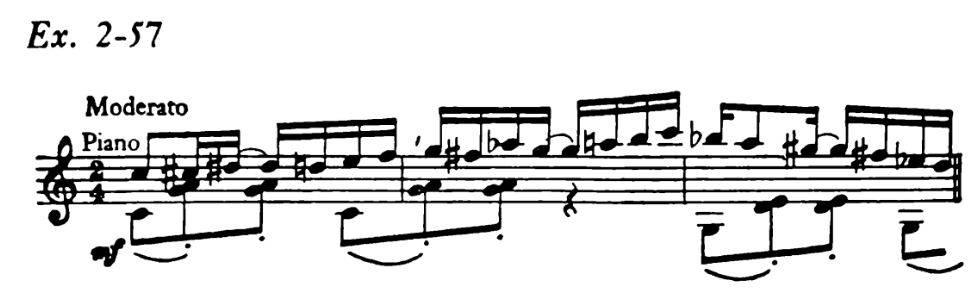
-

Fugue in d minor
Frederic Gill replied to Fermata's topic in Incomplete Works; Writer's Block and Suggestions
Here's my beginner's non-academic point of view (for what it is worth): @Fermata's Fugue in D minor sounds flawless and tasteful. The given motive is very interesting. It is rich in complexity, and intriguing because it feels 'incomplete'. It calls for contrasting complements. Also, is it suitable for a fugue where it has to be frequently repeated? It would be nice as a theme for a long development with less imitation. That's my personnal impression. -
Prelude in C# minor
PeterthePapercomPoser replied to Alex Weidmann's topic in Piano Music, Solo Keyboard
My most recent Muzoracle casting has constant accel.'s and rit.'s throughout: -
Persichetti Exercise 2 - 14 for Clarinet Trio
J. Lee Graham replied to PeterthePapercomPoser's topic in Chamber Music
Well! That quite possibly might be the most interesting thing I've heard in a long time. A very tricky thing to put together. Myself, I've always found canons far more difficult to write effectively than fugues, so therefore I must commend you. This is a very effective little piece. I must say, I don't much care for the sopranino clarinet up top, far too shrill, and I find myself wondering if the whole top part mightn't sound better on a regular B-flat clarinet an octave down. I suppose the texture is more modern for it though as is, and therefore part of your plan. Great work! -
I hadn't even noticed that! But you're right. I guess it just worked out that way by accident. I'm glad you liked the changes of time signature, as I wasn't sure about some of them. I did think of using more ottavas; but found I could read the ledger lines quite easily when playing it through myself. Will add them if the pianist requests it. N.B. The composer who inspired me to write this piece was Julian Scriabin, as I recently discovered his preludes on You Tube. Think my piece maybe sounds more like Rachmaninoff though? Many thanks for your interesting review! Alex
-
Many thanks Peter, for taking the time to listen and review. Yes please do! I'll be getting a real performance from a pianist in May: so I'll probably just wait for that, rather than trying to massage the midi rendition. Will bear your points in mind for the future though. That 9/8 bar originally had a short fermata on the middle note; but I decided to use a time signature change instead. Then I reproduced the same 4/4 to 9/8 in the recapitulation: so it is reflected later in the piece.
-

Fugue in d minor
Fermata replied to Fermata's topic in Incomplete Works; Writer's Block and Suggestions
Thanks for your detailed thoughts! When I mentioned monotony, I was referring more to the process of working with a long, slow subject - after a while the contrapuntal development itself felt a bit repetitive to write. The fugue was an exercise I worked out on paper with pen, mainly as a kind of contrapuntal puzzle, which I've always enjoyed doing as a hobby. That said, you're absolutely right that the playback could be improved. I didn't add any articulation or dynamics, so the notation software makes everything sound much flatter than it would in a real performance. I'll try revising it along the lines you suggest to make it sound more natural. Thanks again for taking the time to comment! - Last week
-
Fugue in d minor
Wieland Handke replied to Fermata's topic in Incomplete Works; Writer's Block and Suggestions
Hallo @Fermata! Your asking about the issue of „monotony“ in your fugue. Sometimes it is not an issue with the composition itself, but rather a question of the interpretation or recording. Since you are using four string instruments „played“ by your notation software, you „naturally“ encounter the problem that the entire piece sounds somewhat monotonous. Even real string instruments blend the sound very well, in my opinion, but are not as expressive for individual voices. I can imagine, when played on a piano, the impression would be totally different. As currently discussed in another thread @PeterthePapercomPoser suggested to improve the recording by “fine-tuning” the articulation, dynamics, and tempo for each individual hand or even voice. I also had a fugue which I considered to be „boring“ and I was nearly to get around and throw it away. But then I applied such tiny adjustments in the tempo, for example to make the first bar of the subject a little bit „swinging“, which dramatically changed the perception. Since I do so now with all of my piano works, I know that it is a lot of work to literally maintain two scores, one for the printout and one for the recording. But it's really worth the effort to achieve a sound that is much closer to a live performance. Concerning the composition „as is“, I think there are no issues. With a short overview on the score I see that you already applied the necessary counterpuntual techniques (such as tonal answer, a recurring countersubject, inversion, augmentation, stretto). As in 6/2 meter with mostly half and quarternotes (perhaps in an older, more Palestrinian style), it would be not appropriate to add passages (in episodes) or countersubjects with a faster rhythm. Perhaps one could introduce a kind of diminution which doesn’t increase the rhythmic pulse by doubling the speed but is merely a rhythmic variant of the original subject preserving the quarternotes as the fastest ones, finally resulting in a 1.5x diminution (such as in Bach’s D# minor fugue from the WTC1 BWV 853). -
Very nice dreamy, yet mysterious and passionate prelude! I like the frequent changes of the time signature. While initially looking complicated, the rhythm of the piece has an intuitive pulse and a continuous flow. I noticed, that your score is without a key signature. But since you often change harmony from keys with sharps to keys with flats, this decision avoids that the score is cluttered with natural signs. And when listening and reading the score I like that the more serene passages correspond with the flats, while the more passionate passages feature more sharps! In some bars, I would like to see more octave brackets to make it easier to read when playing. Personally, I refuse to read more than three or four ledger lines. However, I agree, that too many octave brackets disrupt the visual impression of the runs in the score. I completely agree with @PeterthePapercomPoser's suggestions for improving the recording by “fine-tuning” the articulation, dynamics, and tempo for each individual hand or even voice. Since I do this with my piano works, I know that it is a lot of work to literally maintain two scores, one for the printout and one for the recording. But it's really worth the effort to achieve a sound that is much closer to a live performance. Thank you for sharing!
-
2-part invention in counterpoint
PeterthePapercomPoser replied to Frederic Gill's topic in Piano Music, Solo Keyboard
you can't delete the whole post and other people's comments, you can just delete your part of the convo by leaving just a dot/period in place of the things you wrote. I think the system requires there to be something there so just leave a dot/period -
2-part invention in counterpoint
Frederic Gill replied to Frederic Gill's topic in Piano Music, Solo Keyboard
. -
2-part invention in counterpoint
PeterthePapercomPoser replied to Frederic Gill's topic in Piano Music, Solo Keyboard
you can edit out what you don't want to be in the post by clicking the three dots in the right corner of the window -
2-part invention in counterpoint
Frederic Gill replied to Frederic Gill's topic in Piano Music, Solo Keyboard
. -
2-part invention in counterpoint
Frederic Gill replied to Frederic Gill's topic in Piano Music, Solo Keyboard
. -
I'm on a trip lol
-
2-part invention in counterpoint
Fermata replied to Frederic Gill's topic in Piano Music, Solo Keyboard
This book was intended as a supplement to harmony studies; on its own I don't find it very useful. For self‑teaching it's unsuitable — it tries to cover too many topics in too little space. Could you post a few of the exercises you solved from the book? I'm curious to see how you approached them. By the way, have you studied harmony in a formal setting, for example at school? -
 What about 'better than Peter'? @PeterthePapercomPoser
 -
Thank you very much
-
 It's been too long! I thought I would share this piece written for my theory and composition class at Berklee. We were asked to work with a couple of "exotic scales" from a selection including the whole-tone scale, the octatonic scale, and modes other than those derived from the major scale. I felt drawn to the Lydian Augmented and Spanish Phrygian modes. I ended up with a contrapuntal rock instrumental in rough ABCA' form. The A section is in B♭ Lydian Augmented, the B section is in G Spanish Phrygian, and the C section an unbroken transition into D Spanish Phrygian. Finally, I modulate with the common tones D and A back to B♭ Lydian Augmented, for the A' recapitulation. The title (Iridescence) was inspired by my understanding of modes as a concept. With many modes sharing the same collection of notes, the tonic note that each mode centers on is what makes it unique -- gives it a unique color. And, iridescence is when something appears in different colors depending on the angle of viewing. I see that as a fitting metaphor. The artwork is my own, made with ProCreate. I didn't paint it for this track, but as a birthday present for my mother, inspired by Kate Bush's song "Kite". She is a massive fan of Kate's and introduced me to her when I was a little girl. I rediscovered her recently and I've been spending a lot of time with her early work. My current favorite album is Never for Ever...whose influence I thought was bleeding into this track. So, in the end there is some relation. 🙂 I hope you enjoy! Any feedback on both the mix and composition is more than welcome. ~ GP P.S. I was required to include a detailed score for the assignment. It might be too precise for a rock track in general, but if enough people are interested I will upload that, too.
-
- 1
-

-
- instrumental
- modal
- (and 5 more)
-
Who wants to help on a Lied?
TristanTheTristan replied to TristanTheTristan's topic in Collaborative Works
I think I got the idea for n.2! -
Gwendolyn Przyjazna changed their profile photo