Leaderboard



Popular Content
Showing content with the highest reputation on 06/09/2020 in Posts
-
3 pointsThe - usually well-meaning - advice not to write pastiche (which is to say, not to write in old styles) but rather to write music that is "true to oneself", that is "authentic", is built on several assumptions that are questionable at best. Chiefly, it assumes that authenticity is the chief virtue of art - which, in turn, depends on a very particular view of the role of the artist, as if the value of art is primarily in the expression of the artist, rather than its value being in the art itself. It's as if the only reason to listen to a Corelli piece were because it is by Corelli, or because it dates from such and such a year. And this strikes me very much as nonsense. I (and I would daresay the vast majority of people) listen to a piece of music because I enjoy the music itself, because the music itself provides me a satisfying artistic experience. So it matters not one whit, as far as the value of that work (to me) is concerned, whether it was written by Corelli or by Simen N. The music is what it is, and its value is in itself, not in who wrote it or in what year it was written. Moreover, there's an unwarranted assumption not only that someone's "true voice" exists in a meaningful way but also that this true voice has to be more or less in line with current musical trends. Who's to say that Simen N's authentic musical spirit, if such a thing exists, is not the Baroque one displayed here? If I had a CD of concerti like this one by Simen N, I would gladly listen to them, just as I listen to my CDs of Corelli concerti grossi - neither because they were written by Simen N in 2020, nor in spite of it, but just because I would enjoy them.3 points
-
2 pointsConcerto Grosso in g major: Concerto grosso in g major written in the early italian school after Corelli for two solo violins, solo cello, strings and basso continuo. Written to my son Jonas. Key signature i used for this piece is G major (Everything rustic, idyllic and lyrical, every calm and satisfied passion, every tender gratitude for true friendship and faithful love,--in a word every gentle and peaceful emotion of the heart is correctly expressed by this key.) I. Grave - allegro. II. Adagio III. Vivace IV. Largo V. Presto Please tell me what you think. SimenN2 points
-
2 points
-
2 pointsMarkus, what an thought trough statement. In all my years and disscusions on this subject nobody has ever said something like this. What you say is true. And as you say, most composers on this forum write post-romantic music. When they are attacking what i am doing, they forget that they are doing the same as me to an extent. No one on this forum do not write within a style, nor did anyone here invent their own style. Every composer are influenced and expressing themself within a practice or style. Some styles are more free, some styles are more restricted. Ask yourself this: When somone hear your "ture voice" works, what do they say? Do they mistake it for beeing baroque music? - no they dont. Do they mistanke it for beeing Classical or romantic music? - no they dont. Do they hear its post-romantic or modern? Yes they do. How is that? - Is it because the score is dated 2020? - Or is it because the music in buildt on practice and principles from modern music? - The lack of tonalcenter, the figures for modern music, the use of the instruments, the use of long notes and more rests then notes, the harmony, the structure and the form. This is your style and tratis, but you did not invent them, as i did not invent the traits of my style. If what you Maartin say is true, then we all are just copyists. How amazing is that. To actually say that a piece of music or art is just a copy its a bit mean 😄 Even as the practice is long gone, its fully possible to learn the craft and the language of the practice and write expressive music in it with one own crativitiy and voice. To be creative in the style is not to do something extreme that never have been done before, but a individual will allways have hes own traits (as explained over).2 points
-
2 pointsThe opposition to pastiche composition has a common theme, one which I experienced at my school when I first developed an interest in it. It harbors the idea that music is the creation of an artist, and all art should contain artistic expression. Imitation of a style or composer from a bygone era, therefore, should not be encouraged for it will limit one's means to distinguish themselves within a school or tradition that countless others have already exhausted through their output. Whilst this argument has some merit, it is based on a number of misconceptions and assumptions that cannot be ignored if one is to think about it. As Simen points out in his quote by JS Bach, composers of the 18th century were more craftsmen than artists, whose craft centered around pleasing and relatable patterns. Many highly successful composers from this period were educated in institutions that from an early age drilled their students in such patterns by rote, to the extent that it became a second language. I think it is fair to say that the underlying practice of composers from the 17th and 18th centuries conflicts with our understanding of artistry (that is, if you associate artistry as something beautiful or profound that pushes boundaries and which may challenges people intellectually). It is no coincidence that popular music from this era is predominantly by figures whose mastery enabled them to set themselves apart from their contemporaries. But how can one begin to understand their art without looking at the context in which their craft was cultivated? The truth is, the practices of the 18th century musical world have long ceased to exist. There is much we do not understand and may never do. The attempted revival of their practices in my view, is more a scholarly exercise and Simen seems to do this better than others. I have observed that most who use this forum subscribe post-romantic models, and many have become quite specialized in their respective disciplines. An inevitable outcome of this is that people will project different things on other people's works. That is an important thing to consider when you are offering criticism.2 points
-
1 pointMy head is preoccupied with a polyphony of thoughts They alternate fore- and backgrounds remaining in the same space; all having their own movement and direction. The corona crisis evokes deep questions like: who am I as human, what am I doing as a composer, why do I make music. Contemplation and musing have become an essential part of my life. Please tell me what you think. 🙂1 point
-
I've been working on a piano sonata in the classical style (Mozart/early Beethoven inspired) and recently finished a draft of the third and final movement. It's intended to be in sonata-rondo form. I wonder if some of the transitions are little off and/or abrupt particularly at measures 93 and 195. Thanks for listening.1 point
-
1 pointA new tune I composed inspired by "New Age" composers like Yanni, whose music I've long admired. Let me know what you think! Thanks.1 point
-
1 pointThis is a tone poem inspired by a work penned by Icelandic poet Jónas Hallgrímsson in 1843. His poem speaks to the frailty of life, the uncertainties that threaten us, and the watchful eye of God. The imagery evoked here is of a lone seagull flying out across the sea under moonlight, who meets his untimely demise in the jaws of a lurking shark. The phrase "Máninn er hátt yfir sæ"—the moon is high over the sea—anchors each stanza of the poem, providing a sense of steadfastness against an otherwise bleak tale. This I chose to be the title of the tone poem, and I hope the proceeding aural onslaught captures the evocative imagery of the source poem. Do let me know your thoughts and feelings about this work. The harmonic language is my own, but I sometimes question whether it suits its purpose in storytelling... Even if you don't feel qualifed to comment on the technicalities of the piece, your insight into the tone poem's emotional depth (or lack thereof) is just as valuable to me. For those with more theoretical savvy, I've also attached the score and would greatly, greatly appreciate feedback regarding that. I've tried to make it as succinct as possible but I know I've overlooked things. Thanks in advance for your thoughtful input!1 point
-
1 pointThis is an orchestral miniature I wrote recently. I've been wanting to improve my 'grooviness' and orchestral writing overall, and this is one of the results. Hope you like it, and please, share your thoughts or comments! 🙂 (please forgive the still very messy score, it needs some cleaning up)1 point
-
1 pointWhat a fun piece!!! I don't know how I missed it when you posted it on Sunday. It's very lyrical and captivating, especially with the chromaticism and colorful chord progressions. Fine work! I will echo what @Bradley Scarff says... I think a short interlude with the melody in the bass/left hand would be very tasteful. But fantastic job nonetheless!1 point
-
1 pointWhat a beautiful review, Hendrik! I'm very humbled and glad that the piece evoked such images in your mind; it was my intent but I'm never exactly sure how it comes across to the "audience." You seem to have picked up on everything I was going for, and that makes me smile! 🙂 I especially like the way you described the end as "the northern lights." I wasn't specifically thinking of them when I wrote it, but it absolutely fits the picture! Ah, here we are again at Sibelius. Being compared to such a composer is a huge compliment (to me), and I thank you for that! I've been told on a few occasions that my music has a "Nordic" sound to it, whether that's because of Nordic composers' influence or simply a similarity in our cultural values, I don't know. Once again, thank you for this wonderful review. I love hearing what others felt during the music, and your review was particularly delightful. Best, Jörfi1 point
-
1 pointThat's an interesting piece also a dark one. I like the dotted rythm in piano right hand and the low figures in the left hand, it contributes to built a tense atmosphere you are aiming to create, but I aggre you could create more constrast with differents textures to change for a few seconds the accompaniment...Maybe just a solo cello part in the middle or a choral-like passage would help to create some contrast. I find some great ideas there, but I'm not able to classify the style. Have you taken particular a composer or style as a source of inspiration?1 point
-
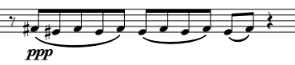
1 pointI was going to comment how the strings created this effect of waves very well done, but I see is already taken 😉! Well If it doesn't matter, I'm going to repeat it anyways, I think you did a great job with creating a universe in a musical composition. The beginning already creates a splendidous dark feeling and you can really feel the presence of an immense sea in front of you. When the strings begin with this pattern: then immediately you feel those waves. By minute 2:10 I got goosebumps being a MIDI!! I can not imagine what would have been the feeling hearing live, and again in minute 5:30 the same, as well, I would love to hear the "storm" (or at least is what I felt when I heard it) live. Overall is super well accomplished. After the storm, then reapers the bassoon playing the two-tooo-tooo-tooo from the beginning and I think it was necessary as It have the piece more coherence (not in the bad sense though). Then in the minute 9:30 there is such a sense of "resolvance" and accomplishment that I can even see the northen lights with those cresendo and decresendo and the horn and everything and how it slowly fades out. I think is a very well accomplished piece, lately I've been listening a lot to Sibelius (the 7, 6, 5, 2 symphonies and Tapiola) and I have to agree with @Thatguy v2.0 because it does have a flavour of late Sibelius.
 1 point
 -
1 pointReally enjoying piece. The cadence of minute 0:52 feels weird to me. But cool work.1 point
-
1 pointA very charming piece. I love how to B section has a darker feeling but not to dark that it would unbalance the piece. The appogiaturas I think work very well with the context of the piece because they give a more dance-like mood (or at least for me) .Overall I think it has a great proportion. :)1 point
-
1 pointVery nice, elegant and simple as the illustrious commenter above describes it. Though I always think of a scherzo as a faster tempo work, this sounds more like a minuet.1 point
-
1 pointElegant but simple, two things not so easily brought together in a single piece. Great job, Guillem!1 point
-
1 pointMan I loved this piece, a lot of great things to talk about. First of all, tone poem complete haha. Your piece was very true and idiomatic to the context your were going for. The strings especially created the sensations of waves and winds. Have you heard the piece "The Swan of Tuonela" by Sibelius? Some of the oboe and clarinet lines reminded me of the longing melodies he uses, awesome job at creating a picturesque world! I also really enjoyed the sustained dynamics in the strings, great use of an instrument that can sustain forever while still keeping those lines interesting by swelling their volume. It's a nice pulse effect! The harmonics in the strings after what I can only assume was the section where our bird friend meets it's demise was really cool too. In general, what I'm getting at is you use the orchestra brilliantly to create a sparse and unsettling atmosphere. However, I think it would benefit you to thicken the orchestra as well in some spots. For instance, you have hits in the strings before the harmonics section I mentioned that use this chord: F# C# G B F C F# B What a cool chord to use in this moment, and it's fine as it stands. But the tuba's play the Bb (A#?) and the bassoons play B nat? It's a cool percussive effect, but I think you would get a much stronger root of the chord if they were all doubling the F# (or whatever the root of your chord is :D), and then you have all of the dissonance you want with the minor 9ths and split 5ths you desire. Also you mention your our own musical voice. I think that's what we are all striving for, and you have definitely developed your own unique personal style. What I would suggest is that you make that a bit more clear in your writing. I guess it just depends on what you're going for. If your plan is to have an orchestra perform this, your score looks incredibly clean and tidy. You don't need any help there! I didn't care for the giant time signature changes (no worries, just a style preference), but as I read on it grew on me. I'm more concerned with the enharmonics. The cello at one point was reading F# for a while, and then all of a sudden switched to Gb. It's just harder to follow along with, but honestly I know that most of us here aren't getting these wonderful orchestral ideas performed and we have to rely on sound samples, but for the future I would kind of map out the language and tendencies of accidentals to keep it more consistent in how you're thinking about your piece, and then if you have to import into Sibelius or Finale or whatever you use, it's much more clear to you how you want the enharmonics to appear. The only other thing I would watch out for is the breathing in the winds. There are several long legato passages where I would be worried about the steady stream of eighth notes, but to be fair I'm not a wind player so I would always ask their opinions on any lines I'm unsure of. More importantly, Mozart said it best when he mentioned how rests are more important then the notes themselves. I know you were going for an atonal approach, but something as simple as removing a few eighths out of a set of 16 or so will a lot of times give an easy way to create syncopation and more phrasing to the great lines you've given. Overall, any qualms are small for me and you absolutely achieved a wonderful tone poem that had me captivated from the beginning. Thanks for sharing!1 point
-
1 pointAs always, your compositions are done with total perfection but I never hear Simen N in these works, rather a full-blooded imitation of baroque music of late 17th and early 18th century. I was really hoping you'd get bored by now and try to find your own personal language so listeners may say: This is definitely Simen N, not Corelli for example. I know you will probably berate me for writing this (as you have done it before) but I can't help myself, I find it a shame for such a talented composer like you to be satisfied with pastiche.1 point
-
1 pointI think you could've used more stuff during the breaks, cuz the robotic noise thingy could've used more, well, rhythm noise. Or something, right now it feels like it's too naked imo.1 point
-
Hey there, since i am new to this forum: a big hello to everyone. 😉 After several years i went back to my keyboard and DAW, and this is the result. I got the idea for this piece while reading a fantasy book, set in the fictionious world of "Aventurien". The main character, a seaman named Asleif Phileasson - also known as the "Foggwulf" - goes on a perilous adventure. I pictured him and his crew, sailing through the dangerous sea. And then i had this main theme in my mind, which was the starting point for building this track. This is a classic orchestral piece, no synths or sound effects. I wasn't sure about posting it in this section of the forum, or in "Orchestral and Large Ensemble", but since it is more the film/videogame type of score, i thought it would be better here. This was made with Cubase and the Hollywood Instrument Libraries of EastWest. So, let me know what you think. I appreciate any kind of feedback. Thanks! 🙂1 point