
Marc Deflin
Facebook
-
Joined
-
Last visited
-
Hi @Luis Hernández, Thanks a lot for your review 🙂 I know I don't review a lot in those pages, but I'd think I'd go strangle myself if this one wouln't get any, with the amount of efforts I put in 😄 Late classical/early romantic is exactly the period I point out - if needed - to situate the style of my music. About the timpani, it's a limitation of the virtual instruments I use, they propose distinct sonorities at various tessituras, so I was forced to raise the notation. "Qleg" is just a markpoint for playback rendering (it triggers a VST articulation), it's got nothing to do with the presence or not of legato around 🙂 So for this two points I didn't make the effort of preparing the exact "real life" score for orchestra, I apologize for this. I'm interested, which instrument would you choose as possible substitute for the horn when playing bass notes ? I must agree I'm most familiar with strings orchestration than with other instruments'. Thanks again, have a good day. Marc
-
Hi all 🙂 As a new born violonist (started the instrument in october 2024), I thought I would give it a chance at composing a concerto for violin and orchestra with my humble technical skills knowledge (far from pushing the instrument to its limits 😉). Here it is. Three movements : allegro moderato / lento / allegro. There are various themes inside, main ones being : Theme 1 : enunciated straight at the opening (bars 1-4), it's developed further by various sections as well as by the soloist under several forms, Theme 2 : appears first bars 219 to 225 at the end of the first movement, then in second and third movements under several forms Theme 3 : bars 31 to 71 in second movement, then reappears in the conclusion of the concerto at the end of the third movement. Other leitmotivs (don't know if it's the appropriate term) emerge throughout the piece. The third movement is an allegro but strongly slows down at the end for a quiet, peacefull, opened ending mainly reusing colors from the second lento movement. In the attached pdf score : Allegro moderato : page 1 Lento : page 69 Allegro : page 102 Here's the video (let me know if it's better that I attach MP3s) : 0:00 : Allegro moderato 8:32 : Lento 15:57 : Allegro (timeline also in the description of the video) Best regards 🙂 Marc
-
-
Hi all 🙂 On vacation doing little treks in the eastern Vosges mountains in France, I profited by my late afternoon free times to give a first try at a woodwind quartet. Here's the result study. I merely structured it as A B ... A B 🙂 and there are one or two harmonic attempts in it. Regards
-
Really enjoyed your piece, @Kvothe Nice melodies, expressiveness, and a story telling writing ; that's what I like in music 👍 Regards
-
Not bad 🙂 Indeed there's a dark, melancholic mood surging out of it.
-
-
-
Hi 🙂 Here's the third and last movement of my first complete string quartet. It's a moderato which starts quietly in the main D Major tone, before modulating in its first theme to a strong A Major viola-leaded melody. Then both main themes from the first and second movements are sequentially reexposed. Follows a happy interlude in D major. Whereafter first theme comes back and developments bring us slightly as a conclusion to the final exposure of the principal theme of this string quartet (the one from the adagio), first hinted at in the background by the viola. Thanks for listening ! 🙂 Regards, Marc
-
Hi @MJFOBOE I enjoyed your march. This instrumentation reminded me of the Music for the Funeral of Queen Mary by Purcell, though your work is of course in a happier - more glorious mood. This work might be see as not complicated, but it's surely efficient and pleasing. Best regards, Marc
-
Hi @Henry Ng Tsz Kiu Thanks for reviewing 🙂 Well, I guess the bare chords in the A section are indeed intentional, they give a strong, rigorous - bare - tone to this first part, aimed at evolving towards a more flourished, lyrical part when switching to D Major for the main theme. You're right about the harmonisation errors in b.16 and b26, I missed that. Your last remark about the transition towards the end in D Major makes sense ; I had wondered a little bit about it must admit, but finally let it like it is. Best regards, Marc
-
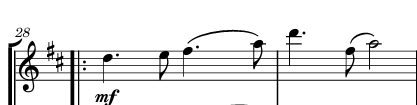
Hi forum 🙂 Here's the second movement - adagio - of my first string quartet. It's a quite even piece, structured A B C A' D C. The A' is the first A theme replayed lower in a clear G Major tone, whereas the original A is more thought about as in a B minor b9+6 (written in a G Major key for commodity). The main theme of the first movement is hinted at on bar 28 (beginning of C theme) : That's all ; hope you'll enjoy 🙂 Best regards Marc
-
-
Great work @Fugax Contrapunctus, counterpoint master 🙂 You set a nice drama mood here not devoid of hope as I feel it. Would be a great opening - though rather short - for a larger, epic opus. Thanks 🙂
-
Hi @Willibald I enjoyed your work. It's pleasant to hear some - nice - music in this demanding style 🙂 I'm a fan of harpsichord, which you handle well here. Regards 🙂 Marc