
PaavolaPyry
Members
-
Joined
-
Last visited
-
Wow yes, absolutely! I have done some shorter text-based scores before, often with a lot of improvisation and have often had these sort of textures in mind, one way or another... But here's a question: How do you approach form or the overall arc of the piece in this process? Asking because it is something I often struggle with myself. -P
-
-
-
To add a bit of nuance to the idea I had floating around when I started: The start idea (Dbm-Eb#9) is quite dissonant and reminded me of the feeling you get when you are watching a show or reading a book and often something happens around late parts of the "middle" of the story where you sort of feel sore of something in the story. There is that unfortunate upset, the part you need to get over as the viewer, so that the ending makes sense and is satisfying in the way intended. That's what came to mind. From that it grew into a waltz and with my detuned E-string, a morsecodish pattern seemed fun. The way the piece evolves in my head is from this soreness, anxiety - what I imagine like one of those wounds you get for falling on asphalt or gravel, you know the ones. That soreness is distracted by this 11/8-ish thing, in a sort of bliss you get in a bad situation from small things. Everything's not alright and you know something is wrong, but your mind is preoccupied with this random thing for just a moment. The ending of the piece is abrupt, fragmented, it's like coming back to your senses, realizing the grimness of the situation. By complete chance "chapter 11", my original name idea (based on the 11/8 and the idea of this being a chapter in a story around the late-middle) means something adjacent to this - bankruptcy! Failure and reorganizing due to such. So the name has that pun in it (I mainly associate bankruptcy with businesses). To me improvisation and composition (and especially comprovised music which is partially what this falls into - a combination of the two) give a chance to tell about feelings, moments, memories, concepts, colours, smells etc. in a vastly abstract sense. Therefore all of this stuff is going through my mind while playing, and I think as that chapter of the book it works quite nicely :D. But feel free to disagree and give your own thoughts! -P
-
Here is a quick semi-improvised piece I made! 🔷--...-- - waltz for chapter 11 of a movie (or business).mp3 It is based on 2 basic ideas really, a Eb6/9 (or Eb6b9) to Db6/9 movement (with the occasional Dm/F) and a morse code idea that evolves into what resembles a 11/8 pattern (--...--/2+2+3+2+2). The idea in the very start is a Dbm to Eb#9 (omit5, sometimes with a 6 too; basically a reduced Hendrix). The tuning is Drop-D with the E-string tuned up by around 20-25 cents. This is a technique I like to use to make things sound out of place - or to give them that slight microtonal colour. My question would be building on this. Like many of my guitar compositions this was originally an impro session, then I recorded my attempts to redo that impro session. TWO CENTRAL QUESTIONS. *How much detail is too much?* (in notation) -> As this composition is highly impro-based and there are a lot of small improvisatory moments (i.e. the percussive sounds which have a specific place in the form but not specific rhythms or techniques) and I'm wondering how much of them has to be notated. Also there are moments where I purposefully "throttle" the rhythm, like towards the end, where the rhythm fragments and by effect the pace slows down. What's the best way to both visually AND verbally (an)notate this *fragmentation*? I want to have both visual and verbal, reinforcing one another. *What instrumentation do you see fit for this?* -> I want to add other instruments - or effects too maybe - to this piece once I notate it. My mind first wonders towards R. Dyens' ideas for Libra Sonatine if I recall correctly: Originally for guitar, arranged for gtr, contrabass, fiddle and percussions. Ensemble Dre's rendition (spotify) . But I am wondering what to do. Often these first feel so... intimate for the guitar to me, but I still yearn for other instruments to join. This is a long standing block for me. (I also want to know what you guys think of my, self-claimed to be hilarious title) Love from Finland, Pyry
-
Revisiting this but wondering if anyone has ideas on how to build from this? I feel like it could work both as only having guitar as well as having something else. It wouldn't be unfathomable to have even a larger ensemble in the background. But either way I'm also thinking about effects and such. If anyone has thoughts let me know; I'll update here
-
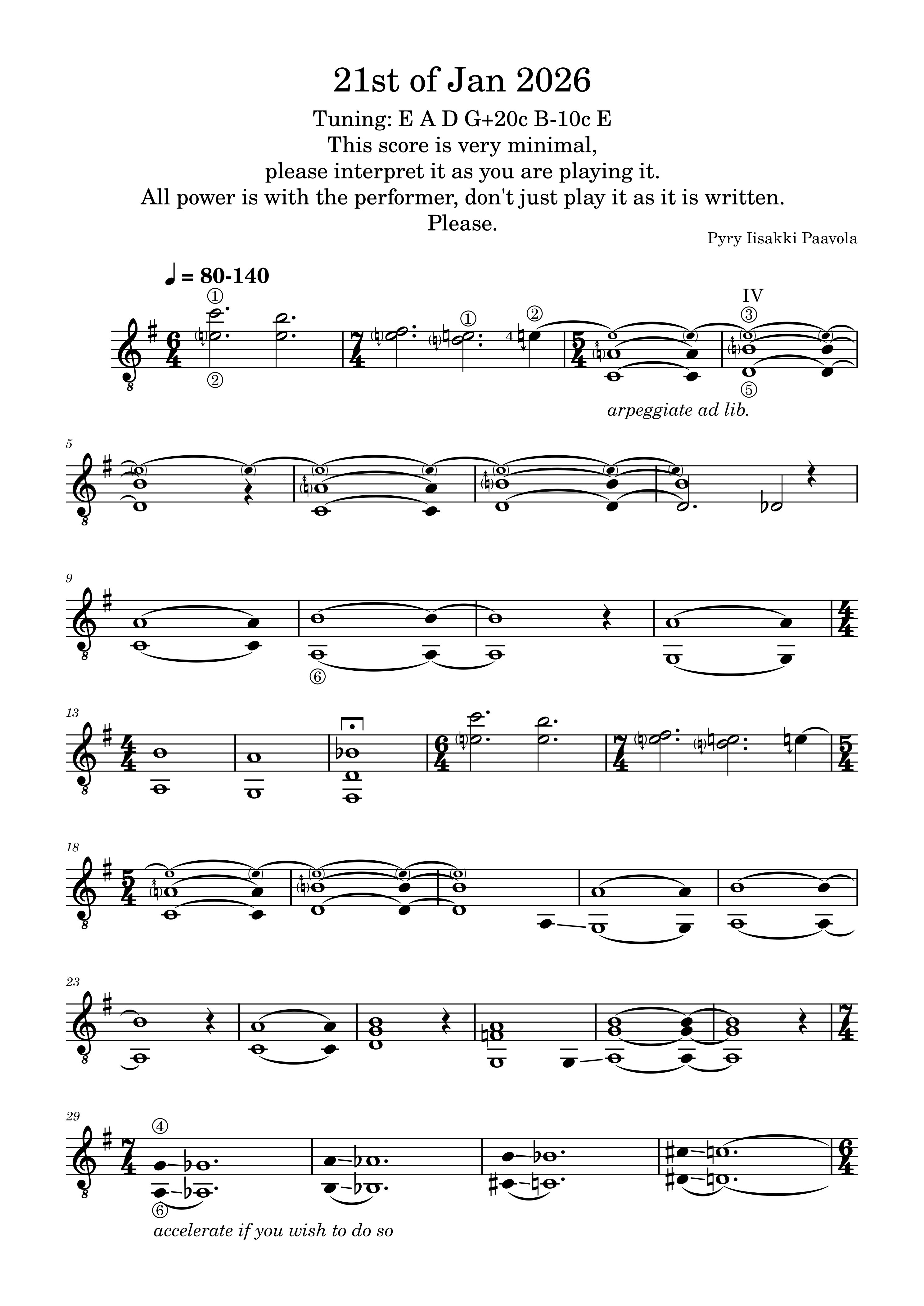
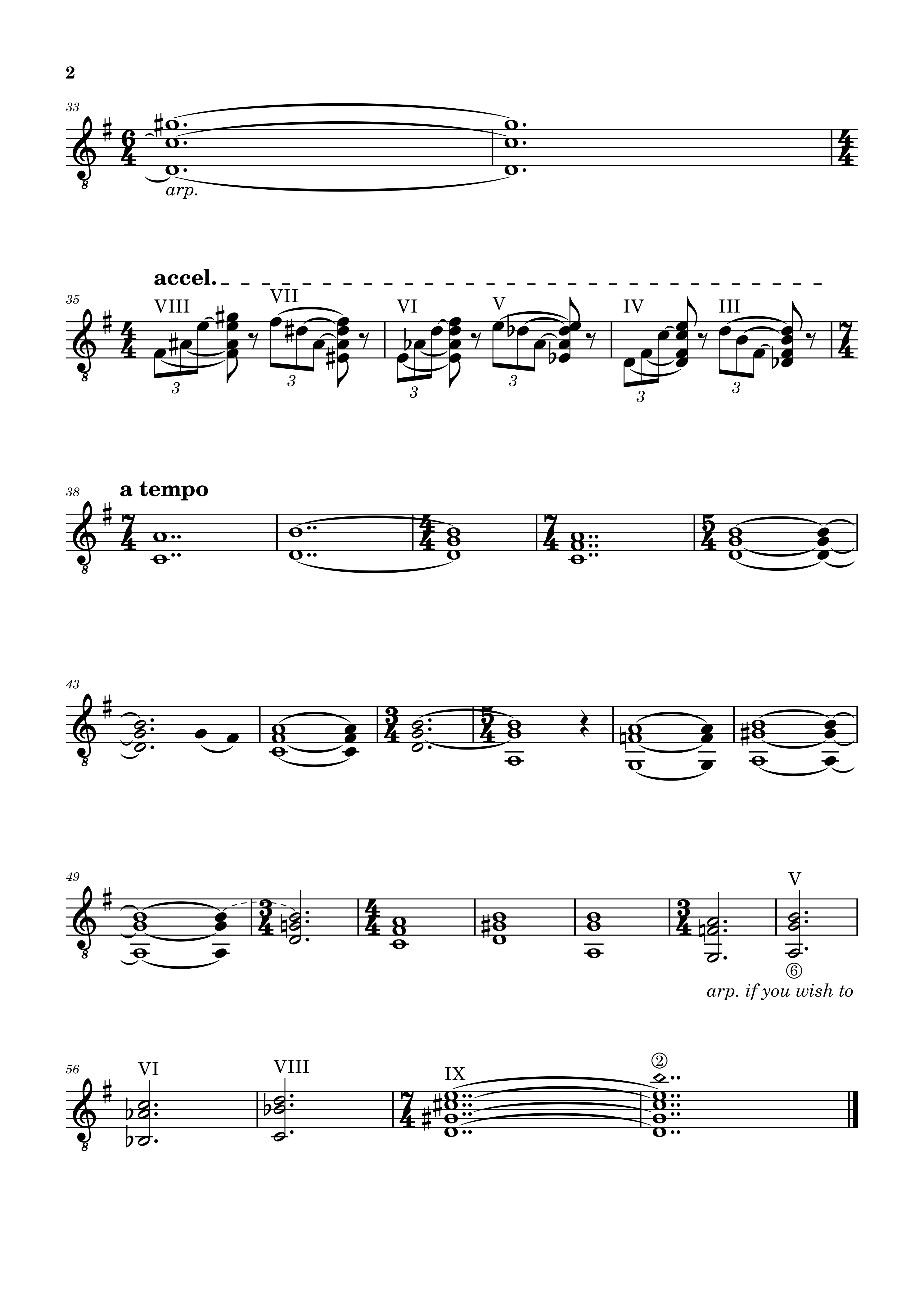
Hi Henry! The microtones are only sort of marked in passing and occasionally on the score as I wrote the score for the player. The tuning of the guitar string is what gives the microtonality to the score, so in an effort to not overcomplicate the score I tried to show them as little as possible. As the subtitle says, the G-string is tuned 20 cents high and the B-string 10 cents low. I could also write an analysis score in which all the microtones are visible, but I felt like player-wise this solution felt more organic. But tell me if you disagree, I don't fully know if I made the right decision😅. And indeed initially it was improvisatory but I sometimes do this thing where I first improvise and then try to repeat my improvisation 6-10 times. After a while I land at something, and this is where I landed yesterday :D. Thanks for the kind words and the review ❤️
-
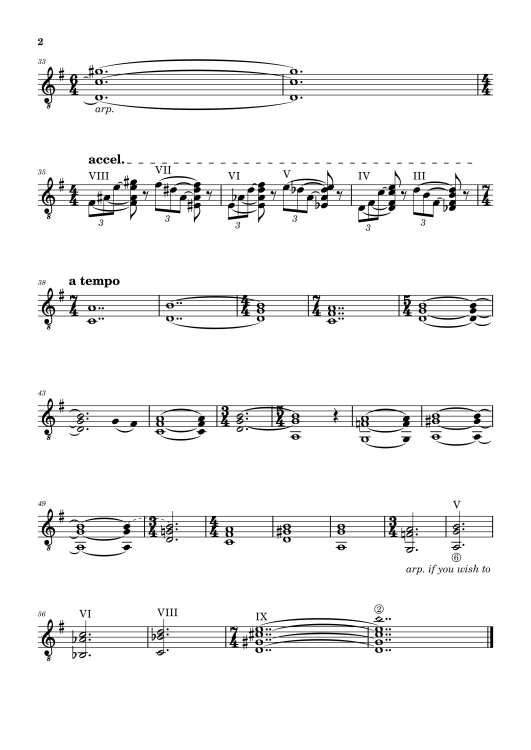
I was thinking about the ice that's formed here on the ocean. How in foggy conditions it looks like it never ends. I'd like to go sit at the beach of my cottage with an omni mic and just stare into the fog and play this... This is also a slight experimentation on both microtonal tunings (aesthetic) and in player's freedom. You'll note that my recording sounds a bit different to this (and was actually played on steel string guitar), but that's the point :D. I often feel that the player is not given enough free reign to interpret what they are playing - not enough free reign to bring themself to the stage. So this is a slight complaint to that I suppose. All thoughts, feelings, colours, landscapes, gibberish, textur 21st of jan.mp3 es that come to mind please tell me.
-
Thank you! On the ending, if I may ask for advice, do you think the instrumentation would work, or are there some that could work better?
-
Hi Luis and thanks for the feedback! I am not an expert either, but I tried to make sure that the timings are sensible - hence why it alternates between the two horns (1&2) in the themes. If you have any further thoughts all are welcome! I think with these minimalistic pieces I really try to find small things, like colours or feelings or smells or certain tactile sensations... So everything is very interesting to read! With great thanks from Finland Pyry
-
Wow! Very interesting! I'd gladly learn more!
-
Nice! Looks like you have everything in order, good luck 🙂
-
This all sounds and looks very professional so pardon me but I will give some subjective thoughts on the piece: For the first part, I really like your use of the minor 6th scale degree. It is well used, but also its sound maybe looses some power towards the end. I also feel that maybe I would've wanted a bit more time before the strings come in loud, before it explodes so to speak. I personally love to exploit the perfect 4th that forms between the minor6th and minor9th, but that might not fit into here anywhere, just wanted to point it out :D. I love bar 81 and how that part develops. Love it. Nice use of seconds in horns and violas on page 16. On page 17 bar 150 and forward I am a bit sceptical about the flutes hitting those high notes, perhaps the oboes too. I feel they distract from the theme a little bit. The chords between page 17 and 18 are very nice, I like those a lot! It breaths a lot of colour to the lines. Page 19 works really well too, maybe there's some things about form I would look at over there (kinda feels like it jumps from one thing to another), but I think you do a very good effort of gluing those themes together. I would maybe just recheck it and try a couple different things, but your solution might just be completely fine. The Andante Cantabile feels rewarding. That whole Andante Cantabile part has a nice energy to it, gives you goosebumps. Very ballet-like! I don't know if I fully agree with the turn from the horns in bar 213 to the earlier waltz theme in bar 227. I would maybe hope for a bit more glue there, something a bit more elegant. Trumpets are nice though! Although once again I feel that the trumpets could've played for twice as long, the jump feels a bit rushed now to me. Ending in the larger sense is powerful, maybe I would think a little about form once again, like how have we earned this ending. Also the last bars I don't agree with :D, I feel like you bring us to the mountain top and then there's a different ending to the one I was anticipating and waiting for - this said, endings in my opinion are one of the most difficult parts of a piece. But you have built up well to the ending, really well, I was feeling goosebumps, but the hits left me feeling a bit betrayed. I hope this doesn't come off as mean! That is not my intention. I liked the piece a lot, these are just the things that jumped at me. You don't need to agree with these or do anything about these, most of these are not some general guidelines or greater truths but just how I felt myself. I am not opposed to you keeping the score musically as is (other have pointed out the technicalities). Great piece! Thank you for sharing, and do keep sharing! With great admiration from Finland, Pyry
-
Fun and very joyful! I have no specific nitpicks, all I would say is what my composing teacher(s) has (have) told me for as long as Ive been studying under them: After you have finished a score or a part, go through it and think with intention what things you intend and why. Try to make sure everything in some way has a meaning and that for example one idea leads to another properly. Make sure the "macro and micro" (as I like to call them) are both intentional: That means greater form things and also small individual things. But great piece! This is more of a general guideline than anything. I think mostly everything works here, perhaps I would've done some things differently for personal reasons, but that doesn't then concern you. Best regards from Finland, Pyry
-
Very cool! I have no idea how to read your PDF file, but cool! It is very exciting to listen to music with a philosophical or musicological point! The high frequency sounds make me shiver slightly, and I find myself adjusting the volume constantly, but this is most likely more because of my unfamiliarity with the genre and style. If I may ask, what do you mean by parallax? Best regards, Pyry from Finland.