All Activity
- Today
-

Piano Sonata no 3 / 3. Scherzo.Allegro vivace
MichaelJohn replied to Vasilis Michael's topic in Piano Music, Solo Keyboard
Enjoyed this charming piano work, which is bright and lively. I like the sudden changes like borrowed chords and a quick major to minor, then back. Has a touch of humor, as scherzo's can often have. -
I enjoyed it and just listened and followed the score. I also wrote a stream impression piece called The Brook. It uses arpeggios which I think works nice for something like flowing water.
- Yesterday
-
thought I was going for a dark song; guess I was wrong.
-
 Tango to the death - Casino de Monte Carlo | Rendition From the Film : Never Say Never Again | James Bond 007 https://jamesbondlocations.blogspot.com/2011/11/tango-to-death-monaco-part-3.html Tango to the death - Casino de Monte Carlo .mp3
 -
Thank you for your review and valuable feedback. It is great to receive feedback from a performer's perspective. Regarding the metronome marking, I have had that criticism by another pianist concerning another piano piece. I will make sure to be more careful in the future. I will also keep all your other feedback in mind in future pieces.
-

Piano Sonata no 3 / 3. Scherzo.Allegro vivace
MJFOBOE replied to Vasilis Michael's topic in Piano Music, Solo Keyboard
Quite a charming work ... echo's of "Schumann's Scenes from Childhood". Mark -

Taking Control of my Creative Process
johannhowitzer replied to johannhowitzer's topic in Composers' Headquarters
https://flat.io/score/69ac2e0ec3fb848b0b1ba22e-rainbow-motif?sharingKey=c41a8a0ae1afde60e4d714077a6c63bf9c03d1373a7f7d3f7897743a5aa00cb69e393452925b590a859c557105db3d587e5a8dd6ced3488277ad205afa53e256 https://www.youtube.com/watch?v=E0Ux3ULOuAU Writing a triumphant 8-bar intro in the style of Rainbow Road themes. Tried to vary up the melody and bass rhythms so it doesn't come off as Legally Distinct Rainbow Road. I really like how the descending notes in measure 4 shift to a bit of minor, underlining the return to tonic in measure 5. And the left hand jumps worked out better than I expected. Dunno how much I am a fan of that last flourish on the trumpet, but... on we go! -
Concerto for violin and orchestra #2 in B minor
Marc Deflin replied to Marc Deflin's topic in Orchestral and Large Ensemble
Hi @Luis Hernández, Thanks a lot for your review 🙂 I know I don't review a lot in those pages, but I'd think I'd go strangle myself if this one wouln't get any, with the amount of efforts I put in 😄 Late classical/early romantic is exactly the period I point out - if needed - to situate the style of my music. About the timpani, it's a limitation of the virtual instruments I use, they propose distinct sonorities at various tessituras, so I was forced to raise the notation. "Qleg" is just a markpoint for playback rendering (it triggers a VST articulation), it's got nothing to do with the presence or not of legato around 🙂 So for this two points I didn't make the effort of preparing the exact "real life" score for orchestra, I apologize for this. I'm interested, which instrument would you choose as possible substitute for the horn when playing bass notes ? I must agree I'm most familiar with strings orchestration than with other instruments'. Thanks again, have a good day. Marc -
The Magnificent Seven | Rendition Elma Bernstein, Quite a Magnificent Composer. https://www.youtube.com/watch?v=jcgtshkzb8c&list=RDG-MVReDrRwo The Magnificent Seven Theme. Redition.mp3
-
 This is an orchestration exercise, and my solution.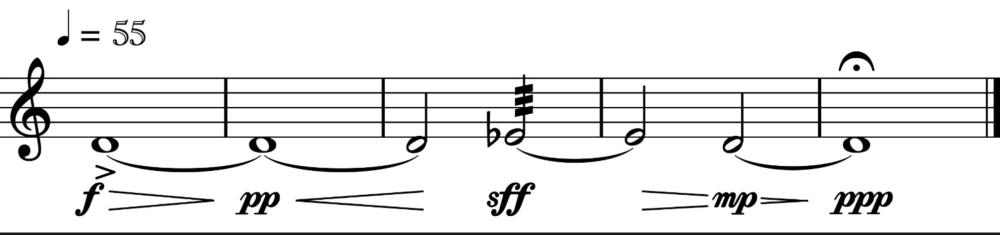
-
- 1
-

-
Piano Sonata no 3 / 3. Scherzo.Allegro vivace
Luis Hernández replied to Vasilis Michael's topic in Piano Music, Solo Keyboard
How did this go unnoticed? It's a really good piece, in a style that, to my mind, is like neoclassical. The writing is very refined. The recurring motifs give it a lot of coherence. -
Thanks, Mark! It's just a round with the W. E. B. Du Bois as a separate layer on top when you get right down to it, but that's certainly more organized than I usually am. Something I'm trying to be better about.
- Last week
-
.thumb.png.8b5b433a341551e913a34392660bc95b.png) That's not true Luis! We can post renditions, mock-ups and covers of other composers works here too, as long as we specify whose work we're covering!
That's not true Luis! We can post renditions, mock-ups and covers of other composers works here too, as long as we specify whose work we're covering! -
Piano Stream No. 5
WowBroThatWasReallyEdgy replied to luderart's topic in Piano Music, Solo Keyboard
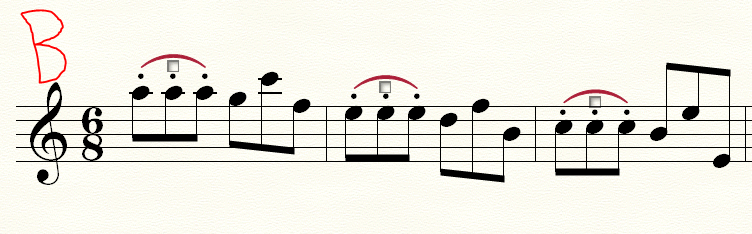
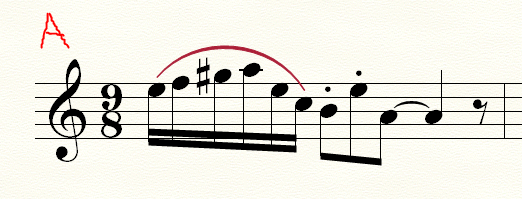
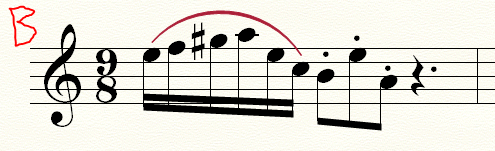
Hi luderart, I am approaching your music as a performer. If I were sitting at the piano and you handed me this, these are the questions and suggestions I would have: 1) The first thing that stands out to me is the metronome marking. You indicate the quarter note receives the beat at 140 beats per minute. Yet, your starting time signature is 6/8. You need to indicate what the dotted quarter note receives. 2) The writing is pianistic; I can play this and it fits in my hands well. However, adding fingerings, articulations, and music shapes would prove your technical intentions. Example A demonstrates a finger alternation technique. Chopin's Grand Waltz Brillante, Op. 18, is a good example of this technique. Example B tells me to use the same finger on the repeated notes. 3) Measure 14 is slightly confusing because of the way it's presented to me. The time signature is now 9/8 and I have a dotted quarter note on beat 6, not 7. You also have a staccato marking on the dotted quarter note. Did you want it to be short? Example A depicts the music as you've written it, but with a display in accordance with the meter of 9/8. Example B depicts the note on beat 6 as short. I hope my approach finds some consideration with you, Patrick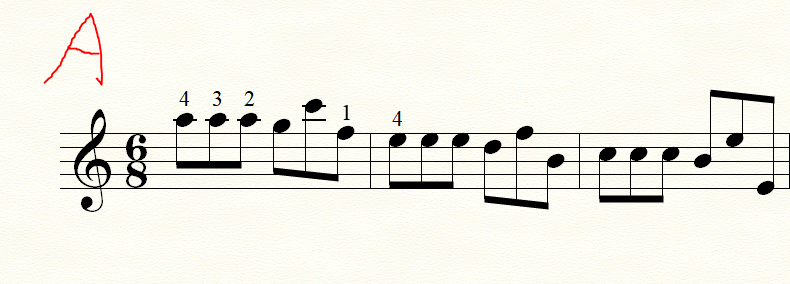
-
Nice song. But this subforum is intended for music composed by us...
-
Hello, I think it's a huge undertaking. In particular, it's very well structured and the themes develop and evolve smoothly and beautifully. To me, it sounds like late classical or early romantic music. The solo violin part isn't particularly complicated (virtuoso). There are some things that strike me as rather strange. For example, the tessitura where the timpani appears is excessively high, although it seems to sound where it should (so I gather it is a question of notation). Sometimes the horn acts as a “bass” in a very (too much, I think) deep tessitura... when you have other instruments available. The indication Qleg (quasi legato?) appears in many places where it makes no sense (with separate notes and staccato). There is a tendency (logical at certain stages of one's training in orchestration) to use strings predominantly. In moments with orchestral weight, I think the bass (double bass) needs to be doubled, as it is what the ear hears least. On the other hand, when parts are played where sections are separated (wind or strings), the counterpoints can be heard very well. Good work.
- 2 replies
-
- 1
-

-
- original compostion
- concerto
- (and 1 more)
-
Streets of London | Rendition No idea if this Rendition is Baroque, Adagio , or Chamber, either way it was Interesting. Streets of London Cover.mp3 https://youtu.be/DiWomXklfv8
-

Orchestration (Mendelssohn)
Kvothe replied to Luis Hernández's topic in Orchestral and Large Ensemble
Why hello there @Luis Hernández! I have listed, below, some things to help you: 1. It is more common for Horns to be notated in treble cleft these days. This will be help you a lot when you condense the horn parts: Two Treble lines for HR 1, 3 and HR 2, 4. 2. When you have parts are divi, you can use a2. 3. I see a dovetailing/over lapping. Just think logically where the rest should go. On the overall presentation: Great job. -
Orchestration (Mendelssohn)
Luis Hernández replied to Luis Hernández's topic in Orchestral and Large Ensemble
Thank you for listening and commenting. Yes, the high range always gives you pause with these instruments. In fact, in the original piece for piano, there are moments when the tessitura shoots much higher, but I had to think of other ways to express those exaltations. I don't get too complicated with the sound bank because, although I know my way around a DAW, my priority is not to make the sound perfect and realistic, but to write the music and make it sound decent. In other words, what I like is composing. So, what I use is the Dorico editing programme, where I write directly, and I leave the sounds to Noteperformer. Of course, I have taken care to equalise each and every instrument, apply a compressor to the final sound and make some panning and stereo adjustments (all of which can be done in Dorico itself). My own compositions... There will be loads of them on this forum. Some bad, some better. Given that I am an amateur and never stop learning. The thing is, right now I'm focused on learning to orchestrate better, rather than writing my own stuff. -
Orchestration (Mendelssohn)
Luis Hernández replied to Luis Hernández's topic in Orchestral and Large Ensemble
Thank you for listening and for your comments. Yes, the piano version is considerably faster. But when transferring it to an orchestra, or an ensemble like this one, if you don't reduce the tempo, it's difficult to appreciate what's happening. That's why, rather than a literal copy for orchestra, it's a reinterpretation. However, in some parts I had (and still have) doubts. More than because of the ranges and tessitura, but because of what each instrument can do, especially in the runs or fast passages. Best regards. -
Favorite Musical Book Quotes?
PeterthePapercomPoser replied to PeterthePapercomPoser's topic in Composers' Headquarters
A short musical quote from "The Occult" by Colin Wilson about Pythagoras incoming! And if you've gotten this far, thanks for reading! -
 Greetings @Wieland Handke! The response I was writing got lost when I tried to post it, which saddens me considering I went on a very long tirade about how Bach's music cannot conceivably be surpassed and how my admiration for his genius renders my own works insignificant in my view, but perhaps precisely for that same reason it's for the better that such a reply will never see the light of day. At times even I grow concerned by my absolute devotion towards Bach, so stating the obvious a thousand times with different words would only further make it seem like an unhealthy obsession. As for the canons in Die Kunst der Fuge, there are actually 4: Contrapunctus XII at the Octave - in Hypodiapason/alla Ottava, XIII at the Twelfth - alla Duodecima in contrapunto alla Quinta, XIV at the Tenth - alla Decima in contrapunto alla Terza (not to be confused with Contrapunctus XIX, the unfinished Fuga a 3 Soggetti, which is usually presented as Contrapunctus XIV in most of the modern versions that omit the canons) and XV in Augmentation and Inversion - per Augmentationem in Contrario Motu/al roverscio et per augmentationem. There is also one more, found in the Appendix of the Art of the Fugue and often relegated to obscurity in most editions for that very reason, as well as probably because the beginning of its theme until the entry of the 2nd voice is identical to that of Contrapunctus XV, and only then diverges: the canon in Hypodiatessaron al roverscio et per augmentationem perpetuus. As you can see, the format of the title itself had a far greater impact on my own canon's technical conceptualization than the music itself. And regarding the point you're making, I am rather inclined to agree. Shunske Sato arranged the Netherlands Bach Society's recording of the Art of the Fugue so that every couple movements, a chorale would be sung. Perhaps my own canons could serve as interludes instead of being the focal point of a given programme or concert cycle, though for such an outcome a far more monumental and extensive work would need to be composed first.
 -
making a second version soon!
-
A New Orchestral work about the Ocean | Feedback Wanted
MK_Piano replied to MK_Piano's topic in Orchestral and Large Ensemble
Thanks for the comment. If you read the "About" section on page 4 of the score, you will find the construction behind the piece and who/ what I sourced for its creation. I did use the orchestration and outline of the second theme from the Sea Hawk Overture as I fell in love with Korngold's music. After spending time studying the Sea Hawk, I knew I wanted to pay homage to his work in my own way. I have no reservations about doing so as it is a not a direct quote, instead using different harmony and melodic skeleton; and to me, only realizes the sounds and feelings I personally heard and felt in my own head. Outside of that one instance, everything else on the score has come from me and has not been quoted from anywhere else. Thanks again for the feedback and you are right, I do reallllyyy love the romantic era lol
.thumb.png.1e2763f479362bbb522da50d31ef2e50.png)