All Activity
Past hour
-
I really liked it. The beginning at least sounds a bit like the music from the Zelda video game series. Thanks for sharing… definately keep making music like this. I’ll be coming to listen!
-
@CrystalCanon I think the current landscape of academic music is complicated. On the one hand, the few major venues that remain play it safe and, yes, every now and then, they programme something from the 20th century. Contemporary composers are rarely programmed, and often these are commissions that result in a premiere and little else, with a few exceptions. Ideally, more opportunities should be given to this contemporary music. Another issue concerns composers who build their careers within a closed environment such as music academies or conservatoires, where they have access to musicians to perform their works. As for the idea of learning from all sources and styles, that’s only logical. But it strikes me that many people have little or no interest in listening to, let alone learning how, other styles work. What strikes me even more are those who, when writing music, limit themselves to imitating very specific periods, whilst showing no interest in anything else. And I also agree with your final point. Each person’s preferences influence their objective compositional style. I, for example, thoroughly enjoy the Baroque, the style galant and Romanticism, though I’m less keen on Classicism. And I’ve studied everything from the Renaissance right through to rotational matrices… Yet my preference is for the modern language of music, from Impressionism onwards. In order to start doing something in that vein, I’ve had to spend a long time learning (with great pleasure) about tonal music, and I still enjoy it to this day.
Today
-
Thank you all for your feedback, and sorry for my slow response! @maestrowick! Thank you so much for taking the time to give such detailed feedback! There’s a lot here for me to think about. I’m glad you think the piece has enough potential to expand further. I originally set out specifically to write something short and relatively simple, so rather than expanding this particular movement into a 10-minute piece, I’ve been thinking it might be interesting to make it part of a suite of several short movements in a similar style. I could keep this movement relatively intimate with flute, harp, and strings, while the additional movements gradually make use of the full orchestra and explore different colors and ideas. That would let me keep the compact character I was aiming for here while still developing the overall concept into something more substantial. Your harp comments are especially helpful. Harp is one of the instruments I’m least familiar with writing for idiomatically, so the explanation about automatically changing hands within the octave figures is exactly the kind of thing I was hoping to learn. I’ll go back through those passages and rethink the beaming and hand distribution, and I like the idea of expanding some of the runs upward into a different register as well. I appreciate the clarinet suggestion too, and I can definitely see how that could open up some interesting harmonic and contrapuntal possibilities. For this piece, though, I think I’d prefer to keep the flute as the only wind instrument. I like the simplicity of having one clearly defined solo voice against the harp and strings, and I think that contrast is part of the character I’m aiming for. And I hadn’t considered alto flute at all! That could be a really interesting alternate version, especially given the atmosphere I was going for. I’ll also go through the specific flute phrasing and notation comments you mentioned. Thanks again — this gives me a lot to experiment with, both in revising this piece and in future writing. @Luis Hernández Thank you! I’m glad you enjoyed the relative simplicity of the piece — that was something I was intentionally trying to preserve. I appreciate the suggestion about violin harmonics. I can definitely see how they could reinforce the ethereal quality, although I think for this piece I prefer the warmer, more direct sound of the strings as written. I wanted the atmosphere to come more from the harmony, register, and texture rather than from extended or more distinctive string colors. @PeterthePapercomPoser Thank you! I’m glad the floating quality came across — that was very much the atmosphere I was trying to create, and I was particularly concerned with keeping the rhythmic motion from feeling too repetitive or mechanical. And yes, writing for the smaller ensemble was a deliberate exercise for me. I usually find myself wanting to add more instruments and colors, so part of the challenge here was seeing how much I could do with a very limited palette. Thanks again everyone for listening and providing feedback!
-
But you're not implying that composers should imitate all the classical, romantic, and 20th century composers that are getting into programs, right? I don't know--I'm not discouraging eclecticism in any way, but I'm a bit wary of composers imitating other composers simply because they are the ones currently being programmed. Popularity is often a good signal to dig into examine someone's work more closely, examine it's "why". But I think it also pays off to be honest about the music you really like, what inspires you on an intuitive and visceral level. Sometimes it just isn't worth compromising. Agreed--you often don't know what works for you and what doesn't unless you try. The music one listens to can be different from the composers that actually influence your creative processes. You can't develop any kind of original style without all the practical work of trying out many different things (and accumulating many failed sketches in the process!) I think the personality of the composer also has a lot to do with that, besides just the professional/amateur divide. Or maybe those who feel the need to define their singular "personal voice" are also those more likely to commit to a head-on, professional career. But I think both approaches can be quite respectable.
-
Thank you, CrystalCanon, for your feedback. It was one of the more specific and insightful reviews I've received, a couple of your points overlapped with one of my other reviews (from a friend of mine that specializes in string performance). I think the best course of action for me would be to scale things down and work on some fundamentals before scaling back up to sonatas and larger ensembles. As for the 6/8, I can think of counterexamples from both Brahms and Mozart; what you said about it may still be a point to consider as a guideline, however.
-
-
Some recordings I've been into recently, diverse genres: James Francies - Purest Form Tigran Hamasyan: A Musical Portrait Jacob Collier: A Musical Portrait Toru Takemitsu - Orchestral Works Messiaen - Poemes pour Mi Rouvali Conducts Sibelius
-
A short study for string quartet composed by the sea this morning Regards, Marc 01 - Conducteur - Etude pour quatuor à cordes n°8.pdf Etude pour quatuor à cordes n°8.mp3
-
(Originally written for my Substack - welcome to follow me there: https://substack.com/@markoloco95) It is not often I stumble upon music by Johann Sebastian Bach that I had not heard before - especially among his cantatas that I have grown to obsess over. Then came Zerreißet, zersprenget, zertrümmert die Gruft (BWV, 205), a lavishly scored ‘secular’ cantata with the the full might of the baroque orchestra, including three trumpets, timpani, two horns that in the opening chorus come together in such a way that resembles the festive character of his better known celebratory oratorios (his Easter and Christmas Oratorios & the Magnificat in D). My interest soon extended beyond its aesthetic appeal, however. Quite often I read the accompanying commentary to these cantatas to better understand what Bach was depicting exactly, made all the more necessary as a non-German speaker experiencing this music outside of its historical context and ~300 years later (Bach wrote BWV 205 during August 1725). Little did I know that this reading about BWV 205 would lead me down a significant rabbit hole that I now have the pleasure of sharing. The ‘profane’ cantatas Bach himself made no explicit effort to create a systematic taxonomy of his cantatas between the sacred and the secular; this was more a posthumous scholarly construction (his son, CPE Bach, was among the first to do so). Interestingly, the term ‘profane’, I learned, has traditionally been applied to his secular cantatas. A contemporaneous reading of that word may imply something that is anti-religious, blasphemous or morally corrupt - this was indeed my initial impression! Rather, ‘Profane’ comes from the Latin ‘pro fanum’, which originally designated what is ‘outside the temple’ - or outside liturgical or sacred use (Charlton, 1897). Its usage to classify his secular cantatas seems to have emerged only from 1885 - in French criticism - by one René de Récy, who states in his ‘Jean-Sébastien Bach et ses Derniers Biographes’ “une autre composition du maître, celle-là toute profane” (p 415) (another composition by the master, this one entirely profane.) The French Dictionary defines profane as “l'art profane et l'art sacré” (“secular art and sacred art”), and we have no reason to doubt that its usage in French musicological expression principally meant ‘non-liturgical’. Nonetheless, the semantics of the word remains problematic considering its historically recognized extended meaning, stated in the first edition of Dictionnaire de l’Académie française (1694): C'est une action profane & impie" (It is a profane and impious action) While it may seem that I am venturing into unnecessary abstraction, this is important context. The libretto by Picander for BWV 205 is inspired by Greek mythology. How could Bach - whose art has come to embody the pinnacle of divine Christian expression in music- also write music inspired by paganism particularly with the same quality of musical-rhetorical devices that underpin the former? On the use of classical mythology It is true that early Christian writers exercised hostility to worship of pagan deities, maintaining that practice as a falsehood. This extended to use of violence to subdue paganism in parts of Europe (the Northern Crusades, for example). Yet a remarkable amount of pagan culture was preserved through art, often explicitly since the Renaissance. At face value this is contradictory, but can be rationalised. The fact is that many of the christian clerics shaming the pagan cults from antiquity were often themselves inspired by the very writers whose works were imbued with a pagan spirit. The intellectual influence of writers such as Homer, Plato, Virgil, Cicero & Ovid, for example, on Christian Europe remained significant. The answer to this conflict was eventually through the secularisation of the Greco-Roman religions, whose deities came to represent literary figures, allegories and rhetorical symbols. By Bach's time, Christianity had already long appropriated ancient culture as an acceptable and educated symbolic vocabulary for artists to deploy in their craft. History and Text of BWV 205 The cantata was commissioned by the students of Leipzig University in tribute to August Friedrich Müller, a lecturer in philosophy and law at the university. It was apparently performed outdoors near Müller’s house in the Katharinenstraße - many magnificent townhouses were built in the baroque style during the early 18th century on Katharinenstraße and regarded as the most magnificent street in Leipzig. Café Zimmermann on the Katharinenstraße where many of Bach’s secular cantatas were first performed Picander’s libretto depicts a mythological clash centred on Aeolus, the Greek ruler of the winds, and his seasonal release of autumnal storms. He takes the storm episode from Book 1 of Virgil’s Aeneid, in which Juno, wishing to prevent Aeneas from reaching Itality, travels to Aeolia and asks Aeolus to release the winds against the Trojan fleet. In the book, Virgil describes Aeolus as a sovereign ruler who keeps the winds imprisoned inside a vast cavern in Thrace, struggling against their chains and reverberating the mountain. He retains their passions and rage and without his governance, the world would be swept away (Packowski, 2007). The libretto of the opening ‘Chorus of Winds’, with English translation: Zerreißet, zersprenget, zertrümmert die Gruft, Tear up, burst apart, smash to pieces the cave Die unserm Wüten Grenze gibt! that sets limits to our rage! Durchbrechet die Luft, Break through the air Dass selber die Sonne zur Finsternis werde, so that the sun itself may turn to darkness Durchschneidet die Fluten, durchwühlet die Erde, cut through the tides, rage through the earth, Dass sich der Himmel selbst betrübt! so that even heaven is distressed. Aeolus, a Greek god of the wind How Bach Depicts the Winds in the Opening Chorus (Chorus of the Winds) Bach makes extensive use of contrary motion - instrumental lines moving in opposing directions - in the opening chorus. From bar 5, for example: From Bar 5 (violins & viola): 2nd violin and viola descending in thirds against the rising first violin part From bar 16: (flutes and oboes): contrary motion again emphasized, with wind parts moving in opposing directions. From bar 20: more elaborate example imitative counterpoint in the minor, dominated by contrary-motion scalar figuration: the bass, strings, oboes and flutes each play their own contribution to the counterpoint in unison. The effect is a flurry of independent and contrasting motifs, much like the motion of a violent storm. Some 'word painting' highlights The passage contains remarkable word painting, in which the ‘Zerreißet’ (English: tear up) is presented as though torn to pieces through fragmented imitation with staggered entries. Its three syllables are separated into short attacks, interrupted by rests (depicting the winds as scattered and violent) before consolidating into a cadential block. It is also interesting to see the cadence on ‘Gruft’ (denoting the prison or cavern) is set in longer, more stable notes. From Bar 29: ‘Zerreißet’ (tear up) before consolidating into a cadential block Starting with “Durchbrechet die Luft” (“break through the air”), the B section immediately provides a contrast to the earlier fragmented assaults of “Zerreißet”. Here, Bach gives way to a homorhythmic pattern as though perhaps the dispersed winds have now combined into a single current, before descending to a cadence in F minor as the sun turns to darkness. From bar 85: Durchbrechet die Luft, Dass selber die Sonne zur Finsternis werde, (Break through the air so that the sun itself may turn to darkness My final highlight From Bar 102: “Durchschneidet die Fluten, durchwühlet die Erde, Dass sich der Himmel selbst betrübt!” (cut through the tides, rage through the earth, so that even heaven is distressed.) Look at how how Bach treats "Himmel selbst betrübt" ("Heaven is distressed") , here. Bach prepares a cadence in b minor, but on "-trübt" he abruptly shifts to the dominant (f sharp minor). Notably his vocal writing suddenly shifts to a perpetual type of motion, while the continuo retains the rapid scalar motion that maintains the image of turbulent wind. The passage finally closes with an end to the B section in the key of F sharp minor. Together, this f# minor passage is evocative of a mighty storm that gives way to cadential consolidation. And contrasted with the restorative de capo (return to A section) that follows, Bach juxtaposes - almost theatrically - the cosmic consequence of the destructive power of the wind where even the heavens are plunged into distress, and with their original demand to "tear, burst and smash" the cavern containing the winds. Closing remarks From hearing this work for the first time last month, this has evidently become quite a rabbit hole. Notwithstanding Bach's sheer genius in his use of musical rhetoric to depict these classical myths, what's perhaps more interesting his that this rhetoric closely resembles that which he applied in his sacred cantatas. It demonstrates his ability - and indeed willingness and adaptability - to transfer musical-rhetorical techniques between both sacred and secular contexts. Being less familiar with his secular cantatas, for me this has added a new dimension to Bach and which deserves much more exploration. Indeed, it appears that his secular cantatas have received relatively less analytical attention from Bach scholarship, which I suspect has historically been drawn more strongly to the theological and devotional significance of his sacred works. Sources Académie française. (1694). Le dictionnaire de l’académie françoise. Paris, Vve de J.B. Coignard. Internet Archive. https://archive.org/details/bub_gb_VEw4AQAAMAAJ Charlton, L. (1879). A latin dictionary Lewis and short. Internet Archive. https://archive.org/details/in.ernet.dli.2015.147309/page/n1459/mode/2up For "Profanes", see Page 1459 Paczkowski, S. (2007). A Polonaise Duet for a Professor, a King and a Merchant: on Cantatas BWV 205, 205a, 216 and 216a by Johann Sebastian Bach. https://www.bachnetwork.org/ub2/paczkowski.pdf Récy, R. de. (1885). JEAN-SEBASTIEN BACH ET SES DERNIERS BIOGRAPHES. Wikisource. https://fr.wikisource.org/wiki/Jean-Sébastien_Bach_et_ses_derniers_biographes
-
Hi everyone, I’m currently in the planning and sketching phase of an art song cycle, my first song cycle yet, for baritone and piano. I’m expecting it will take me around six months to complete. The cycle explores themes of distance, obsession, and the inadequacy of symbols when attempting to reach an absent Other. I’m going to be writing in a post-impressionist vein, with a tonal system of my own devising. I’m planning to coordinate pitch collections and tonal centers with symbolic themes and emotional atmosphere, kind of reminiscent of Wagner’s leitmotifs but subtler. The poems/poets I've selected are a diverse group, ranging across various genres, nationalities, and time periods, but I tried to find some organic coherence among them. Do you have any advice about writing art songs/cycles? For instance, do you typically write the vocal line and accompaniment together, or do you write the vocal line first, perhaps with a bass line under? I know the harmony can’t be totally ignored at any stage of the process! Any recommendations? I’ll take anything I can learn! Song Cycle Texts.pdf
-
I listened to your piece and I admire your stamina and commitment in writing such a lengthy movement! However, I don't feel that its length is completely earned. A sonata form of 420 bars needs a really strong main idea if it's to retain the listener's attention and interest. Your folksy melody was pleasant, but if it were up to me, my first thought wouldn't have been to expand it into a large sonata-allegro form. I also noted a sort of meandering quality to your lines that came from long phrases without a clear beginning or end. I think it's typically a good idea to write for string instruments in a similar way as one might write for voices or winds. Of course, strings have unique capabilities, but both the musicians and listeners will appreciate giving them space to "breathe." Chamber music especially, regardless of the musical language, is most naturally structured like a conversation. I am also not sure that pandiatonicism is a good fit for sonata form without extra structural support. It's one of my preferred harmonic palettes, but without the "directionality" of functional tonality—or a rigorous approach to motives and pitch-class sets—it has the potential to sound a bit aimless. Since sonata form is essentially a teleological (goal-oriented) narrative, that directionality needs to be provided through other means, such as striking pitch contours, rhythmic drive, or strong motivic contrasts. As for the meter, I typically wouldn’t write a sonata form in 6/8, because of its lighter “dance” associations. But I’m sure it’s been done. So all things considered, I would advise you to pursue greater concision in your presentation of ideas and find ways to articulate the structure of your piece more clearly on multiple levels. I am curious about what your creative process was for the movement: did you begin by planning the sections at a high level, or did you work mostly from beginning to end as you went? It's all part of the process of finding your own voice. We're all in it with you! Good luck with your composing, and I'm eager to see where your creativity takes you!
-
Hello @TristanTheTristan! So, you’ve fixed the clipping issue, right? If so—yes, it certainly seems to be resolved, and the sound is so good! The absence of clipping really gives it a sense of polish and attention to detail. By the way, upon listening to it again, I felt that the pizzicato sound starting around the 3:10 mark could use a little adjustment. It sounds a bit unnatural to me as it is; what do you think? Perhaps one shouldn't expect perfection from playback, but I think it’s worth a quick fix when you have some spare time :) This is a great work! Best, Lithl.
-
Ah, I understand perfectly. It’s a ‘cultural’ issue. I strongly associate this sort of piece with the Romantic style, and back then, counterpoint was still very much the order of the day. There’s one thing I learnt a long time ago. If you introduce a change like that in this sort of context, unless it’s done repeatedly (to the point where it’s perceived as ‘normal’), the listener might interpret it as a ‘mistake’.
-
I wrote this piece a while ago, I'm not quite sure why I haven't posted it yet, as I believe it is my best choral work so far. This is a dark piece in the latin liturgy, and I wanted to use it to imitate some late-renaissance styles, without really adhering the the rules strictly. I aimed towards a Gesualdo like harmonic progression, and in doing so I broke ALOT of renaissance writing rules. But the texture is interesting nonetheless. Let me know what you think! Aestimatus sum cum Descendentibus in lacum. Factus sum sicut homo sine adjutorio, Inter mortuos liber. Posuerunt me in lacu inferiori, In tenebrosis et in umbra mortis. Factus sum sicut homo sine adjutorio, Inter mortuos liber. Translation: I am counted among those Who descend to the depths. I became like a man without help, Released among the dead. They have laid me in the lowest pit, In darkness and in the shadow of death. I became like a man without help, Released among the dead. Aestimatus.mp3 Aestimatus.pdf
-
Very nice although i do prefer the Original 1959 version too.
-
PeterthePapercomPoser replied to PeterthePapercomPoser's topic in Music Appreciation: Suggest Works or ArticlesThe Mummy OST by Jerry Goldsmith - Imhotep:
Yesterday
-
-
Hello @Alex Weidmann, Congratulations on this fantastic-sounding orchestration of this beautiful piano piece! Even though I’m more familiar with pieces for solo piano and am just at the beginning of my “orchestration career,” I have to admit that the orchestrated version is calmer and gentler than the piano original, where the difficulty of the piece remains perceivable, even in a professional recording. Having an entire orchestra „at its disposal“ gives the chance to create seamless transitions between the various passages and moods from one instrument to another, and – as I’m now also experimenting with orchestration examples, I’m always astonished how well the different instruments blend together, even though they have such distinct timbres on their own. This is a very interesting topic. Having arpeggios in a piano piece tempts one to utilize the harp for that passages. But as Luis demonstrated in his fantastic example, this can be achieved in a more natural way for the orchestra by distributing the arpeggio among several different instruments. However, the „arpeggios“ in this Elegy are real slow (in eight notes), somewhat more in a kind of „broken chords“ which are even written out in full in the original piano score. But what to do if arpeggios in the piano piece are “faster”—that is, block chords preceded by the arpeggio symbol, played the way a harpsichordist would (i.e., with a gap of 32nd or even 64th notes between each note of the chord)? I struggled with that problem in my own orchestration example, in which I tried to achieve the arpeggiated piano texture by distributing it among pizzicato strings, sometimes percussions (vibraphone and glockenspiel), while also retaining much of the original piano notes for the harp. In a „second layer“, the voice leading was then „doubled“ by the remaining „singing“ instruments (woodwinds, brass and some violins). Concerning the usability of the key of E-flat minor for an orchestra, there have been interesting discussions in this thread (and also here in@danishali903 ‘s Nocturne No. 1 in E Flat Minor by Gabriel Fauré (Orchestrated) https://www.youngcomposers.com/t50225/nocturne-no-1-in-e-flat-minor-by-gabriel-faur%C3%A9-orchestrated/ ). The arguments that transposing the piece could make it more playable—for example, for string instruments—cannot be dismissed out of hand. However, as long as there is no actual performance, I would hesitate to transpose the piece to D minor or even E minor. Although there are no longer any physical characteristics distinguishing the various keys since the introduction of the equal-temperament system we use today, there is nevertheless a strong historical and psychological connection between certain moods and their respective keys, a connection that has been “followed” and repeated by numerous composers over the past few centuries, especially in the romantic era. One can even go back to Bach’s Welltempered Clavier where we have the wonderful E-flat minor prelude (in the first book) which is a perfect example for the mood of a „Nocturne“ or „Elegy“, whereas the pieces in E minor are much more „harsh“ and therefore bear the absolute contrasting characteristics. Wieland
-
PeterthePapercomPoser replied to UncleRed99's topic in Incomplete Works; Writer's Block and SuggestionsI just hope you don't use triplets as a crutch. I think beginning composers often struggle with writing good melodies that don't sound like just noodling up and down in a certain scale/key and introducing triplets or other novel rhythms is a crutch that many use to try and create melodic interest and imo it doesn't really work. Nothing can substitute for a good idea of where a melody is going and having a good form/structure.
-
I have noticed that I love me a good set of triplets. Breaks from the steady 1-2-3-4, or 1-&-2-&-3-&-4-& rhythms that you get in the common X/4 time signatures, without deviating from the familiarity of it. Can't help myself. xD I also noticed that I tend to use add9 and 2 chords quite often, both in major and minor. with the occasional major 7th sprinkled in for good taste. I'm going to try and compare my scores, one of these days, to find out what my ear does when I'm composing, because I tend to just follow through with writing what feels right, while stopping to make educated inferences on what would be most effective moving forward, before reverting back to letting my ear lead the composition again, while the cycle repeats until the end of the score. I 'spose I have some reflection to do xD
-
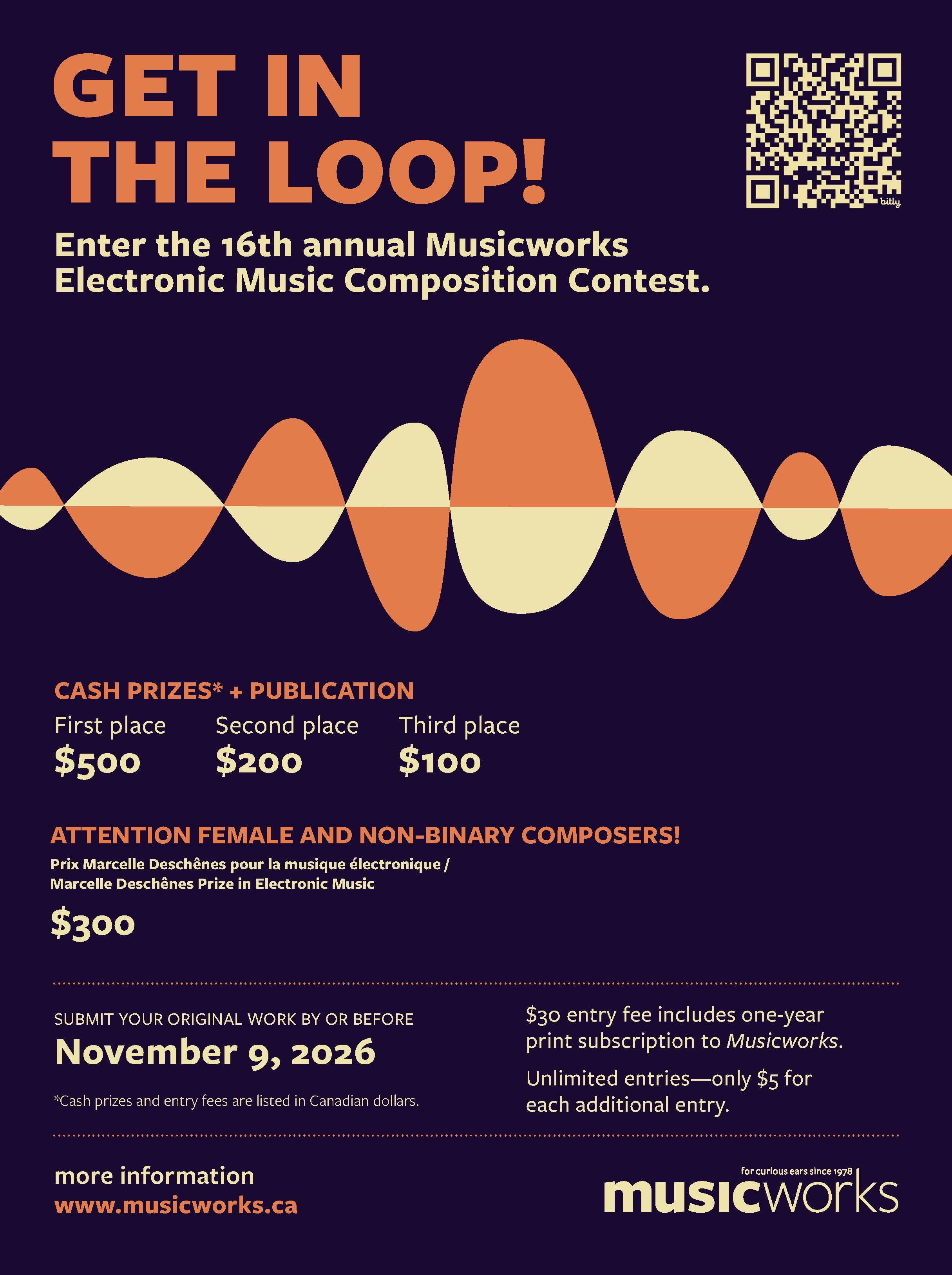
The sixteenth Musicworks Electronic Music Composition Contest is now open. Our annual juried contest spotlights new musical talent from around the world, offering four cash prizes and opportunities to be heard and published. In 2025, we received 127 submissions from 17 countries, including Canada, the U.S. and U.K., Italy, France, Japan, and others. First prize: $500, a composer profile in Musicworks in 2027, and the composition released on the accompanying Musicworks CD. Second prize: $200 and composer coverage on musicworks.ca in 2027. Third prize: $100 and composer coverage on musicworks.ca in 2027. Marcelle Deschênes Prize in Electronic Music / prix Marcelle Deschênes pour la musique électronique: $300 and a composer profile in 2027. This prize is open to entrants who self-identify as female or non-binary. Learn about the prize HERE. *Cash prizes and entry fees are listed in Canadian dollars. REQUIREMENTS Compose and submit an experimental piece in any electronic-music genre—acousmatic, electroacoustic, glitch, soundscape, intelligent dance music (IDM), turntable art, or video music. The contest is open to entries from anywhere in the world and from artists at any stage of their careers. Pieces must be previously unpublished (i.e. not released on a commercially available recording at the time of submission). Maximum length: 10 minutes. Accepted file types: MP3 or MP4 only. Contest entry fee: $30 CAD. Unlimited additional entries are $5 CAD each. All entrants receive a one-year print subscription to Musicworks ($44–$59 value). Contest closes November 9, 2026 Prize details, eligibility, assessment criteria, rules and restrictions, and the entry portal can be found HERE. Previous Electronic Music Composition Contest First-place Winners 2025 Panayiotis Kokoras (Greece/U.S.) 2024 Rocio Cano Valino (France/Argentina) 2023 Ningxin Zhang (China/USA) 2022 Leah Reid (U.S.A) 2021 Mariana Vieira (Portugal) 2020 Rocio Cano Valino (Argentina/France) 2019 Alex Buck (Brazil / California) 2018 Manuella Blackburn (Manchester, U.K.) 2017 Erik Ingalls (Windsor, Ontario) 2016 Craig Aalders (Vancouver, British Columbia) 2015 Juan Camilo Vásquez (Bogotá, Colombia) 2014 James O’Callaghan (Montreal, Quebec) 2013 Margaret Noble (San Diego, California) 2012 Bennett Jenisch (Los Angeles, California) 2011 Ian Battenfield Headley (NYC)
-
-
-
@Luis Hernández Thank you so much for listening and for the feedback! Totally get where you're coming from! While writing these, I kept trying to maintain fairly strict counterpoint, but I found that when both voices became too active, the music started losing some of the calmness I wanted from a lullaby. So in several places I made the second voice more of a harmonic support rather than an equally independent contrapuntal voice. I also found that stepwise motion was really important for the sense of calmness I was going for. So sometimes i prioritized that over strict counterpoint, which led to some of the parallels you noticed. I probably could have found a better balance between the two! And again thanks so much for listening!
-
If you limit yourself to one style, you might restrict yourself, and make it harder for modern audiences to enjoy your work. The modern audience today still attends orchestral concerts. But the programs that orchestras schedule are mix from classical, romantic, and 20th century composers...and some times music from other media.






.thumb.png.8b5b433a341551e913a34392660bc95b.png)