All Activity
Past hour
-
Hi everyone, I’m developing a new music notation and composition platform and I’m looking for composers who would be willing to test it and give practical feedback. The main idea is to combine simplified text-based editing with a traditional graphical score, so that editing rhythms, notes, voices or larger passages can be faster without constantly switching between many graphical tools. The platform is still in testing, but it already focuses on things like: real-time collaborative score editing; text-based editing with graphical rendering; importing MusicXML, MXL, LilyPond, ABC, MEI and MuseScore XML; sharing scores through read-only or editable invitation links; multi-voice and larger-score editing; optional AI-assisted tools. I’m especially interested in real composer workflows rather than general impressions: orchestral writing, chamber music, piano, choral music, film scoring, unusual notation, complex rhythms, large scores, etc. If you test it, I’d be particularly interested in knowing: what notation software you currently use; what takes too many clicks or too much time; what tends to break when editing an existing score; what you wish notation software handled differently. Early testers will also get access to some beta features before their wider release. If this sounds relevant to your workflow, feel free to reply or message me.
-
Austin1 joined the community
-
Hello @latebeethoven_addict, congratulations for your submission just before the deadline – and, yes you’ve accomplished it in time! Melodies Themes Motives and Harmony Chords Textures: The piece is full of different themes of motives, some of them more „melodic“, while others seem to be a more virtuosic accopaniment. That strength is, in my opinion, also the weakness, since in the combination it results in a huge variety of the texture with a slightly tendency to „randomness“. With that in mind, the section between mm. 24 and 55 is the strongest part of the piece, for the memorable recurrence of the „sung“ melody. Form Development Structure Time: You mentioned, that the piece is in a („loose“) A-B-A form. I suppose, the boundaries of those three sections are at the moment of the key signature changes, at mm. 60 and 100. However, I must admit that I didn’t perceive the third section as a kind of „recapitulation“ of the first one, and even the three sections consist themselves of several passages with quite different textures. Overall, after listening three times, the form seems to me a more „free“ one. Originality Creativity: The piece is original and unique among the submissions for its instrumentation and perhaps for its „virtuosity“, especially in the harp-like piano runs. Score Presentation: The first thing I noticed was the order of the instruments in your score. In a trio with piano as the keyboard or continuo instrument, it would be placed at the bottom of the score, whereas the other instruments are ordered according to their register/pitch, meaning the violin on top and the French horn in the middle. Here is an example of a „traditional score“ of Brahms’ Horn Trio. As another „nitpick“, there is a redundant key signature in mm. 95. Instrumentation Orchestration Playability: The choice of that particular three instruments gives the piece a variety of colors which I really liked (and which could not be achieved, for example, with a strings-only trio). Concerning the playability, you mentioned yourself that the horn part is challenging. I think, this is the case for the piano part, too. Execution of Given Challenge: You have chosen the three stanzas of the poem and expressed their different moods, „the summer day“, „the nature of love“ and „the evening wind“, during the three sections (ABA) of the piece. The „cantabile“ passage from mm. 24-55 could be interpreted as „the sung poem“, in a duet between the piano’s treble voice and the violin. Therefore, I can see a strong connection between your piece and the challenge of the contest. Taste: It is a pleasant piece to listen to, but unfortunately it does not captivate me all that much, perhaps due to the somewhat overboarding variety in texture. Melodies Themes Motives Harmony Chords Textures Form Development Structure Time Originality Creativity Score Presentation Instrumentation Orchestration Playability Execution of Given Challenge Taste 7.5 7 7 8 7.5 8.5 9 7.5 Average Score: 7.75
Today
-
This composition originally started out with the intended goal of serving as an exercise in textual intelligibility, a skill which has often been found lacking in many of my previous vocal works and choral writing. As such, this one has turned out far more homophonic in style than the rest of my earlier production, since in seeking to keep the text as clear and understandable as possible, distinct contrapuntal possibilities were rendered moderate to negligible. The reason I originally sought to approach the text from this angle throughout had a lot to do with the reasons for its choice. As of now, I have submitted one of my newly composed pieces to an ongoing composition contest centered around vocal sacred music. While I cannot give away many details concerning this competition as of now, in accordance to its rules I cannot yet publish the work I submitted (lest I might end up disqualified for early publication, given that, to my understanding at least, submitted works are to remain unpublished until the jury has decided). Instead, now that the submission had been fully dealt with, I set out to finish this early alternative, which I had deemed far too bland for the requirements and expectations of the contest before it was even complete. Also, for the first time now I have switched from my usual vocal renderings using Cantāmus to a different software integrated directly into MuseScore 4 named Cantai, which procedurally renders the text to be sung locally allowing for modifications in real time. After trying it for a few weeks now I thought an upgrade in sound quality to my renditions was finally in order. YouTube video link: https://youtu.be/pirPFlcrmSc Gustate et videte Communion Chant in G major.mp3 Gustate et videte Communion Chant in G major.pdf
-
Hello, I tried playing with the sheet music and I'm not sure if your recording is the same as the sheets. It definitely deviates after the repeat. Personally, I find measure 13-16 too repetitive. I think I get what you are going for, with the building of the tension, but it just doesn't good (to me). My ears want to have some variation. Also I think the notation does not match what the mp3 is playing here. I like the mp3 better than the notation. It gets really weird at 0:59 in the recording. I guess it all depends on the direction you want to take the piece in. Whenever I get stuck, I try things like: 1) Doing the same thing in a minor key 2) throwing in a key change 3) reversing the theme, so it sounds completely different 4) depending on the piece, I sometimes like to take tidbits from the theme and make a new theme. For one of my pieces which had a passage that was 8 bars long, I just took the first note of each passage, which created a new musical idea consisting of 8 notes. So that was fun and worked well. 5) Give the left hand something interesting to do, perhaps move the theme there, or change the accompaniment. I always try to understand my music. Maybe this sounds kinda weird, since I'm also writing it... but I don't assume that I understand the music that I am writing. I figure that if I truly understand my music then I can understand where the music will naturally go. I realize that this advice is not very tangible but this is the most honest answer for what I do when I feel stuck. I'm sure some of the more classically inclined musicians in this forums can give you some other ideas...the possibilities are literally endless. Hope you find some inspiration.
-
Finished it! https://www.youngcomposers.com/t50554/donc-ce-sera-par-un-clair-jour-d%C3%A9t%C3%A9/
-
This piece was written for the 2026 Summer Competition. It is technically past midnight on my side, I apologise as the audio took a while, hope this can still be reviewed. Note: I named this piece directly after the poem, maybe because it's the best name I could give it, actually. It's meant to directly translate the poem into music, so I figured that would be apt for a piece such as this. It's written in a loose ternary form with a few motifs consistently coming back throughout. Each section (ABA) represents a stanza in the poem. The first section opens with a bright, jubilant depiction of a summer day, before transitioning to the beauty of the subject. Then, the middle section adds some turbulence to this nature of the love, a personal interpretation of mine on the poem. Finally, the return of the A theme is accompanied by fleeting runs like the evening wind, as the lovers gaze into the sky. Most of the rest I will leave to your interpretation of what is happening, but I do encourage physically reading the poem while listening to the piece. As for the instrumentation, the French Horn is an instrument dear to me, despite having only picked it up for slightly less than three years. Through all the technical difficulties of this piece (yes, the Horn part is playable, albeit challenging), I wanted to showcase the mellow, melodic sound of the horn as something unique. The choice of the violin, then, was nothing special, another melodic instrument to complete the lovers' dialogue portrayed thoroughout the piece. The piano, then, allows for all the word painting possibilities. It was quite a rushed piece, given my recent schedule, but I enjoyed the time spent just appreciating the loveliness of the poem. Enjoy listening! Donc, ce sera par un clair jour d'été.mp3 Donc, ce sera par un clair jour d'été.pdf
-
Melodies Themes Motives Harmony Chords Textures Form Development Structure Time Originality Creativity Score Presentation Instrumentation Orchestration Playability Execution of Given Challenge Taste 10 8 10 7.5 8.5 9 7 8.5 Avg: 8.56 Nice romantic harmony paired with a gorgeous theme makes this a very clear and easy to follow piece. Variations of your themes are also very cool, and your key changing keeps this piece from feeling too repetitive. I definitely hear your Tchaikovsky influence, but around 3:30 I actually think I hear some Mendelssohn influence as well, maybe you didn't even realize it. Be careful though with balancing the piano parts of your melody, they were definitely too weak in velocity especially compared to your strings. But that's just an audio issue. As far as the execution of the challenge, this one is tough for me because it does remind me of romance between a man and a woman (or some type of heartbreak), but the story you are portraying here is so romantic-heavy, I forget about the summer part. But that might just me! Despite that, this is a beautiful and heartfelt piece.
-
Melodies Themes Motives Harmony Chords Textures Form Development Structure Time Originality Creativity Score Presentation Instrumentation Orchestration Playability Execution of Given Challenge Taste 6 6.5 7 9.5 7 8 8.5 7 Avg: 7.4 I think you chose very difficult instrumentation. Your harmony is simple, but yet, tricky. I say this because your instrumentation makes it a bit hard to decipher sometimes (for me), but I do hear your key changing as I listen through. Your piece also appears to get more dense and complex as it moves on. I think your melody and instrumentation are doing a pretty good job in portraying a serene summer afternoon, especially towards the beginning. It almost reminds me of being on an island. I marked you high on creativity because this is an interesting piece in terms of instrumentation, and your overall theme and structure. I also feel like a lot of moods and emotions are going on here which may confuse the listener as to what the goal of the piece may be. If I had to summarize the piece, it goes from serene summer afternoon, and ends with a high energy midnight dance on an island perhaps. With regards to your audio, be careful with tearing. Be sure you normalize your audio output so that your loudest parts do not red-line.
-
-
Melodies Themes Motives Harmony Chords Textures Form Development Structure Time Originality Creativity Score Presentation Instrumentation Orchestration Playability Execution of Given Challenge Taste 8.5 4 9 7 7.5 9 10 7.5 Avg: 7.8 You have a very distinct serene melody which reminds me of the poem. Given that this was the challenge, I think you obviously succeeded on that front! The simple harmony however puts more pressure on you as the composer, because then your on the hook for a good, clear theme. In this case, the harmony definitely can get a little repetitive after awhile. However, the piece is short enough where you are almost pushing the limits, but your theme luckily is strong enough to balance this out! If the piece were any longer though, I would have to sit down with you and have a discussion about changing key :-) Even if it meant throwing in a flat here and there. But the melody is fun and your structure is another strong point. In conclusion, this is a very easy to follow piece with a clear structure and a fun theme!
-
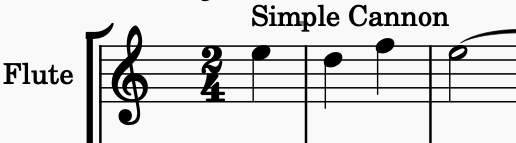
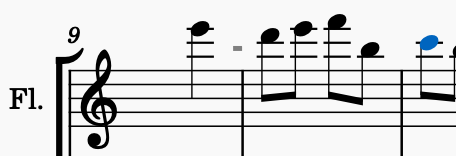
Rameau discusses how to make a simple four part canon at unison (that is, each voice entry follows unison). The easiest method involves a short melodic idea that follows a simple harmonic progression (e.g. I-V7-I). For my first try, I used this simple melodic idea: We can then add each of the 4 entries at their exact points, and realize the range of possibilities while avoiding parallel octaves 5ths. One limitation is that the final entry (where all voices are at once most likely taken by the bass part) may not correspond with established cadential voice leading conventions, unless the motif resolves from the leading tone or the 5th (as the case here). The second exercise I did was slightly more ambitious, utilizing secondary chords and greater diminution. I also embedded the leading tone in the second half of the motif in the interest of the above. Finally, as the second line approaches the V7-I cadence from the 4th (F natural) I depart from the stricter option of rising to the G (as the first part did earlier) in the interest of the conventional resolution of the V7 chord. In practice, Neidhofer & Schubert state that most imitative contrapuntal textures are neither strict canon nor free imitation but somewhere in-between. So it is quite justified to loosen the framework in such places. Play around with your own ideas... it doesn't need to be a masterpiece but at least adhere to the basic voice leading rules. I have composed canon's before but not as targeted exercises. Canon Practice.mp3 Canon Practice.pdf
-
Hi Henry! As @chopin says, the intro is catchy yet solemn and wonderful. In the progression building up even further from 1:58, it feels as though something is surging forward—it is sad that this isn't a live recording. The structure itself is well-composed, and the transitions are smooth. Around 5:00, a vivid scene of live musicians performing came to mind—starting with a solo performer and then adding instruments one after another. The entire piece maintains a consistent structure, drawing the listener deep into its worldview. The clarinet solo around 14:31 is also a personal favorite. After the busy dialogue between the instruments up to that point, it shifts into a quiet solo, and then from 15:13, it connects to the final development, returning to the origin of the piece—a great finale. How many movements do you plan to create? I thought it would be great if a file where we can listen to everything all at once were uploaded someday. Well done, I enjoyed listening! Best, Lithl.
-
18th Century theoriest, Johann Mattheson, discusses the importance of imitation in counterpoint. He contrasts this with "melody and accompaniment", in which the melody is simply supported with corresponding harmony. He states that without imitation, music sounds "wooden". It is imitation that brings music to life through dialogue, the reason being that: we relate to musical dialogue like our own social world. Obviously, our social experiences are not singular but at least bi-directional. The usefulness of imitation extends beyond its aesthetic appeal; it is also a critical tool for developing a musical idea. From personal experience, producing a convincing dialogue/conversation in my own writing helps me consider where it might go next. Mattheson goes on to state that, for experienced composers, imitation becomes instinctive which is particularly useful in improvisation: against a given melody, thinking how it can be imitated becomes central to its corresponding solution. I conceived a melody of my own to practice this. Try to do the same: produce a short melody and consider how it might be imitated. Figure 1: a melody with basic accompaniment: Figure 2: the melody with imitation In my attempt, the imitation follows the rhythmic pattern of the melody a like a canon but without faithfulness to its script. Note that the bass is still primarily supportive of its harmony, following the voice leading outline shown in figure 1. Importantly, I used the do-re-mi schema (1-2-3) as the basis for this simple idea for it facilitates stepwise contrary motion in the bass (here this was useful in bar 3 where the bass rises to the Bb against the melody that descends to D. Making use of such schemas (see Robert Gjerdigen's 'Music in the Galant Style') can be useful for this sort of thing.

 Morning all, I am going to produce some learning material on here as part of my own studies to share & promote knowledge relating to baroque counterpoint. I have acquired the not inexpensive book, Baroque Counterpoint by Chistoph Neidhofer & Peter Schubert that I am thinking of translating into a workable guide on here. Disseminating this is as much for my learning as for the potential benefit of others, in addition to generating constructive conversation around these concepts. I am thinking of uploading one class per week - or more - depending on the time I have. Stay tuned for these.
Yesterday
Ale_Violinplayer joined the communityHello @Fruit hunter, another of your percussion pieces, now for a „more traditional“ percussion ensemble and not for „bottles“, „leaves“ and „wooden sticks“! Melodies Themes Motives and Harmony Chords Textures: The use of various pitched and unpitched percussion instruments allows you to introduce, on the one hand, a range of melodic motifs and even chords, and, on the other hand, rhythmic patterns that enrich the piece with a vast array of motivic material. Form Development Structure Time: Even though I’ve listened to the piece a few times now, I have to admit that the impression of a “kaleidoscope” of sounds and motifs prevents me from recognizing a specific traditional form development, so that the length of the piece increases the risk of a certain “randomness” or monotony. Originality Creativity: Given its instrumentation, the piece is undoubtedly one of the most original and unique entries in this competition. Score Presentation: There have been pointed out a number of engraving issues already by @MK_Piano, which I don’t want to repeat here. Beside that, I generally like your score since it has a good readable font size, spacing etc. However, I can see that you’ve struggled with the arrangement of the staves and systems on the pages. I know this, and it’s not always easy to find a satisfactory balance between readability (i.e., the font shouldn’t be too small and the staves shouldn’t be too close together) and the effective use of space on the pages. This always seems to be the case with pieces that require seven staves, so that sometimes there is room for two systems on a single page, while in other cases only one system can fit on a single page. For aesthetic reasons, I would prefer a more even distribution across the pages, but that is not always possible. In some cases (for example, in measure 40 and measure 137), the tempo markings or other annotations extend beyond the page margin or the page size. Instrumentation Orchestration Playability: I think, you have thoroughly worked on the instrumentation, the choice of the mallets, the situation when to change to another percussion instrument etc., which shows that you are familiar with that family of instruments. The only question – the playability of the fast changes between mallets or even instruments, as already stated by other reviewers – still remains for me, and I can’t answer it. Perhaps, you had have been a bit more „conservative“, introducing rests before that changes, which would be possible, especially if only one player changes the instrument/mallet while playing unison with another one (for example in mm. 108 or 116). Execution of Given Challenge: As for the question of to what extent this piece sounds “French” or conveys the atmosphere of a summer day, I have to admit that my first impression was, that the piece could be performed on the street at the „Fête de la Musique“ - which is a massive, nationwide free music celebration held annually on June 21, the day of the summer solstice, in France. And for that reason, I can see a real connection between your piece and the challenge of the contest. Taste: It's a piece that is interesting, surprising, and fascinating. On the other hand, it gets a little “monotonous” after a few minutes, so at the “Fête de la Musique”, I might have already moved on to the next musicians. Melodies Themes Motives Harmony Chords Textures Form Development Structure Time Originality Creativity Score Presentation Instrumentation Orchestration Playability Execution of Given Challenge Taste 7.5 8 6.5 10 6.5 8.5 9 8 Average Score: 8.0This is casual competition without any prize money and hence we are not requiring any particular format for the reviews. Even the official reviewing template is purely optional and one is free to review without it or use your own template. Therefore, I don't think it's reasonable to expect everyone to rank the entries also given that if you are using the official template you'd have to create a sheet/excel document to keep everything consistent. (Of course the official judges of previous more formal competitions did do this and it was definitely fun for some and a headache for others)Hello @Ninja Nolan ! When I first came around to read your explanation of the submission and took quick look at the score, I asked myself, “How is this supposed to work?” and “How is this supposed to sound?” when you put four soprano saxophones together in an ensemble. Isn’t it a mistake to combine instruments of the same register—and even the same timbre? Wouldn’t they get in each other’s way? But after listening to (just the first few minutes of) your piece, I was proven wrong: I have to admit that the four saxophones blend together so beautifully, without any clashes or overlapping! I also get the impression that I sometimes hear the timbre of other woodwind instruments, such as a flute or an oboe (that’s a bit like a sommelier tasting a wine and raving about how it has notes of wild berries, melon, or even pepper…). I - La soie (The silk) The first movement has for me a very calming atmosphere, somewhat like a lullaby. Another impression was that it reminds me somewhat of pieces which are played at Christmas time, but than with a brass ensemble (i.e. „Posaunenchor“) and in a different seasonal mood. II - Le ciel (The sky) The second movement reminds me of a dance at Thanksgiving – I mean a Baroque-style dance (while I can’t – since I’m not familiar with the characteristics of those dances – say whether it’s a Gavotte, a Sarabande or a Galliard …). I very like the sometimes humorous passages, as for example, in mm. 36 or at the beginning of the Trio in mm. 56. Le soir (The evening) A more melancholic movement, that arises a picture of sitting around a campfire, thus really capturing the mood of a late summer evening. Melodies Themes Motives and Harmony Chords Textures: The piece uses beautiful, simple melodies and harmonies, which are sometimes „spiced up“ with some dissonances (such as in the first movement, mm. 18-20) - which I very liked. The textures are – while being relatively simple – well balanced. For that reason, I most liked the texture of the opening section of movement three, mm. 1-16 for their slightly couterpuntual approach. Form Development Structure Time: Since consisting of multiple movements and featuring a „dance“ in the second movement, the form could perhaps described as a suite. The movements are well developed and the entire piece perfectly meets the time requirements. Originality Creativity: The piece is original and unique among the submissions for its instrumentation and the use of the „suite“ form in three movements. Score Presentation: The score is clear and professional with no issues. I very like your descriptive program notes at the beginning. Instrumentation Orchestration Playability: As always said, the instrumentation seems at the first glance somewhat „adventurous“, but has been brilliantly mastered. I think, there are no playability issues, since it doesn’t seem to be „difficult“. Execution of Given Challenge: You have chosen the three stanzas of the poem and created three movements, each with a clear, distinct mood, trying to depict „The silk“, „The sky“ and „The evening“ as they are the topic of those stanzas. If listening to the music evokes images whose seasonal mood sometimes differs from that of a summer day, this should be considered merely my personal opinion. Taste: It's a piece that's pleasant to listen to and has a calming effect. However, it might not be the kind of piece I would listen to every day. Melodies Themes Motives Harmony Chords Textures Form Development Structure Time Originality Creativity Score Presentation Instrumentation Orchestration Playability Execution of Given Challenge Taste 9 8.5 10 9.5 10 10 9.5 8.5 Average Score: 9.375Entry: Melodies Themes Motives Harmony Chords Textures Form Development Structure Time Originality Creativity Score Presentation Instrumentation Orchestration Playability Execution of Given Challenge Taste 10 7 10 8 9.5 10 10 10 Average Score:9.3 Review: Overall, I did not notice any engraving issues on the score presentation. The only thing I would recommend would be to use expression sim. when there is the same type of articulation. That way, you do not have to write out the articulation for each note. The execution of the piece of this piece has meets the challenge. Each part is easy to read and playability. The creative and originality reflect the German lieder in tone and character. Hence while it unique to this contest, it original in the sense that melody and harmony and creative in the instrumentation and such. Homophony is the primary texture throughout this piece and sounds like chorale.Since the submission deadline will be soon, and I expect that there will arrive some pieces today or even tomorrow, I would like to ask whether we have some more days time for our reviews (perhaps at least over the weekend). I would appreciate it, if the deadline for the reviews could be clarified (not just for me, but also for the benefit of other reviewers, since we haven’t received that many reviews yet).soorajspgp joined the communityThank you for the wonderful feedback! I believe I forgot to add dynamics at the end by mistake... :( Dynamics and bowings are up to interpretation I guessLast week
Maharani joined the communityThanks for listening and commenting, @Seni-G ! I am glad you found that it slowly built up. It was one of the main things I put effort on since it was such a short piece, and the addition of the Coda was mostly for that same reason, as I felt the piece needed a little extra build-up/release with the main quarter note motive. I really liked your idea of the accompaniment, specially I might experiment with it during the coda since that is where the rhythm is freer and most of the notes of all chords are static, so it is a good place for testing it out. Thanks for the idea! Thank you!






.thumb.jpg.a1bd070fa88caa1c83527ffe77c97a41.jpg)




.thumb.png.8b5b433a341551e913a34392660bc95b.png)