All Activity
- Past hour
-
Let me start by saying that I love the graphic design. I find MusicJotter's graphics very appealing. I loaded a midi, saw the score in front of me, and my first reaction was.....trying to find the "play" button. I hope I am not the only one feeling a bit frustrated because I cannot see clearly where to clic in order to get the score played.
-
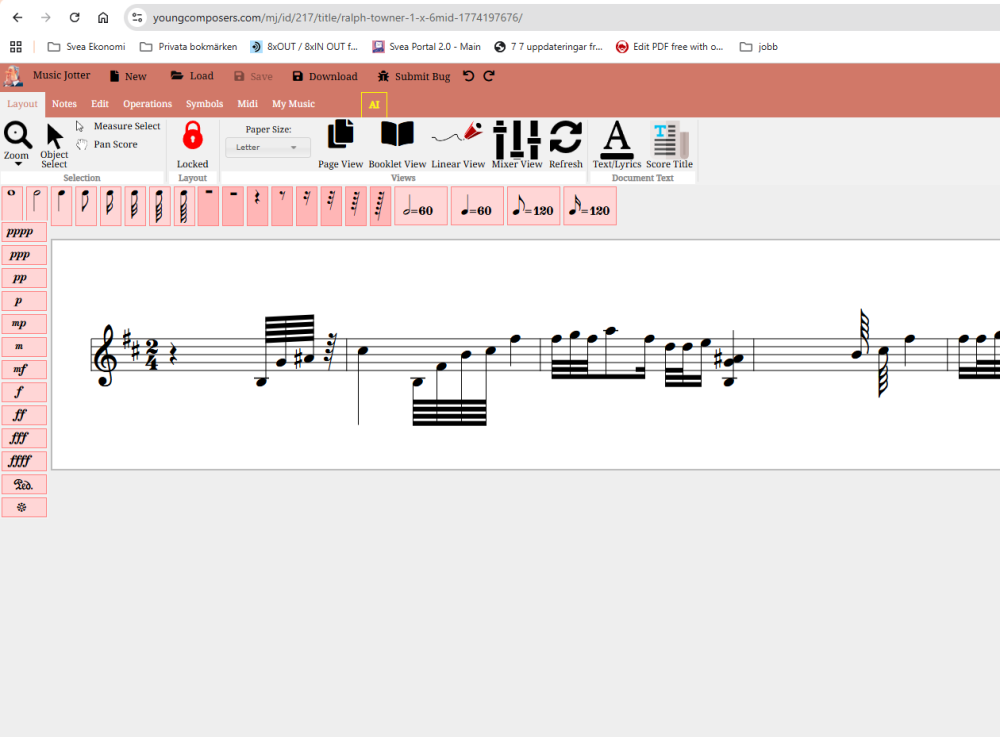
Ok this has been addressed. I didn't have support for Midi type 0, but the import now works. If you still have issues with the graphics and output, I can work on the quantization. The issue is that if you composed arpeggios from another program, Music Jotter can't interpret that. But if the rhythms are not correct, send me the pdf or visual output of the score, and I'll take a look.
- Today
-
If this is your midi file from another program though, I will see what I can do to fix this. Give me a bit to diagnose the problem, shouldn't take too long.
-
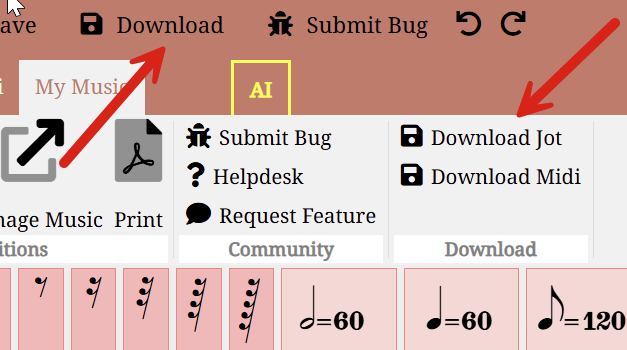
This part may be a bit confusing for first time users. I have 2 ways to export midi. As a jot file, and as a midi file. The jot file is actually the file you want to save and load back into Music Jotter. The midi file is the performance file, which is intended to be used in DAWS or other software. I strip it of all the formatting meta data so keep the files lightweight. Download the .jot file, load it back into Music Jotter, and see if that fixes your issue.
-
Attached you will find a little midi file...it is a short piece for guitar. When I import it into music jotter I get only an empty measure. is that ther expected behavior for v1.0 of music jotter ? Ralph Towner_1 X 6.MID
-
It saves on every keystroke while you compose, it's like Google Docs; you can just download your midi file. But if basic composition isn't working for you, it could be a browser bug, so if this is the case, I would need more information about your browser. I've tested Music Jotter with Firefox and Chrome, and it should also work with Safari. Here's another trick...as long as your composition plays back, you know it has been saved, because saving your midi file happens before the playback compiles (behind the scenes).
-
@chopin haha
-
I do not know how to enter notes on Music Jotter. I am trying to 'save' and Idea.
-
It is self explanatory.
-
Thanks everyone for your comments, I sincerely appreciate every one of them! As is ever the concern of a composer I'm very happy to know that the right mood/atmosphere came across to other people :) There seems to have been some discussion about the key and key signatures: I was never really a fan of music with all sorts of accidentals and black keys until I came across Scriabin, whose delight for the likes of F♯ major/D♯ minor, B major/G♯ minor, G♭ major/E♭ minor, and D♭ major/B♭ minor seems to have slightly rubbed off on me. Idk though, I felt like F♯ major gave off sweet lyrical romance (e.g. Poème op. 32/1 or Étude op. 42/4) vibes so I went with writing in that for this work. The key signature switch to G♭ major/E♭ minor was actually only a logistical sight-reading one, if I remember correctly. In the middle section there's some vacillation between a major key and its relative minor, which would have been fine for bars 9-12. However, I move a fourth lower in the following four bars, i.e. tonicising the dominant, which means that if I kept the original key signature I'd get C♯ major and its relative minor A♯ minor. Eek. Sharp overload. I am not quite sadistic enough to put that onto the performer, let alone F♭ major (though that has now given me an idea...). I figured that writing out the middle section in flats meant that I could resort to using natural signs rather than extra sharps in bars 13-16, but yo, @Luis Hernández and @Wieland Handke, you may have a point with it also engendering a somewhat darker mood, as I had intended. This is an excellent point, now that I'm poring through the score again. I think there are some spots (e.g. b. 12) where I quite like the arpeggiated quality, but I have also decided to add a few markings for spots where I think it is justifiable to have the other hand take a note or two. Was this what you were thinking of? Version with redistributions.pdf
-
I like these ideas. Or at least some of them as that I could definitely do and feel motivated. I do have others just in case if something I wasn’t prepared got voted on and it’s probably still do things. Frankly, I prefer to do string orchestra works for things like these. But I’m open too many things.
- Yesterday
-
L.A.P.D. Documentary Style Theme-1+2 Using Symphony Stopped-Horns, for Intense-Themes. https://orchestrationonline.com/horns-practical-range-of-stopped-notes/ L.A.P.D. Documentary Style Theme-1.mp3L.A.P.D. Documentary Style Theme-2.mp3
-
-
Hello everyone! I‘m very excited looking forward to the next competition I would like to participate. The suggestions concerning the the topic in combination with the instrumentation are very interesting, but also challenging. After a quick look, I’m not really sure yet which topic/instrumentation I would prefer, and which musical idea would best fit for any of them, so I need to take some time thinking about, how to vote in the poll. (Hopefully, I won‘t miss the deadline ...)
-
That sounds really interesting. Is there a video of @chopin doing something like this that I can watch? I like this idea, as well as the landscape one and the mashup. As for the overall theme, I don’t know—it should be open-ended, right? And as for the duration of the competition, maybe two months at most, so it doesn’t spill over into the next season.
-
Wonderful suggestions! I am eager to see what this one turns out to be. In my opinion, I wish I voted for two genres as both landscapes or autobiographical writing seems very interesting to me. I do like writing for large orchestra, but for things like this, I find the intimate nature of a chamber group or solo instrument befitting for a few minutes depicting spring. Two months seem very appropriate to start a brand new work and finish it.
-
Spotlight On Saxophone Depending on the Mood, The Saxophone can be made to sound Sassy or Sad. Spotlight on Sax.mp3Moody - Sassy or Sad.mp3
-
As smooth as the rolling seas with the fog. -fruit hunter approves! I’m a serious note even with MuseScore basic sounds this sounds amazing. This is definitely a good ballad to program into a concert orchestra and we need more music like this although that I may say that the orchestra is kind of a dying art in itself hopefully in the future change will be made that academic full orchestra’s can be existing and play music by composers and just not arrangers This would sound incredibly beautiful with real instruments or even just muse sounds
-
@Wieland Handke Of course! Feel free to message me here, on discord or other! As a brief reply: With all the rules or trends in music, it is equally often to see breaks in the trends. If you know the product will be effective, then it is only in your best interest to do so! Again, @Marek, I am eager to see how your music will change. Even me, if I shared my first attempts…. It would be bad. 😅
- Last week
-
Hello @Marek , I see, that you have joined the forum recently and now at the first topic you have the fortune – or even the evil – that you’ve received a very detailed review which is not only intended as suggestion on the improvement of your particular piece but useful to all other members in this forum. So I could imagine, that there will be many replies on this topic in the future – perhaps a discussion or even a little dispute about the issues MK_Piano pointed out, especially on engraving. So there is my advice, take that serious, but not personal. I remember on a topic by Frederic Gill where some members had (their own) conversation about details he surely had not in mind and finally was a bit overwhelmed and „overteached“, so that I was a bit afraid he would be too disappointed and would leave the forum at all. Therefore, I now come first to your music, where I only speak from my listening impression: I can really imagine a shore in the morning where the fog is slowly lifting and the sun comes on shining through the clouds. It’s a very calm and serene moment, in which the perception of time seems to be gone away. After you’ve walked an endlessly seeming time at the shore, you turn your head and look back – now discovering the great lighthouse you hadn’t seen before, since it was hidden by the cliffs above, you now have passed. I tell that story to express the sole criticism which I have, and that is the length of the piece in comparison with the things that happen. And in this I can only agree with MK_Piano’s comments on his final pages of the annotated score. Now to the comments concerning engraving: Hello @MK_Piano, thank you for your effort you have put into annotating the score. I think this is helpful not only for Marek, but also to me and many other forum members. There are a few general rules you pointed out which one should follow to achieve a clear score presentation, for example • No dynamics on rests. • Not to prolong notes using ties whenever it is possible to notate otherwise, for example with dotted notes. • No separated rests whenever it is possible to combine them into a larger rest. • No diminuendo to „nothing“ (e.g. unplayable dynamic marks like „pianississimo“). • Some aesthetics (clashing dynamics symbols). And in the examples in that particular score, it is „obvious“ to follow that rules would be a huge improvement. However, as I remember at some of my piano preludes and fugues, there are some situations where I intentionally violated that rules in situations where I find that the score becomes more readable when using tied notes instead of dotted ones or when separating longer rests and put the shorter against the notes of the same length in another voice – to mention some examples. I don’t want to go into detail with this at Marek’s thread here, so I would ask you whether I could discuss that topic with you in the future, for example when I’m about to present that respective pieces here on the forum. One advice I can really emphasize, is to maintain two different scores. One as the „printing“ score to be used for playing from, and one solely for the purpose of recording in your software. I do so with all of my pieces, and the „recording“ score is full of exaggerated articulations, dynamic marks and even micro tempo changes to achieve a satisfying, more realistic recording result wherein I can express my ideas about the interpretation.
-
-
Your composition has John Williams cinematic feel to it ... a sweet melody. I enjoyed the thematic orchestration and development. Mark
-
Hello @L.S Barros , Reviewing a fugue without a score is a challenge, but if you choose not to reveal it, I fully accept that decision and will try to figure out what I can discover just by listening… The fugue has a short and memorable subject that modulates to the dominant. When I try playing a few notes on my “GarageBand piano,” I’d guess it’s in G-sharp minor, which is one of the most interesting minor keys to me because it has a somewhat spooky vibe (perfect for Halloween) and is a great choice for your energetic and humorous little fugue. I said „humorous“ because the first transitional passage between the second and third subject entry introduces funny repeated notes or intervals which are even more pronounced in the first episode. This somewhat repetitive and homophonic motif is reappears later as counterpoint of the subject, and I enjoy how well it works not damaging the overall counterpoint of the fugue. In the later episodes, you have presented a more traditional transition using sequential motifs, so that the fugue as a whole has an engaging texture that never becomes boring. You mentioned that there are parallels, but aside from the repeated notes or intervals in the first half of the fugue, I always felt to perceive contrary motion in the voices which naturally avoids parallels. Thank you for sharing, very enjoyed.
-
Oriental Melody For those that travel the world ORIENTAL MELODY.mp3
-
It will be difficult read, like REALLY difficult.