All Activity
Past hour
-
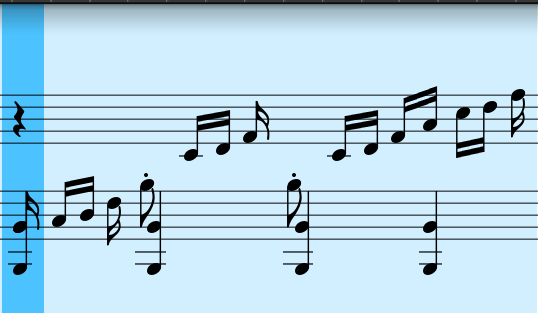
I'm teaching myself piano and this arpeggio is the only thing stopping me from playing Schala and the Queen at tempo. What fingering would you use for the right hand here? What are the good reference sources for learning the theory behind how to figure this out? I think I probably need to start practicing something a level or two below this. Just a book of arpeggios with good-habit finger notes would be amazing. Does that exist? Schalas_Theme_-_Chrono_Trigger.mid
Today
-
Wonderful orchestration - lovely, lovely color! I find this orchestration to be incredibly balanced - fresh and innovative, while holding to the character of the original. As @Alex Weidmann said, I also think the flute choir was an excellent idea. Your choices feel very intentional, and I enjoyed listening to your orchestration! I would love to see how you might approach something by Bonds or Price.
-
Hi @stewartIM and welcome to the forum! I think writing a set of variations on two themes is a really great idea! And writing them so that their order can be reversed is especially ingenious! I listened to both versions and was amazed that there weren't any awkward transitions between variations - perhaps this is because you wrote each variation as a standalone piece of music? If you were tasked with writing them as one smooth and continuous piece of music it would be harder methinks! Also - amazing performance of your own music! Great job playing and recording this piece! My favorite variation was perhaps the Chiasmus: Bleak. Although the Lamentoso variation was especially affecting as well. Now for some critique! I write a lot of variations and I consider it my life's calling to find themes that nobody has written variations on and write variations on them! In my own composition adventures I usually expect there to be an intensification of the awareness of the theme throughout the variations. When I listen to some of my favorite variations pieces my mind is stimulated by how different they get while still being audibly related to the original theme. In other words, the pieces stimulate the listener to recognize the theme in all it's various new and different forms. But, in your variations, I don't perceive that to happen. Perhaps it's because you're using two themes? Or perhaps your variations don't have as tight of a motivic development as I've come to expect from other favorite variations pieces I've heard? But don't take this the wrong way - I've still enjoyed your music immensely and it is very good! The other critique is that the music in both versions seems to just stop and there's no audible drive to a strong conclusion - this is obviously because the piece can be played backwards and forwards and it would be impossible to accomplish because of that - unless you had two conclusions - one at the beginning and one at the end. In any case - I enjoyed your music very much and thank you for sharing!
-
Hi Luis, This is a great piece to choose for orchestration! I'm sure I've played this on the piano in the past. It uses one of Debussy's favourite tricks with its harmonic planing, and has some lovely impressionist touches. I wonder, are there any other orchestrated versions; or is yours the first? Using a choir of flutes was a neat idea, and I like your harp harmonics (near the start). Also harp with glockenspiel is an effective combination that I probably wouldn't have thought of. My only wish is that you had slightly better instrument libraries to do justice to your score, as the rendition doesn't always sound fully realistic.
Yesterday
-
-
I wrote this piece back in 2018, when I was still in college. The conceit is that it's a theme and variations with 2 themes, one on each end. The variations are played starting with one theme and ending with the other. To add to the compositional complexity, the piece is reversible: you can start with the other theme, play the variations in reverse order, and end with the first theme. "Variations" should probably be in air quotes - they're really more like microscopic character pieces that use the themes as a jumping off point. I've given this piece a lot of thought over the years - most people I've shared it with enjoy it, although they disagree about which order is better (which I consider a success ). The most common criticism I've heard is that the individual variations are too short. I'm curious - what do you all think? I've grown a lot ear-wise since I wrote this piece, even though I haven't written very much since college, but I'm still very happy with it for the most part. I'm thinking of revising the work and expanding some of the sections (e.g. N2, N3, S3) to give them a bit more symmetry. I might also try to get the work published, although I don't expect major publishing houses to be super interested or to get it to a wide audience. Here is a pair of recordings I made of the piece right after I finished writing most of it, synced with the sheet music. I later added a cadenza to the opening of N1 which is not included in this recording. Chiastic Variations, Op. 6a Chiastic Variations, Op. 6b
-
Hey! Thanks for the comments. To be honest, I struggled on a name in the first place lol. When I started this in 2024, my goal was to make a sonata and my original second movement was a Courante. So, the idea just stuck with me until now. I thought giving a dedicated name like some of my other works, however, it was a roadblock there. With the melodic voicing, it just comes to MuseScore at that point. I did some hidden notation to voice stuff louder or softer for the playback however. I may go back and update it for the dynamic reasoning, however, my thought process veers towards performance. The conductor of this work would hopefully know when to bring out the melody, or the ensemble would know how to balance regardless of dynamic.
-
Hey @MK_Piano ! This is a nice piece for chamber orchestra! I listened on headphones. I personally would have called it a Suite for Strings with the first movement being perhaps a Serenade, the middle movement a Bagatelle and the last movement a Scherzo or something. But those are just my personal suggestions and by no means do I intend to impose my interpretation upon your vision. One thing I did notice is that you don't seem to balance the melody above the rest of the voices (or perhaps you do in the mixer? But that wouldn't make sense since you don't always have the melody in the same voice.) I see all the string parts at the same dynamic at the same time. I think it would bring more clarity and balance to the music if you brought the melody out more by setting it at one dynamic level higher then the rest of the voices. One way that you do use to bring the melody out is by sometimes doubling it with multiple instruments together so good job there! I enjoy the sections where the melody is in the bass - I think that's a cool creative decision that brings variety to the music! Overall I really enjoyed it! Great job and thanks for sharing!
-
-
-
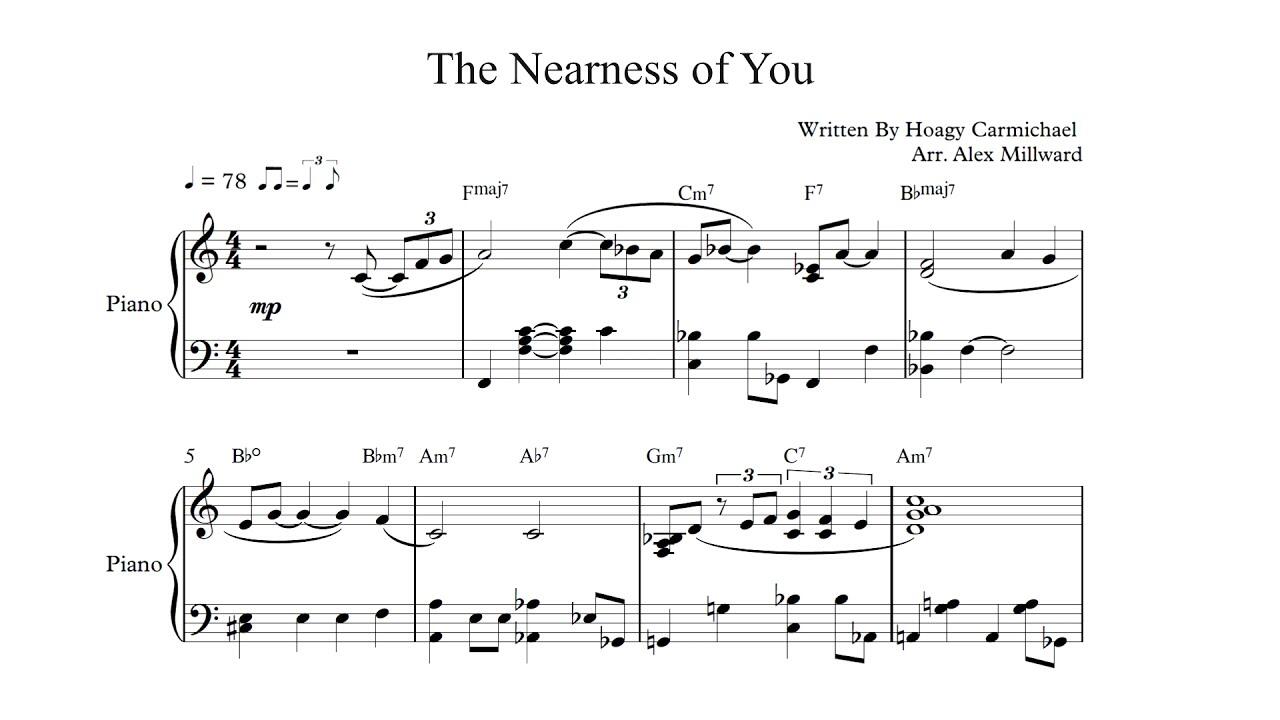
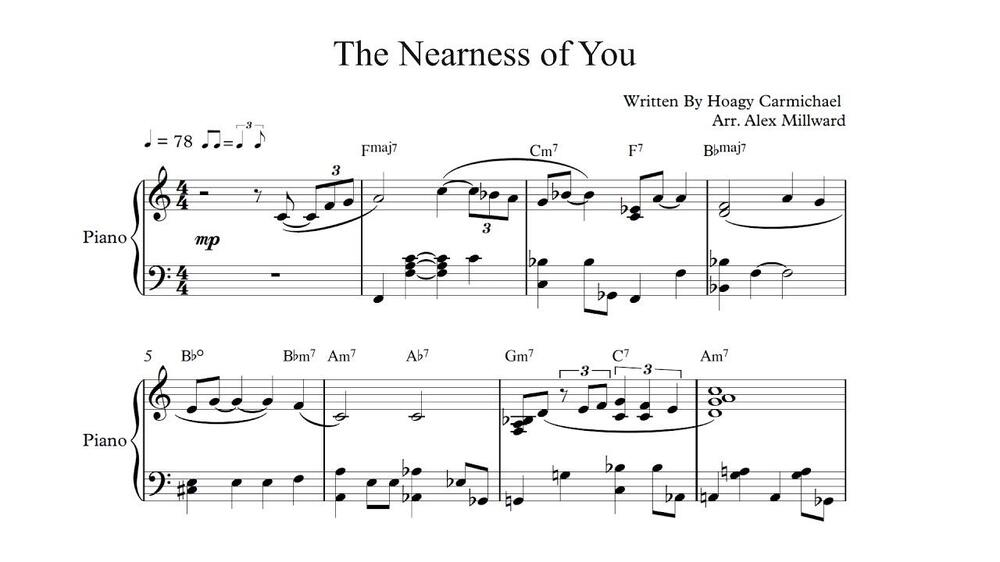
"THE NEARNESS OF YOU" 1937 Songwriters Hoagy Carmichael, Ned Washington | Orchestrated Rendition - by V.I.P. EXCLUSIVE Iceland Symphony Orchestra THE NEARNESS OF YOU - Orchestrated Rendition - by V.I.P. EXCLUSIVE.mp3 THE NEARNESS OF YOU - Orchestrated Rendition - by V.I.P. EXCLUSIVE.midTHE NEARNESS OF YOU.pdf
-
-
Hello everyone! Today, I am sharing my newest and extensive work for the string orchestra. Set in three movements within the key of G-minor, this work was completed after two years since it's initial creation and has a runtime of 14 minutes. The original first movement was made back in April of 2024, while the rest of the sonata was both created and completed in the summer of 2026. The two years in between these milestones saw an exponential growth in my skill and after a summer of listening to a large sum of chamber music, I felt inspired to finish the set and diversify my collection of works. If you would like to know more about the score, please go to page 2 (or page 4 of the PDF) to view specific information at each movement. Thanks for listening and viewing the score! __________________________ If you have any comments, whether constructive, critical or positive, drop your thoughts on this thread! I will reply when able. G-minString_Sonata_AUDIO.mp3 G-minString_Sonata_SCORE.pdf
-
Kyawe Say Min joined the community
-
Okay!! Nicely done I will do my best to address your points for feedback as best as I can, but I am not the most experienced composer on the site, so I would keep your eyes out for better feedback later. 1. You have a few spots (really a whole section), starting at m.89 until m.96 where your beat 3 is completely unseen. It's a general rule of thumb to keep your 3rd beat clear, for reading purposes. 2. I enjoy the way your build up the piece, but I'm wondering if it would've been more effective had you established the melody a little sooner. Like even right after you state the iconic canon baseline - the melody starting in m.5 rather than the dotted qtr figure would help establish some familiarity (but disregard if this doesn't align with your vision for the piece). In my opinion, I just think it goes on for a little too long without the melody, especially since you mentioned this will be used in a game, I think having the iconic melody present from an earlier point would be nice. 3.This is just another one of those "in my opinion" things. But I would like if the rhythmic escalations were smoother. Like in m.6, if those 32nds were 8th notes or 8th and 16th notes (which would be 3 notes, but you get the gist). Up until that point you've just had qtr notes and 8th notes. Same thing in m.32, I would just prefer a rhythm that is different from what we've seen so far, but not jumping from qtr notes and 8ths and 16ths to 32nd notes. It's just a little jarring. This is part of what makes your inversion section successful to me. The rhythms are lining up and diverging in a way that seems smooth if that makes sense. By that point we've heard all of the rhythms you will use til the end of the piece and the 16th against the 8th makes sense and doesn't feel jarring. (This may speak to your 6th point above) I would say yes, however some of the times where I get a little lost are probably midi playback things and not issues with what's written. This is getting long-winded lol, so I'll end there. But thank you for sharing your work!! Hope my feedback was helpful.
-
Hio, This is my first composition post here. I would be very grateful for honest feedback on a solo piano piece called Pachelbel’s Keygen — Ascent to Elevation 100. A little context about me: I am a software and game designer, not a trained composer or an accomplished pianist. I have no formal education in harmony, counterpoint, or composition. I made this piece largely by ear and through experimentation with MIDI, then produced the score in MuseScore. It's not obvious to me that I have any musical talent at all, actually. But I need this piece to be good for a project I am working on. Because of that, I suspect there may be errors or missed opportunities that I simply do not have enough musical experience to recognize. I am posting here because I would like criticism from people who know more than I do—not merely reassurance that it sounds pleasant. The piece lasts approximately 5 minutes and 40 seconds. It uses the familiar ground bass from Pachelbel’s Canon and passes through a series of increasingly elaborate eight-bar stages, which I call “Elevations.” The general progression is: the initial signal and subject introduction of the ground bass canon and additional contrapuntal voices inversion and mirrored material increasingly dense recursive treatment an intentionally excessive virtuosic summit destabilization, fragmentation, and eventual reconvergence The idea is that the piece is being progressively “overclocked.” It was composed partly for an open-source piano-practice application I am developing, so the clearly separated stages and steadily increasing technical difficulty are intentional parts of the concept. However, I do not want the concept to serve as an excuse for weak composition. I would like the piece to hold up as music independently of the software. I would especially appreciate feedback on any of the following: Are there problems in the harmony, voice leading, counterpoint, register, rhythm, or notation that seem like mistakes rather than deliberate choices? Do the successive Elevations genuinely develop the material, or do some of them merely add more notes and difficulty? Does the main subject remain perceptible as the texture becomes denser? Are there places where the material presents an obvious opportunity for a stronger variation, reharmonization, transition, or climax that I failed to use? Does the post-summit destabilization feel like a natural consequence of the ascent, or does it feel like a separate ending attached to the piece? Is the piano writing convincingly virtuosic, or are passages simply awkward, impractical, or poorly divided between the hands? Are any sections redundant, overlong, underdeveloped, or insufficiently differentiated from the sections around them? Please feel free to be direct. I am particularly interested in criticisms that distinguish between: definite craft or notation problems important opportunities for improvement legitimate differences in personal taste Measure numbers and concrete alternatives would be extremely helpful. I may need to ask questions when terminology is unfamiliar to me, but I will take the criticism seriously. The attached MP3 is a computer-rendered reference performance rather than a recording by a pianist. I have also attached the PDF score. I understand that the rendering may have limitations, so I would appreciate help distinguishing playback problems from problems actually present in the writing. Thank you very much for listening and for any observations you are willing to share. Pachabel's Keygen Draft 3.mp3 Pachelbel's Keygen - Ascent to Elevation 100.pdf
-
badmozart joined the community
Last week
-
Thank you for taking the time to listen to my work. Well, it's beyond me why I called it a Trio. I must have had another work in mind when I posted. As for the sparse piano accompaniment is to create a specific mood/feeling. I understand the slurs are not bowing marks .... placed there for interpretive intent only ... will it confuse the violinist? You provided some motivation to do more with the piece ... maybe I'll work on it. I'll see if my muse speaks to me! 🤔 Mark
-
PeterthePapercomPoser replied to PeterthePapercomPoser's topic in Music Appreciation: Suggest Works or ArticlesSpongebob Squarepants: Supersponge - Precipice Canyon (Extended):
-
I think I have a long way to go. My composition is still at it's lowest level, I think (but first in school).
-
Greetings! 1) Your title says string trio, yet this a duo. 2) if you can, please add more chords in your piano part. 3) A VST violin will always generally play legato. What you wrote is not. The one bow marking you did write is implausible. Remember, phrase markings are not the bow markings. 4) I do like your melody here. With that being said, this piece is too short. This piece could go at least for another 3 minutes. There are never enough string trios or violin pieces. Keep at it!
-
-
Hi, Lithl Thanks for the feedback. I am still getting used to both the forum and Musescore so that’s why the storyline wasn’t explicitly there. So far, I have the: Children playing - first part Evil stepmother - second part Banished to the forest - third part Finding the house - fourth part After the huge B chord, at “p subito”, the right hand being eventually joined by the left hand is them seeing the witch. Parts I need to finish: The witch actually trapping them Children fight back The witch gets cooked (literally) and the children escape Finale I’m working on them! Plus, only one school week to go until summer break!!
-
-
Stylistically the composition reminds of the soft folk rock of the late 1960's. A very pleasant work. Mark
-
Multiple users have inquired about the next competition, so that warrants a new Summer 2026 Competition Poll! Here are the givens that each competition will maintain: The duration of each piece should once again be between 3 - 7 minutes. Reviewing the entries will once again be spearheaded by the members/competitors at large. You are free to use the Official Competition Reviewing Template or you can review the entries in any way you see fit or create a template of your own making! There will be tiered "Ardent Reviewer" badges given out for this event: Featherweight Reviewer - for reviewing 33% of the entries Welterweight Reviewer - for reviewing 66% of the entries Heavyweight Reviewer - for reviewing 100% of the entries We are instituting a policy of not allowing any AI generated works in the competition. Because of this you will be required to detail how you created your piece and submit a PDF score or midi file for the perusal of the staff and members at large. The musical entries to the competition are final once submitted. This is for the sake of consistency of reviewing (so that each reviewer reviews the same piece of music without any changes). However, there are a few things we'd like the members to help us determine (in the poll): 1) What should the competition be about? To write background music for one of @chopin 's Retry Bro's YouTube videos. Explanation: @chopin has a new YouTube channel! It's called Retry Bros. and consists of him playing Super Mario Maker levels and coming up with entertaining narration from Mario, Luigi, Princess Peach, Bowser, and other assorted characters. There's also a musical element. So far, Mike has come up with some clever lyrics and used AI to make realistic sounding songs that go along with the video. Now, where you would come in is that you'd be writing background music for one of @chopin 's new videos! To write some kind of autobiographical piece with a paragraph describing how the music portrays the autobiographical material. This one is @UncleRed99 's suggestion. The idea is to "write a piece that simply tells a story about your life, and something meaningful within it. Utilize complex elements to express emotion, tension, or any other desired emotional or mentally relatable expression. Provide a brief summary describing the root of the story being told." @Thatguy v2.0 has bestowed his theme proposal to me. I had another idea for an "Excerpt Exchange". Basically composers entering the competition would send the staff an unfinished excerpt of their music for the ensemble that we'll be writing for in this competition (we'll find out what ensemble from the member voting to question no.2 below). By sending your unfinished excerpt you bestow upon others the right to work on and finish your composition. The composers will be given a random excerpt from a random composer without being told who composed it. Each composer will be tasked with making the best piece they can and finishing it to the best of their ability. The minimum length of the excerpt should be 8 measures. @Henry Ng Tsz Kiu has also bestowed his theme proposal to me so I decided to include another theme in the options: "Sound Mimesis - Acoustic Anatomy". The idea is to use the instruments at your disposal to mimic sounds in your natural environment (although the sounds don't technically have to be created by nature - they could definitely be artificial sounds, but should be mimicked by acoustic instruments). As an example watch this Talking Piano YT Video. Or watch this flute mimicking bird calls. @Omicronrg9 has also bestowed his theme proposal to me. This theme would be called "A Plenty of Persichetti Prompts". The composers would be given a choice to compose music based on prompt(s) inspired by exercises from Vincent Persichetti's "20th Century Harmony". There would be 5 prompts inspired by Persichetti's exercises (but not directly taken from the book) that the composers could use to inspire their music. These prompts would be based around various music theory ideas. I've amassed a document listing various such ideas that could be used in this competition: Musical Composition Prompts. @MK_Piano has proposed the theme - "From Nothing, to Something." What greater challenge of a composer than to take nothing and turn it into something! Your goal is to take the text from Paul Verlaine’s summer poem “Donc, ce sera par un clair jour d'été,” (So, on a bright summer day it shall be) and turn it into a piece! This poem is short, but filled with evoking images of what summer can feel like. Attached is the poem in English: So, on a bright summer day it shall be: The great sun, my partner in joy, Shall make, amid the satin and the silk, Your dear beauty lovelier still; The sky, all blue, like a tall canopy, Shall quiver sumptuously in the long folds Above our two happy brows, grown pale With pleasure and expectancy; And when evening comes, the breeze shall be soft And play caressingly about your veils, And the peaceful stars looking down Shall smile benevolently on man and wife. The poem in French and English @Tónskáld has also bestowed his theme proposal to me. Another idea I had would be called "An Invitation to Dance". The composers would be tasked with writing music in the style of a dance in a modern style, that could actually be danced to and exhibited all the proper characteristics of said dance. The composers could choose from a list of dances including but not limited to the following: Pavane, Galliarde, Tarantella, Saltarello, Allemande, Courante, Sarabande, Gigue, Minuet, Bourree, Polonaise, Chaconne, Gavotte, Tango, Samba, Mambo, Merengue, Rumba, Paso Doble, Cha-Cha-Cha. Note that the composer would be tasked with composing only one of these dances rather than a whole set (such as a Baroque Dance Suite). It would also be expected that the music be "dance-like" meaning that it's not just an instrumental derivation of one of these dances that aren't meant to be danced to. My own idea is for the members to write M&M&M's - Mock-ups, Mash-ups and Medleys. The idea is for the members to take 2 or more preexisting themes from different genres of music and to make mash-ups and medleys with them. The staff and/or members would vote about what pieces/songs to include in the following list of genres and the composers would then choose 2 or more pieces from the list to combine in a medley or mash-up (or both!): A single piece of Film Music A single piece of Video-Game Music A single piece of Early or Ancient Music A single piece of Classical Music (Baroque, Classical or Romantic) A single piece of Pop, Rock or Jazz Music A single piece of Rap or Hip-Hop Music A single piece of Anime Music A single piece of Modern/Avant-Garde Music A single piece of World Music 2) What kind of ensemble should the competitors be free to choose to write for? Solo piano/keyboard or solo polyphonic instrument (such as guitar, harp or accordeon) One monophonic instrument accompanied by one polyphonic instrument Choice of mixed trio/quartet/quintet of individual instruments Other mixed ensemble of more than 5 individual instruments not exceeding 10 Chamber orchestra (string orchestra) Full orchestra 3) How many months should the competition span? (1 month, 2 months or 3 months) Happy voting and let us know what you're happy about or what could be changed about the upcoming competition!
-
HELLOOOO!! It has been a while since i don't post here so it's nice to be back, today i bring you guys a small Ricercar with a very simple subject. I done this piece while i was bored and i had nothing to do, so i just started writing, but i didn't finish it at first, i only finished a few days later. The instrumentation is: Cornetto, Renaissance slide trumpet, Tenor Sackbut, Dulcian. I hope you enjoy! LOB 101 Ricercar.mp3


.thumb.png.8b5b433a341551e913a34392660bc95b.png)