All Activity
- Past hour
-
I was wondering if it would be useful for me to learn thoroughbass
-
Colenbacher joined the community
- Today
-
-
All right, so I'll be looking at your structure of this. Since because this is a canon by nature, it should have a really good structure intact with it. I do see some call and response sort of situation in between with the strings. However, though, I think this is due to the nature of the canon, how the melody is kind of like twisted in that sense. Just a little bit of mixing and balancing, I do believe that the chorus is a bit too loud compared to the actual orchestra itself. I don't know if the score is condensed, but I don't see any brass. So what I would just do is just blend in, fix that. Nice change of melody and great job with the ending. I appreciate uh the very satisfying ending. I do see that you do are changing keys a lot. You're getting into territory that there are double flats and also weird enharmonics, so for example, like B sharp and like C flat and so forth, and like F flats, all that crazy stuff. But anyways, though, I would treat this like a really good uh orchestral warm-up in a sense. Really good work.
-
Hello, I will be looking at your structure and your development of your music today. I'll be specifically looking at Cthulhu. I will also have the score pulled up, Very interesting we have here. A very interesting, very stable introduction here. And I could see the use of tarrace dynamics. Okay, so I see stepwise movement to and fro thereout. It reminds me of the Rite of Spring a lot. You must have probably drawn inspiration from that. The score is not presented well, though. There is a lot of smearing of notes, and I don't think the recording does go with the actual score. Okay, that's pretty much it, though. And really good job. .
-
PeterthePapercomPoser replied to PeterthePapercomPoser's topic in Announcements and Technical ProblemsSome more ideas for the Landscapes - Soundscapes competition: "The Peace of Nature" award "A Rustic Mood" award "Nature's Garden" award "Nature is wild" award
-
Brilliant, thanks! Will repost once I've made some changes. I think I'll keep the harp glissandi, as these seem to work quite well. The effect creates a new texture to end the cadenza. (Though maybe others disagree?)
-
Errr...probably still won't work. It would be better to keep all those runs within the same instrument family (strings or winds). This reminds of a passage in Brahms' 1st Piano Quartet where the piano has a mini cadenza towards the end: https://youtu.be/uwAQ7zVM6sE?si=HpAKiiDPOwnDPdHC&t=2285 Arnold Schoenberg eventually orchestrated this piece and had a clever take on this passage: https://youtu.be/7wzJluXJ5H8?si=th4OTUQ7RTSntfSD&t=2422 The Fauré passage is bit different in character, but I think Schoenberg has a good example of something you can try. Maybe give those runs to a 2 clarinets: 1 Eb for the higher pitches, and 1 regular Bb clarinet. They'll be sitting close to each other, and would easily blend in to each others' runs and timbre. The violin/piccolo combo would be too jarring in tonal color, and the fact on stage they'll be separated by a few feet, making the coordination really difficult.
- Yesterday
-
@danishali903 You are correct for most of your assessment. I never learned the proper format for notating string harmonics. This is a gap in my knowledge and the way I meant to convey the information was the pitch written is what the harmonic should be sounding. Not to start a harmonic on that pitch. In a simple fashion, I liked what was sounding based on the notes I picked and decided to keep it.. whether it was correct or not 😅 If you are able, would you be willing to explain the notation? Are you meant to write the note head lower? I saw your example note heads, however, I am still confused by what the information is conveying. With the dynamic marks/ hairpins, yeah… I got lazy the last few weeks on this copy. I was focused on school and actually publishing the movie versus all the final engraving passes. It is fixed on the completed soundtrack score with all 12 pieces back-to-back. Lastly, while I can understand the stillness of the B-section may not keep everyone’s attention, I have my reasons. While I can add more movement in accompanying instruments, it is kept simple for the title theme so I was able to expand upon it in later installments. To add, I also know not all pieces of music need a moving line in the accompaniment. It was my goal to focus on the harmonic language and advance the harmony compared to the A-section. ‘Simple and sublime’ if you will. I intentionally went with doubling as it is reminiscent of how I play it on piano. Just slow moving chords moving higher in register. Adding the weight from the literal sound and feeling the vibrations from the entire ensemble. Thanks again for the comments!
-
Great analysis, thanks Danish! For the cadenza, what if I just have one solo violinist dovetailing with the woodwinds?
-
Hello @Aiwendil Review: Let us talk about what a trio is. In a piano trio, you have two solo players and a piano player. When I listen to your piece, i did not hear two solo string players. I heard multiple. They sound different. Next thing you want to check is balance. I feel that FF is too loud a trio. The background elements will overpower the foreground. You do not want that. I would suggest remove the dynamics for now. The thematic material the proceeds b.19 confuses me. what is the purpose for that section? So much empty in the solo strings. 10 measures of inactivity. I suggest removing those bars and start at 68. :) Then place the first ending repeat at b. 122. the second ending where femata is! in other words, look where this no activity in the piece and re arrange it. :) You will be amazed what will happen. :)
-
True. There definitely will be some comments made though lol. Also, Rachmaninoff’s symphony is in the friendly key of E Minor, not E Flat minor.
-
"Orchestral players are not going to love it" 🤪 Rachmaninoff wrote this piece in the same key...Rachmaninoff's Symphony No. 2 / Vasily Petrenko / Oslo Philharmonic Professionals will be fine. Student musicians are the ones you have to worry about.
-
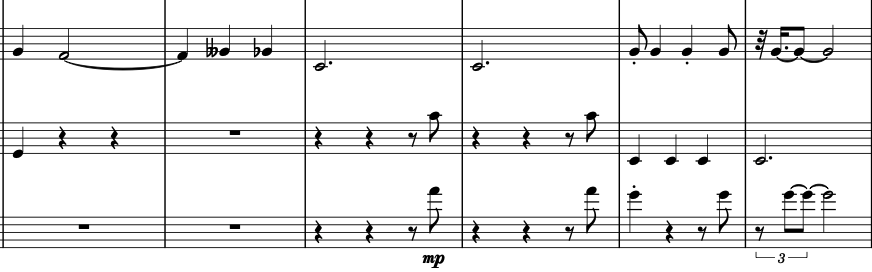
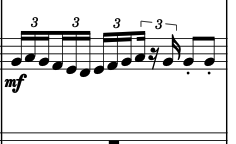
Looking at that key is giving me anxiety....orchestral players are not gonna love it. I wasn't familiar with the piano piece so I did take a listen to it to compare. I'm not a fan of the faster tempo marking....I think it zaps away the "nocturnal" feeling and feels more like a slow waltz at the faster tempo. Also, the piece as written by Faure is so idiomatic for the piano, that it invites tempo fluctuations/rubato that will be hard to capture in an orchestration without clear guidance in the score. And with that awful key!!!! Orchestrating this is a challenge. There is a lot of over reliance on woodwinds here....especially in the beginning. Without slurs and phrasing markings in the score and audio, it sounds a little sterile. Also wind players have to breathe....that flute line from the beginning to A is gonna be tough. Also, a lot of awkward writing in general (comments above already have highlighted some of these). Example below of the bassoons/contrabassoon before A...contrabassoon part seems wasted on high random notes, and the 64th rest (I think?) right before A in the 1st bassoon is dangerous: I think there are certain figures that can be better suited for string players: The figure above might be better for the cellos to play (with proper slurring and articulation written in). Measures 23-29 can be given to the upper strings. I think in general you have to be a little more creative with your orchestral colors. The whole thing from 86-93 is not good in my opinion. This is where you have to get REALLY creative to orchestrate that cadenza, and the way it is written now....having 12-14 first violinists play those fast notes (in that very ugly key) and then dovetailing to one piccolo player and back is not going to sound good. I think @Luis Hernández said it best in his comment: it is a little to literal "transcription" of the original piano work. It definitely needs a lot of creative changing to translate it to have an orchestra tackle it.
-
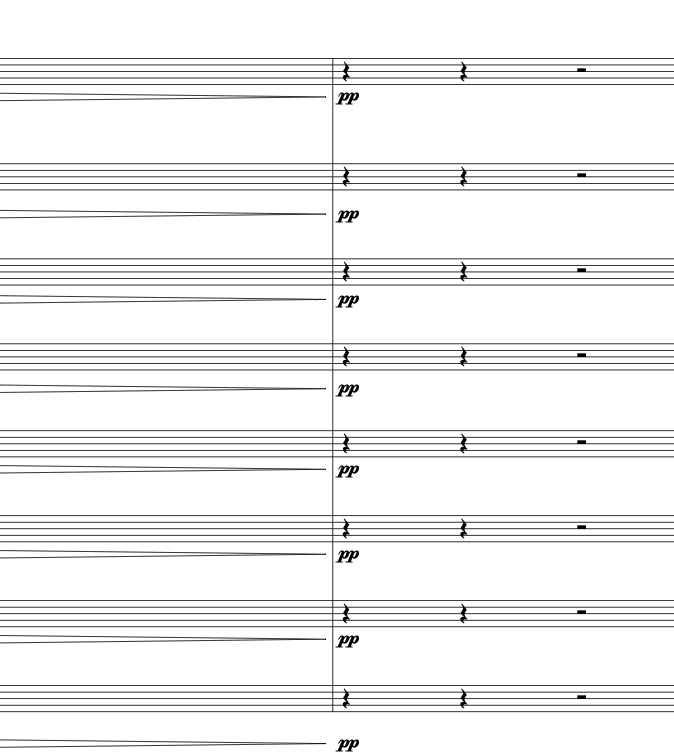
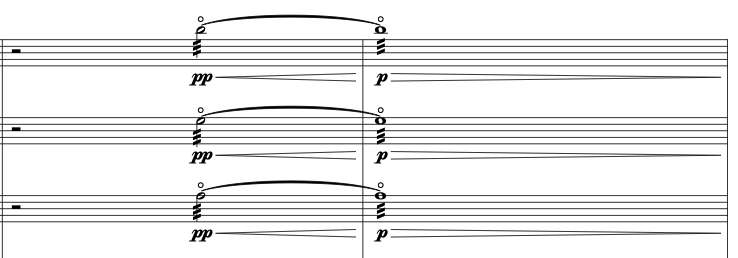
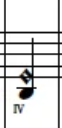
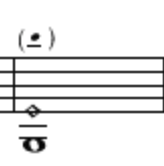
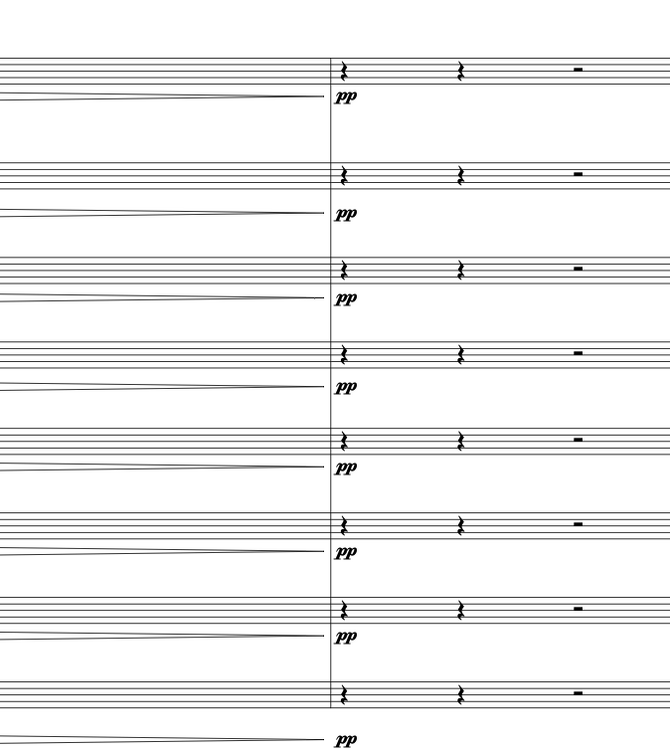
Having read the program notes page, I think you capture the atmosphere of some of the themes (ie. betrayal, turbulence) you mentioned. It would be interesting to hear the rest of the soundtrack to see how the themes/motifs you have here develop. Though, I gotta be honest...film scores lately have a very generic sound to them and this (for me anyways) falls in that category. Some things musical things from the score I noticed: The way these harmonics are notated is confusing. I'm saying that as a string player. Some 2nd violinists might think you want an open E string, which I'm pretty sure you don't want. If these are actual sounding pitches, the 1st violinist would have an easier time understanding these notations (one is a natural harmonic, the other is an artificial....don't really have a preference): The 2nd violin note (if that is the sounding pitch) is impossible to play as a harmonic on a violin. As I said, players would probably play an open E string. The viola one looks alright, it'll be a natural harmonic on the G string. Saw this in the score a couple of times. Wondering if you could move the pp before the barline to avoid those awkward looking measures with rests. Overall, there seems to be over-reliance on doublings between instrument groups. E to the end is the prime example. I think most of the wind/brass instruments can drop out at 47 for a quieter ending. Also that section felt a little...static? Could use some more rhythmic drive (maybe bring back the bass guitar/cello figure from the beginning?) or just some counterpoint.
-
Entry: I do not what to put here? Melodies Themes Motives Harmony Chords Textures Form Development Structure Time Originality Creativity Score Presentation Instrumentation Orchestration Playability Execution of Given Challenge Taste 1 1 1 2 1 1 0 1 Average Score: 1 Review: Score presentation: The score was not well presented. You did not know what the instruments were playing! Playability: This is impossible to be played by anyone. Execution: this failed to meet the goals of the competition Form: This piece barely any proper form or structure. Taste: sadly, this is not with in my musical taste. (Note: It hurts me score a piece this low)
-
Entry: Amidst the Clouds & Flowers Melodies Themes Motives Harmony Chords Textures Form Development Structure Time Originality Creativity Score Presentation Instrumentation Orchestration Playability Execution of Given Challenge Taste 10 9 10 10 7 10 10 9 Average Score:9.3 Review: There were some engraving errors in the score I have noticed. Thorough out the score, you were constantly with the placement of expressions. And there was collision issue with one of the expressions. You have to make sure everyone can be readable and is constant! I personally enjoy the string harmonics throughout this piece! They create rich deep texture. Although this is out of comfort zone, it was enjoyable to listen to. It was with in taste for sure. I would not mind hear more of this!
-
I've been doing a compose everyday challenge and this is the miniature from Day 13. Probably the first piece from the challenge that genuinely feels like a complete character piece to me rather than just an experiment or sketch. So i decided to share it would love to hear what u guys think! YouTube link 13.mp3 13.pdf
-
Hello! This is a very very VERY simple sinfonia. I did it just for the fun of it as i'm quite bored, i hope you guys like it. It's a single section that's just repeated. In a real performance the instrumentalists would make diminutions on the second repeat for more variety. Enjoy! LOB 82 Sinfonia Semplice.mp3
-
BlackkBeethoven replied to BlackkBeethoven's topic in Incomplete Works; Writer's Block and SuggestionsThanks everyone for all your feedback! That's all for now
-
BlackkBeethoven replied to BlackkBeethoven's topic in Incomplete Works; Writer's Block and SuggestionsI don't really know...I just like lush, full-sounding harmonies. O don't really need help for rn...I'm gonna take a break from the piece til August-Sept., and really study & get a handle on form before proceeding.
-
-
A FIRE WITHIN A RAILROADER MOVIE A Fire Within is a short film made solely in the video game, and railroad simulator, "Railroader," which released in December, 2023. Written by Mason Kistler in 2025, this story follows two friends, Sam and Andy, who work for the Southern Railway in the mid-20th century. Over the course of a few months, we see their relationship change and see their activities on the railroad. This project is an indie film, being produced for free and by the dedication of volunteers. It has an original story, sound design, voice cast, and soundtrack. It is something I have hinted at here on YCF, having shared two scores from the film; and it is a project I am very proud of. Now, I have come to share the results! Watch the Shortfilm here: https://www.youtube.com/watch?v=9Dk5nnrS1gw&t=843s Find the soundtrack here: https://open.spotify.com/album/5tJchNkg6fGUNrQs8oMHq2?si=7d9go3uQSbSMW7L6sDhZXg __________________________________ Unfortunately, due to my schedule and some travel arrangements, I am not able to share more of the scores for the Soundtrack at this time. You may find the two scores I have published for the film on my page. Thanks for viewing and I hope to see you all soon!
-
Tchaikovsky IMPORTATION TEST into system1.....................Not sure what to make of it. https://www.kunstderfuge.com/tchaikovsky.htm tchaikovsky_nutcracker_suite_sugarplum_71a_3_(c)kirschbaum.pdftchaikovsky_nutcracker_suite_sugarplum_71a_3_(c)kirschbaum.midTchaikovsky IMPORTATION TEST into system1.mp3
-
Morgini changed their profile photo
-
Yes a Decade ago........... i found this by accident under the... tag# "ATONAL" you state that this is NOT a formula.................what a shame, i saw it as an "Unbreakable-CODE" ................that could be deciphered I presumed the Horizontal first line reading, was the first 4 notes............ played in Octaves B-Gb-F-A = Atonal Chord ATONAL CHORD MATRIX.mp3 --I luv the way you used this concept in your Rondó (atonal) PIANO version I would like to learn how to transfer this concept into a Full blown Orchestra version as iv had requests for "BACKGROUND" music for certain Media-Outlets but i have to decline.........because i just cant figure it out. regarding The dodecaphonic matrix theres got to be a way to break the mystery Code of this concept from.................... "COMPLEXITY to SIMPLICITY" this was one of the Main reasons i joined this site.

-
Hello It’s been a long time since then… about 10 years! You see, back then I was in the midst of exploring post-tonal languages. I have to say that to compose with any degree of discernment in any system, you have to study it thoroughly. This was, like many other things from that era, an example of seeing what might come out of these twelve-tone matrices. I say this because many people believe that dodecaphonism and systems of this kind are like ‘formulas’ for making music, and that is not the case at all. Composers of this period expressed, never better said (the Expressionist movement), what they felt and translated it into this music which is by no means created at random. Trying to answer your question... Here I simply tried to follow the rules of Schönberg’s system once it had been developed: that is, all 12 notes must be played before they are played again, so that there is no tonal hierarchy. With that, you can combine the series sequentially, simultaneously, vertically, or in whatever combinations you like. At the time, I chose those combinations in an attempt to make it sound the way it does.




.thumb.png.8b5b433a341551e913a34392660bc95b.png)