All Activity
- Past hour
-
Thanks, Henry! The delayed recap you mention is something I came across in JC Bach's piano quartet in G major during my early studies. Likewise, he commenced such a passage on a diminished 7th of the home key that marked the end of the development section. It is less of a trick in my view than a way to build momentum towards the initial theme (opposed to commencing immediately after the dim7th. Your note about the alides between non slur notes is informative. I really don't like it either but didn't understand why it does this. I wonder if by adding slurs it resolves the issue. All the best, Markus
-
weird...
-
Great work, I througholy enjoyed it. Quick notes: your main motif that first appears in the horn, you should use sharps instead of flats, as in A# instead of Bb because you're then leading into the B. Just the more easy to read version. A piccolo to flute switch cannot happen as quickly as you have written on page 4. I have a feeling you know this an ignored it for play back but still worth mentioning. m. 90 oh my god so stunning. Shook me to my core the same way when my favorite character in a movie dies. m.120 B natural not Cb. Really beautiful melodies and accompaniment. This is phenomenal work, regardless of if it is your first. However there are some general things to mention. The first is the doubling, or in your case, half-the-orchestra-ing. Every composer has done it, but it almost always in the beginning of their orchestra careers they do so. You’ve written a phenomenal melody here. Right now, it's heavily doubled across a massive chunk of the orchestra. It's a classic trap we all fall into because the melody sounds so good we want everyone to play it! However, when everyone plays the melody at once, we lose the unique fingerprints of the individual instruments. What if you experimented with passing the melody around like a torch? How does the emotional weight shift if a solo cello introduces it, and then a clarinet takes over? Try giving the melody to fewer instruments at once, and use the rest of the orchestra to create distinct, evolving textures underneath. Make us believe that this specific instrument is the only one that could say this part of the phrase. Also for the accompanying instruments, find new ways to accompany so even the double basses can have something interesting to do. I myself wrote (and still write) works similar to yours, but I would recommend fighting your desire for the super double, instead finding new ways to fill the space with sound. You'll find this in most composers, but my favorites for understanding this is Brahms, Tchaikovsky, and Rachmaninoff. Also resources: Principles of Orchestration by Nikolay Rimsky-Korsakov (Korsakov is a huge stickler for reduction in the orchestra to maximize color) The Study of Orchestration by Samuel Adler
-
Nice work! Very Pleasant.
-
Some Guy That writes Music replied to Some Guy That writes Music's topic in Orchestral and Large EnsembleNew title “Death of a space knight”
- Today
-
Play this movement with Romantic Rubato; Rachmaninoff without the black notes! Really, the whole sonata could be looked at as Rachmaninoff with the accidentals gone AWOL, but reserve the free romantic rubato for the third movement. Measure 210 with its overlapping, duplicated D looked goofy to me at first too, but it has to be that way and should sound as if it were possible!
-
A quick scan of the score while watching a YouTube video tells me the part writing is at least basically correct, and that it seems to be Haydn Light in style.
-
Teacher Junior Asia replied to Teacher Junior Asia's topic in Incomplete Works; Writer's Block and SuggestionsOf course! Mouvement de l’Air.pdf
-
Entry: The voyage of the sunken ship. Melodies Themes Motives Harmony Chords Textures Form Development Structure Time Originality Creativity Score Presentation Instrumentation Orchestration Playability Execution of Given Challenge Taste 7 7 7 10 10 6 2 8 Average Score:7.12 Review: Execution: One of the requirements is write a piece with in 3-7 minutes. This was 9 minutes. The overall aura of this piece is mixed. At times, it gave off eerie mood then it didn't? Score Presentation: The score was readable and there were no engraving errors. Instrumentation: The imbalance between the strings and horns is problematic. You could not horn at all! Watch out for those stops in the string part. Make sure they are playable! Creativity: Yes, this a creative piece. The over structure and form of the piece is hard to determine. I am not sure if it is sonata, or scherzo, or something else... In general, I would want to see him grow as writer and see more of his works. He has the potential! I love what he did here.
-
Entry: Warmth Melodies Themes Motives Harmony Chords Textures Form Development Structure Time Originality Creativity Score Presentation Instrumentation Orchestration Playability Execution of Given Challenge Taste 10 9 9.5 9.5 10 10 10 10 Average Score:9.75 Review: With its' simple texture and harmonic language, this entry created the correct spring aura for the competition. I thoroughly enjoy strings and the piano were playful with each other. They danced around each other and provided melodic and harmonic support. That was clever. The score was easy to read. This is definitely playable. I can see being played at schools. Perhaps middle grade. As composers, it is know who will perform will our music these days.. This was truly creative. Keep writing. Kvothe.
-
-
Teacher Junior Asia joined the community
-
-
my submissionnnnnnnn
-
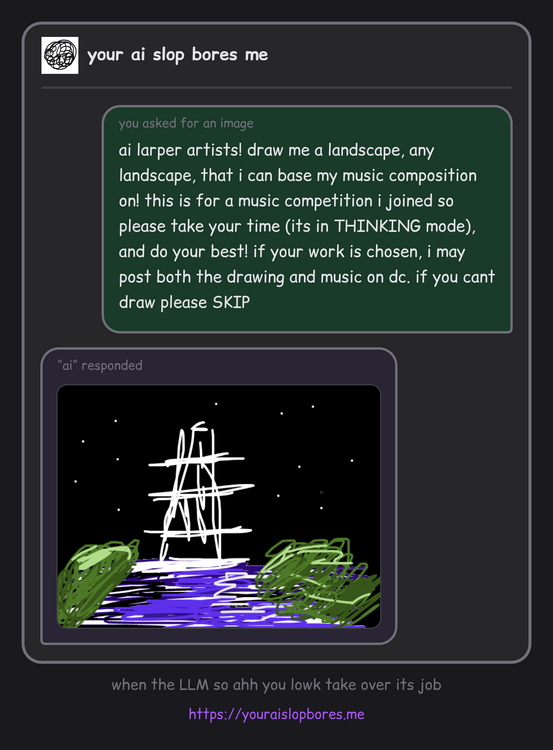
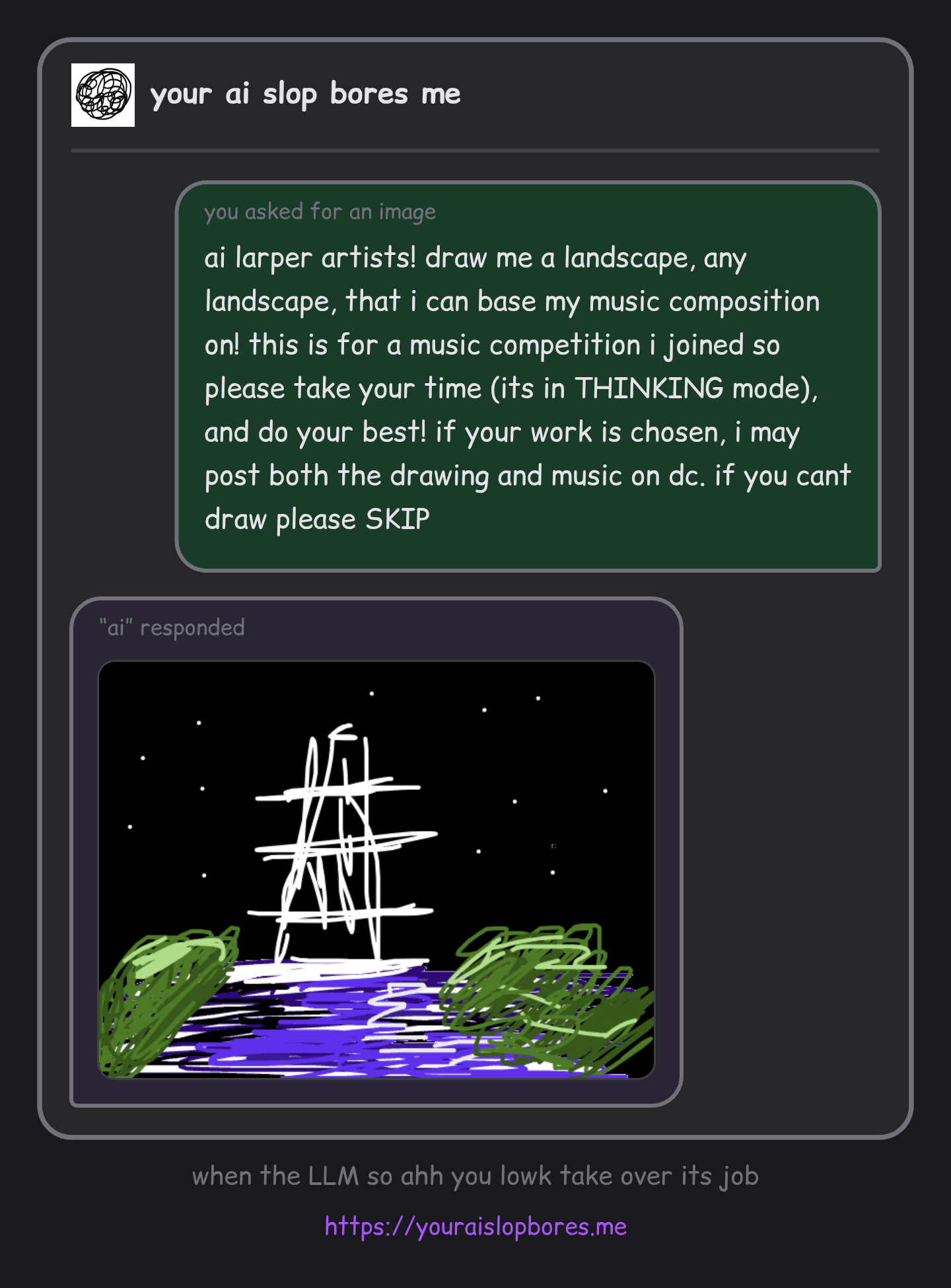
helloooo "The Voyage of a Lone Ship" is a piece for mixed quintet (violin, cello, horn, timpani, and piano). it is based on a sketch from the website youraislopbores.me*. i've asked a random person to draw a landscape for me to base my composition on and what i got is this sketch of a lone ship sailing on the sea under a starry night. the piece contains many different aspects that i try to portray: the lone night voyage, the shimmering star, the creaking wooden ship, the wavy sea, the exciting morning conundrum, and the night fall once more. *of note, youraislopbores.me is a website where real people can roleplay as an ai and answer/draw prompts from humans. people can also be the role of the humans and give the "ai(s)" (people who's roleplaying as ai(s)) many kinds of prompts. therefore, this artwork is not made by ai. a real anonymous person sketched my prompt and created the artwork below. this website is an act against ai art in general. im going to be honest, composing this piece was a tough journey. i had to rewrote the early sections so many times and my motivation keeps dwindling down day by day to finish this, but ive pulled through!!! i'd say there are many things that i'm not entirely satisfied with the piece, but it's in a good enough condition for me to post. also mightve gone overboard with the duration, oh well lmao enjoy the piece guysss The Voyage of a Lone Ship.mp3 The Voyage of A Lone Ship.pdf
-
Melodies Themes Motives Harmony Chords Textures Form Development Structure Time Originality Creativity Score Presentation Instrumentation Orchestration Playability Execution of Given Challenge Taste 8 5 5 10 8 10 10 10 Average Score: 8.25 BipolarComposer. Great job overall, my friend. You've depicted what you were aiming to with this one. Very Ethereal and mysterious sounding, just like a large still lake in the early morning on a cloudy day with a layer of mist rolling over the top of the water, is what I was able to imagine. I agree with pretty much all of the suggestions that have already been made to take this score to the next level, should you decide to continue editing after the competition. Thanks for your submission! Keep Composing! -Unc
-
Melodies Themes Motives Harmony Chords Textures Form Development Structure Time Originality Creativity Score Presentation Instrumentation Orchestration Playability Execution of Given Challenge Taste 1 5 1 10 5 6 1 5 Average Score: 4.25 the reason I score the way I do is; This score does not have a motif/themeatic element that's familiar to the listener to pick up on. Your melodies feel "random", in a sense. You did well with keeping solid harmonies that resemble chords that can be discerned from one another, but I feel the execution was lackluster the Form of this score is.. well.. there is no form. It's quite "thru-composed" without any disctinctive sections. (Think Binary, Ternary etc...) Originality. Well, it's definitely original, and you do hit the mark on making it sound similar to music from the culture that you're aiming for It appears that you have left the score in it's original formatting in MuseScore studio. Not bad formatting, but not very distinctive or "neat" appearing, imo. There were a few areas in here that appeared to be difficult or nearly impossible to physically play with the instrumentation used, but generally, it is playable Unfortunately, the duration of this score is too short to fall within the parameters of the competition rules... Taste. I'm honestly unsure of how to determine my judgement on the taste of the score, so I've simply scored it as a 5. Keep composing! -Unc
-
Certain parts of this remind me of the Halo OST soundtracks. :) Very harmonically intelligent, and enjoyable to listen to. I have no critical feedback on this one that's right at the top of my head to point out without doing an analysis on the score itself. Great work
-
Sorry Guyz...................This post wasn't created as a tribute to anyone's birthday Just the Fact that , if anyone Hummed this melody , to most people in the world That MELODY would be instantly Recognized.......... Despite the Fact that nobody knows who created it.................. or where it came from How do you explain that ?
-
I wrote this piece with a focus on form over programmatic intentions. It is by far my most complex work yet, with a few distinct motifs which are reused and varied throughout. There is very few times where the motives are not apparent. This is also technically a first full draft, but I was very excited to show you all this work. Death of a Knight.pdf
-
Thank you for your comment, @Kvothe. In actual practice, a string player will still hold the bow and use the index finger (for violin/viola) to perform pizzicato. That way, they have enough time to switch back to arco. quickly without disrupting the performance, at least from my experience as a violinist. The quadruple stops are also taken care of when I write this piece and should not bring too much of difficulty playing. Most of them are designed and indicated to be played as broken chords for better playability and for intentionally lighter textures. Moreover, open strings are used to make the chord more resonant for better projection. The choice of pizz and arco. depends on the texture - Do I want a richer sound to accompany the main melody? I often consider the sound quality before the playability issue. Nevertheless, the 16th notes are projected better in arco. For the double stops in m.58, they are playable using both A and D strings, with the last note played using the 4th finger to press both strings.
-
-
- Yesterday
-
Well understood
-
PeterthePapercomPoser replied to PeterthePapercomPoser's topic in Announcements and Technical ProblemsThat is in fact an award that I was going to create with your piece "Sacrificed to the Wilderness" in mind. But the staff have decided to only award thematic awards to contestants whose pieces have qualified under the rules of the competition. Strictly speaking, your piece does not qualify since there is too many instruments being used total, while the rules stated that the contestants were free to write for between 3 - 5 monophonic or polyphonic instruments/voices, not "players". Thank you for your participation and understanding. (However, you will still be in the popular voting polls and people will be free to vote for you regardless of this.)
-
First, some negative considerations: What I’m a bit sad or disappointed of is the fact that you – together with two other submissions so far – have not meet the requirements of the competition, since the piece is too short than the requested 3 minutes. I don't think that was an unintentional mistake, but rather a sign of a certain laxity: “I can easily ignore these rules—it's just for fun, after all.” Yes, the competition is „just fun“ and the rules are not given from a higher authority. But if you are playing a game with some friends where you have negotiated some rules in advance, and somebody does not obey them, the „fun“ instantly decreases. With this in mind, you bring me as reviewer into the uncomfortable situation to be forced to break the rules, too, whenever I give you a review taking all (other) criteria into consideration and do not skip your piece due to disqualification. Now, coming to the music. Some other reviewers have noted that the piece „is not a fugue“. That is true – not only since it does not start with the subject in only one voice. But it doesn’t matter because the task of the competition was not to write fugues. Writing a „Chinese Fugue“ is „inherently impossible“ since, when using pentatonic harmonies you cannot apply the formal rules of a western fugue which are based on diatonic harmonies. So I think, the piece is an invention or a „fugato“ and the title could be changed to „Fuga“ Chinesen (with quotation marks around the word fugue) to avoid complaints by contrapuntal purists (like me 😀). I have taken a quick look at the score while listening and discovered at least the following entries of a subject and countersubject: Subject: mm. 1-8 (G Dizi) Subject: mm. 22-29 (Erhu) Subject: mm. 63-70 (G Dizi) Countersubject: mm. 1-5a (Erhu) Countersubject: mm. 31-35a (Guzheng) Countersubject: mm. 63-67a (Erhu) There are also some nice sequences (in mm. 47-52 and 53-63) which could be considered as fugal episodes and the last bars (from mm. 71-78) could be a coda. There are as well shorter motifs which are derived from the initial thematic material Melodies Themes Motives: There are distinctive themes in the different instruments which are organized in a counterpuntual technique. Harmony Chords Textures: Nice pentatonic harmonies and interesting textures. Form Development Structure Time: The development should have been continued in order to achieve the minimum required length for the piece. Originality Creativity: Well done. The piece is unique and distinctive between all submissions (so far) with its pentatonic harmonics. Score Presentation: The score is clean, however I would like to have some dynamic or articulation marks (so far they are applicable/possible for the respective instrument) Instrumentation Orchestration Playability: I’m not able to judge that since I’m not familiar with the instruments, but I would guess there are no problems. Execution of Given Challenge: The piece clearly depicted a – for me – exotic world, however it did not arise the imagination of a phoenix. Taste: I like the piece with its really Chinese mood. Melodies Themes Motives Harmony Chords Textures Form Development Structure Time Originality Creativity Score Presentation Instrumentation Orchestration Playability Execution of Given Challenge Taste 9 8 1 10 8 8 5 8 Average: 7.125







.thumb.png.8b5b433a341551e913a34392660bc95b.png)