

All Activity
- Past hour
-
In anticipation of tomorrow being Bach's 341st birthday according to the Julian calendar, I have decided to upload now the modified version of this fugue, which I initially intended to repost back on July 28th last year to commemorate the 275th anniversary of his passing, but couldn't due to circumstances which prevented me from publishing it in time. As such, in order to better honor his unparalleled legacy and eternal spirit thriving within the vast reaches of his art, still echoing through Western musical history long after the world was graced by the timeless genius, unabating magnificence and unmatched brilliance of his divine compositions, I have chosen to once again mark this occasion by sharing the definitive revised edition of this humble work of mine, originally based on the subject of his G-sharp minor fugue from the 1st volume of the Well-Tempered Clavier (BWV863b), as a tribute to his insurmountable greatness and immortal spirit. In roughly 10 days from now, his 2nd birthday according to the Gregorian calendar will also take place, so by then I may have hopefully finished another piece I'm currently working on in time to celebrate his actual birthday. Note: the whole composition has been rendered in A = 415 tuning and 1/5th-comma meantone temperament, in order to better, more accurately capture the Baroque essence this piece strives to convey. YouTube video link: https://www.youtube.com/watch?v=5xU93vQDgOA Fugue in A minor (Subject from BWV 863b).mp3 Fugue in A minor (Subject from BWV 863b) Piano.mp3 Fugue in A minor (Subject from BWV 863b).pdf
- Today
-
-
Fabrizio92 joined the community
-
This did have a hint of sweetness, which I usually expect in music that is written with the intent of love. usually when I write music with irl love blended in it’s usually more cryptic and abstract (see event horizon; coda material) this did have some end of darkness without the heavy weight of absurdity so it sort of had this impact of coming out of the darkness and revealing its light. Really nice work though good job.
-
for this, I used an old broken, and out of tune synth keyboard to give me an arpeggio, I played around with the notes switches to make it sound right. Then I had to record it, send it, download it, and sample it; I added some piano and the song was good. It's supposed to sound off tune and off beat, to make it sound more janky and broken like the piano. let me know if I should compose more music like this please! nostalgia.mp3
- Yesterday
-
-
Wieland Handke replied to Luis Hernández's topic in Incomplete Works; Writer's Block and SuggestionsHello @Luis Hernández , Thank you for the score! Yes, I’m interested in it and did download it, because it is such a small but great example. Since I’m usually focused on piano pieces, I’m not familiar with orchestration – especially with large ensembles. I only did some arrangements/orchestrations of my preludes and fugues, for example during the last two YCF competitions – which I very enjoyed. So, if there is the next such event, I think I’ll come back to your exercise using it as an inspiration how I could make my piano pieces sound in a larger ensemble. And since my preludes just have some more notes than only two – or better to say more than three, as our beloved Tristan correctly pointed out – it will be very helpful!
-
Hallo @PeterthePapercomPoser ! Thank you. I always highlight the subject entries in the „colored score“ which I use for the videos and even for myself when composing, since it helps me recognizing the subject and I enjoy if it is helpful for the visitors, too. I’m not quite sure which exact subject entry you meant, the first one (of the original, non-diminished subject) is in bar 46 in inversion as accompaniment in the transition section to the anthem (and from there on, the subject appears several times with that shift). While analyzing the fugue (which I’ve composed four years ago), I found out a few more interesting „shifts“ (which I did not remember furthermore). For example, in the exposition there is a recurring countersubject which starts together with the first subject entry as Comes, but is than shifted a half bar (for the second) and a whole bar (for the third occurence). Astonishingly, it seems to work and those „shifts“ help that the fugue is not repetitive in its rhythmic texture, but has a continuous flow – which is required to resolve the dissonances I use heavily in this fugue (somewhat contradicting the consonant style of Palestrina) but which I find appropriate given the serious programmatic backdrop of war. As far as I remember, a ricercar is an „older ancestor“ of a fugue, dating back to the Renaissance; while it is “close” to the fugue, its structure is perhaps less rigid. I have chosen the slow note values to be reminiscent on the style of Palestrina and not thought at a ricercar which also employs long note values as the „stile antico“. But yes, one could call it ricercar, especially since due to the introduction of the Ukrainian national anthem in the second part, the piece became „multithematic“ as early ricercars are.
-
Hallo @TristanTheTristan , Haha, F-flat major, a key with a double flat in its key signature … But thanks for the link; interestingly, it included some examples where composers actually used F-flat major, at least in certain passages or movements of their works. So you brought me to an idea: Since I have not yet composed my E-major fugue, there might be a spot where I could use F-flat major in a passage with a mood that calls for flats rather than sharps (I associate the mood of flats with „darker“ and „somber“, but also „warmer“ and „mellow“.) But to take it a step further, I should not use F-flat major, but F-flat lydian, so that I could make a key signature change in the score to seven flats in order to stay within the common range of usable accidentals. And the mood of F-flat lydian must be completely confusing: As „dark“ as possible due to the seven flats and „luminous“ at the same time, from the Lydian mode.
-
Here's the SoundCloud version: https://soundcloud.com/olivercomposer/violin-cello-duet-original
-
I would argue sharps are more brilliant, flats are more ambient, and c major... is just nursery rhymes basically.
-
The cellist is really talented. I like her performances. Nice music, hats off!
-
Nice mysterious, atmospheric intro. I really like it!
-
Hey Guys, Here's my original composition featuring cello and violin. I've been working on this piece for 3 days. It's very hard to write for only two instruments, because it's not that easy to form harmonies with two solo instruments. Technically it's possible, but they play broken chords and arpeggios. (Of course, both cello and violin can play double stops, but I deliberately didn't add double stops to the piece.) So, it was challenging to create the illusion of harmonies without real harmonies. What's your opinion? Feel free to share it with me in a comment!
-
-
Listenable? Very much so - I'd say a beautiful work indeed.
-
Hello friends, I have released a piano album this week (a home recording). It consists of 19 pieces I've composed in the last three months. I've tried to space around different kinds of harmonies, especially modal and with lots of incursions into the hexatonic. Piano album After a couple introductory pieces, there is a 6-part suite which very loosely follows the forms of the Baroque suite. Then a short sonatina, and finally some longer pieces of freer form and broader inspiration. ---- I've tried to embed the link but I am just not capable of.
- Last week
-
I had this doubt long time ago for tying around 16 times or so and all lost lol.... Later just figure out the seniority rule myself haha Henry
-
-
I like this „petite“ piece for just four instruments (which is not for a large orchestra). It doesn’t require sophisticated orchestration skills to achieve the desired effect; instead, it works well with its “simple” four parts. Starting already in the first three bars, all four instruments have the equal right and equal importance in playing the melody. None is the soloist, while the others are „degraded“ to accompany only. Although I would not call it „counterpoint“ in the academic sense, it works. Sharing the melody or the various motifs among the voices creates an atmosphere of „dialogue“ between the instruments that captivates the listener.
-
I very enjoyed this dreamy prelude with its nocturne-like charm. What I was especially excited for is the tonality, e.g the use of both F-sharp major and G-flat major. (I mention this because my last recently posted composition is in G-flat major/F-sharp major, too, while not a prelude but a fugue …). I guess you’ve chosen that key change to emphasize the different nuances of mood in the piece, the sharps for the brighter passages and the flats for the melancholic ones. The texture is well balanced and I like that you decided to present the score with revealing the five-part movement. As you yourself noted, there are some large chords which are playable with arpeggiating only. When I’m looking at the score at the first glance, there are – beside the large chords – some intervals that seem to be uncomfortable to be played. However, many of them are playable when taking a note in the other hand. I would appreciate, if such situations would be written out or marked in the score (even if it would look somewhat cluttered) for an easier sight-reading experience.
-
*Sad face*
-
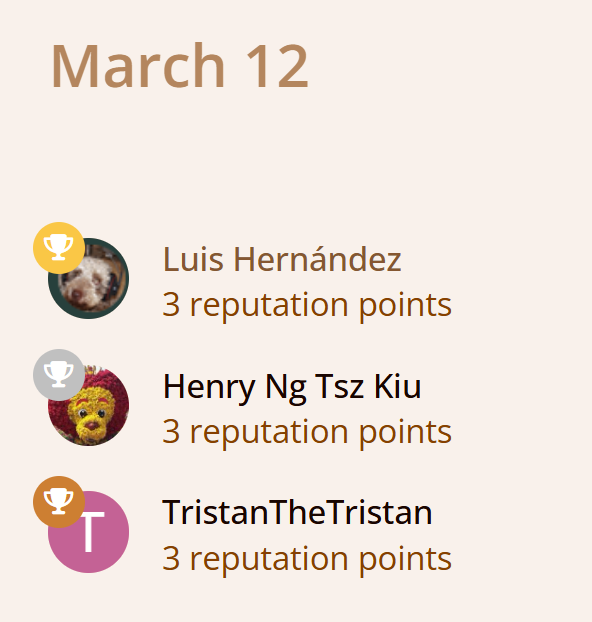
Ties between members for the day won are broken by seniority. So that means that Luis won the day because he's been a member the longest - Henry has been a member 2nd longest and you have been a member here for the shortest amount of time which is why you didn't win the day that day.
-
I didn't win that day. The rest is just common sense.
-
Just saying, I want a new competition soon. Thx!
-
Nice stuff. F Sharp?! Why? So many sharps! Anyways, taking a guess, the next thing you compose is in F Flat Major.



.thumb.png.1e2763f479362bbb522da50d31ef2e50.png)







.thumb.png.8b5b433a341551e913a34392660bc95b.png)