All Activity
- Past hour
-
 Agreed. Very nice point. I think we should be real about this. We can't just do everything at once. False assumptions are not ideal, are they? See you guys later. Bye. (I feel like I just broke my hand after practicing a few hours Mozart Piano Concerto 12 in A Major and need to recover too, btw.)
 -
Overrated: Mahler, Brahms, Tchaikovsky (although I love his music most of these selected composers), Puccini and Chopin (I cannot stand his piano music anymore, sorry). From modern era, I would also mention John Cage (he is an inventor, not a composer), Pierre Boulez (terrible attitude) and Gyorgy Kurtag (very poor composing skills, sorry) Underrated: Henk Badings (fantastic Dutch orchestral composer, many of his symphonies are excellent), Uroš Krek (one of the finest Slovene composers), Eugen Suchon (excellent Slovakian composer of operas and instrumental music), Witold Lutosławski (what a great combination of impressionism and modernism, especially in his works from 1970 onwards!) and Nikos Skalkottas (Bartok from Greece)
-
 Wow, a lot to digest... About bar 16. I guess I was sloppy not to add crescendo to basses. About mixing sharps with flats: I prefer diatonic intervals to diminished even if the vertical structure looks strange, I guess for practical reasons (for example, this always happens when harp is used). Beam over rests: from my experience, it depends what type of metre is used. I try to properly control the beaming but sometimes it looks a bit rough. Still, we are used to such notation at the ear and rhythm training sessions. 🙂 I usually don't add extra bowings, unless I am 100% in necessity for the specific articulation. Maybe I am a bit more aware of the bowing since I have a daughter who plays double bass. 🙂 Anyway, thanks for the comment. You really pointed out specific situations which made me take some extra peeks in the score. 🙂
 - Today
-
 Anything I say isn't gonna be very useful, since you've clearly gotten a performance of it, so it's obviously “good enough,” but I'll throw some stuff out. What an interesting piece, here. It has some very Barber cello concerto-esque vibes, mixed with almost a little bit of Meyer's violin concerto? I love the harmonic language you used throughout and it's very refreshing to see some good string writing. I really liked the transition back to the opening material: I love cascade effects because I'm a normie, but it's used really well here to bring us back to the original register too, which is clever. I think the only real musical note I have is just wanting to hear a little more textural variation. Like, I think the upper strings are homophonic with each other essentially the whole time, which is admittedly a nice split from the full homophony of the intro/ending material, but it feels like—especially at big moments—there could have been some more counterpoint. I have a few score nitpicks, like sometimes your markings that feel like they should apply to the whole group aren't done so (e.g., cresc. in bass in m. 16, mp for cello in m. 17). Bass note spacing issue in m. 73, etc. I was very surprised to see you mix flats and sharps in m. 77, especially when the cello acquiesces to the B major in the orchestra by the end of the measure, but I understand wanting to make the contour clearer in the solo instrument. Have you considered using beam over rests? I'm sure you have; it's just some of the rhythms starting in m. 58 are (despite being totally fine with practice) kinda rough to look at on first glance, and you're at the disadvantage of doing it with 16ths and not 8ths as is normal for that kind of texture. m. 62, in my mind, clef changes are applied only to the note and not any rests; I'm sure it makes spacing look better having the clef change in the solo be just at the beginning but it made me do a double take. And I'm just selfish, but I'd have loved to see some bowings (🙂), just for that little extra professionalism pop, haha. Great work and very enjoyable to listen to!!
 -
 Maybe you could start from C major then try and switch from C major to G major to add some more texture to the music from time to time
 -
This is my second piece from the Spring Trilogy, April. It is the most easy-going of the cycle. It begins as a gentle waltz but it gets more energetic and drammatic. After a short recapitulation the piece ends surprisingly in dark contrast between bright pizzicatos and low, murky tremolos of the cello.
-
- 2
-

-
Symphony no 1 in A minor (I) March
Musicman_3254 replied to Musicman_3254's topic in Orchestral and Large Ensemble
That does make sense now you say that. I'll try to use better modulation next time! -
Symphony no 1 in A minor (I) March
Sojar Voglar replied to Musicman_3254's topic in Orchestral and Large Ensemble
The first question, that came to my mind is: are the piccolo players you know skilled in circular breathing? If not, the beginning should be revised, no piccolo player can play these high a's without breathing and hence breaking the obvious attempt to maintain the pitch uninterrupted. I personally believe this is more appropriate to be the movement of a Suite, rather than a Symphony. The piece needs some modulations to other tonalities. The varied use of orchestration and dynamics help this music a lot, but there is no real climax or waypoint towards a certain progression of the musical material. You are relatively new in the field of composition. I remember my beginnings, and this is more ambitious than mine were though. -
Most of my music from 1995 to 1996 in worthless, I had very limited skills in motivic development, harmony progression and formal approach. So therefore I consider my studies at the Academy to fully improve all these skills, plus knowledge of all instruments, orchestration, contrasts, fresh expansions of tonal colour and timbres. You don't seem to show any interest in developing yourself into a more wider and skilled composer. These "Sententiae" are always, always the same. For decades. Just notes, no dynamic marks, no articulation, no formal development, nothing attractive for performers. But I guess I am consistently hiting a brick wall by talking about your opus.
-
Add Your Own Composition-Related Maxim.
Sojar Voglar replied to luderart's topic in Composers' Headquarters
As composers, we never really know why we compose. If we knew it , we might never have become composers. I DO know why I became composer. It is the passion and the will to speak positively to your audiences and, if necessary, criticize the negativity or simply enjoy the widest range of possibilities of art. It is also about exploring and sharing your talents with everybody. The Bible also says the talents should never be burried. And you should always try to improve your skills and explore the little explored and be open-minded. -
Add Your Own Composition-Related Maxim.
luderart replied to luderart's topic in Composers' Headquarters
Let me revive this old and interesting thread I had started many years ago, and also take this opportunity to encourage newer members to add their own compositional wisdom in the form of maxims, as well as discuss each other’s maxims. Here is a new maxim that I thought of a few hours ago today: As composers, we never really know why we compose. If we knew it , we might never have become composers. -
No composer composes thinking their music is worthless! They all do so thinking that they have something valuable to say. That includes you and me. Of course I appreciate the music of all the masters that you mentioned, and also that of Bach and Handel, Haydn, Schubert, Cherubini, Brahms, Khachaturian, and many others (including living composers). But all those composers do not negate me as a composer; or comparison with them does not devalue me as a composer. They do not replace me or make me irrelevant, redundant or useless. They are not me! So however great and genius their music is, it can never fully express my mind, my thoughts and my feelings. I compose what I am inspired to compose and what I have to express inside myself. I do not have to imitate them or to devalue myself just because they were and are great! And I evolve as a composer at my own pace, even though you might not notice it, just as they did at their own pace.
-
A professional composer should be opened to various styles and genres. Although I am primarly a contemporary classical music composer I also write popular pieces, simple music for church services, also jazz. But I always try to maintain high professional standards, even in simple works.
-
Piano sketch or not for orchestrating and composing
Sojar Voglar replied to Luis Hernández's topic in Composers' Headquarters
During my studies I sometimes did the sketches but with the experience comes the inner ear skill. Today I can hear the orchestra before I even write notes down. I guess I would be able to be deaf like Beethoven and compose further, trusting my inner ear. -
And what makes your music so good compared to masters such as Mozart, Beethoven, Mahler, Prokofiev, Shostakovich, or so many great living composers? You must imagine that you are the best there is, the best there was and the best there ever will be...
-
.thumb.png.8b5b433a341551e913a34392660bc95b.png) I have moved on to Chapter 7 of Persichetti's "20th Century Harmony" which covers polychords. The prompt for the piece was "4. Extend the polychordal passage for piano:" Thanks for listening and I'd appreciate any of your comments!
I have moved on to Chapter 7 of Persichetti's "20th Century Harmony" which covers polychords. The prompt for the piece was "4. Extend the polychordal passage for piano:" Thanks for listening and I'd appreciate any of your comments!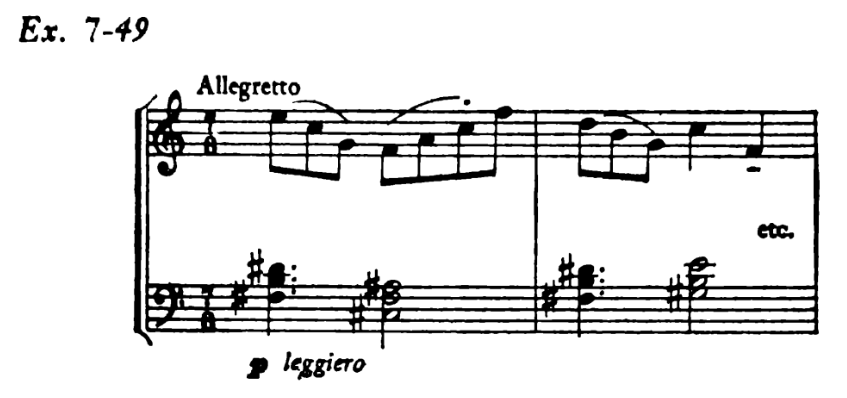
-
- 1
-
-

Poll concerning AI sub-forum
AngelCityOutlaw replied to PeterthePapercomPoser's topic in Announcements and Technical Problems
Hell yeah brother -
.thumb.png.1e2763f479362bbb522da50d31ef2e50.png)
Poll concerning AI sub-forum
therealAJGS replied to PeterthePapercomPoser's topic in Announcements and Technical Problems
How about we just ban AI and trust that people are honest, and if people find out that it's AI, they get temporarily banned. This way, people will be afraid to post AI content and not post any. - Yesterday
-
 Thx for your comment. Yeah I know maybe it’s too long for the contemporary environment now, but who cares. I just wrote what the music needed. And I know G flat Major is a hard key to play on strings, it’s a good way to let the piece sound less bright to express Tao.
 -
'Good' and 'popular' are not necessarily the same. Besides, I believe that the evaluation of music is a largely subjective matter. So, people's opinions of music differ. And that is natural. What you might not like, there are others who like. You have no right to impose your opinion as objective truth as far as music is concerned.
-
And I believe I am not the only one, who doesn't think you are a good composer. Your youtube videos (uploaded several years ago) don't even reach 100 views.
-
Plenty of mixed feelings about this one. Sure, you can write for strings (although G flat major is a terrible key for strings) but the work does not progress anywhere for a pretty long time. No modulations (barely any chromatic), similar character. This is more like a minimalism style, akin to early Glass or some less expansive John Adams. The transition at 5:35 is refreshing. I am pretty impressed with final movement, it is a piece within a piece. There are some nice and memorable moments but the overall form is probably too large for what it offers. Still, I admire your bravery to compose such a long string sextet.
-
It sounds simple but I can hardly imagine a perfect live performance. Sounds a bit like Webern though.
-
Of course not. What new I could have said to your repetitive sketches?
-
Welcome back Sojar! I must say that your reviews haven't changed at all too. Nothing constructive, all negative and judgemental....