All Activity
Past hour
-
Blurryface by Twenty One Pilots Thanks for the Memory - An Album from the "Great American Songbook" by Rod Stewart (a lot of cool really old songs on this one) Both of these albums really helped me get through a tough time while I was in the mental hospital - I listened to them almost everyday since someone just happened to download them onto the public computer (which wasn't connected to the internet at the time).
Today
-
What's your favorite album ever? If there are several, list as many as you like.
-
To me, this is always a masterpiece of film music.
Yesterday
-
Truly one of the most stylish pieces I have ever heard. It is so bold and unusual, yet at the same time incredibly stylish and unique. I genuinely loved it. Bravo, my dear friend!
-
Absolutely beautiful. I enjoyed it immensely. The harmonic language is magnificent, and the piece is so beautifully written. It really captivated me, and I enjoyed every moment of it. Bravo, my dear friend!
-
Hello my dear friends , This Allegretto is a heartfelt tribute to my beloved Franz Schubert, whose music has been a constant source of inspiration and admiration. Through its lyrical character, harmonic colours, and contrasting moods, this piece reflects my deep affection for Schubert’s musical world and the profound sensitivity that makes his music so timeless. Though written in my own hand, it is offered with gratitude and love to a composer whose music continues to speak directly to the soul.
-
One practical thing to add for the orchestration stage: ranges. They're in every one of those books, but they're easy to lose track of once you write in a notation program or a DAW, because the samples will play notes no player would give you. The usual trouble isn't the outer limits but the edges of them: a horn sitting high for bars on end, a bassoon parked near its top, a flute low and quiet under brass where nobody will hear it. Writing mostly inside each instrument's practical range and keeping the rest for special moments is a good default while you're learning. I made a free range chart on my site with full and practical ranges for 28 orchestral instruments at sounding pitch, and you can drop a MIDI file on it to list every note outside either range by bar and beat: https://modwheel.net/tools/instrument-ranges
-
lraveton joined the community
-
Reserve the tail and fit the musical section on its own. At a new tempo the notes move but the reverb decay stays the same length in seconds, so a ratio taken from the whole file comes out wrong. The sum is tempo = beats x 60 / seconds. Say the cue is 48 bars of 4/4 at 128 BPM, exactly 90 seconds with no room for a tail. Keep 3 seconds for the decay and you need 192 beats in 87 seconds, so 132.4 BPM, about 3.4 percent faster. A plug-in's decay time is the time to fall 60 dB, so reserving that much is safe. Re-rendered from MIDI, 2 or 3 percent rarely gets noticed. Much past 5 percent the cue starts to sound rushed, and I'd rather cut a bar, shorten the last chord or end on a hit. I'd only stretch rendered audio if the project is gone, and only slightly. I made a free calculator on my site whose fit-to-duration box does this sum and gives the tempo for a whole number of bars: https://modwheel.net/tools/tempo-calculator
-
Karlsson changed their profile photo
-
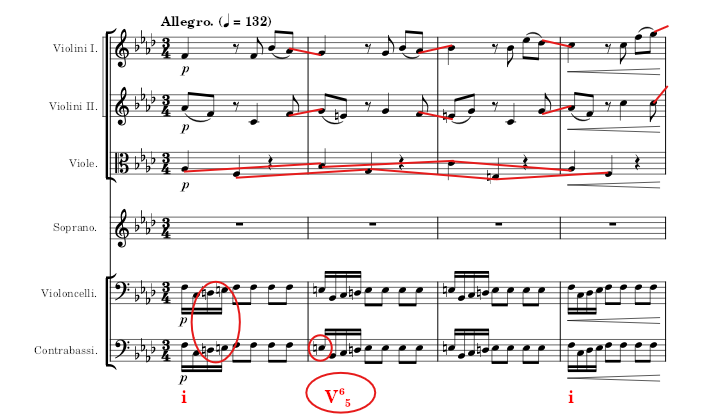
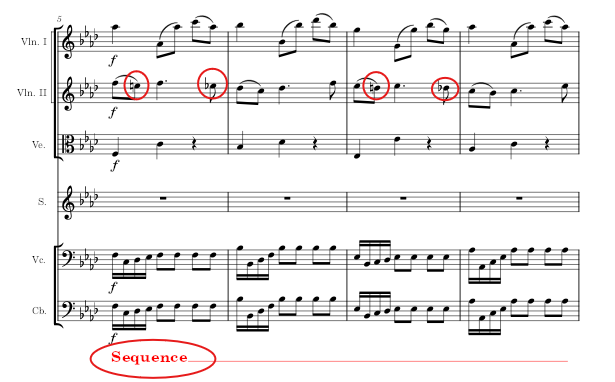
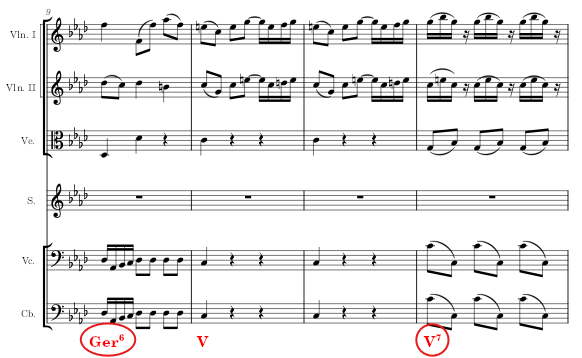
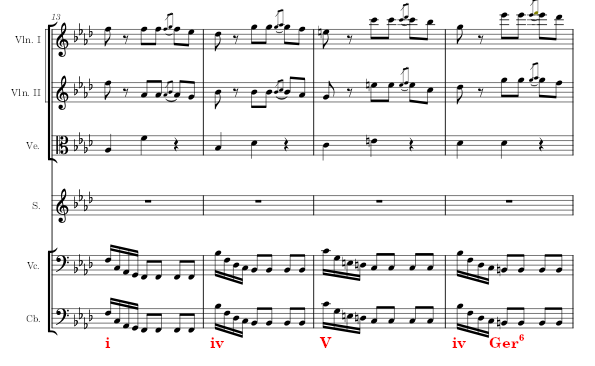
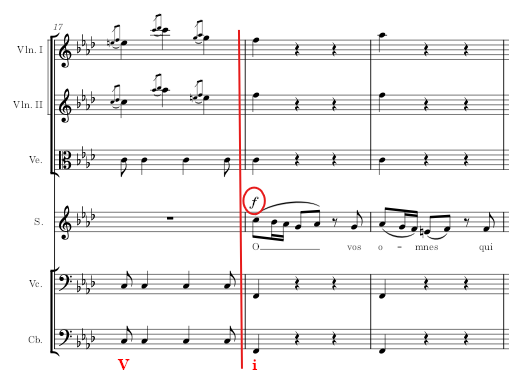
Ok, so to help you understand what I'm trying to say, I've copied and reworked the first 18 or so measures with tonal music theory in mind whilst trying to maintain a baroque aesthetic. Notice in my rework what I have done. This is how I would have done these first 4 bars had I written this piece. I have relabeled the Roman Numerals to better reflect the harmony that you suggested (which was simply i-V65-i). Also notice I have included dynamics at the beginning of the piece, as well as a metronome marking, and I've nixed the solo violin as I felt it was redundant. I have revised the second violins to not interfere as much with the first violins; see how they overlap much less. This provides melodic and harmonic clarity. Look also how the bass line now has the scalular run in melodic minor, which means it includes the leading tone for F-minor, making the tonic feel stronger. I also made the beginning of the 2nd bar in the bass an E-natural to bring about better harmonic clarity (dominant chord in first inversion). Finally, notice how at the ends and starts of each new measure, the lines cadence to each chord with smooth voice leading. This next system had a very nice sequence over the circle of fifths. The biggest changes I have made was to raise the leading tones, which makes the harmony clearer. I have also changed the Roman Numeral analysis, since much of the harmonies you analyzed would actually not be functional. This would simply be labeled as a sequence. The next system felt imbalanced because of the premature resolution. I decided for this example to extend the dominant pedal, and I believe it had a great effect. I also adjusted the harmony to better reflect what you implied, which would be some augmented 6 chord (your analysis said VI and then later, VIb5, however, the functionally since it leads into the dominant, it would be augmented 6. In the second one, there was no flat 5 present, instead the 5 was actually raised, making it a Germain 6 chord. In the future, be sure you understand chord functions.) Here I have continued to adjust the notes to match the harmony you implied. In particular, I found the parallel 4ths to be problematic and changed them to parellel 6ths. Finally, here I felt that the music began to lose momentum, so I simply cut out a few bars. Note the entrance of the soprano has a dynamic marking, and it appears above the music. This is so it doesn't interfere with the lyrics. Also be sure to divide the syllables properly and know that the "____" marks the ends of words being sung over multiple notes, and the "-" only occurs between syllables of the same word. Your usage of both of these is very inconsistent and unclear. And note how I simplified the line to make it slightly easier to read and sing. The rest of the piece has similar issues throughout. In terms of playability, I have already explained that the soprano is too fast and intricate and especially goes too high for this speed. Here is a great chart for vocal part ranges. choral-ranges.pdf Slightly simplifying the melody, especially removing the appoggiatura, should help. As for the violins, you mentioned they may go too high in some areas. They do not, the range is fine. What bothered me were these huge leaps. However, having checked with a violin player, these are actually doable. The changes I've made are obviously free to take what you like and discard what you don't. The important thing to keep in mind is that the music has proper voice leading, and clear harmony. My revision does improve it, but there are other ways to improve it besides what I did. Just remember to study voice-leading and harmonic function more in depth, and you'll be golden OVosOmnesReworkAndAnalysis.mp3

Last week
-
What version of Sibelius are you using? I'm using Musescore 3.7 Evo and for me it's just a simple "small" checkbox 😬. Last time I used Sibelius was 10 years ago or so. Can relate to this. Happened in some sonata of mine, I just don't remember on which one lol. Best regards!
-
Fafa joined the community
-
welltemperedcat joined the community
-
I have things that were started and put in the drawer 15 years ago that I still plan to get back to. We are fortunate to have so much more time (probably) than composers of the past, thanks to progress in medicine and public health. Eat your broccoli, take your time, and with luck we all may eventually have a few pieces that we are really proud of.
-
bestminicat joined the community
-
UNSELFmusic joined the community
-
Hello Young Composers, I am sharing Three Knocks by UNSELF, my independent musical project in melodic metalcore / emotional post-hardcore. I write the lyrics myself and define the musical direction. Suno is used to generate the music and vocals. Listen: https://too.fm/or4r4rb I would appreciate honest, specific feedback on the lyrics, whether the chorus is memorable, how convincingly the vocals communicate the words, and the overall sound. If you think a section loses momentum or the vocal delivery does not work, please point to the moment and explain why. Constructive criticism is welcome. Thank you for taking the time to listen.
-
Hi Everyone! I've been sick for the last month and to be honest, it’s been quite hard to be productive. During the downtime, I ended up writing three short, lyrical piano pieces inspired by Felix Mendelssohn. I tried to keep them quite short and simple hope you find some joy in their simplicity! I would love to hear your feedback and opinions on it! Songs Without Words No. 1.mp3 Songs Without Words No. 2.mp3 Songs Without Words No. 3.mp3 Songs Without Words No. 1.pdf Songs Without Words No. 2.pdf Songs Without Words No. 3.pdf
-
Pacoleo - El Castillo de La Asomada Hello. This is the first original piece I’ve composed for piano. I also mixed and mastered it myself in my DAW, so any constructive feedback regarding the composition or the music production is welcome. Synopsis: A composition for solo piano inspired by the castle of the same name, built in the 12th century. This nationalist-style piece reflects the strength and vigor of its builder (Ibn Mardanish, “the Wolf King”) by combining elements of Spanish nationalism and Islamic tradition, which are in turn embellished by impressionistic coloristic techniques. Thank you for listening.
-
Pacoleo joined the community
-
-
"This is one of my adagios. I’m purposely not posting a YouTube link and sharing a Spotify link instead, because I feel that this music doesn't really need visuals and it's better this way. The translation is not mine as I don't speak English, but I hope my thoughts are conveyed accurately. "For those who don't have access to Spotify, I am uploading the MP3 file here." B1 (Op.39 Adagio E-moll).mp3
-
-
Aresfir joined the community
-
-
-
-
-
left hand is octaves, right hand 1245 shift 1245 shift and so on. Good luck! -TristanTheTristan
-
"This is a track from my first vinyl album, where I first tried blending soft rock with classical elements—something that later evolved in my second vinyl album." "Later, I fed this composition into an AI and tasked it with changing absolutely nothing in the melody, harmony, and style. If you're interested, I can drop that here too." This is a Google translation. I hope it conveys what I intended to say.
-
Hi everyone, I'm a developer, and I've been building MaestroNote, a free music studio for Mac, iPad and iPhone. It's now in beta, and I'd love to hear what student and amateur composers think of it. It has three modes: Play, Analyze and Compose. On iPad, you can write notation by hand with Apple Pencil. It's free, and you don't need an account It works offline and syncs between your devices through iCloud There's no AI in it; it's simply a tool for you to use To be upfront about where it stands: It's a beta, so there will be rough edges There's no PDF export yet (it's on the list) Handwriting requires an iPad with Apple Pencil running iPadOS 17 or later Does writing by hand fit how you sketch ideas? What would you need for it to become part of your composing or studying routine? And what feels confusing or missing? If you'd like to try it, you can sign up for the beta here: https://maestronote.app Thanks for reading. I'm happy to answer any questions in this thread.
-
Jony joined the community
-
.thumb.png.8b5b433a341551e913a34392660bc95b.png)