Search the Community
Showing results for tags 'counterpoint'.
-
Today I am presenting another fugue from my preludes and fugues project. Since it is a long piece with a special feature in its second half, I have decided to split the presentation into two posts. I began composing this fugue four years ago, inspired by Bach's Fugue in E major from WTC2 (BWV 878), after seeing Jörg Demus' wonderful introduction and tutorial, which unfortunately is no longer available on YouTube. The idea is to compose a fugue in the „stile antico“ or Palestrina style, which means having • 4/2 time signature (long allabreve), • long note values (from quarter notes to whole notes, and even „brevis“ notes), • a subject that moves primarily by step, with few leaps. Any leap that occurs is immediately balanced by stepwise motion in the opposite direction. Exposition (mm. 1 – 15). The „regular“ exposition is ascending (subject highlighted with blue-colored notes) • Dux, G flat major, bass (mm. 1) • Comes, D flat major, tenor (mm. 5) • Dux, G flat major, alto (mm. 9) • Comes, D flat major, soprano (mm. 12b) with tonal answer. We have a recurring countersubject (highlighted with olive-colored notes) which is paired with the subject entries in mm. 5, 9 and 13. Whereas the first occurrence of the countersubject starts together with the subject entry (mm. 5), the second one is delayed by one whole note (mm. 9) and the third one is delayed by two whole notes (mm. 13), thus not repeating the previous entry rhythmically but creating a continuous flow. Second Development Section (mm. 17b – 26a). After a one-bar codetta (mm. 16b – 17a) with a tritone substitution we reach the second development section where the subject appears in stretto as following • B flat minor, soprano (mm. 17b) • F major, alto (mm. 18) • B flat minor, tenor (mm. 21b) • F minor, inverted, bass (mm. 23, highlighed in green) The countersubject appears three times (mm. 17b, 21b and 23), the latter one in inversion (highlighted by plum-colored notes). Episode (mm. 26b - 32a). This episode is built from the material of the countersubject (highlighted with olive-colored notes) creating its own fugato. Third Development Section (mm. 32b – 36a). In the third development section the subject occurs the first time in a diminished form. It is not an exact halving of the notes values but also a rhythmic variation. • A flat major, diminished (highlighted with turquoise notes), soprano (mm. 32b) • C minor, tenor (mm.32b) • C major, diminished, soprano (mm.34c) • F major, diminished, alto (mm. 34b) • A major, diminished inverted (highlighted with pink notes), bass (mm. 34b) The subject entries are heavily squeezed together as strettos, and we have a surplus subject entry. The countersubject does not occur in this development section. Episode (mm. 36b - 40a). This episode is built from the material of the inverted countersubject (highlighted with plum-colored notes), also in a fugative way. Fourth Development Section (mm. 40b – 43a). The fourth development section is another one where the subject is presented in its diminished and normal form, together in stretto. • D flat major, tenor (mm. 40) • A flat major, diminished, soprano (mm. 40b) • C flat major, diminished, bass (mm. 40b) • F flat major, diminished, alto (mm. 42) Episode (mm. 43b - 50). This episode consists of two different sections with sequences (mm. 43 – 45 and mm. 46 – 50) whereas the fugue subject once occurs in its inversion (E flat minor, bass, mm. 46). With the crescendo of the second sequence motif, the fugue reaches its first climax, leading to the second half, which I will present next Tuesday, February 24th. Stay tuned!
-
Hello my fellow musicians, now I present the second half of the fugue with the „special feature“. Today is the 24th of February and it is now exactly four years ago since the Russian invasion in Ukraine. As I composed the fugue between February and May 2022, I decided - after I had accomplished the first half - to integrate the Ukrainian national anthem as further theme in the second half of the fugue – as a dedication to those which suffer from that terrible war, or more worse, have even lost their lives. For continuing the „analytic comments“, we cannot speak from now on of „development sections“ and „episodes“ since the fugue is now structured by the verses of the anthem and interludes between them: First Verse of the Anthem (mm. 51b – 43a). The first verse in B flat minor in the soprano is „accompanied“ by three subject entries: • B flat minor, inverted, bass (mm. 51b) • F minor, tenor (mm. 55b) • D flat major, diminished, alto (mm. 58b) Interlude (mm. 60 - 66). The interlude, dominated by a sequential motif which appears three times in normal form and three time in inversion. The fugue subject appears once in normal and once in the diminished form: • D flat major, bass (mm. 60b) • E flat minor, diminished, bass (mm. 64b) Second Verse of the Anthem (mm. 67 – 74). Similarly, the second verse, again in B flat minor in the soprano has tree contrasting subject entries, where the last, diminished one could be counted to the following interlude, too: • F minor, tenor (mm. 67) • B flat minor, bass (mm. 71) • D flat major, diminished, tenor (mm. 74) Interlude (mm. 75 - 82a). This interlude consists of four sequences, each featuring an entry of the diminished subject, which perform the modulation from the „sad“ keys with flat key signatures used so far (for example E flat minor) to the „triumphant“ keys with sharp key signatures (finally to F sharp major): • D flat major, diminished, tenor (mm. 74) • A flat major, diminished, bass (mm.76) • B major, diminished, soprano (mm. 78) • F sharp major, diminished, alto (mm. 80) Third Verse of the Anthem (mm. 82b – 90). The anthem repeats the last half bar of the second verse and is now in the third verse finally in the brightest major key in F sharp major! The remaining subject entries of the fugue are as follows: • B minor, inverted, bass (mm. 82b) • F sharp minor, diminished, tenor (mm. 85b) • A major, diminished, tenor (mm. 86c) • F sharp major, „tail only“, bass (mm. 89) I hope, you'll enjoy it. Wieland Here is the link to the previous thread with the first part of the fugue:
- 3 replies
-
- 1
-
-
- fugue
- counterpoint
-
(and 1 more)
Tagged with:
-
Ellooo! This is a very very simple and short passamezzo i made a while ago. The technique i used is pretty straightfoward, i used the passamezzo bass notes as pillars and in between free counterpoint. That way it doesnt sound so monotonous. And it allows for spicy imitations! Enjoy.
-
- recorder
- renaissance
-
(and 2 more)
Tagged with:
-
It's been too long! I thought I would share this piece written for my theory and composition class at Berklee. We were asked to work with a couple of "exotic scales" from a selection including the whole-tone scale, the octatonic scale, and modes other than those derived from the major scale. I felt drawn to the Lydian Augmented and Spanish Phrygian modes. I ended up with a contrapuntal rock instrumental in rough ABCA' form. The A section is in B♠Lydian Augmented, the B section is in G Spanish Phrygian, and the C section an unbroken transition into D Spanish Phrygian. Finally, I modulate with the common tones D and A back to B♠Lydian Augmented, for the A' recapitulation. The title (Iridescence) was inspired by my understanding of modes as a concept. With many modes sharing the same collection of notes, the tonic note that each mode centers on is what makes it unique -- gives it a unique color. And, iridescence is when something appears in different colors depending on the angle of viewing. I see that as a fitting metaphor. The artwork is my own, made with ProCreate. I didn't paint it for this track, but as a birthday present for my mother, inspired by Kate Bush's song "Kite". She is a massive fan of Kate's and introduced me to her when I was a little girl. I rediscovered her recently and I've been spending a lot of time with her early work. My current favorite album is Never for Ever...whose influence I thought was bleeding into this track. So, in the end there is some relation. 🙂 I hope you enjoy! Any feedback on both the mix and composition is more than welcome. ~ GP P.S. I was required to include a detailed score for the assignment. It might be too precise for a rock track in general, but if enough people are interested I will upload that, too.
- 1 reply
-
- 2
-
-
- instrumental
- modal
- (and 5 more)
-
Hello! This piece is dedicated to a friend of mine, he gave me the text and i quickly got working on it, i finished it in 1 day and im pretty proud of it. I tried to mimic the style of Orlando di Lasso a bit but it didn't quite work out the way i wanted, so i just decided to stick with my own style. Enjoi! Text: Corpus omne perseverare in statu suo quiescendi vel movendi uniformiter in directum, nisi quatenus illud a viribus impressis cogitur statum suum mutare.
- 2 replies
-
- renaissance
- vocal
-
(and 3 more)
Tagged with:
-
I made this very small renaissance motet for 4 voices, Cantus, Altus, Tenor and Bassus. However my stupid brain wrote the text wrong and instead of "Sicut LILIUM" it became "Sicut ILIUM", I only noticed it after finishing the motet! But besides that part everything is in accordance to what it should be. Enjoy! Text: Sicut [l]ilium inter spinas Sic amica mea inter filias
- 2 replies
-
- 1
-
-
- renaissance
- vocal
-
(and 4 more)
Tagged with:
-
Another small invention I created in 2022. The motive is in me1-2. When I saw it I thought 'what the hell am I gonna do with this thing?' And to my surprise, something came out. I couldn't help but bring variations to the motive's repetitive notes. I think the result is somewhat funny.
- 7 replies
-
- invention
- counterpoint
-
(and 1 more)
Tagged with:
-
.
- 36 replies
-
- 1
-
-
- invention
- counterpoint
-
(and 1 more)
Tagged with:
-
Here's another small invention. More quiet than the 1st one. It's an adagio! Mostly done in 2020, but updated in 2026.
- 5 replies
-
- 1
-
-
- invention
- counterpoint
-
(and 1 more)
Tagged with:
-
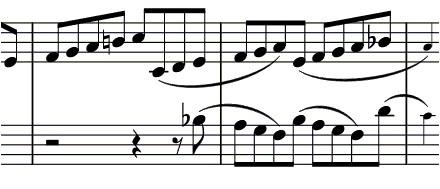
Not sure if this is the right place for this post, but I came across something, quite simple but still fun. Was browsing youtube and stumbled upon a video. At the very beginning, the creator presented a 4 bar line of a Violin melody. (I've altered it a slight bit to make it a tiny bit more interesting. the original challenge melody reused the 1st measure, except with the same 4 32nd notes you see at the end of bar 3. I elected to simply change it to Gb, rather than staying on the G. I also included an ending 1 and a fine measure to sort of round it out a bit more. Here is the Challenge Melody): The instrumentation to be used for this challenge includes Vln. 1 & 2, Viola, and Cello. 4 Staves, with Vln. 1 already written for ya. Just curious to see what everyone else comes up with 🙂 Here is mine! I'm not a virtuoso or a master so mine will probably pale in comparison to some of yours. Lets see it! Harmony Challenge.mp3
-
These are two inventions I wrote after studying species and free counterpoint with a teacher. If you have any feedback, I'd be grateful to here it!
- 1 reply
-
- counterpoint
- invention
-
(and 1 more)
Tagged with:
-
I've been studying counterpoint for years now, learned mainly from Fux's gradus and developed a solid understanding of species counterpoint. That said, one quick analysis of this first movement will reveal deviations from the rules presented in that book. Accented passing notes, leaping from dissonances, and the occasional unprepared chord in second inversion, that one consecutive fifth... I'm well aware of the rules broken and the liberties I have taken when it came time to make the transition from species exercises to actual composition. Despite that, i'm very proud with what I ended up with. There's plenty that I wish to improve, and hopefully you'll get to hear the results of my efforts in the following 2 movements, as well as in everything that will be released following the completion of this sonata. Youtube link with sidescrolling score:
-
As implied by its title, this arrangement was based off my Crab Canon (aka. Canon Cancrizans) a 3 in C minor ( • Three-voice Crab Canon in B minor.): Since its initial publication, it has been transported one half step upwards to accomodate for the ranges of the instruments involved in this double trio, with the full realization played by the Continuo harpsichord part (which may be omitted entirely on account of the extremely wide intervals between voices in certain invertible configuartions making it rather difficult to play). Enjoy! YouTube video link:
- 5 replies
-
- 4
-
-
- counterpoint
- canon cancrizans
-
(and 2 more)
Tagged with:
-
Hi, I wanted some feedback on a basic Fugue I composed. I attached the pdf and Midi file
- 4 replies
-
- counterpoint
- composition
-
(and 1 more)
Tagged with:
-
This is my first fugue, I followed a structure given by Albrechtsberger’s. Some feedback will be appreciated, just note that this is my first fugue so it isn't the best. I'm looking to turn it into a keyboard fugue and need some help on that as well. Thank you Fugue - F major.pdf
- 4 replies
-
- composition
- feedback
-
(and 1 more)
Tagged with:
-
- 1 reply
-
- counterpoint
- harmony
-
(and 2 more)
Tagged with:
-
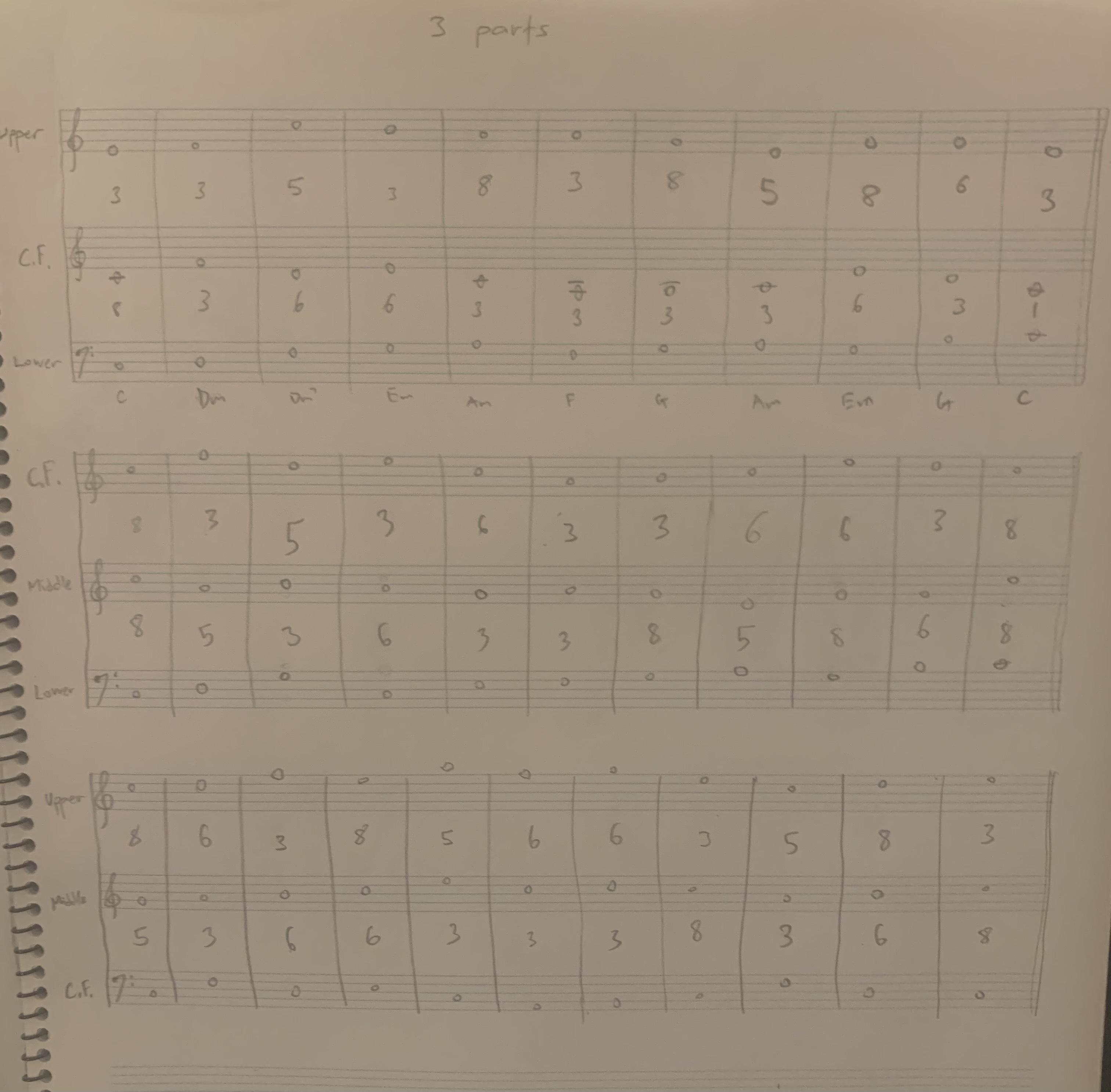
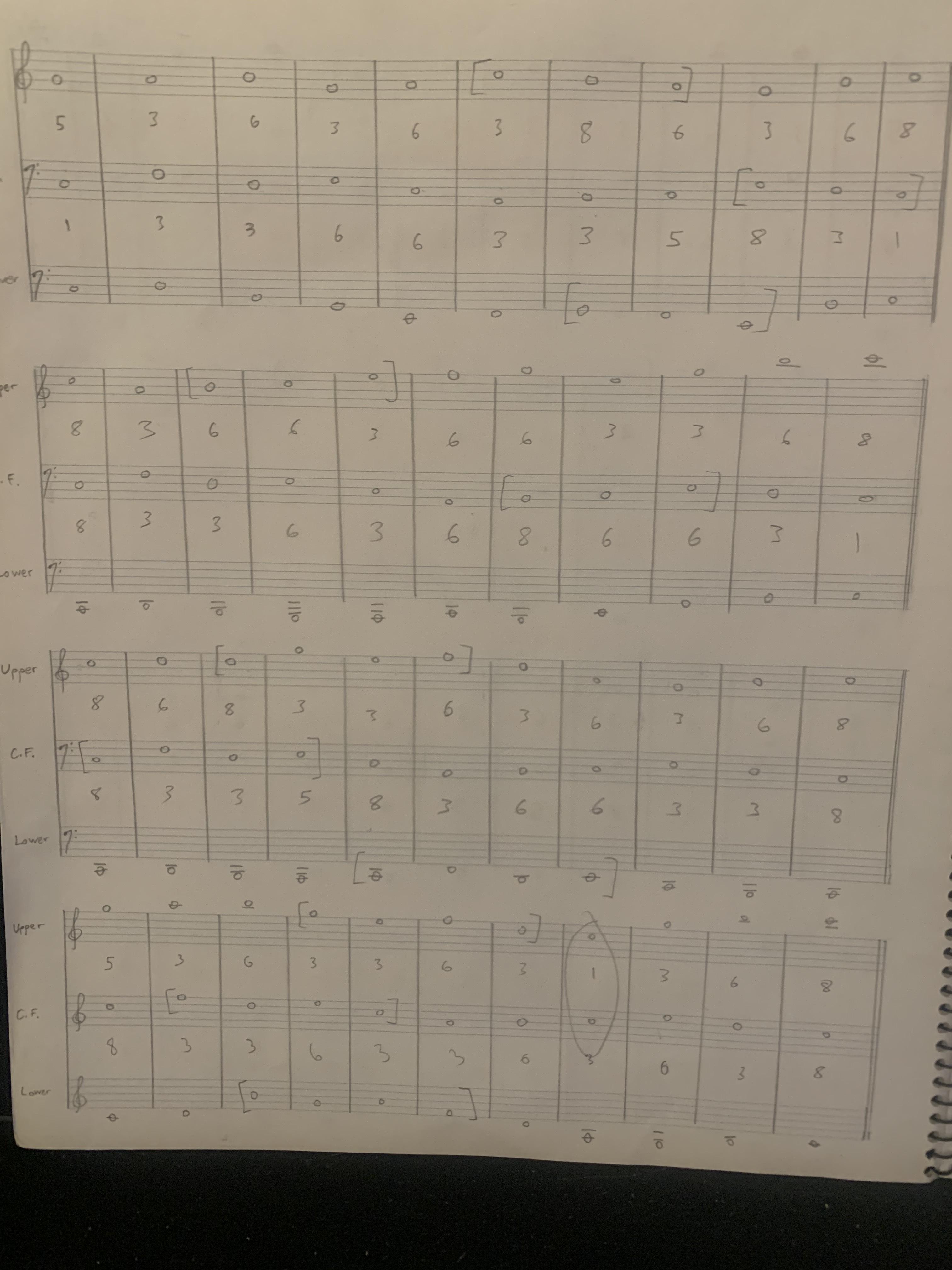
See the attached scores. I wrote two part 1st species counterpoint to a cantus firmus. I wrote one part above and below the cantus firmus for each exercise, note that they are not 3 parts but they are separate 2 parts, I did this to save space. I also included different motifs from the cantus firmus and imitated them in the other parts as shown in the square brackets. I added the intervals between the counterpoint and the cantus firmus Feedback will be greatly appreciated
-
counterpoint First Species Counterpoint Feedback
bhelloworld420 posted a topic in Advice and Techniques
Hi, I have just began writing first species counterpoint and want to get some feedback on it. I wrote four countermelodies for two upper cantus firmus and two lower. Any advice would be greatly appreciated First Species Counterpoint.pdf -
Hello Guys, This is my very first counterpoint attempt. It's just a brief piano piece. What do you think? The music sheet is an auto-generated one because I'm lazy...
-
Good evening everyone! I'm excited to present a new piece I have been working on for the last month or so: Scherzo for Orchestra. I deliberately wrote this fairly quickly, with the intent to write something fun, conventional, and maybe even a little whimsical. I'm interested in any and all constructive feedback. I had a few goals in mind as I composed this, feel free to critique my success or failure on these: Write something a little more informal and accessible, with catchy, memorable themes. Start with a very simple idea, and build the entire piece off of it. The four bar opening phrase in the 2nd violins popped into my head one day, so I tried to build the entire piece off of this motive and transformations of this motive. Practice having multiple contrapuntal lines. Some details on this are below. Write something that would work as a middle movement of a larger work, such as a symphony. Write something under 10 minutes, since I might decide to enter it into a competition and a lot of competitions have a 10 minute time limit. The piece is loosely structured in a three-part rondo form (ABACABA). (0:00 - 1:32) - A Theme - A very quick staccato theme in C# minor. I based this on the idea of a fugue, with each voice entering at different scale degrees, before they all come together to cadence. I'm sure I broke a few rules on the counterpoint, but it got the job done. The section ends on the V (G# minor) (1:32 - 2:21) - B Theme - A soaring theme in E major, then restated in Db major. Here I tried to have descending chromatic lines to complement the ascending melody. (2:21 - 3:04) - A Theme - Restatement of the second half of the A Theme, this time ending on I (C# minor) (3:04 - 6:31) - C Theme - A waltz in D major that begins very timid, gradually gains confidence, and goes out with a bang. (6:31 - 8:01) - A Theme - Restatement of the A Theme, this time in D minor, with the orchestration modified slightly. I threw in a couple unprepared modulations up a half step, to Eb minor and E minor. As a result I may have broken a "rule" here since I ended the section on B minor (which is not the V of D minor, the key I eventually return to). (8:01 - 8:49) - B Theme - Restatement of the B Theme, this time in Db major and Bb major. (8:49 - 9:37) - A Theme - The second half of the A Theme again, eventually returning to D minor to end the piece. As usual, I have an onslaught of questions I would like specific feedback on. Feel free to answer as many or as few as you wish: What effect does the music have on you? Does in conjure up an image? Or an emotional feeling? Does it tell you a story? This can be the piece as a whole, or a specific part or parts. What was your favorite part? What was your least favorite part? Do you have any comments or critiques on technique, e.g. harmony, melody writing, counterpoint, orchestration, voice-leading, etc.? How do you feel about the overall form? Is it effective? Do any of the parts seem impractical to you? It's a pretty fast piece with a lot of technique, so I'm curious if some of the parts are impractical. I don't mind them being difficult, I would only be concerned if they are borderline impossible. Do you have any comments of the quality of the performance in the audio file? I really want this to be a decent representation of how the piece would sound if it were performed live, since it is unlikely it ever will be. Feel free to put your "conductor hat" on and critique the "orchestra". I have included a score and welcome any constructive feedback on its presentation. And if you're like me it's a lot more fun to follow along with the score. Are there any composers this reminds you of, that I might enjoy listening to? Sound libraries: Spitfire Symphonic Orchestra and Spitfire Percussion VSL Trumpet (only for some of the lyrical trumpet melodies) VSL Violins (only to layer with the violins in Spitfire) Thanks for listening, I hope you enjoy! If you liked something I did and want me to explain how I did it, feel free to ask as well. -gmm
- 20 replies
-
- 9
-
-
- counterpoint
- scherzo
-
(and 2 more)
Tagged with:
-
Handel's "And With His Stripes We are Healed," but with my own contrapuntal addendums, twists, and best of all, vocaloid! Let me know what y'all think! The PDF below highlights all of my addendums
- 16 replies
-
- motet
- counterpoint
-
(and 1 more)
Tagged with:
-
Last Thursday was a special date for the history of Western music. 337 years ago, on the 31st of March, a child was born in Eisenach, a town located in Thuringia, modern-day Germany. His name was Johann Sebastian Bach, and he would become one of the greatest composers ever to live, even though most of his fame would be posthumous. Regardless, it has been of the utmost pleasure for me to dedicate one of my humble fugues to the birthday of Master Bach, in order to commemorate his art and work of such unfathomable abundance and heavenly quality as his spirit deserves. Link to the video:
- 3 replies
-
- fugue
- counterpoint
-
(and 1 more)
Tagged with:
-
For the last couple evenings I have invested most of my energy into finishing this fugue, which as shown below the title is coupled with an aphorism in Spanish, my native language: "Cuando cae el respeto a la muerte, decae la vida misma", which, leaving aside metaphorical extension, would roughly translate into English as "When respect to death is lost, so degenerates life." Even though said aphorism wasn't the main inspiration for this piece, I thought it was a nifty addition given the fatigue and withering emotions it was intended to wake on the listener. Since it is difficult for me to describe the nuances of this one as strictly "enjoyable", I guess the most appropriate closing expression for this one would perhaps be "feel existential" or something on those lines.
-
Composed between yesterday evening and today afternoon, as inspiration finally came forth amidst the silent darkness of tedious stagnation, bringing along a burst of renewed hopes and a dusty fugal subject from my earlier days, forsaken inside a long-unopened folder up until now. Also, happy 337th birthday to J.S. Bach! (If he could hear me from Heaven...) Link to the video:
-
After more than a year of inactivity in this forum, I've decided to return and paulatinely post my compositions from this period. Starting with my latest fugue, which as shown on the score PDF file was composed just two days ago and has undergone a key set of minor details being changed since I published it on my YT channel. Enjoy! Fugue in C minor #5.pdf